Not all the weight you lose is fat.
If you're on a GLP-1 drug, you've probably seen the warning: some of the weight comes off as muscle, the tissue you most want to keep. HM500197 (also written HM-500197 or HM 500197) is Hanmi Pharmaceutical's attempt to fix that. It is a small, long-acting peptide that blocks myostatin, the body's main brake on muscle growth, and it was built to be taken alongside weight loss shots rather than instead of them.
🔑 Key Takeaways
- HM500197 is a myostatin blocker made from a peptide, not an antibody. Hanmi says it is the first of its kind.
- In obese mice it added muscle on its own and turned tirzepatide's lean mass loss into a gain. How big that swing was is in the data section.
- Against bimagrumab, the best-known drug in this space, it built less total lean mass but left the liver, heart and testes alone. That trade-off is the whole design idea.
- It has not been tested in people. Every number below comes from mice or lab dishes.
- You can't buy it. What vendors sell instead has a very different evidence base.
Below, we'll explain myostatin in plain English, show how much muscle GLP-1 users actually lose, walk through Hanmi's numbers, and compare HM500197 with the antibody drugs and with Hanmi's other muscle candidate, HM17321.
What Is HM500197?
It's a code name, not a brand.
HM500197, also called LA-MSTN (long-acting myostatin inhibitor), comes from South Korea's Hanmi Pharmaceutical. Hanmi first named it on May 27, 2026, calling it the fourth core program of its H.O.P. (Hanmi Obesity Pipeline) project, and showed the first data at the American Diabetes Association meeting in New Orleans on June 5 to 8, 2026, as late-breaking poster 3073-LB.
Three things set it apart, according to the poster and Hanmi's pipeline page:
- It's a peptide. Hanmi says its in-house AI platform, HARP, designed the sequence from scratch. Most rival muscle drugs are antibodies, which are far larger molecules.
- It's long-acting. A fatty acid chain lets it ride on albumin in the blood. Hanmi wants it on the same once-weekly schedule as semaglutide or tirzepatide, ideally in one injection.
- It's selective. It blocks myostatin while leaving related signals almost untouched.
Hanmi lists two uses: protecting muscle during GLP-1 weight loss, and age-related muscle loss (sarcopenia). Only the obesity use has published data.
Myostatin, Explained in Plain English
Your muscles come with a built-in brake.
Myostatin, also called GDF8, is a protein your muscle cells make to stop muscle from growing too much. Scholar Rock, which makes a rival drug, notes that lacking the myostatin gene is linked to more muscle and strength in several species, humans included.
The catch is that myostatin has relatives. Activin A, activin B and BMP9 belong to the same protein family and share some of its receptors. Block too many and you get side effects unrelated to muscle. That happened to ACE-031, an older drug that soaked up myostatin and its relatives: a trial in boys with Duchenne muscular dystrophy was stopped over nosebleeds and small dilated blood vessels in the skin. Our ACE-031 guide covers that story in full.
So the goal for every new drug in this space is the same: hit myostatin hard and leave the relatives alone.
Why GLP-1 Users Lose Muscle
Eat less, and your body sheds more than fat.
Any big calorie deficit takes lean mass with it, whether from diet, surgery or drugs. The BELIEVE trial authors put it at roughly 25% to 40% of weight lost. "Lean mass" on a body scan includes water and organs too, so it isn't all muscle.
Here's what body scans (DXA) found in the main trials:
- Semaglutide 2.4 mg, STEP 1: in the 83-person scan group, people lost 9.3 kg of fat and 5.8 kg of lean mass over 68 weeks. That's about 38% of the loss as lean mass.
- Tirzepatide, SURMOUNT-1: in a 160-person scan substudy, about 25% of the weight lost over 72 weeks was lean mass.
- Semaglutide 2.4 mg in Regeneron's COURAGE trial: 33% at 26 weeks.
- Tirzepatide in Scholar Rock's EMBRAZE trial: 30.2% at 24 weeks.
If you lose 20 kg and 7 of it is lean tissue, that's a real cost, especially for older adults. The chart shows what adding a muscle drug did in the trials that tested one.
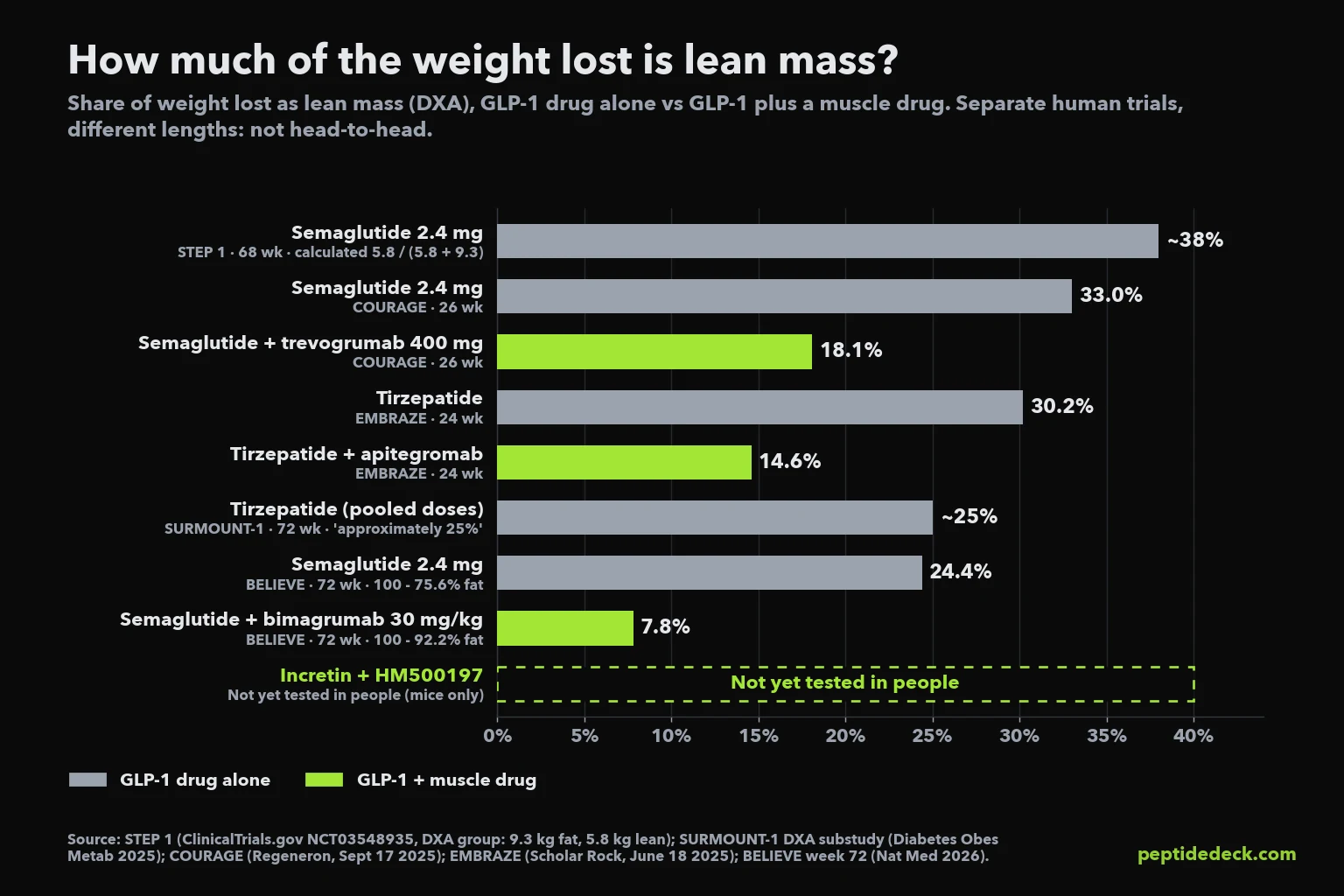
The pattern is consistent. Every muscle drug tested so far cut the lean share of weight loss by roughly half or more. All of them are antibodies, though, and that's the opening Hanmi is aiming at.
HM500197 Results: What the ADA 2026 Mouse Data Showed
Two experiments, both four weeks long.
Hanmi used diet-induced obese mice: lab mice fed a high-fat diet for 15 to 17 weeks, six per group. HM500197 was injected under the skin every other day at 100 to 800 nmol/kg. Bimagrumab, the antibody Eli Lilly is developing, served as the benchmark, injected once a week.
First, the lab-dish test. In human muscle-tumor cells carrying a signal reporter, HM500197 blocked myostatin about as well as bimagrumab (105.3% of bimagrumab's activity in the abstract, 106.8% on the poster). Against activin A and activin B it showed under 0.01% of bimagrumab's activity, and 0.02% against BMP9. Bimagrumab blocks the shared receptor, so it hits all of them at full strength.
Second, HM500197 on its own. Lean mass rose with the dose, by up to 6.7% from baseline, against 11.0% with bimagrumab. Fat mass fell by up to 17.0%, against 21.0%. That looks like a loss for HM500197 until you weigh the muscle itself. Every HM500197 dose produced heavier thigh (quadriceps) muscles than untreated mice, in the same range as bimagrumab. Hanmi's reading is that some of bimagrumab's extra lean mass sat outside muscle: bimagrumab-treated mice had significantly heavier hearts and lighter testes, and their livers trended heavier. HM500197 caused none of those changes.
Third, HM500197 with tirzepatide. This is the experiment that matters for GLP-1 users. Tirzepatide alone cut body weight by about 22% and took lean mass down by about 3.5%. Adding HM500197 left total weight loss about the same but flipped lean mass to a gain of roughly 3.5% at 200 nmol/kg and 7.5% at 800 nmol/kg. Hanmi reported that the lean mass difference was statistically significant at both doses. Fat loss trended a little higher with the combination, but not significantly.
*Read from the bar charts on Hanmi's ADA 2026 poster; Hanmi did not print these values. Figures without an asterisk are from the published abstract (Diabetes, 2026, 3073-LB).
The blood sugar result is a bonus worth noting. At the top dose, HOMA-IR, a common insulin resistance score, dropped to roughly a fifth of the untreated level, and non-fasting blood sugar was lower too. Bimagrumab didn't move either one in this experiment. Grip strength improved at one HM500197 dose (200 nmol/kg) but not consistently across doses.
Read this with care: six mice per group, four weeks, run and reported by Hanmi's own R&D team (several authors list Hanmi employment), and published as a conference abstract and poster, not a peer-reviewed paper. The mice got HM500197 every other day; a once-weekly human dose is a goal, not a result. Mouse muscle results often shrink in people.
HM500197 vs Bimagrumab, Apitegromab and Trevogrumab
The rivals are all antibodies, and all further along.
Three antibody drugs have already shown in people that blocking the myostatin pathway protects lean mass during GLP-1 weight loss. HM500197's pitch isn't that it works better. It's that a small, selective peptide could pair more easily with a weekly GLP-1 shot and skip the off-target effects. If you want the antibody side in more depth, see our ACE-031 vs apitegromab comparison.
Two honest caveats about that table. The antibody results come from different trials with different lengths and drugs, so they aren't a ranking. And the side effects differ: bimagrumab caused muscle spasms, diarrhea and acne in BELIEVE, and Regeneron's triple combination with a second antibody (garetosmab) had more dropouts and two deaths that the company did not link to treatment. Fewer off-target hits is exactly what HM500197's selectivity is meant to buy. Whether it does is still unknown. For a side-by-side of bimagrumab and the follistatin approach, see bimagrumab vs follistatin.
HM500197 vs HM17321: Hanmi's Two Muscle Bets
Same goal, completely different route.
HM17321 is a long-acting copy of urocortin-2, a hormone outside the incretin system. It aims to cut fat while keeping muscle through a different signal, and it is much further along. The FDA cleared its trial application in November 2025, a phase 1 study in healthy volunteers and people with obesity is running, and on August 24, 2026 Hanmi licensed it to Genentech, part of Roche, for $190 million upfront and up to about $2.3 billion in total with milestones. Hanmi finishes phase 1; Genentech takes over from phase 2. Our GUB-UCN2 guide covers Gubra's rival UCN2 drug.
HM500197 is not part of the Genentech deal. Hanmi presents the two as one strategy: weight loss where most of what comes off is fat.
When Could HM500197 Reach People?
Not soon. Here's the honest timeline.
- May 27, 2026: Hanmi names HM500197 as the fourth core H.O.P. program.
- June 5 to 8, 2026: first data at ADA 2026, poster 3073-LB.
- August 24, 2026: the sister drug HM17321 goes to Genentech.
- Second half of 2026: Hanmi's pipeline page says formal safety (toxicology) studies, the step required before a trial application, are planned.
- Next: an IND filing and a first-in-human phase 1 study. Hanmi has given no date for either.
Our estimate, not Hanmi's: toxicology work of this kind usually takes the better part of a year, so a first human dose before 2027 looks unlikely, and phase 2 and 3 would follow. We found no ClinicalTrials.gov entry for HM500197 as of October 22, 2026.
Can You Buy HM500197?
No, and anything sold under that name is a red flag.
HM500197 is a proprietary sequence Hanmi has never sold, and there's no trial to join yet. A website listing "HM500197" can't be selling the real molecule.
What people buy today, when they want the myostatin-blocking idea, is follistatin. It's a natural protein that binds myostatin. Online vendors sell follistatin 344 and modified versions such as FLGR242, which BioLongevity Labs lists at $299 for a pair of 10 mg vials or $250 for a single vial (checked October 22, 2026). The vendor describes FLGR242 as a follistatin fragment built not to bind activin, with an albumin binder for a longer life in the blood, which sounds a lot like HM500197's design brief. PeptideDeck may earn a commission if you buy through links on this site.
The honest difference is evidence. HM500197 has a selectivity profile and a dose-response curve, if only in mice. Neither follistatin 344 nor FLGR242 has a published trial in people for muscle or weight loss, and vendor descriptions of selectivity are claims, not test results we could check. If you're weighing one, treat it as an experiment on yourself, talk to a doctor first, and insist on a batch-matched lab report.
What This Means If You're on a GLP-1 Now
The muscle question is real today.
You don't need to wait for HM500197 to take muscle loss seriously. Ask your doctor whether a body composition scan makes sense, especially if you're over 60, losing weight fast, or already feel weaker. The lean share ran from 24% to 38% across the trials above; the only way to know yours is to measure it. If you're lifting while on a GLP-1, our piece on training on retatrutide covers what lifters report.
HM500197 is worth watching for what it would make possible: one weekly shot where most of what comes off is fat. The mouse data says the design works. The human data doesn't exist yet.
Frequently Asked Questions
Sources
- Choi J, Kim J, Kim JY, et al. 3073-LB: HM500197, a de novo-designed long-acting peptide myostatin inhibitor, improves skeletal muscle mass and body composition in diet-induced obese mice. Diabetes. 2026;75(Supplement_1):3073-LB. doi 10.2337/db26-3073-LB. Abstract
- Hanmi Pharm. HM500197 ADA 2026 poster 3073-LB (PDF). Poster
- Hanmi Pharm. Hanmi to unveil second muscle-building obesity candidate at ADA 2026. Press release, May 27, 2026. Hanmi
- Hanmi Pharm. Hanmi captures attention at ADA 2026 with new muscle-gaining obesity drug candidate HM500197. Press release, June 16, 2026. Hanmi
- Hanmi Pharm. HM500197 (LA-MSTN) pipeline page (accessed October 22, 2026). Hanmi
- Hanmi Pharm. Hanmi licenses HM17321 to Genentech. Press release, August 24, 2026. Hanmi
- Heymsfield SB, Aronne LJ, et al. Bimagrumab plus semaglutide alone or in combination for the treatment of obesity: a randomized phase 2 trial (BELIEVE). Nat Med. 2026;32(3):869-882. PMID 41772149. PubMed
- Novo Nordisk. STEP 1 (NCT03548935) results: change in total fat mass and lean body mass, week 68. ClinicalTrials.gov. Record
- Wilding JPH, et al. Once-weekly semaglutide in adults with overweight or obesity (STEP 1). N Engl J Med. 2021;384:989-1002. PMID 33567185. PubMed
- Look M, Dunn JP, Kushner RF, et al. Body composition changes during weight reduction with tirzepatide in the SURMOUNT-1 study of adults with obesity or overweight. Diabetes Obes Metab. 2025;27(5):2720-2729. PMID 39996356. PubMed
- Scholar Rock. Positive phase 2 EMBRAZE trial results: preservation of lean mass with apitegromab during tirzepatide-induced weight loss. Press release, June 18, 2025. Scholar Rock
- Regeneron. Results from phase 2 COURAGE trial presented at EASD. Press release, September 17, 2025. Regeneron
- Campbell C, McMillan HJ, Mah JK, et al. Myostatin inhibitor ACE-031 treatment of ambulatory boys with Duchenne muscular dystrophy. Muscle Nerve. 2017;55(4):458-464. PMID 27462804. PubMed
- BioLongevity Labs. FLGR242 (10mg) product listing (accessed October 22, 2026). Listing
Medical Disclaimer: This content is for informational purposes only and does not constitute medical advice. HM500197 is an experimental compound that has not been tested in humans and has no FDA approval. Always consult a qualified healthcare provider before starting any new medication or treatment. PeptideDeck may earn a commission from affiliate links at no additional cost to you.