💡 Quick Answer
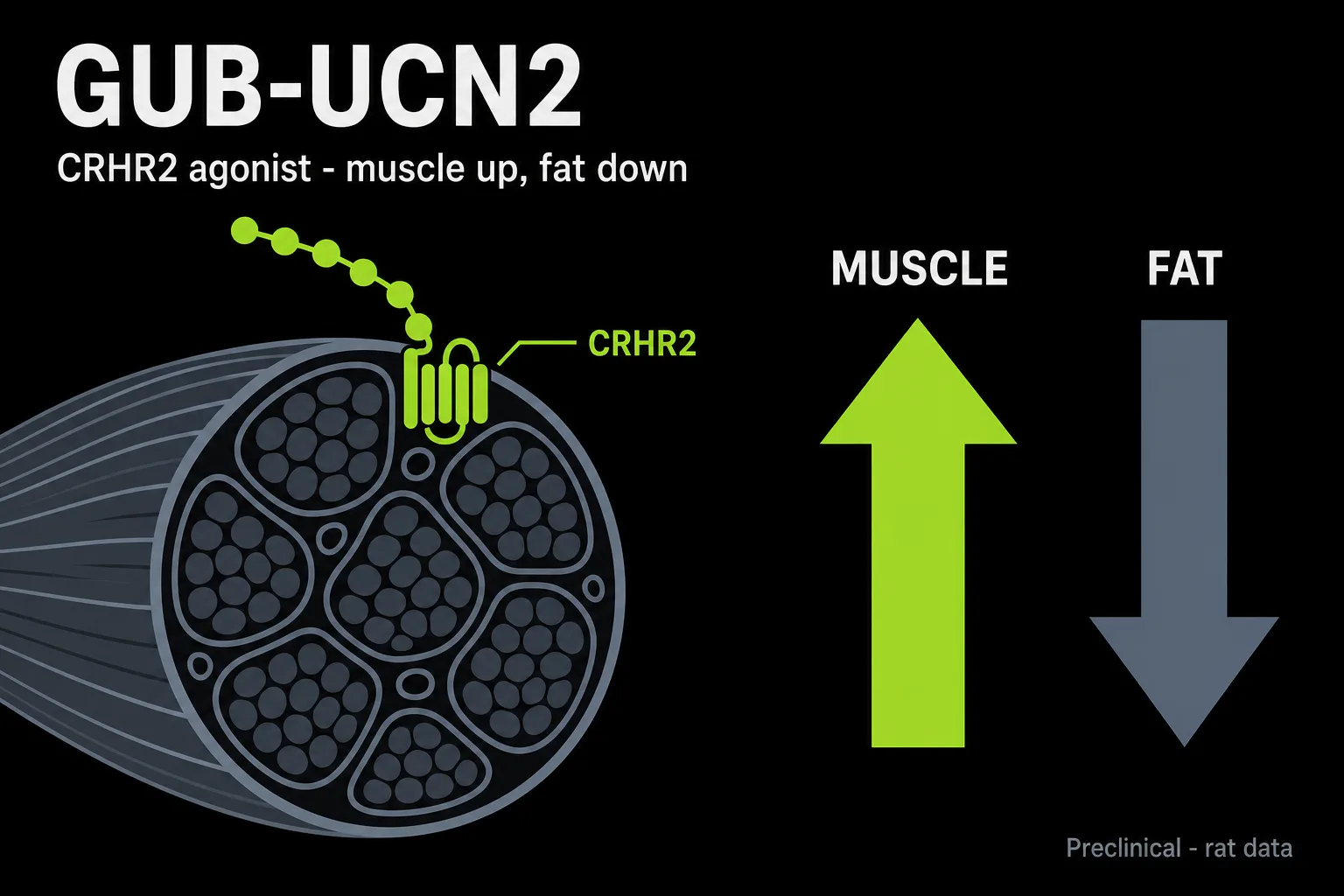
GUB-UCN2 is a long-acting, CRHR2-selective urocortin-2 analog from Danish biotech Gubra, designed as a once-weekly injection that builds muscle while stripping fat — the opposite of what GLP-1 drugs do to body composition. In aged obese rats it raised lean mass by about 14% while cutting fat mass by up to 33%, and when stacked on semaglutide it turned a 5% lean-mass loss into an 8% gain. It entered its first human trial in 2026, with the earliest data due in the first half of 2027. There is no human efficacy data yet, and GUB-UCN2 cannot be bought from any source — research-grade or otherwise.
Every GLP-1 user eventually runs into the same uncomfortable statistic. Somewhere between a quarter and 40% of the weight lost on semaglutide or tirzepatide is not fat. It is lean tissue — skeletal muscle, organ mass, the stuff that determines how strong you are at 70 and how fast your metabolism runs at 50. The scale rewards you and the DEXA scan quietly bills you.
That bill is now the most valuable problem in obesity pharmacology, and GUB-UCN2 is one of two drugs in the world built specifically to pay it.
What GUB-UCN2 Actually Is
GUB-UCN2 is a synthetic analog of urocortin 2, a 38-amino-acid neuropeptide your body already makes. Urocortin 2 belongs to the corticotropin-releasing factor family and binds selectively to CRHR2 (corticotropin-releasing hormone receptor 2), a receptor expressed heavily in skeletal muscle and the cardiovascular system.
Native urocortin 2 is useless as a drug — it clears in minutes. Gubra's contribution is a fatty-acid-modified version engineered for a long half-life, which is what makes once-weekly subcutaneous dosing possible. The "GUB" prefix is simply Gubra's internal naming convention, the same as their amylin analog GUBamy.
Three properties define it:
- CRHR2-selective. It deliberately avoids CRHR1, the receptor associated with the stress-axis and anxiety-type effects. The selectivity is the safety story.
- Non-incretin. It has nothing to do with GLP-1, GIP or glucagon. It does not work by making you less hungry.
- Anabolic, not just protective. It does not merely blunt muscle loss. In animals it adds muscle.
The Mechanism: An Exercise Signal Without the Exercise
When urocortin 2 activates CRHR2 on a muscle cell, it triggers what Gubra describes as reprogramming toward an exercise-like phenotype. In practical terms, treated muscle starts behaving like trained muscle: it grows, it shifts its fuel handling, and it clears fat out of the muscle fibres themselves.
That last part is worth pausing on. In the rat work, GUB-UCN2 reduced intramyocellular lipid content by 41% to 57% — the fat stored inside muscle cells, which is one of the tightest correlates of insulin resistance there is. It is a strong hint that the metabolic benefit is not just a by-product of a better fat-to-muscle ratio.
This is a fundamentally different lever from the other muscle-preservation approaches in development. Myostatin pathway drugs like those covered in our bimagrumab vs follistatin comparison and ACE-031 vs apitegromab guide work by removing a brake on muscle growth. CRHR2 agonism presses an accelerator instead.
The Preclinical Data
The clearest dataset was presented at the American Diabetes Association's 2026 Scientific Sessions (abstract 1103-OR), run in aged diet-induced obese rats — an unusually honest model choice, since ageing is when muscle loss actually hurts.
GUB-UCN2 on its own
- Whole-body lean mass increased roughly 14% at both doses tested
- Whole-body fat mass fell 22% (low dose) and 33% (medium dose) versus vehicle
- Soleus muscle weight rose 25–29%, volume 29%, cross-sectional area 21–24%
- Intramyocellular lipid dropped 41–57%
Stacked on semaglutide
This is the comparison that made the pharma industry pay attention:
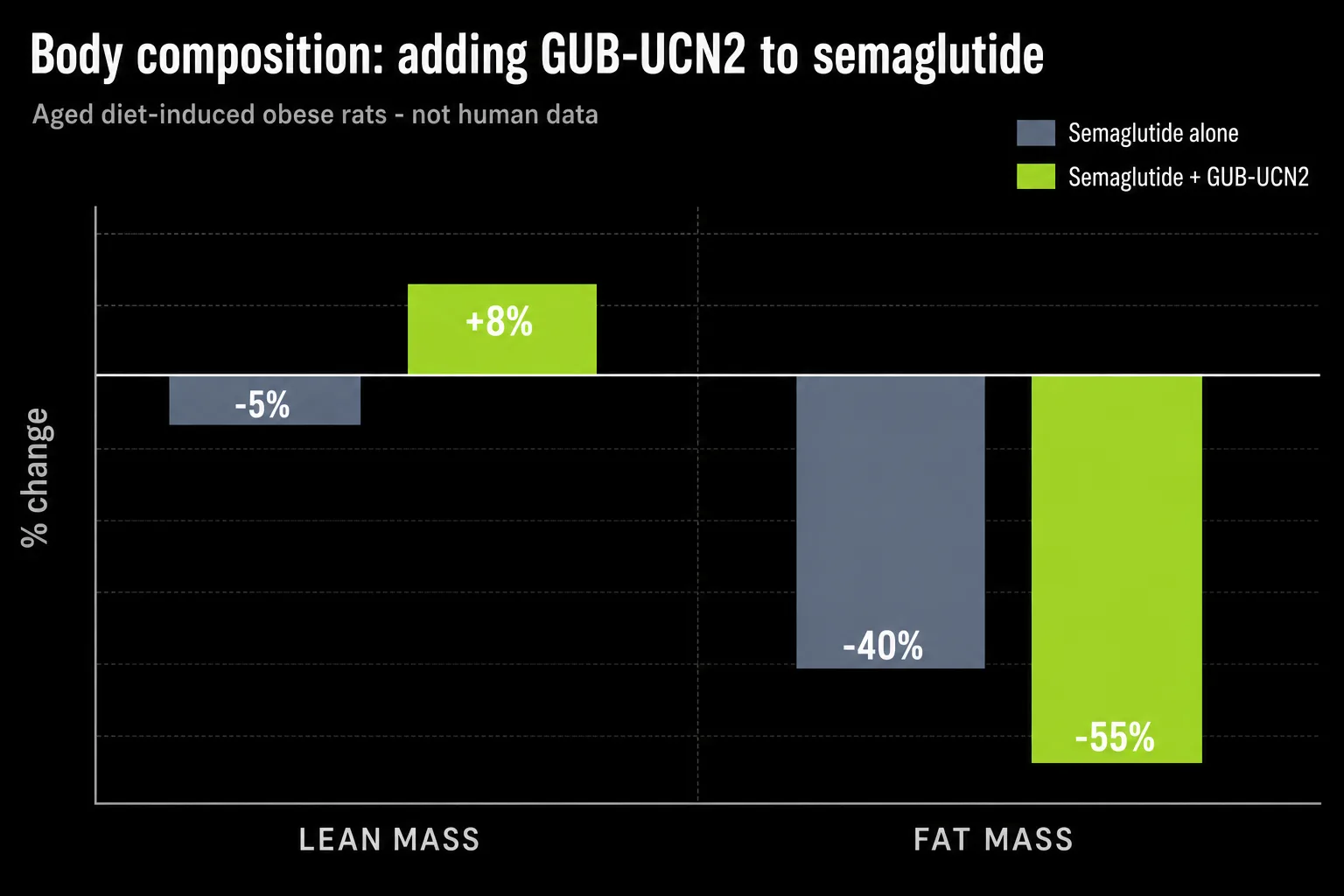
| Measure | Semaglutide alone | Semaglutide + GUB-UCN2 |
|---|---|---|
| Lean mass | −3% to −5% (lost) | +8% to +12% (gained) |
| Fat mass | −40% | −48% to −55% |
| Body weight loss | Baseline | Maintained |
The combination did not just protect muscle. It reversed the direction of the lean-mass change while simultaneously deepening fat loss — and total weight loss held. Glucose, insulin, leptin and triglycerides all improved more than with semaglutide alone.
Gubra has also reported that urocortin-2 completely prevents the lean-mass loss seen with amylin agonists, which matters because amylin is where much of the next-generation obesity field is heading.
⚠️ These Are Rat Numbers
Every figure above comes from rodents. Body-composition effects in rats have a long history of shrinking or vanishing in humans, and a 14% lean-mass gain in a rat should not be read as a promise of anything in a person. As of now there is zero published human efficacy data for GUB-UCN2.
Where It Is in Development
Gubra submitted its clinical trial application in Germany and has since started a Phase 1/2a study. The design is unusually ambitious for a first-in-human trial:
- ~188 participants — healthy volunteers plus people living with obesity, with and without related conditions including type 2 diabetes
- Three parts: single ascending dose (SAD), multiple ascending dose (MAD) and a multiple dose (MD) segment
- Tests GUB-UCN2 both as a standalone therapy and on top of standard-of-care incretin treatment
- First SAD data — safety, tolerability, pharmacokinetics — expected in H1 2027
Running a combination arm inside a first-in-human study is aggressive. It signals that Gubra sees the add-on-to-GLP-1 position as the commercial destination rather than a later add-on question.
Beyond obesity, Gubra has flagged expansion targets in sarcopenia, type 2 diabetes-related muscle loss, and cardiorenal disease. The program actually began as a cardio-renal asset before the body-composition data redirected it.
The Competition: Hanmi, Genentech and a $2.3 Billion Validation
In August 2026, Hanmi Pharmaceutical licensed HM17321 — its own UCN2 analog — to Genentech, part of the Roche Group. The terms: $190 million upfront and up to $2.3 billion in milestones.
For Gubra, this cuts both ways. A major pharma paying that much for the same mechanism is powerful external validation of CRHR2 as an obesity target. But Hanmi got FDA clearance in November 2025 and began its Phase 1/2 trial roughly eight months ahead of Gubra, and Hanmi retains its trial through completion before Genentech takes over from Phase 2.
Two companies, one mechanism, no human efficacy data on either. Whichever reads out first will define what CRHR2 agonism is actually worth.
Safety: What Is Known and What Is Not
There is no GUB-UCN2 human safety data yet. But urocortin 2 itself has been infused into humans in cardiovascular research, and that literature tells you what to watch.
In healthy volunteers and heart-failure patients, intravenous urocortin 2 produced vasodilation, reduced systemic vascular resistance, lowered mean arterial pressure and increased cardiac output, with heart rate rising in healthy subjects. Those were the intended effects in a cardiac context. In a weekly obesity injection, the same pharmacology reads as a list of open questions:
- How much blood pressure drop occurs at weight-management doses, and does it persist across a full week?
- Does heart rate rise chronically — the issue that has dogged other metabolic drug classes?
- What happens when it is layered onto a GLP-1 in someone already losing weight and volume?
Gubra consistently describes a "favourable cardiac profile" from preclinical work, and improved cardiac and renal function in animal models. That is a reasonable claim to make and an unreasonable one to rely on. Cardiovascular tolerability is precisely what the SAD and MAD phases exist to characterise, which is why the H1 2027 readout matters more than the rat data.
Can You Buy GUB-UCN2?
⚠️ No — and That Answer Is Unusually Firm
GUB-UCN2 is a proprietary, patent-protected clinical asset owned by a publicly listed company and currently inside a regulated trial. It is not sold as a research chemical, it is not available grey-market, and there is no legitimate supply chain outside Gubra's own trial sites.
If you encounter a vendor listing "GUB-UCN2," treat it as a red flag rather than a find. At best you are buying a generic urocortin-2 fragment relabelled with a clinical code; at worst you are buying an unidentified powder. Neither is the lipidated, long-acting molecule Gubra is testing — that exact structure is the entire proprietary contribution, and it is not something a peptide shop can source.
The same caution applies to Hanmi's HM17321. Both are trial-stage assets with no commercial availability of any kind.

Why This Matters Even If You Never Take It
GUB-UCN2 is worth understanding because of what it says about where obesity treatment is going. The first generation of GLP-1 drugs proved that dramatic weight loss is achievable. The second generation is being judged on the quality of that loss.
If you are on a GLP-1 now, the practical lesson is not to wait for a CRHR2 drug that is at least three to four years from any pharmacy. It is that lean-mass loss is a real, measured side effect worth actively managing today with resistance training and adequate protein — the same conclusion reached in our guide to Ozempic-related hair and muscle loss and the practical notes in the retatrutide bodybuilding guide.
What to Watch Next
- October 27, 2026 — Gubra R&D event in London, covering trial design and the multi-indication strategy
- H1 2027 — first GUB-UCN2 SAD data: safety, tolerability, pharmacokinetics in healthy volunteers
- Hanmi/Genentech HM17321 — likely to report human data first given its head start
- The MAD and combination arms — where any real signal on human body composition will first appear