💡 Quick Answer
Follistatin is a naturally occurring glycoprotein that binds myostatin and activin and stops them reaching their ActRIIA/ActRIIB receptors — releasing the brake that normally limits muscle growth. The biology is textbook and the animal results are extraordinary. But the impressive human and primate data comes from gene therapy, not from an injected peptide, and the two are not interchangeable. Follistatin is also prohibited at all times by WADA, and the theoretical cancer question is real enough to take seriously. What's actually sold commercially is a recombinant analog, usually FLGR-242.
Follistatin sits in an unusual position. The underlying science is genuinely strong — decades of peer-reviewed work, a clearly mapped mechanism, and some of the largest muscle gains ever recorded in a vertebrate. Meanwhile the products sold under its name have essentially no published data behind them.
This guide covers what follistatin does, what it plausibly delivers, what the safety picture actually looks like including the cancer question, and where the science stops and the marketing starts.
What Is Follistatin?
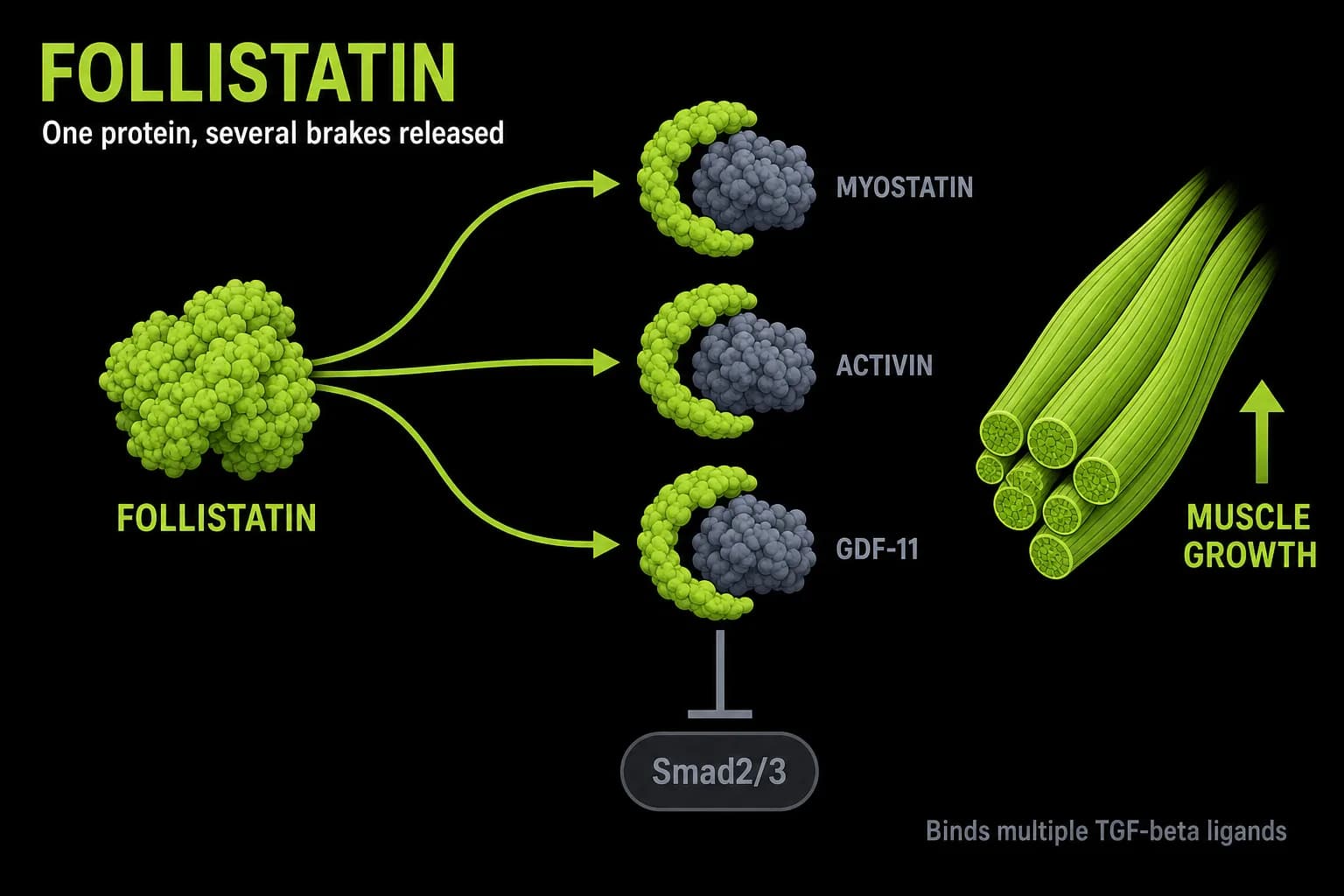
Follistatin (FST) is a single-chain glycoprotein your body produces, found in nearly every tissue. Its job is to act as a high-affinity trap for members of the TGF-β superfamily — most importantly myostatin (GDF-8) and activin.
It was originally identified for suppressing follicle-stimulating hormone, which is where the name comes from. The muscle interest came later, once myostatin was identified as the primary negative regulator of skeletal muscle mass.
Three isoforms matter:
| Isoform | Character | Relevance |
|---|---|---|
| FST-344 | Precursor form, longer circulating | The form used in gene-therapy research |
| FST-315 | Main circulating form, low tissue affinity | Systemic activity |
| FST-288 | Tissue-bound, binds cell surfaces tightly | Local, autocrine action |
Our follistatin isoform guide covers how FST-344, FST-315 and FST-288 differ in structure and half-life in more depth.
How Follistatin Works
Myostatin restrains muscle growth. It binds activin type II receptors — ActRIIA and ActRIIB — which phosphorylates Smad2 and Smad3, driving a transcriptional programme that limits muscle protein synthesis. Animals with non-functional myostatin become conspicuously muscular; Belgian Blue cattle are the textbook case.
Follistatin intercepts myostatin before it reaches the receptor. No receptor engagement means no Smad2/3 signal, which means the growth-limiting programme goes quiet.
What makes follistatin more potent than a pure myostatin antibody is that it is promiscuous — it also binds activin A, GDF-11 and other family members. It releases several brakes at once. That is exactly why it produces larger effects than selective myostatin inhibitors, and exactly why its safety profile is harder to predict.
Benefits of Follistatin
Muscle mass and strength
This is the well-supported one, with an important caveat about how it was demonstrated. In Lee et al. (2009, Science Translational Medicine), an AAV1 vector carrying the FS344 gene was injected into the quadriceps of cynomolgus macaques. The result was pronounced and durable increases in muscle size and strength, with no organ pathology and no observed change in reproductive capability.
Transgenic mice engineered to overexpress follistatin have shown muscle mass increases in the range of 200–300% — the largest such effects recorded — though genetic overexpression from birth is a world away from any intervention available to an adult.
Clinical function in muscular dystrophy
Mendell et al. (2015) ran a Phase 1/2a trial delivering follistatin by AAV to six Becker muscular dystrophy patients. Two improved by 58 and 125 metres on the six-minute walk test. That is a meaningful functional result in a degenerative disease.
It is worth knowing those claims have drawn published pushback: a Molecular Therapy paper titled "Unfounded Claims of Improved Functional Outcomes Attributed to Follistatin Gene Therapy in Inclusion Body Myositis" disputes some reported benefits. Even the strongest evidence in this field is contested.
Body composition and metabolic effects
Because activin and myostatin signalling touch adipose tissue and glucose handling as well as muscle, follistatin has been investigated for fat mass and insulin sensitivity. This work is preliminary and mostly preclinical — treat it as a hypothesis, not a benefit.
What follistatin does not do
- It does not act as an anabolic hormone. It removes a restraint; it does not add a growth signal the way testosterone or IGF-1 does.
- It does not build muscle without training and adequate protein. The brake being off is not the same as the accelerator being pressed.
- It does not selectively target the muscles you want bigger. Systemic exposure is systemic.
Follistatin Side Effects
There is no controlled safety dataset for injectable follistatin products. What follows separates what has been observed from what the biology predicts.
Reported with commercial products
- Post-injection pain and swelling is the most consistent complaint, which is unsurprising for a ~40 kDa glycoprotein rather than a small peptide. Users report finer 31–32 gauge insulin syringes and more dilute preparations reduce it substantially.
- General injection-site reactions — redness, local inflammation, transient nodules.
Predicted from the biology
- Reproductive and hormonal disruption. Activin drives FSH secretion; follistatin suppresses it. That is the original discovered function, not a side note. Sustained systemic activity has plausible consequences for FSH, LH and fertility in both sexes.
- Connective tissue lagging behind muscle. If contractile tissue grows faster than tendon and ligament adapt, injury risk rises. This is a recognised concern with all myostatin-pathway compounds.
- Cardiac tissue. Myostatin is expressed in heart muscle. What sustained inhibition does to cardiac remodelling in humans is not established.
- Immunogenicity. Recombinant proteins can provoke antibody responses that neutralise the product or cross-react with the endogenous protein. Nobody has tested this for the commercial analogs.
Is Follistatin Safe? The Cancer Question
⚠️ This concern is mechanistic, not hypothetical hand-wringing
Activin A is a growth-inhibitory signal in several tissue types and functions as a tumour suppressor in certain contexts. Follistatin's therapeutic effect depends on neutralising activin. You cannot separate the muscle benefit from the removal of a growth restraint that operates body-wide.
The honest position has three parts.
There is no evidence follistatin causes cancer in humans. No trial has shown it, and the primate work reported no organ pathology across a long observation period. Nobody should claim it is a carcinogen.
The mechanism justifies caution regardless. Elevated follistatin has been observed in several cancers, and the direction of causality is not settled — it may be a consequence of tumour biology rather than a driver. But a compound whose job is to suppress growth-inhibitory signalling is a compound where an existing undiagnosed malignancy is the obvious worst case. Anyone with a personal or strong family history of cancer has a clear reason to stay away, as does anyone who has not had unexplained symptoms investigated.
Duration is the variable nobody can advise on. The gene-therapy studies involved a single administration producing sustained local expression under medical supervision. Repeated systemic self-administration over months is a different exposure pattern that has never been studied in anyone.
Follistatin is also prohibited at all times by WADA as a myostatin-pathway agent — in and out of competition. For any tested athlete this is a sanction, not a grey area.
Follistatin Dosage
⚠️ No clinical dosing protocol exists for injectable follistatin
Every figure circulating comes from vendor suggestions, community reports, or extrapolation from animal work. There is no established human dose because no dose-finding study has been run on an injectable follistatin product.
Laboratory reference ranges are the only figures with methodological grounding:
- In vitro: 100–500 ng/mL for myostatin inhibition assays; 10–1000 ng/mL for dose-response work
- Animal models: roughly 1–10 µg per administration, intramuscular or subcutaneous
Commonly reported community protocols run around 100–300 mcg per day, frequently injected intramuscularly into targeted muscle groups, in cycles of a few weeks. That is well above the per-administration animal range, and it is a number derived from practice rather than pharmacology. Treat it as a description of what people do, not a recommendation.
Handling
- Reconstitute with sterile bacteriostatic water or PBS to roughly 1 mg/mL
- Swirl gently — never vortex or shake. A protein this size denatures under mechanical stress in a way small peptides do not
- Lyophilised: −20°C to −80°C, typically specified stable for 24 months
- Reconstituted: −80°C up to about 3 months; working solutions at 4°C used within 48 hours
- Avoid repeated freeze-thaw cycles
Mechanics are covered in our reconstitution guide, with the caveat that a glycoprotein is more fragile than the small peptides that guide mostly addresses.
Gene Therapy vs Injectable Follistatin
This is the distinction that determines whether the research means anything for a buyer, and it is the one most consistently blurred.
| Gene therapy (the studies) | Injectable protein (what's sold) | |
|---|---|---|
| Delivery | AAV vector carrying the FS344 gene | Recombinant protein, subcutaneous or IM |
| Production | Muscle cells manufacture it continuously | Fixed dose that clears from circulation |
| Duration | Sustained for months to years | Hours to days per injection |
| Where it acts | Concentrated in the injected muscle | Systemic exposure |
| Evidence | Primate and human trial data | None published |
A citation to Lee 2009 or Mendell 2015 on a page selling vials is not evidence for the vial. It is evidence for a different intervention that happens to target the same protein.
What Is Actually Sold: FLGR-242
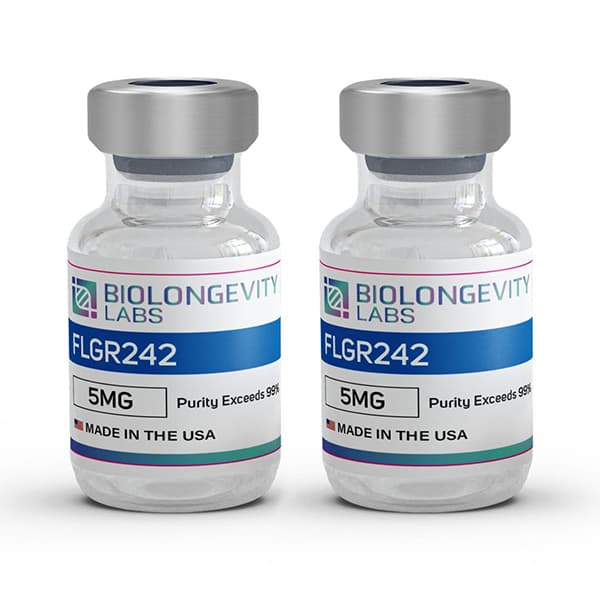
Vials labelled "Follistatin" are almost always FLGR-242 (also written FLGR242) — a recombinant, truncated follistatin analog, roughly 31.5 kDa bare and 35–40 kDa glycosylated. Manufacturers describe it as retaining the follistatin domain repeats that bind myostatin while reducing activin binding and adding an albumin-binding domain to extend half-life.
Those are plausible engineering choices and unpublished claims. If the reduced-activin-binding claim held up it would meaningfully narrow the safety concerns in this article — which is exactly why an unverified version of it is not reassuring.
Our full FLGR-242 guide covers the analog specifically: vendor claims, reported side effects, dosing, and handling.
Where to Buy Follistatin
Because there is no reference standard for the commercial analog and no independent characterisation, documentation is the entire decision. A short peptide can be partly judged by behaviour; a 40 kDa glycoprotein cannot. Without batch paperwork you are trusting a label.
What to insist on:
- A batch-specific COA, not a generic product-line certificate
- ≥99% purity by HPLC and SDS-PAGE
- Endotoxin below 1.0 EU/µg, which matters for anything injected
- Independent third-party verification, traceable by QC number or QR code back to the lab
BioLongevity Labs
BioLongevity Labs is the source we point readers to, because it meets that bar rather than simply asserting purity. Every compound ships with a certificate tied to its specific batch, independently verified through MDx BioAnalytical Laboratory and traceable by QC tracking number or QR code.
It sells FLGR242 as a 10mg pair — two vials, listed at $499.00, with a single vial at $250.00 and tiered bulk pricing from 5% off at six pairs up to 20% at forty-eight. Stated purity is 99%+.
Best fit: choose BioLongevity if you want the follistatin analog specifically and want batch-level documentation behind it.
Check FLGR242 at BioLongevity Labs here.
If the goal is muscle rather than this molecule
If you want lean mass and recovery rather than follistatin specifically, better-characterised routes exist with real human dosing literature. Ascension Peptides does not stock follistatin or any myostatin-pathway compound, but its FIT Stack (CJC-1295 No DAC + Ipamorelin) is the closest growth-oriented option and the Wolverine Stack (BPC-157 + TB-500) covers recovery. Dosing is in our CJC-1295 dosage guide; the category is ranked in best peptides for muscle growth, and the wider myostatin field in bimagrumab vs follistatin and ACE-031 vs apitegromab.