💡 Quick Answer
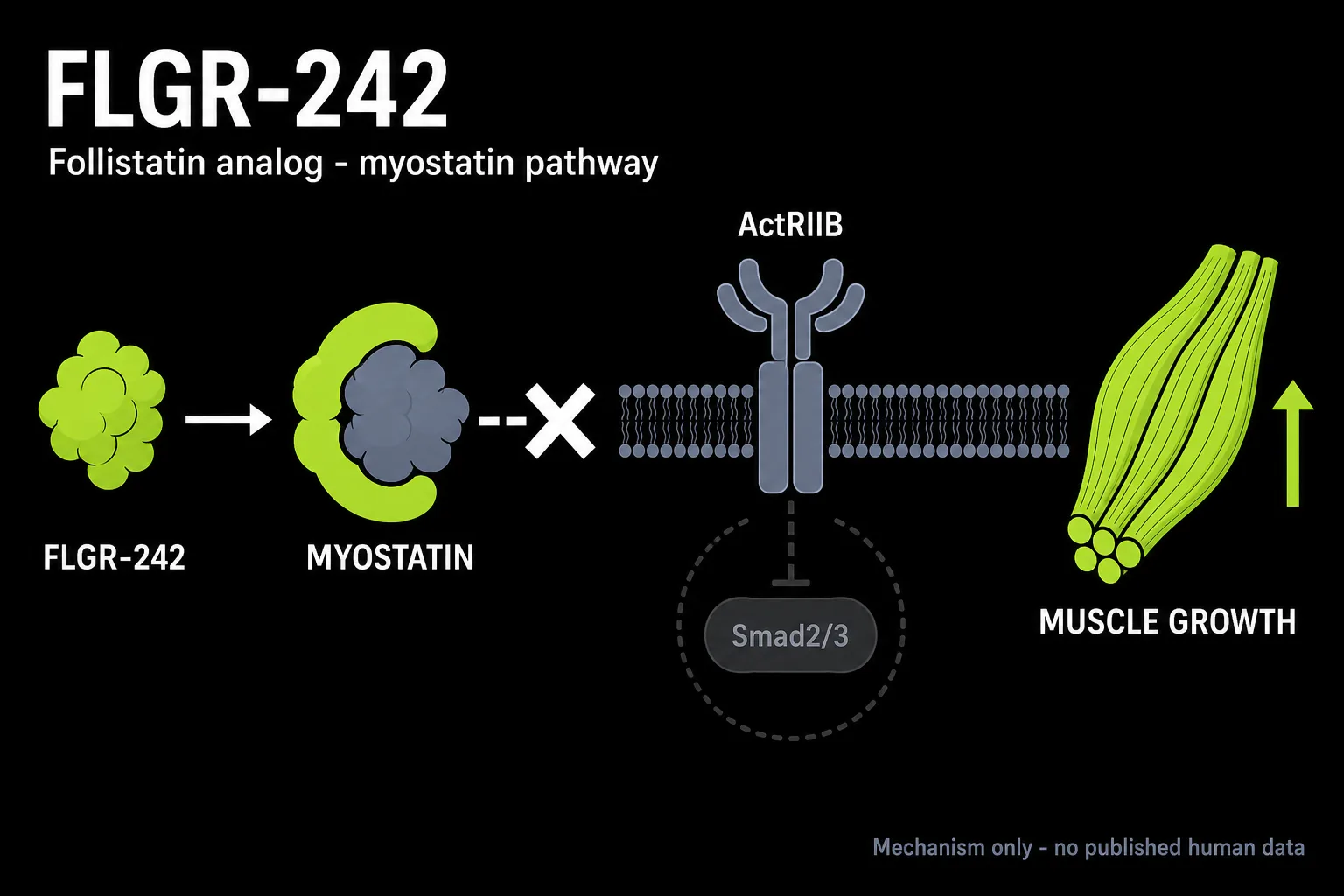
FLGR-242 (also sold as FLGR242 or "Follistatin FLGR242") is a recombinant follistatin analog marketed as a myostatin inhibitor for muscle growth. It works — in theory — by binding myostatin and activin so they cannot reach their ActRIIA/ActRIIB receptors, switching off the Smad2/3 signal that limits muscle growth. That biology is real and well established. What does not exist is a single published study on FLGR-242 itself. The impressive primate and human data vendors cite is gene therapy research, which is a fundamentally different intervention. It is sold by niche research suppliers as 5mg and 10mg vials — a single vial runs about $250 and a 10mg two-vial pair about $499.
FLGR-242 has moved fast. Eighteen months ago almost nobody outside myostatin research circles had heard of it. Today it is one of the most searched research peptides in the muscle-growth category, driven largely by a handful of influencer posts showing before-and-after photos.
The biology underneath it is genuinely interesting and genuinely well-documented. The specific product being sold is not. Those two facts get blended together in almost every page selling it, so this guide separates them.
What FLGR-242 Actually Is
FLGR-242 is a recombinant, truncated form of follistatin — a glycoprotein your body already produces that acts as a high-affinity trap for TGF-β superfamily ligands, myostatin and activin among them.
Vendors describe it as a modified FST-344 derivative in the region of 31.5 kDa as a bare protein, closer to 35–40 kDa glycosylated, retaining the follistatin domain repeats that do the ligand binding while improving solubility over full-length preparations. Two design claims come up repeatedly:
- Reduced activin binding. The pitch is that FLGR-242 binds myostatin while largely sparing activin, which is where the reproductive and unwanted-proliferation concerns of broad follistatin activity come from.
- An albumin-binding domain on a glycine-serine linker, intended to extend circulating half-life well past native follistatin.
Both are plausible protein-engineering strategies. Neither has been published, peer-reviewed, or independently verified for this molecule. They are manufacturer descriptions.
How Follistatin Works
This part is textbook and not in dispute.
Myostatin (GDF-8) is a negative regulator of skeletal muscle mass. It binds activin type II receptors — ActRIIA and ActRIIB — which triggers phosphorylation of Smad2 and Smad3, which in turn drives a transcriptional programme that restrains muscle protein synthesis. Animals lacking functional myostatin grow conspicuously more muscle; the double-muscled Belgian Blue cattle are the classic example.
Follistatin sits upstream of all of that. It binds myostatin directly and prevents receptor engagement, so the Smad2/3 signal never fires. Remove the brake, and the muscle-limiting programme goes quiet.
That is the same target class as the drugs covered in our bimagrumab vs follistatin comparison and the ACE-031 vs apitegromab guide, and the wider background sits in the follistatin peptide guide covering FST-344 and FST-315.
The Evidence Gap Nobody Selling It Mentions
⚠️ The cited studies are gene therapy, not an injected peptide
Product pages for FLGR-242 routinely cite two impressive papers. Both are real. Neither used anything like the product being sold.
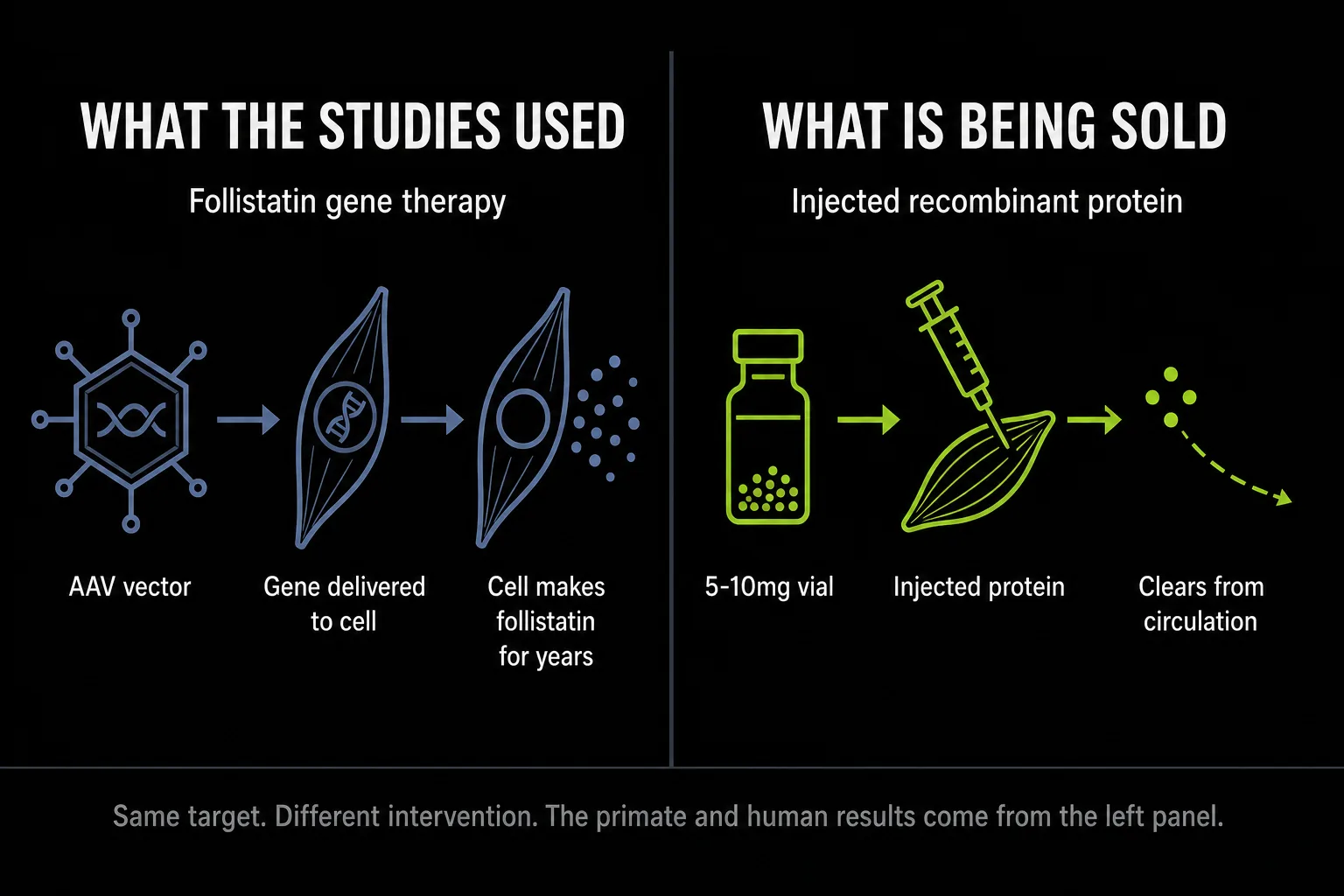
Lee et al., 2009 (Science Translational Medicine) injected AAV1-FS344 — an adeno-associated viral vector carrying the follistatin gene — into the quadriceps of cynomolgus macaques. The result was pronounced, durable increases in muscle size and strength with no organ pathology or reproductive changes observed.
Mendell et al., 2015 ran a Phase 1/2a trial delivering follistatin by AAV to six Becker muscular dystrophy patients. Two patients improved 58 and 125 metres on the six-minute walk test.
In both cases the intervention was a virus instructing muscle cells to manufacture follistatin continuously, in place, for years. That is not the same as injecting a recombinant protein subcutaneously twice a week and hoping it survives long enough to matter. The delivery method, the local concentration, the duration of exposure and the regulatory pathway are all different. Citing primate gene-therapy hypertrophy on a page selling a $150 vial is the single most misleading move in this category.
It is also worth knowing that follistatin gene therapy claims have drawn published pushback of their own — a Molecular Therapy paper titled "Unfounded Claims of Improved Functional Outcomes Attributed to Follistatin Gene Therapy in Inclusion Body Myositis" disputes some of the reported functional benefits. Even the strong-form evidence is contested.
Claimed Benefits
Sorted by how much support actually exists:
| Claim | Evidence status |
|---|---|
| Follistatin inhibits myostatin via ActRIIB/Smad2/3 | Well established — textbook mechanism |
| Follistatin gene delivery grows muscle in primates and humans | Published, but gene therapy, not this product |
| FLGR-242 specifically increases lean mass in humans | No published data — user reports only |
| Reduced activin binding improves the safety profile | Vendor claim, unverified |
| Albumin binder extends half-life | Vendor claim, no published PK |
| Immune and inflammation modulation | Speculative — extrapolated from activin/TGF-β biology |
The honest summary: the target is real, the mechanism is real, the delivery and the specific molecule are unproven. Anyone claiming otherwise is selling something.
Side Effects
There is no safety dataset for FLGR-242. What exists falls into two buckets.
Reported by users
- Post-injection pain and swelling is the most consistently reported issue. Jay Campbell — one of the main figures popularising the compound — publicly reported initial PIP and swelling, and said switching from 28/29-gauge to 31/32-gauge insulin syringes plus a more dilute formulation reduced it to mild soreness lasting roughly 24–36 hours.
- Injection-site reactions generally, which is what you would expect from a ~40 kDa glycoprotein rather than a small peptide.
Theoretical, from follistatin biology
- Reproductive suppression. Activin regulates FSH. Broad activin inhibition has hormonal consequences, which is precisely why the reduced-activin-binding claim matters — and precisely why an unverified claim is not reassuring.
- Unwanted tissue proliferation. Removing a brake on growth removes it everywhere, not only where you want it. Myostatin inhibition has a long-standing theoretical cancer-risk discussion attached to it, and anyone with a known or suspected malignancy has an obvious reason for caution.
- Bone density and connective-tissue effects at sustained high exposure.
- Immunogenicity. Recombinant proteins can provoke antibody responses. Nobody has tested whether this one does.
General injection-safety and handling considerations are covered in our peptide side effects guide.
Dosage

⚠️ No established protocol exists
There is no clinical dosing study for FLGR-242. Every number circulating comes from vendor suggestions, forum reports or extrapolation from animal work. Treat them as a description of what people are doing, not a recommendation.
Laboratory reference ranges quoted by suppliers are the only figures with any methodological basis:
- In vitro: 100–500 ng/mL for myostatin inhibition assays, with 10–1000 ng/mL used for dose-response work
- Animal models: roughly 1–10 µg per administration, intramuscular or subcutaneous, frequency set by study design
Commonly reported user protocols land around 100–300 mcg per day, frequently injected intramuscularly into targeted muscles rather than subcutaneously. That is one to two orders of magnitude above the animal-study range on a per-administration basis, which should give anyone pause — it is a number derived from community practice, not from pharmacology.
Handling and storage
Supplier specifications are reasonably consistent, and this part is standard protein handling:
- Reconstitute with sterile bacteriostatic water or PBS to roughly 1 mg/mL
- Swirl gently — do not vortex or shake. Proteins this size denature under mechanical stress
- Lyophilised: −20°C to −80°C, typically quoted as stable for 24 months
- Reconstituted: −80°C for up to about 3 months; working solutions at 4°C used within 48 hours
- Avoid repeated freeze-thaw cycles
Our reconstitution guide covers the mechanics, though note that a 40 kDa glycoprotein is more fragile than the small peptides most of that guide addresses.
Where to Buy FLGR-242
FLGR-242 is stocked by a small set of research-peptide suppliers. Because there is no published characterisation of this molecule and no reference standard to check it against, the certificate of analysis matters more here than almost anywhere else in the peptide market. A 15-amino-acid peptide can be partly sanity-checked by behaviour and appearance. A 40 kDa glycoprotein cannot — without batch documentation you are buying an unidentified powder on trust.
What to demand before ordering:
- A batch-specific COA, not a generic one for the product line
- ≥99% purity by HPLC and SDS-PAGE
- Endotoxin below 1.0 EU/µg — relevant for any injected protein
- Independent third-party verification, ideally traceable by QC number or QR code back to the testing lab
BioLongevity Labs
BioLongevity Labs is the source we point readers to for FLGR-242, because it is the one that actually meets the documentation bar above. Every compound ships with a COA tied to its specific batch, independently verified through MDx BioAnalytical Laboratory and traceable by QC tracking number or QR code.
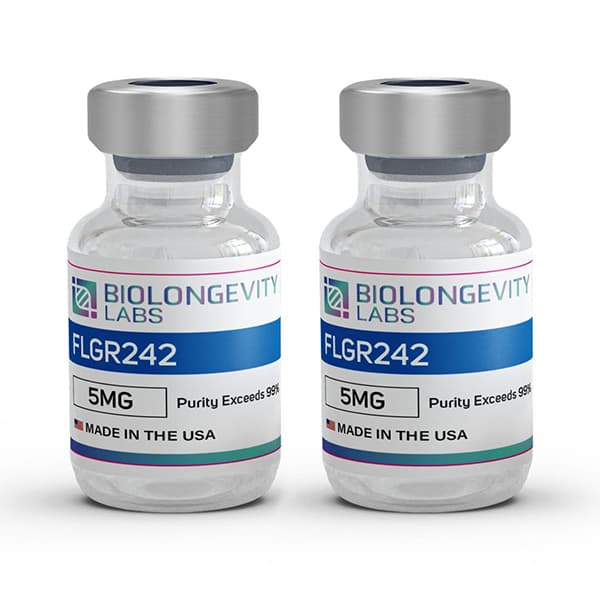
It sells FLGR242 as a 10mg pair — two vials — listed at $499.00, with a single vial at $250.00 and tiered bulk pricing from 5% off at six pairs up to 20% at forty-eight. Purity is stated at 99%+.
Best fit: choose BioLongevity if you want FLGR-242 specifically and want batch-level documentation behind it rather than a bare product listing.
Check FLGR242 at BioLongevity Labs here.
If the goal is muscle, not this specific molecule
Worth saying plainly: everything in the evidence section above still applies. You are buying a compound with no published human data, at $499 for a pair of vials, or $250 for a single, on the strength of a mechanism that has only been demonstrated through a different delivery route.
If what you actually want is lean mass and recovery rather than this particular molecule, Ascension Peptides carries well-characterised alternatives with real human dosing literature behind them — and does not stock FLGR-242 or any myostatin-pathway product, so it is not a like-for-like substitute. The FIT Stack (CJC-1295 No DAC + Ipamorelin) is the closest fit for a growth-oriented protocol, with the Wolverine Stack (BPC-157 + TB-500) covering recovery. Dosing is in our CJC-1295 dosage guide, and the category is ranked in peptides for muscle growth and best peptides for muscle growth.