Another anti-aging peptide made headlines this month.
If you follow longevity news, you've seen the pitch before: clear out the old, broken "zombie" cells and the body works more like it did years ago. SenoMune-0257 (also written SenoMune 0257) is the newest version of that idea. It's a nine-amino-acid peptide from Immorta Bio, picked with the help of AI, and it doesn't kill those cells itself. It's meant to teach your immune system to do it.
🔑 Key Takeaways
- SenoMune-0257 is a vaccine-style idea: a short peptide that points killer T cells at senescent cells, instead of a drug you keep taking.
- Immorta Bio says lab tests went well. Those results haven't been published, so nobody outside the company can check them yet.
- The mouse papers behind it are on a different product, were paid for by the company, and one of them has already drawn a critical letter. What the letter says is in the evidence section.
- Human testing is planned for late 2026. Nothing is registered yet.
- You can't buy it, and the one senolytic peptide you can buy has no human data either.
Below, we'll explain zombie cells in plain English, show how SenoMune-0257 is supposed to work, separate what's published from what's claimed, and put it next to the senolytics that have already been tried in people.
What Is SenoMune-0257?
It's a code name for an experiment.
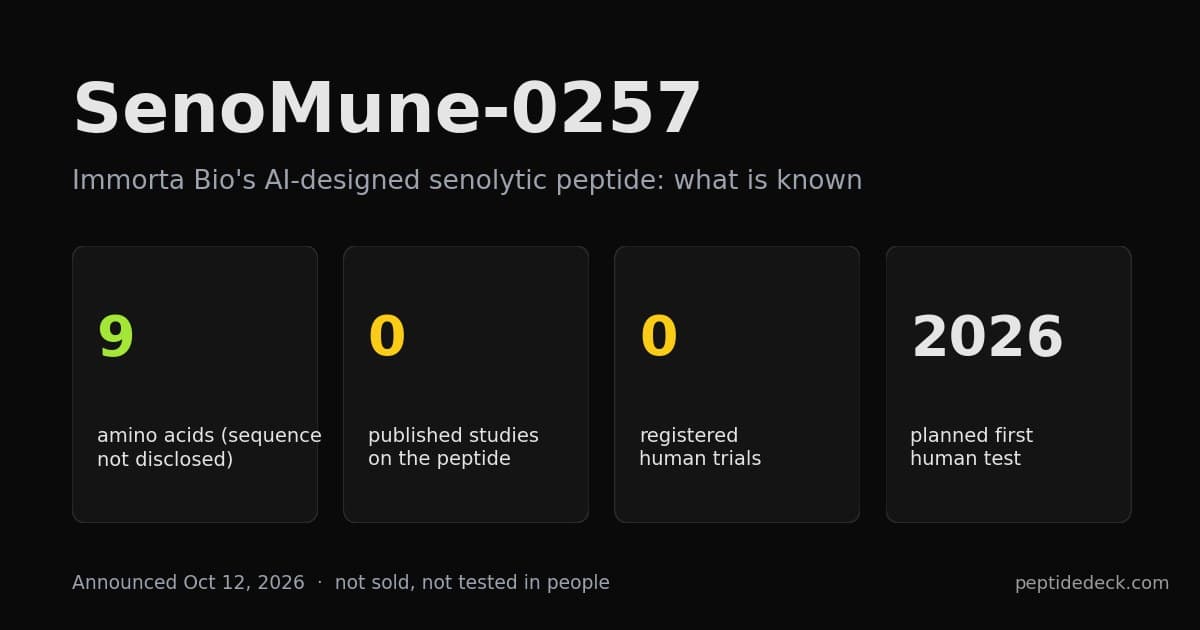
Immorta Bio, a small biotech company in the Miami area, announced SenoMune-0257 on October 12, 2026. The company calls it "an AI-designed peptide immunotherapy developed to restore the immune system's ability to recognize and eliminate senescent cells" (press release).
Here is what the company has disclosed:
- Size: a synthetic peptide of nine amino acids.
- How it was found: AI screening turned up dozens of candidate peptides, and computer analysis plus lab tests narrowed them to one, according to Chief Scientific Officer Thomas Ichim.
- What it should do: stimulate cytotoxic (killer) T cells that, in the company's lab tests, removed senescent cells "while sparing healthy cells under the conditions tested."
- Next step: "clinical entry in 2026, with initial human evaluation anticipated before year-end."
And here is what it hasn't disclosed: the amino acid sequence, which protein on senescent cells it targets, how big the lab tests were, and any numbers from them. Longevity.Technology noted the same gaps, writing that the release "doesn't say whether a regulatory application has been filed, where a trial would take place or how many people would take part" (Longevity.Technology).
Zombie Cells, Explained
Some cells stop dividing but refuse to die.
That's cellular senescence. It's useful in the short term: a damaged cell that stops copying itself can't turn into cancer. The trouble starts when these cells pile up, as they do with age. They release inflammatory signals that wear down the tissue around them.
If your joints, energy or recovery feel older than they used to, this is one of the mechanisms scientists blame. In mice, removing senescent cells extended healthy lifespan (Baker et al., Nature 2016), and the pill combination dasatinib plus quercetin improved physical function and survival in old animals (Xu et al., Nature Medicine 2018). That's why "senolytics", drugs that remove senescent cells, have drawn so much money and attention.
Turning the mouse results into human treatments has been much harder. More on that below.
How SenoMune-0257 Is Supposed to Work
It borrows a trick from cancer vaccines.
Most senolytics are drugs that kill senescent cells directly, which means taking them again whenever the cells build back up. Immorta Bio's bet is different: show the immune system a short piece of a protein that senescent cells carry, and let T cells hunt them down. If that works, the company says, the effect could last, because the immune system keeps a memory of what it has learned to attack.
The company also argues a peptide is cheaper and simpler to make than its earlier approach, which loaded a patient's own immune cells in a lab. A peptide could be made once and shipped "off-the-shelf."
Here's how that compares with the two senolytics people ask us about most:
The immune approach has a real advantage on paper. It also carries a specific risk: senescent cells aren't all harmful, and the immune system doesn't always stop where you want it to. One published letter about Immorta's earlier work pointed out that "the immune damage of physiological sites (e.g. sites of tissue repair) was not investigated" (Xie et al., 2026).
What the Evidence Actually Shows
Everything published is about SenoVax.
The press release says SenoMune-0257 builds on Immorta's published SenoVax work, which it says showed "tumor suppression and substantial survival extension in experimental cancer and accelerated aging models." Two papers in the Journal of Translational Medicine match that description. We read both.
Paper 1: tumors in mice (November 2025)
- What was tested: SenoVax as a cell therapy: dendritic cells (immune "teacher" cells) loaded with material from senescent skin cells. Not a peptide.
- Who: mice with implanted lung, brain, pancreatic and breast tumors, 10 per group.
- What it found: tumors grew less, and the protection carried over when killer T cells were moved into new mice.
- What's missing: the text reports no percentage reductions and no survival data. Senescent cell removal was judged only from blood markers, not by counting cells in tissue.
Paper 2: survival in mice (June 2026)
- What was tested: SenoVax described as "adjuvanted peptides" injected under the skin, alone and combined with stem cells.
- Who: mice given the chemotherapy drug doxorubicin three times a week until death, plus a liver-injury model, 10 per group.
- What it found: with the combination, 50% of mice were alive at day 35 and 20% at day 40. All untreated mice had died by day 30. Liver enzymes fell 58% to 62% with the combination, versus 32% to 40% with either treatment alone.
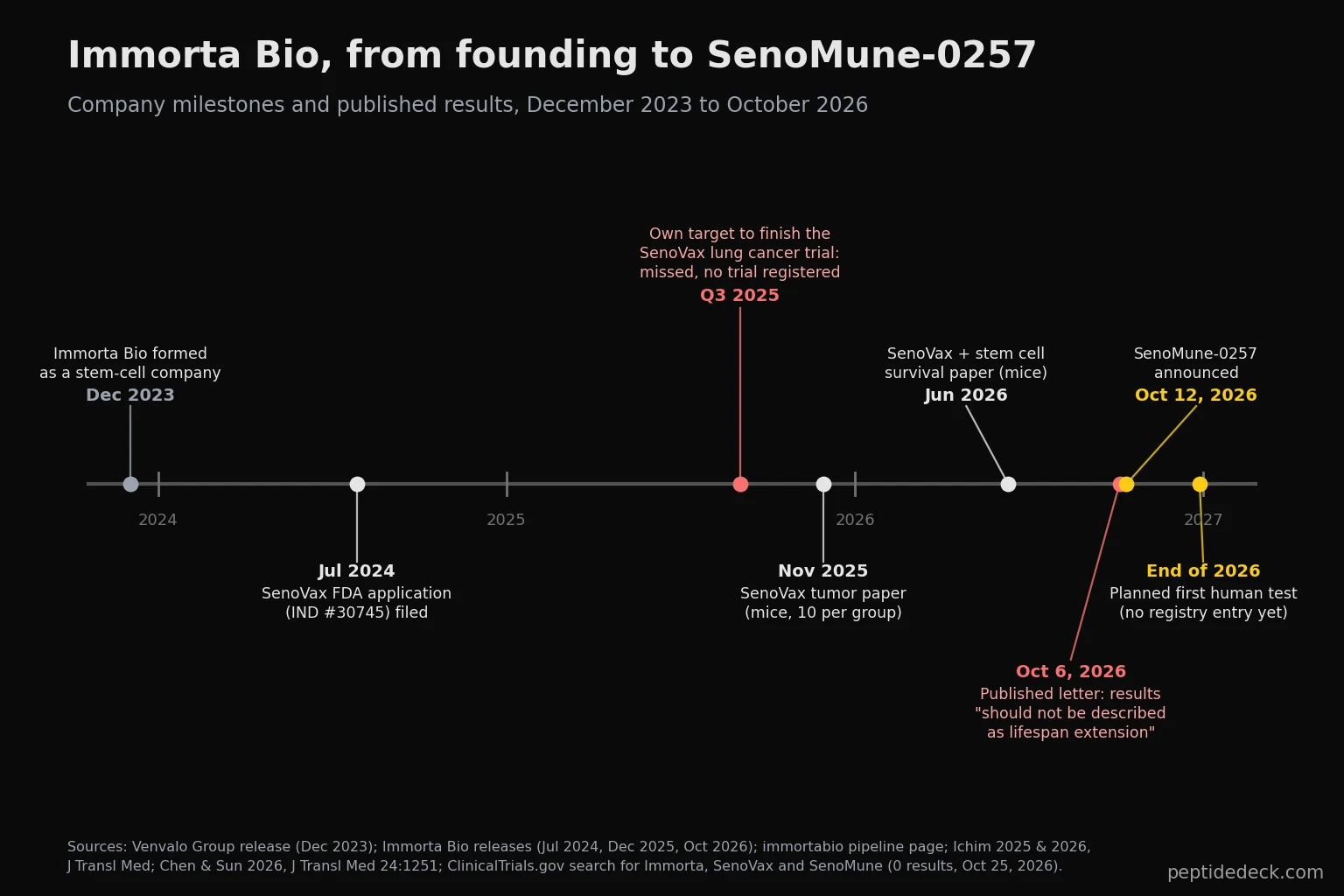
Immorta's June 2026 press release described this as "over 70% lifespan extension in validated aging models" (PR Newswire). Two scientists who wrote to the journal disagreed: "survival during ongoing doxorubicin exposure should not be described as lifespan extension" (Chen and Sun, 2026). They also pointed out that the paper doesn't name the antigens SenoVax targets.
Read this with care: both papers were funded by Immorta Bio, and three authors are listed as the company's managers and shareholders. Each group had 10 mice. Neither paper tested SenoMune-0257, and the two describe SenoVax differently (a cell product in 2025, a peptide formulation in 2026). The 2026 paper's own authors note that senescent cells were never counted directly. None of this means the results are wrong. It means they haven't been checked by anyone independent yet.
Has SenoMune-0257 Been Tested in People?
No, and the timeline has slipped before.
Immorta filed an Investigational New Drug application with the FDA for SenoVax in July 2024 (IND #30745), aimed at a first trial in advanced lung cancer (PR Newswire). Its pipeline page set a goal to "complete the associated Phase I/IIa trial by Q3 2025." In December 2025 the company said it was still "completing the required GMP manufacturing run to enable initiation."
We searched ClinicalTrials.gov for SenoMune, SenoVax and Immorta on October 25, 2026 and found nothing. We found no announcement of an FDA application for SenoMune-0257 either.
Money matters for a trial, too. SEC filings show Immorta had raised $612,503 of a planned $5 million offering as of October 16, 2026, and earlier $450,000 from three investors (SEC Form D). Both filings list no revenue. That is small for drug development, though early-stage companies often raise more once a trial is cleared.
What Happened When Other Senolytics Reached People
The track record is humbling.
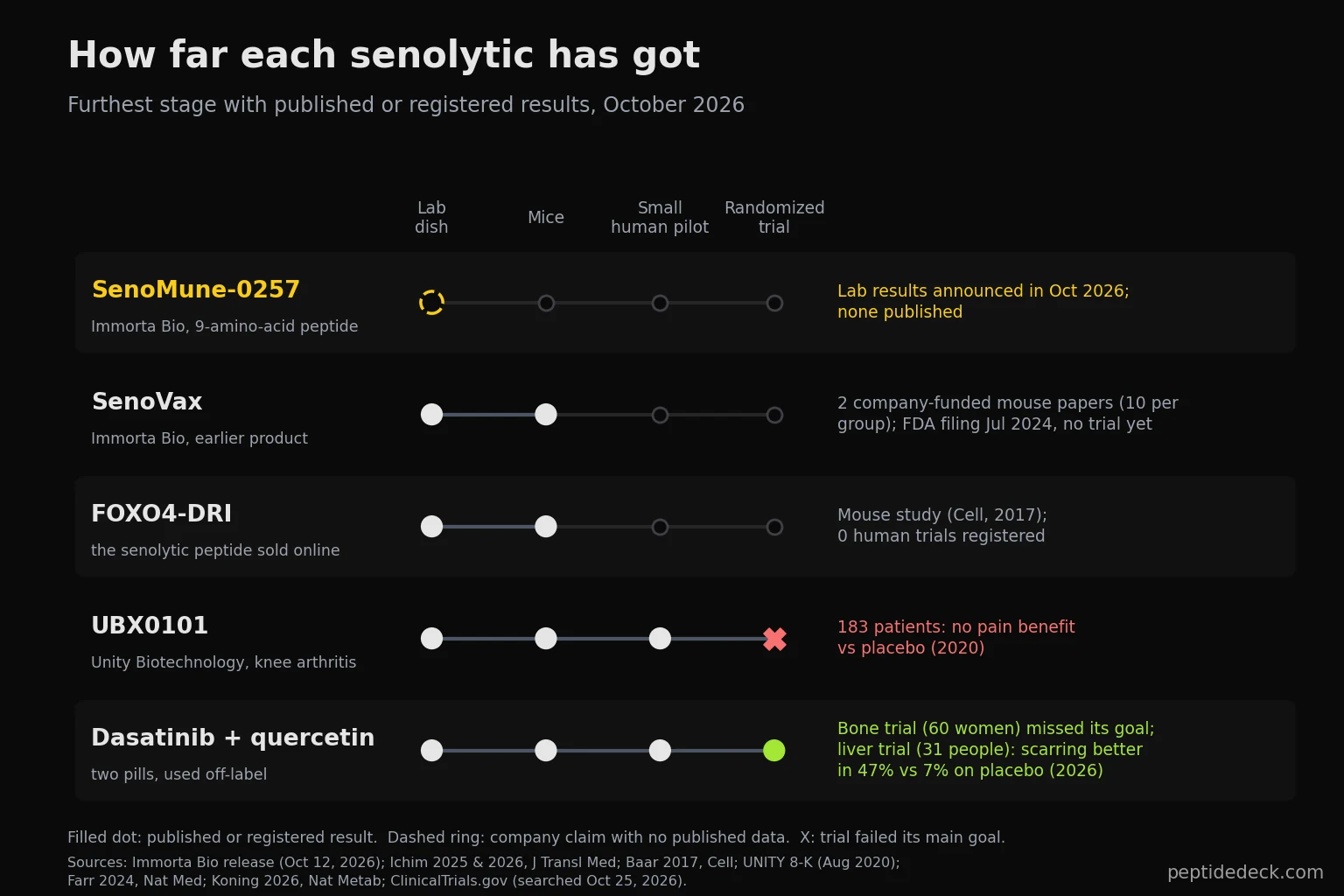
Clearing senescent cells looked spectacular in mice. In people, the results so far are mixed: one clear failure, one miss, one small pilot and one recent win.
The pattern matters for SenoMune-0257. Even drugs that clearly kill senescent cells in mice have struggled to show a benefit people can feel. A first human study of SenoMune-0257 would mainly test whether it's safe and whether it triggers the intended immune response. Whether it helps any disease would take years more.
Can You Buy SenoMune-0257?
No.
Immorta Bio hasn't sold or licensed it, and we found no vendor listing it. If a site offers "SenoMune-0257" before the sequence is even public, ask what is actually in the vial.
Watch out for a name clash too. "Senomune" is also an Amorepacific skincare ingredient made from green tea roots and sold in IOPE products (SpecialChem). It has nothing to do with Immorta's peptide.
The only senolytic peptide you can buy today is FOXO4-DRI. It's a different design: it acts on senescent cells directly instead of training T cells, and its main evidence is a 2017 mouse study in Cell (Baar et al.). There are no FOXO4-DRI trials on ClinicalTrials.gov. If you are comparing FOXO4-DRI for sale, go in knowing it is a mouse-stage peptide with no human dosing data; our FOXO4-DRI guide covers what the mouse work showed. PeptideDeck may earn a commission from vendor links on this page.
What to Watch for Next
Five things would make SenoMune-0257 easier to judge.
If you want the wider picture of how senolytics fit with other anti-aging approaches, see our anti-aging peptides by mechanism breakdown. For another AI-designed peptide that's still at the mouse stage, our HM500197 explainer walks through a similar gap between announcement and evidence.
Frequently Asked Questions
Sources
- Immorta Bio. Immorta Bio pioneers AI-designed senolytic immunotherapy targeting diseases of aging. Press release, October 12, 2026. PR Newswire
- Ichim TE, Bykoriz V, Rath A, Lopes G, et al. Reduction of solid tumors by senescent cell immunization. J Transl Med. 2025;23:1365. PMID 41316207. Full text
- Ichim TE, et al. Synergistic senolytic-regenerative therapy significantly extends healthspan and lifespan. J Transl Med. 2026;24:745. PMID 42260530. Full text
- Chen W, Sun X. Treatment benefit does not establish senolysis or lifespan extension. J Transl Med. 2026;24:1251. PMID 42839247. Full text
- Xie J, et al. Letter to the editor: clinical translation of senolytic immunotherapy: critical considerations for SenoVax. J Transl Med. 2026;24:196. PMID 41689043. Full text
- Immorta Bio. Immorta Bio files Investigational New Drug application for first-in-class senolytic immunotherapy SenoVax for treatment of advanced lung cancer. Press release, July 2024. PR Newswire
- Immorta Bio. Immorta Bio reports reduction of tumors in validated models of lung, brain, pancreatic and breast cancers using SenoVax. Company news, December 2025. immortabio.com
- Immorta Bio. Pipeline page (archived site). immortabio.webflow.io
- Immorta Bio's nine-amino-acid peptide aims at zombie cells. Longevity.Technology, October 2026. Longevity.Technology
- ClinicalTrials.gov searches for "SenoMune", "SenoVax" and sponsor "Immorta" (0 results, October 25, 2026). ClinicalTrials.gov
- U.S. SEC. Immorta Bio, Inc. Form D filings, January 8 and October 16, 2026. SEC EDGAR
- Baker DJ, Childs BG, Durik M, et al. Naturally occurring p16Ink4a-positive cells shorten healthy lifespan. Nature. 2016;530:184-189. PMID 26840489. PubMed
- Xu M, Pirtskhalava T, Farr JN, et al. Senolytics improve physical function and increase lifespan in old age. Nat Med. 2018;24:1246-1256. PMID 29988130. PubMed
- Baar MP, Brandt RMC, Putavet DA, et al. Targeted apoptosis of senescent cells restores tissue homeostasis in response to chemotoxicity and aging. Cell. 2017;169(1):132-147. PMID 28340339. PubMed
- Unity Biotechnology. UBX0101 phase 2 12-week results, exhibit 99.1 to Form 8-K, August 17, 2020. SEC EDGAR
- Justice JN, Nambiar AM, Tchkonia T, et al. Senolytics in idiopathic pulmonary fibrosis: results from a first-in-human, open-label, pilot study. EBioMedicine. 2019;40:554-563. PMID 30616998. PubMed
- Farr JN, Atkinson EJ, Achenbach SJ, et al. Effects of intermittent senolytic therapy on bone metabolism in postmenopausal women: a phase 2 randomized controlled trial. Nat Med. 2024;30:2605-2612. PMID 38956196. PubMed
- Koning M, et al. Senolytics dasatinib and quercetin in metabolic dysfunction-associated steatohepatitis: a proof-of-principle randomized trial. Nat Metab. 2026. PMID 42823536. PubMed
- Thomas Ichim (@exosome), post on X, October 17, 2026. X
- SpecialChem. Senomune by Amorepacific (cosmetic ingredient). SpecialChem
Medical Disclaimer: This content is for informational purposes only and does not constitute medical advice. SenoMune-0257 is an experimental compound that has not been tested in humans and has no FDA approval. Always consult a qualified healthcare provider before starting any new medication or treatment. PeptideDeck may earn a commission from affiliate links at no additional cost to you.