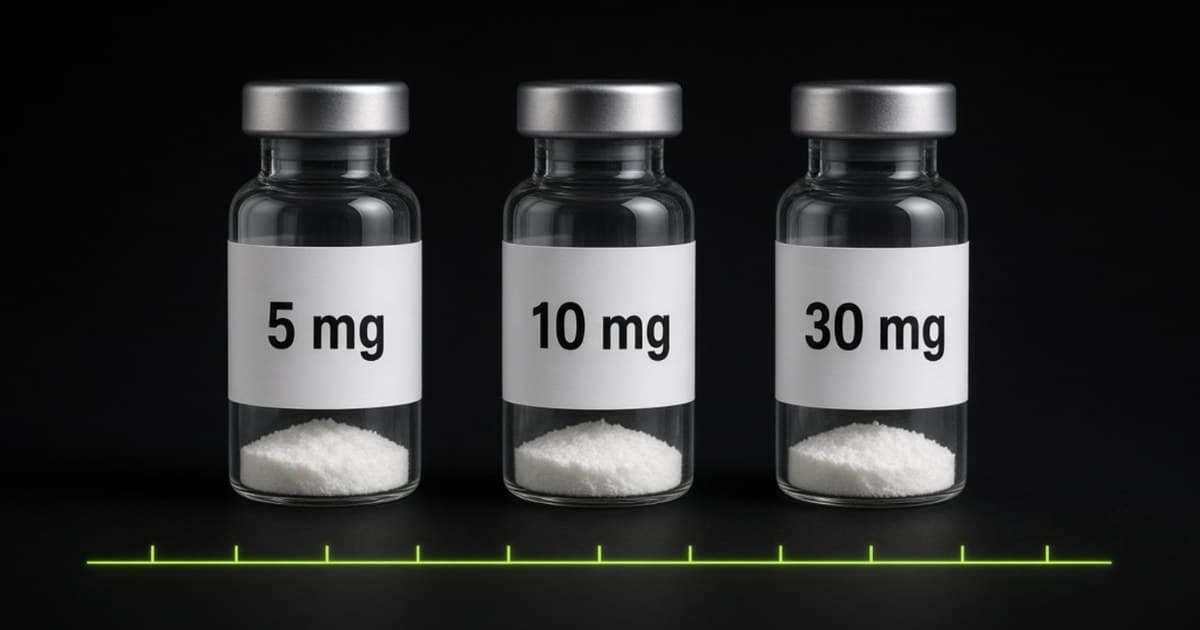
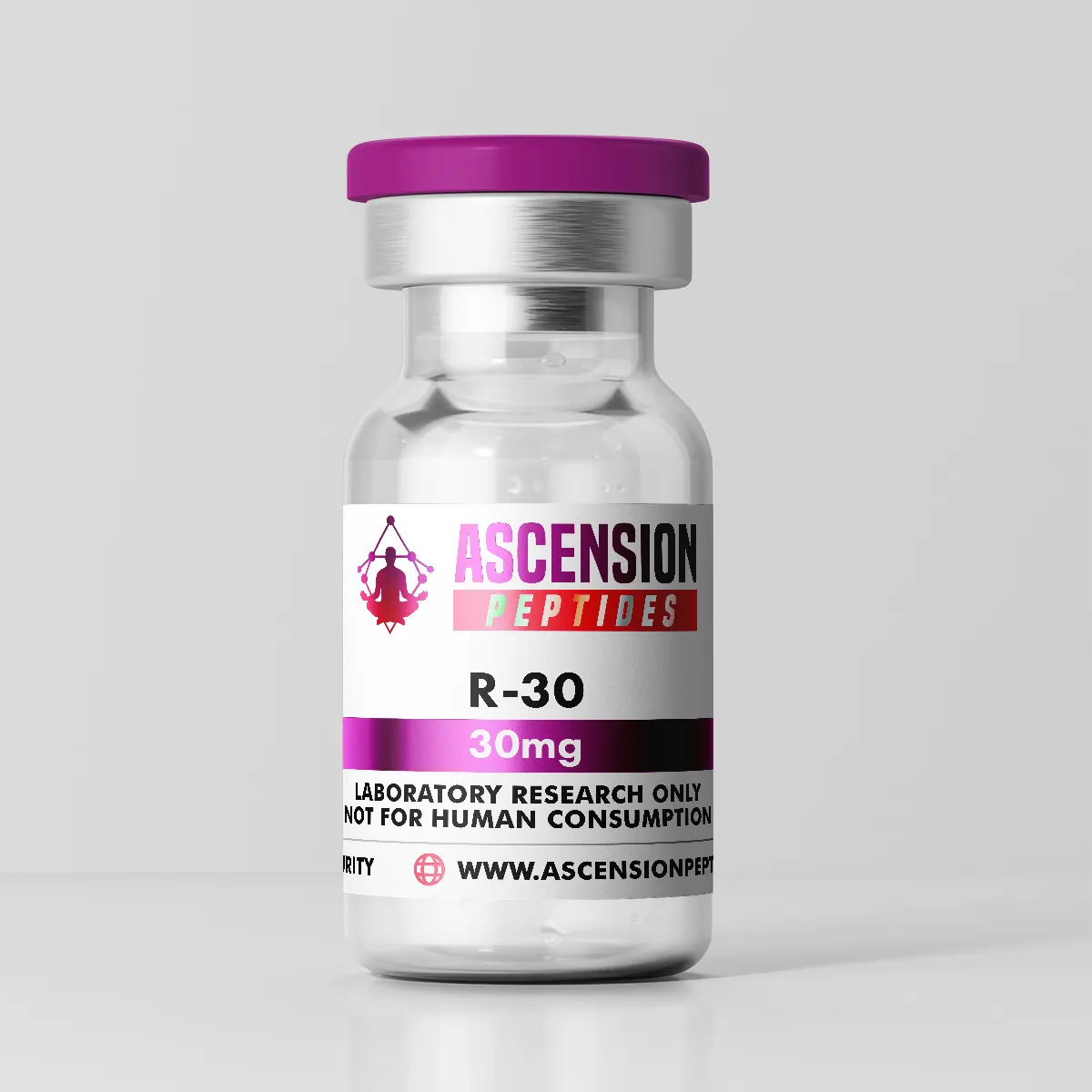
Three numbers on three vials. Only one of them is your dose.
If you have searched "retatrutide 10mg", you are probably holding a product page with a 10mg vial, a 30mg vial and maybe a 5mg one. You want to know which to buy, how to mix it and how long it lasts. That is the right order to ask in. A retatrutide 10mg vial holds ten milligrams in total, which is five weeks of the usual 2mg starting dose, not one injection.
🔑 Key Takeaways
- The milligrams on the label describe the vial, not the shot. Mixing that up is the one mistake that can hurt you.
- The 30mg vial is cheaper per milligram. In the first two months it can still cost you more.
- A 4-week clock starts the day you add water, and it decides which size makes sense at each dose.
- The units you draw depend on how much water you add. The charts below cover every common mix.
- Most people end up buying both sizes, at different points in the same plan.
Below: what each vial size means, the water and units for a retatrutide 10mg vial, a 30mg vial and the 5mg vials some sellers list, how long each lasts at every dose, and a 16-week cost plan that shows when each size wins.
Retatrutide 10mg means the vial, not the dose
Every size you see is a vial size. A retatrutide peptide 10mg vial is freeze-dried powder that you dissolve in bacteriostatic water and draw out a little at a time, once a week.
The doses that were tested are much smaller than any vial. In the phase 2 trial, 338 adults took retatrutide once a week for 48 weeks. The 12 mg group started at 2 mg and stepped up every four weeks, through 4 mg and 8 mg, and lost an average of 24.2% of body weight against 2.1% on placebo (Jastreboff et al., NEJM 2023). In the phase 3 TRIUMPH-1 trial, 2,339 adults started at 2 mg and climbed every four weeks to 4, 9 or 12 mg (Eli Lilly, May 21, 2026).
So the highest weekly dose anyone has studied is 12 mg. Injecting a whole 10mg vial at once would be five times the starting dose. If the numbers on retatrutide labels still blur together, our explainer on which retatrutide numbers are doses and which are vial sizes untangles them one by one.
Retatrutide 10mg vial: water, units and how long it lasts
The 10mg vial suits the first month.
At 2 mg a week you use 8 mg in four weeks, which fits inside one vial with 2 mg to spare. That matters because of the 4-week clock covered further down. The table shows how many units to draw on a standard U-100 insulin syringe, where 100 units equal 1 mL.
Two millilitres of water is the most common mix for a retatrutide 10mg vial. It gives 5 mg/mL, so a 2 mg dose is 40 units, an easy line to read. One millilitre halves the units, which is handy at 4 mg and above but makes small doses harder to measure accurately.
Above 4 mg a week the 10mg vial stops making sense. At 8 mg it lasts nine days, and at 12 mg it doesn't cover a single week. For the step-by-step mixing itself, use our retatrutide reconstitution guide; for the injection, the guide on how to inject retatrutide covers sites, syringes and timing.
Retatrutide 30mg vial: water, units and how long it lasts
The 30mg vial is built for the higher doses.
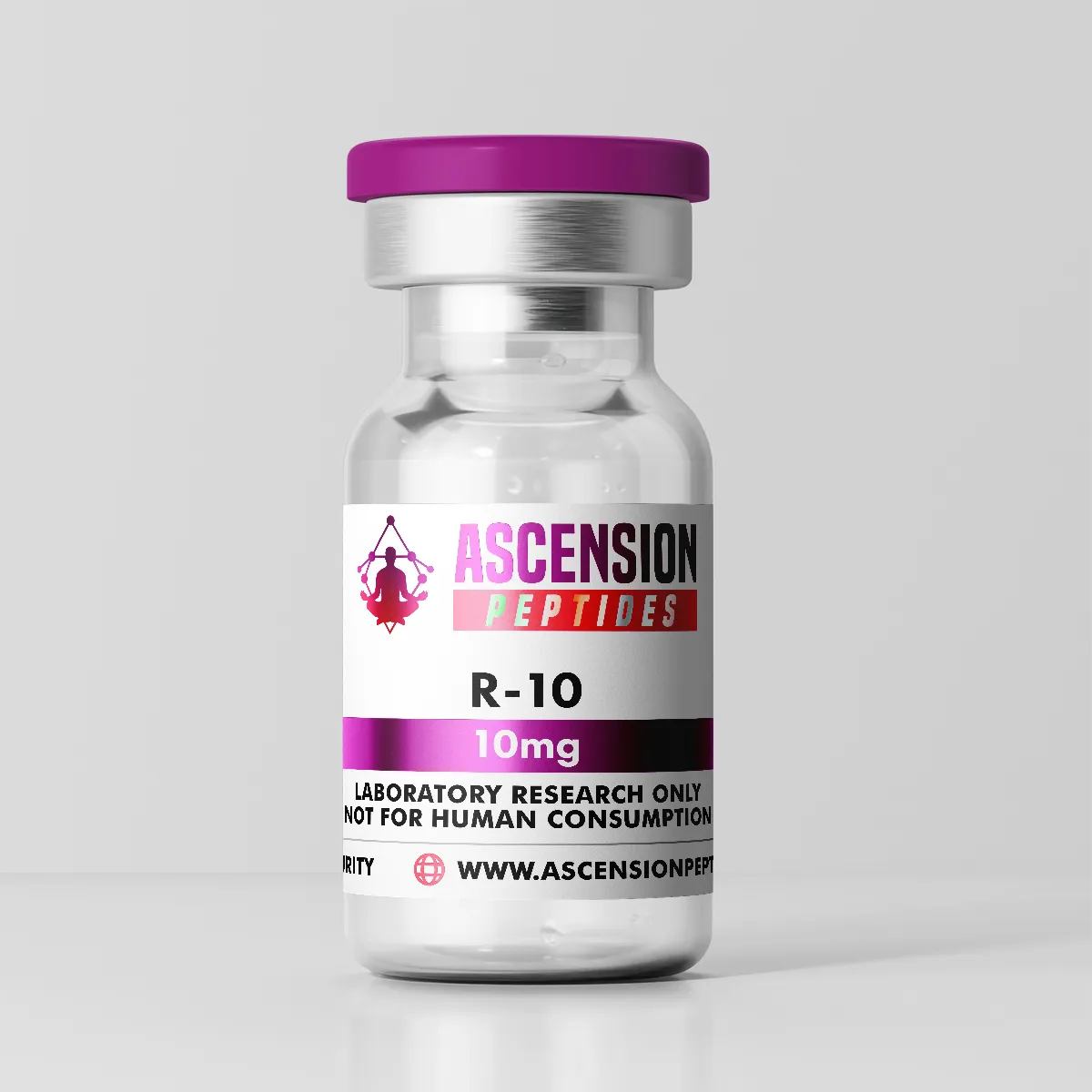
At 8 mg a week it lasts 3.75 weeks, close to the full four-week window. At 12 mg it lasts two and a half weeks. Both R-10 and R-30 come in a 3 mL vial, so 3 mL is the most water you can add.
Three millilitres gives 10 mg/mL, the easiest maths of any mix: 1 mg is 10 units. The catch is the 12 mg dose, which is 120 units and won't fit in a 1 mL syringe. Mixing with 2 mL instead makes the solution stronger, so 12 mg is 80 units in one draw. The trade-off is fiddly readings at 2 mg (13.3 units), which is one more reason the 30mg vial belongs later in the plan.
Not sure which mix you have? The retatrutide dosage calculator converts any vial, water volume and dose into syringe units.
Retatrutide peptide 5mg vials: who they are for
Some sellers still list a 5mg vial.
It covers two and a half weeks at 2 mg and barely over one week at 4 mg, so you mix a new vial every couple of weeks. That means more needles through more stoppers, more water to buy and usually the highest price per milligram. Ascension, whose code we use on this page, doesn't sell a 5mg retatrutide vial at all.
The one case for a 5mg vial is someone who plans to stay at 1–2 mg a week and wants nothing left over. For everyone else, the 10mg vial does the same job for longer.
How long each vial lasts, and the 4-week clock
Here is where the cheaper vial gets expensive.
Once you add water, the clock starts. Mixing guides, including ours, treat a mixed vial as good for about four weeks in the fridge (2–8 °C). That figure is the standard 28-day beyond-use date for opened multi-dose vials in USP chapter 797. Retatrutide itself has no published stability data in solution, so nobody can promise a longer shelf life.
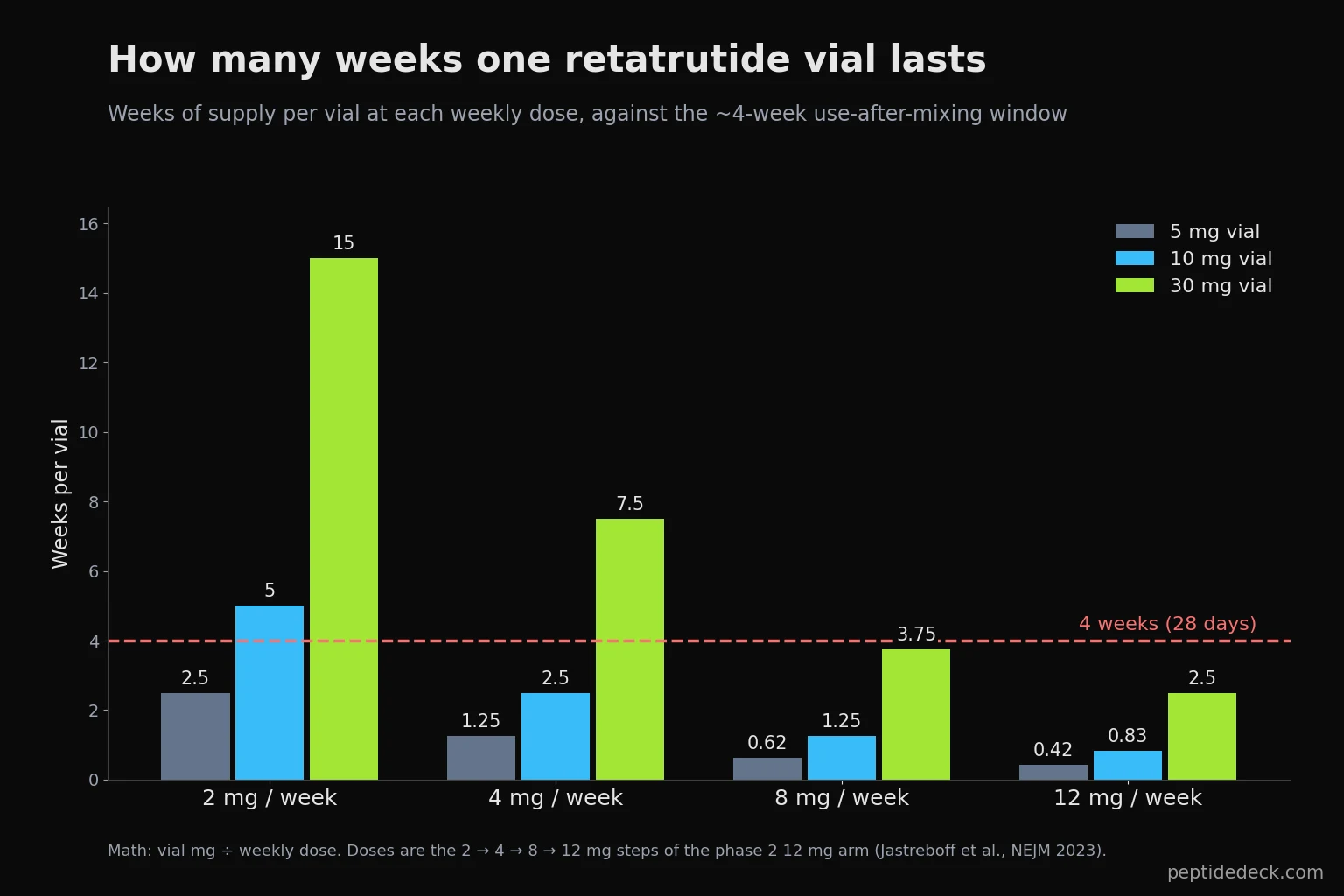
Read the 2 mg column. A 30mg vial holds 15 weeks of supply, but you would be expected to throw it out after four. That is 22 mg in the bin, about $92 of a $125 vial. At 8 or 12 mg the 30mg vial empties inside the window, and its lower price per milligram finally pays off.
Retatrutide 10mg vs 30mg vial: price per mg and per week
Per milligram, the bigger vial wins.
We checked Ascension's prices on October 23, 2026: R-10 lists at $100 and R-30 at $250. Code PEPTIDEDECK takes 50% off both at checkout. Prices change, so check the product page before you order.
That is the whole price story if you could finish every vial. You can't always, so we modelled a full 16 weeks on the phase 2 ladder: 2 mg for weeks 1–4, 4 mg for weeks 5–8, 8 mg for weeks 9–12 and 12 mg for weeks 13–16. That adds up to 104 mg. Each vial is mixed when the last one runs out and thrown away 28 days after mixing.
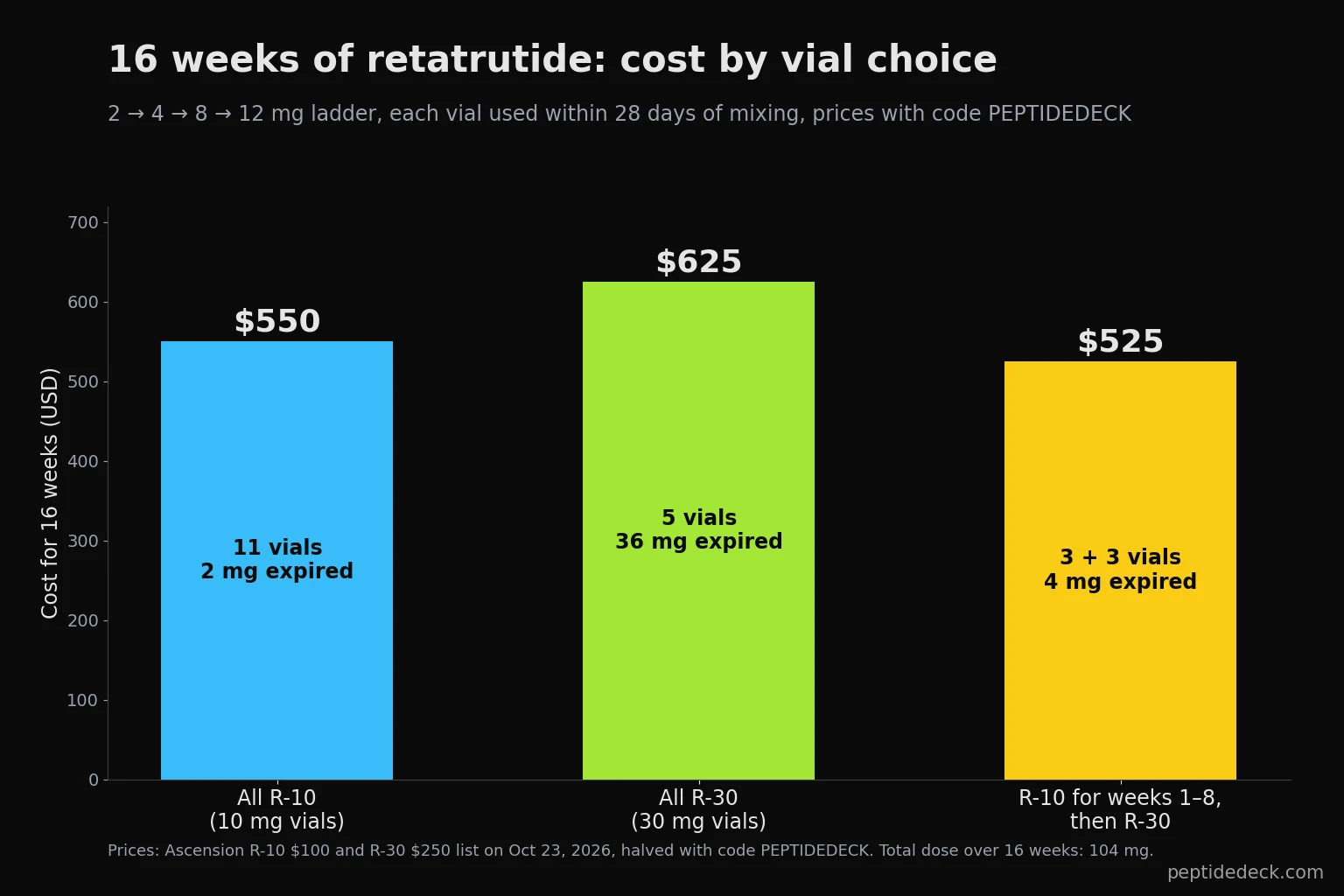
Buying only 30mg vials is the most expensive plan here, because the low doses waste most of the first two vials. Starting on 10mg vials and switching to 30mg vials at the 8 mg step is cheapest, and it carries 12 mg into week 17. If you are comparing retatrutide for sale across sellers, the per-milligram price is only half the comparison. The other half is how much of each vial you'll actually use.
The honest caveat. This model leans on the 28-day rule. Many people keep a mixed vial longer, and with no stability data for retatrutide nobody can say whether that loses potency. If you would use a 30mg vial past four weeks anyway, it is the cheapest choice from day one. We would not plan around that, because a weaker dose is something you can't see.
Which vial to buy at each step
Match the vial to the dose you are on now.
- Weeks 1–4 (2 mg): one 10mg vial. Mixed with 2 mL, every dose is 40 units, with 2 mg spare for a mistake.
- Weeks 5–8 (4 mg): 10mg vials still fit, about two of them. A 30mg vial would be only half used by the 4-week mark.
- Week 9 onward (8–12 mg): 30mg vials. One covers 3.75 weeks at 8 mg and 2.5 weeks at 12 mg, inside the window either way.
- Staying at a low maintenance dose: 10mg vials, for the same reason as month one.
Ascension sells both sizes as R-10 and R-30, and code PEPTIDEDECK applies to each. PeptideDeck earns a commission on purchases through these links, at no extra cost to you.
What to check before you mix any vial
The label is a claim. The lab report is the evidence.
Retatrutide has no FDA approval. Eli Lilly plans to file for it in early 2027, and the FDA says it cannot legally be compounded (FDA, unapproved GLP-1 drugs page). Every vial sold online is therefore unregulated. In October 2026, CBS News reported that the FDA had received reports of two deaths linked to products sold as retatrutide; the reports don't prove the drug was the cause (CBS News, October 13, 2026).
- A batch-matched lab report. The lot number on your vial should match the one on the report. Ascension's current R-30 batch tested at 99.832% purity, with 32.43 mg of retatrutide in a 30 mg vial (Kovera Labs). We haven't seen a published report for the current R-10 batch, which is a real gap; ask for it before you buy.
- Measured content, not just purity. A 99% pure vial holding 7 mg is still a short 10mg vial. Look for an mg figure.
- Identity testing. The report should confirm the molecule by mass spectrometry, not purity alone.
- A price that makes sense. 30mg vials far below the going rate are the ones most likely to be under-filled or mislabelled.
For the bigger picture on risks, read is retatrutide safe. It covers the trial side effects and what the gray market adds.
Frequently asked questions
Sources
- Jastreboff AM, et al. Triple-Hormone-Receptor Agonist Retatrutide for Obesity: A Phase 2 Trial. N Engl J Med. 2023;389:514-526. PMID 37366315. Funded by Eli Lilly.
- Eli Lilly and Company. Lilly's triple agonist, retatrutide, delivered powerful weight loss in pivotal Phase 3 obesity trial (TRIUMPH-1). May 21, 2026. investor.lilly.com
- Lilly Medical Information. What are the results of retatrutide from TRIUMPH-1? (study design: 2 mg start, 4-week escalation). medical.lilly.com
- U.S. Food and Drug Administration. FDA's concerns with unapproved GLP-1 drugs used for weight loss. fda.gov
- United States Pharmacopeia. General Chapter <797> Pharmaceutical Compounding: Sterile Preparations (28-day beyond-use date for opened multi-dose containers).
- Gilbert D. Two deaths were reported to the FDA. Is the bootleg weight-loss drug "Reta" to blame? CBS News, October 13, 2026. cbsnews.com
- Ascension Peptides product pages for R-10 and R-30 (price, 3 mL vial size), checked October 23, 2026; Kovera Labs certificate of analysis for the current R-30 batch.
Medical Disclaimer: This content is for informational purposes only and does not constitute medical advice. Retatrutide has no FDA approval and is still being studied in clinical trials; the doses above describe what those trials tested, not a recommendation for you. Always consult a qualified healthcare provider before starting any new medication or treatment. PeptideDeck may earn a commission from affiliate links at no additional cost to you.