AMCP is a new peptide aimed at acne. On October 11, 2026, a team from Jiangnan University in China published it in Scientific Reports: a 28-amino-acid peptide closed into a ring. In lab dishes it cut fat production in oil-gland cells by up to 40%, killed the acne bacterium at 0.5 µg/mL, and switched off up to 96% of the inflammation signals that make a spot red and sore (Yu et al., Sci Rep 2026). No published trial has tested it on acne in people yet.
🔑 Key Takeaways
- The four acne problems AMCP hit in one go, and the one it hit weakest.
- Why a ring-shaped peptide may last on skin when most "acne peptides" break down.
- Who paid for the study, and the skincare ingredient name you are most likely to see on a label.
- A number in the paper that does not add up. We checked the chemistry ourselves.
- What works for acne right now, matched to the same four problems.
If your acne has outlasted your teens, you know the cycle. Antibiotics clear it, then clear it a little less each round. Retinoids work, but your skin peels and stings. Benzoyl peroxide bleaches your pillowcases. So when a headline promises one ingredient that does everything without those trade-offs, it is worth reading closely. This page goes through what AMCP is, what it did in the lab, who stands behind it, and what you can use today while you wait.
What is AMCP peptide?
AMCP stands for antimicrobial cyclic peptide. (If peptides are new to you, our what are peptides explainer covers the basics.) It names a type of molecule, not a brand, but in 2026 the phrase "AMCP peptide" mostly points to one molecule: the acne peptide described in the Jiangnan paper.
The facts the paper gives (preprint, June 18 2026):
- Sequence: 28 amino acids, CEWYNISCQLGNKGQWCTLTKECQRSCK, including five cysteines.
- Size: 3,310.80 Da, formula C139H217N41O43S5. That is about eight times the weight of GHK-Cu.
- Supplier: Sinagri Yingtai Bio-Peptide Co. in Henan, China.
- Intended use: a topical acne ingredient for skincare, applied to the skin. It is not designed to be injected or swallowed.
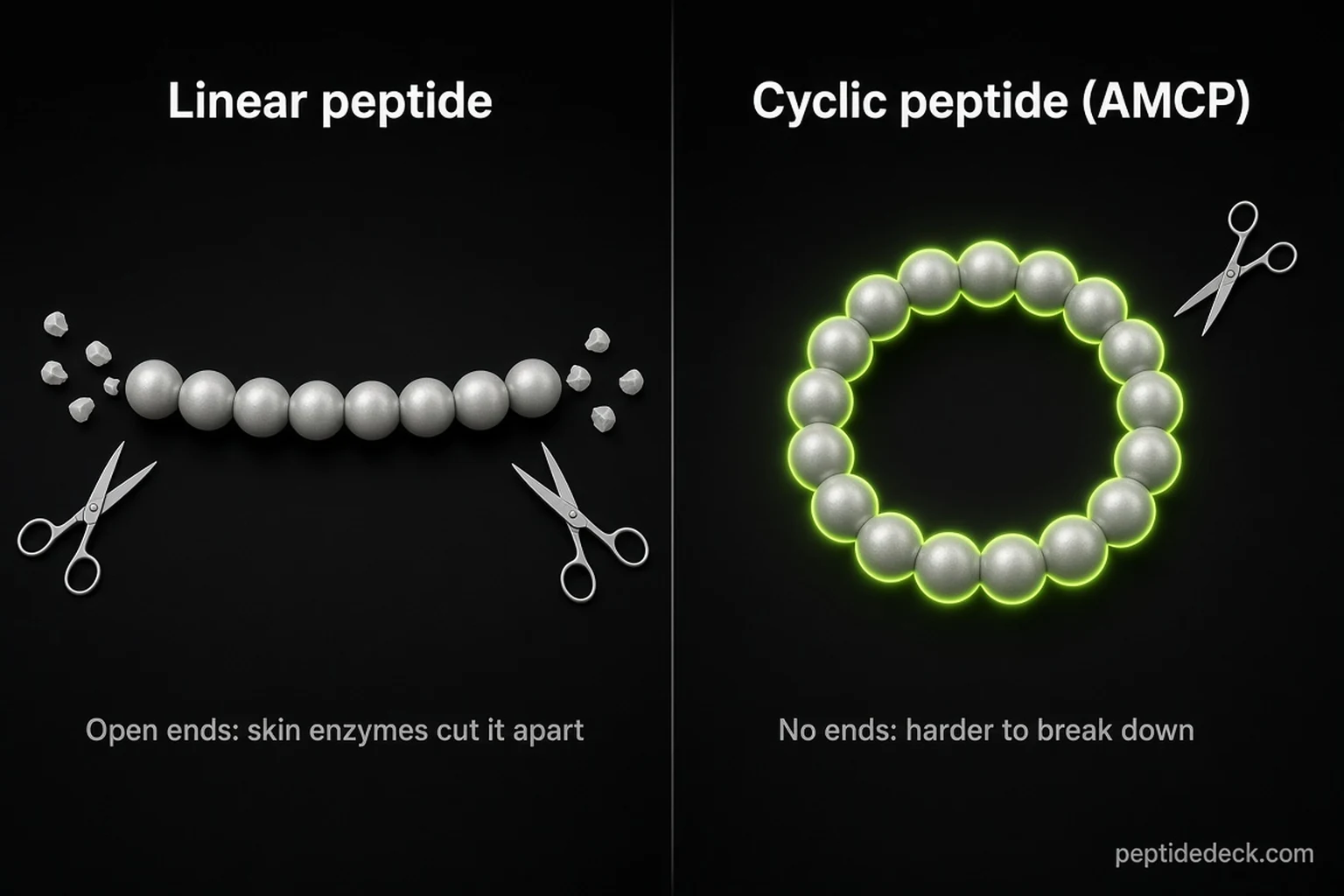
The word that matters is cyclic. Most antimicrobial peptides are open chains, and skin is full of enzymes that chew peptides from their loose ends. A ring has no loose ends. The authors argue this makes AMCP more stable than the linear peptides most acne skincare uses today. They point to daptomycin, a ring-shaped antibiotic used in hospitals, as proof the design can work.
Searching "AMCP" and getting chemistry papers? Two other things share the name. Fmoc-AMCP-OH is a protected aminomethyl-cyclopentane carboxylic acid, a building block chemists use to stiffen synthetic peptides. And the Academy of Managed Care Pharmacy is a US pharmacists' association. Neither has anything to do with acne. If a chemical supplier lists "AMCP", it is the building block, not this peptide.
The acne problem AMCP is trying to solve
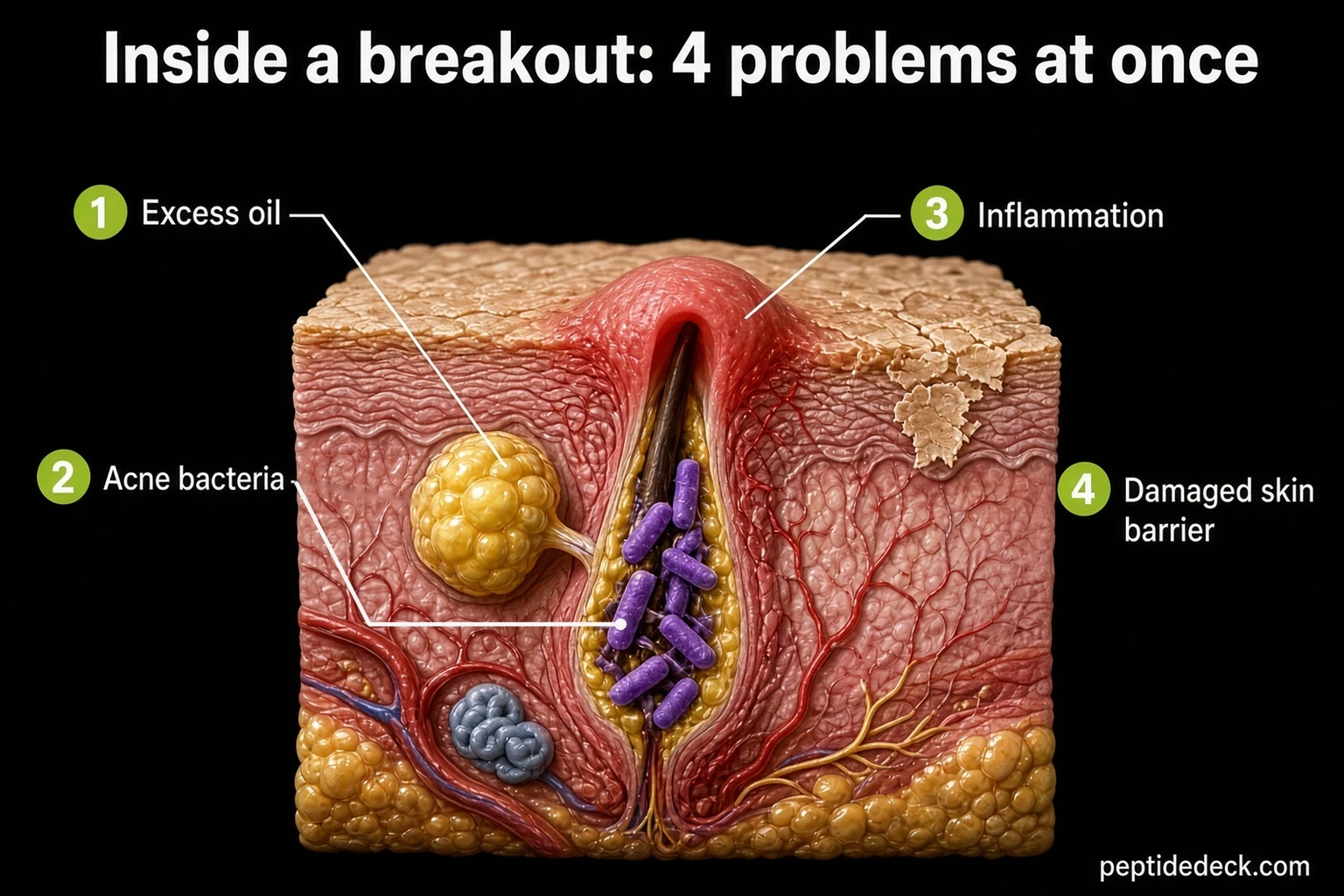
Acne is never just one thing. About 9.4% of people worldwide have it at any time, making it the eighth most common disease on the planet (Tan & Bhate 2015). Every breakout runs on four problems at once:
- Too much oil. Hormones, mostly DHT, push oil glands into overdrive.
- Bacteria. Cutibacterium acnes feeds on that oil inside the blocked pore, and Staphylococcus aureus can move into damaged spots.
- Inflammation. Skin cells release signals like IL-8 and TNF-α, and that is what turns a blocked pore into a red, sore bump.
- A broken barrier. Inflamed skin loses its tight outer layer, which makes the next breakout easier.
Most treatments hit one or two of these. Antibiotics target the bacteria, but the bacteria are adapting. A 2025 pooled analysis of 2,046 C. acnes samples found 22% resistant to clindamycin and 29% to erythromycin, two of the most prescribed acne antibiotics (Zhu 2025). A 2024 analysis of 39 studies put clindamycin resistance much lower, at 3.1% (Beig 2024), so the rate depends on where you live and how the lab tests. Either way, the direction is the same, and the 2024 US acne guidelines tell doctors to limit antibiotic use and combine treatments that work in different ways (AAD guidelines 2024).
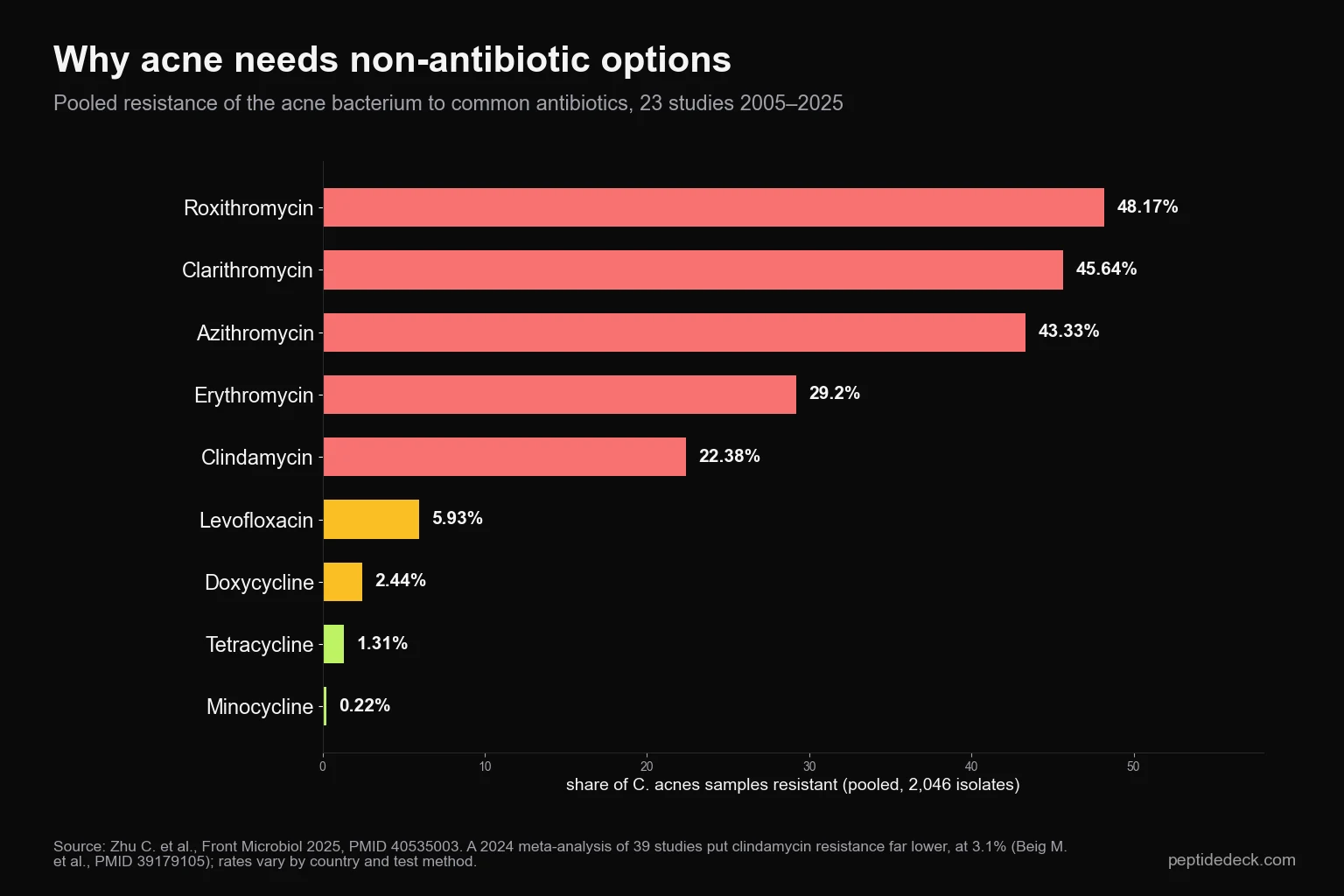
That is the gap AMCP is aimed at: one ingredient that works on all four problems, kills bacteria without being an antibiotic, and doesn't burn like a retinoid. So did it?
What AMCP did in the lab, problem by problem
Short answer: it did something on all four. The tests used immortalised human skin cells (HaCaT keratinocytes), human oil-gland cells (SZ95 sebocytes), two bacteria, and pig skin. Every cell result is the average of three cultures.
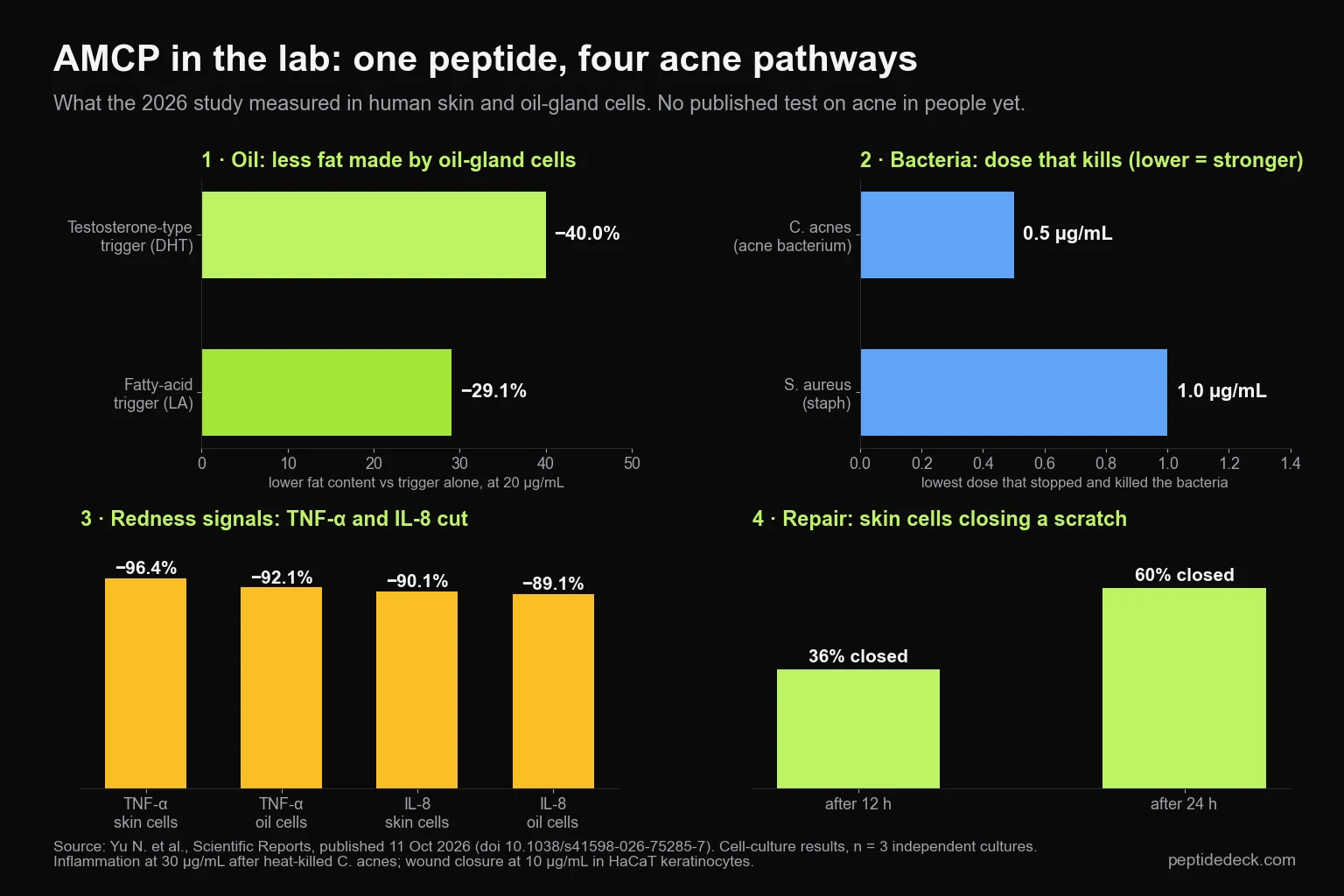
1. Oil: up to 40% less fat made
The team pushed oil-gland cells to overproduce with DHT, the hormone behind most adult acne, or with linoleic acid, a fatty acid. At 20 µg/mL, AMCP lowered the fat inside the cells by 40.0% in the DHT test and 29.1% in the fatty-acid test. If your skin is shiny by noon, this is the result that speaks to you. It is also the one furthest from proof, because fat inside cells in a dish is not oil on a face.
2. Bacteria: killed at 0.5 µg/mL
Against C. acnes, the lowest dose that stopped growth and the lowest that killed it were the same, 0.5 µg/mL. For S. aureus both were 1.0 µg/mL. When the stopping and killing doses match, the peptide is killing the bacteria, not just slowing them down. For comparison, five peptides designed by AI against C. acnes in a 2024 study needed 2 to 4 µg/mL (Dong 2024). That study ran in a different lab with different strains, so treat the comparison as rough.
3. Redness: inflammation signals cut 33% to 96%
To copy an angry spot, the team exposed cells to heat-killed acne bacteria, then added AMCP at 30 µg/mL. Gene sequencing of the inflamed skin cells (data in a public archive, BioProject PRJNA1473534) pointed to the NF-κB, MAPK and IL-17 inflammation pathways. The protein numbers below are where you'd see it.
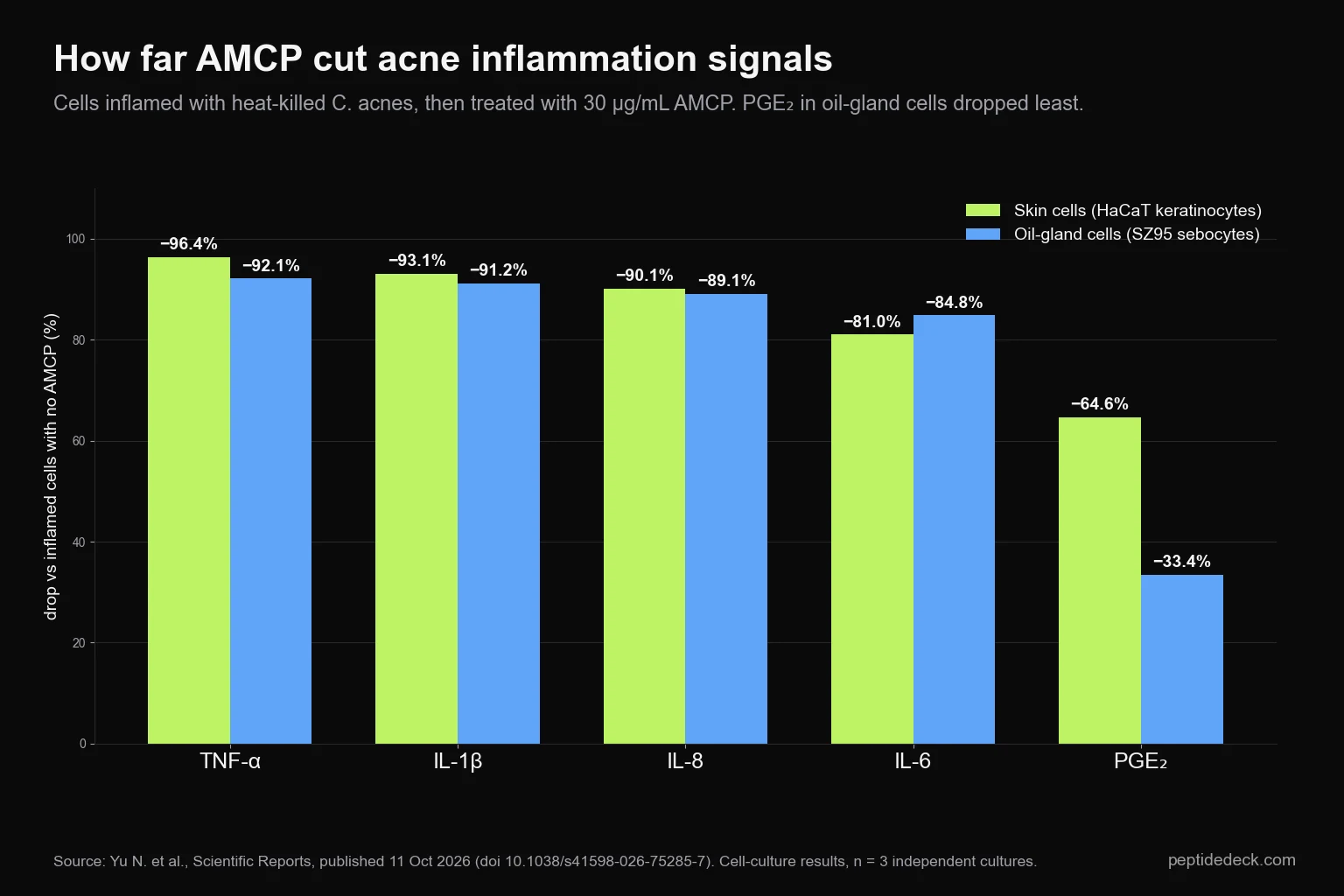
The weak spot is PGE2 in oil-gland cells, which fell only 33.4%. PGE2 helps drive both swelling and oil output, so of the four problems, the oil-gland side of inflammation is where AMCP did least.
4. Repair: the scratch closed faster
In a scratch test on skin cells, 10 µg/mL AMCP closed 35.7% of the gap by 12 hours and 60.0% by 24 hours, both faster than untreated cells. Barrier genes moved the right way too: filaggrin, involucrin, claudin-1 and keratin-1 went up, and KLK7, an enzyme that loosens the outer layer, went down 27%. If your skin stays raw and flaky long after the spot is gone, this is the part that is meant for you.
Does AMCP work on real skin?
Nobody has shown that yet. The closest the paper gets is pig skin in a diffusion chamber, which is the standard stand-in for human skin when testing what soaks in. On its own, a 0.08% AMCP solution mostly stayed in the top dead layer. With 2% propylene glycol plus 0.1% sodium surfactin, a soap-like molecule made by Bacillus bacteria, five times as much got through after 8 hours, and more of it reached the deeper living layer.
That is an encouraging delivery result. It is not an acne result. No acne was treated, and no human skin was involved.
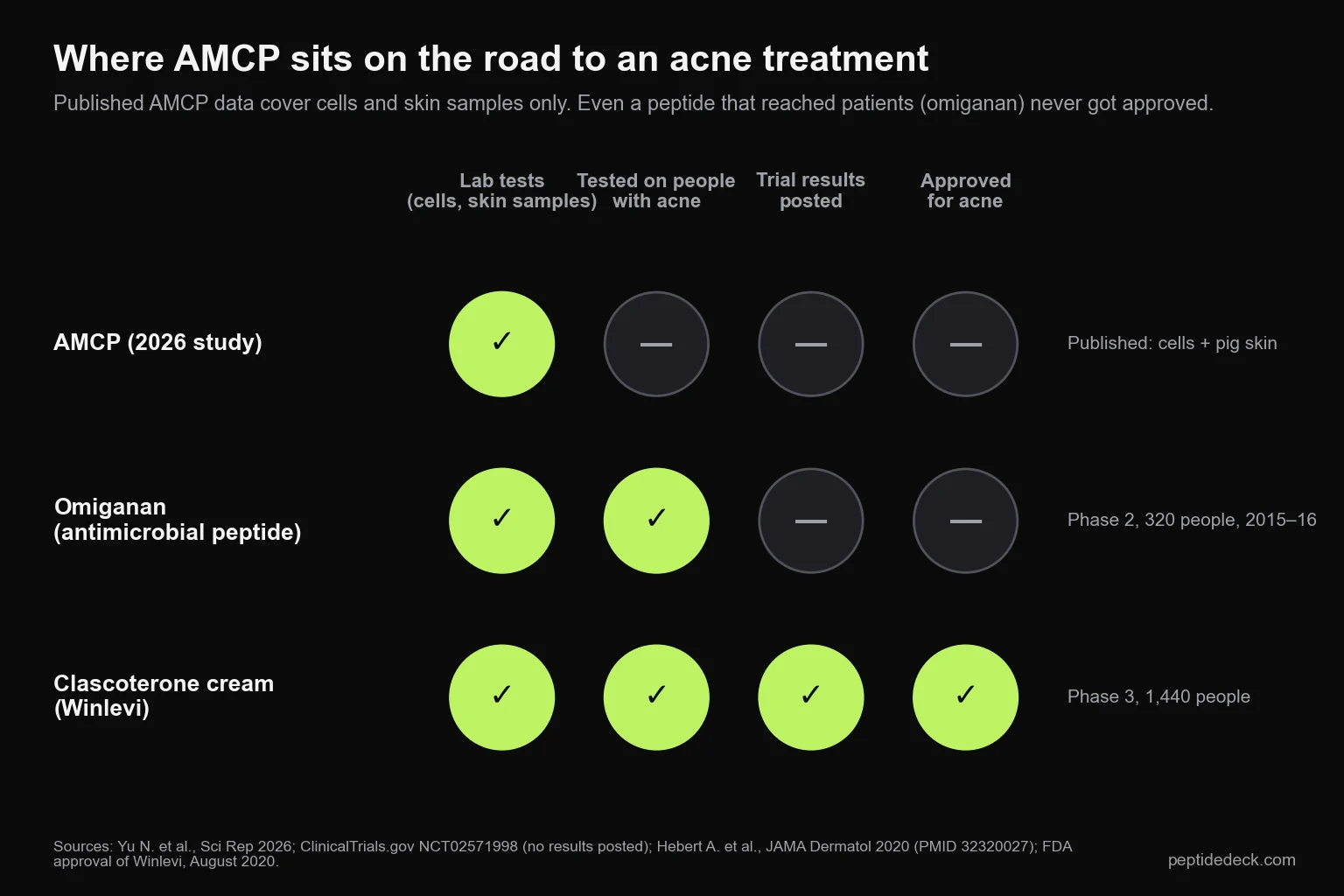
For scale, look at the antimicrobial peptide that got furthest against acne. Omiganan, a topical gel, reached a 320-person Phase 2 acne trial, sponsored by Maruho, that finished in August 2016 (NCT02571998). It has no results posted, and it was never approved for acne. Meanwhile clascoterone cream (Winlevi), the newest acne drug that works on oil hormones, needed two Phase 3 trials and 1,440 patients before the FDA approved it in August 2020 (Hebert 2020, FDA NDA 213433).
Who is behind AMCP, and the name on the label
This is the section most write-ups skip. It matters if you want to find AMCP in a product.
- Funding: the study was paid for by DFSIN (Shanghai) Biotechnology, and two authors work there. The paper states no competing interests.
- The company link: two more authors, Jinfang Wang and Jun "Robin" Yao, list Dermatide Biotec in Singapore. Dermatide's website names Robin Yao as President and Dr. Wang Jinfang as Senior Scientific Advisor (dermatide.net).
- The product: Dermatide's flagship ingredient is AKNETIDE®, described as "a natural antimicrobial cyclopeptide" that targets C. acnes while "regulating sebum oversecretion, alleviating inflammation, and expediting skin lesion repair." Those are the paper's four findings, in the same order. Its INCI label name, the one printed on ingredient lists, is Bacillus Ferment (and) Mannitol, according to the company.
The paper never says the word AKNETIDE, so we can't prove they are the same molecule. Shared authors, the same four claims, and a ring-shaped antimicrobial peptide sold by the authors' own company make it very likely.
Dermatide also says it holds human data. We read its evidence page on October 12, 2026:
None of this means the human studies are wrong. It means you can't judge them yet, and neither can we. Short consumer tests run by testing labs like SGS and Intertek are standard for cosmetic claims. They are much smaller and shorter than the drug trials behind clascoterone.
Five things to know before you trust the headline
- The weight in the paper fits an open chain, not a ring. We added up the 28 amino acids ourselves. The paper's figures, 3,310.80 Da and C139H217N41O43S5, match the straight, uncyclised chain exactly. Closing the ring, whether through a sulfur bridge or end-to-end, would make it 2 to 18 Da lighter. The paper never says where the ring is. That is probably a reporting slip, but it is the one structural fact a reader can check, and it doesn't add up.
- The antibiotic comparisons are borrowed. The paper says AMCP beat minocycline (3.125 µg/mL) and clindamycin (64 µg/mL), but those numbers come from two unrelated earlier papers, including a silver nanoparticle study. Neither drug was tested side by side with AMCP. Minocycline resistance in C. acnes is only 0.22% in the 2025 pooled analysis (Zhu 2025).
- The inflammation dose is above the comfortable dose. AMCP kept oil-gland cells above 80% alive only below 20 µg/mL, so the team chose 20 µg/mL or less as its working range. The inflammation results come from 30 µg/mL.
- Some numbers swap places. In the June preprint, the results section reports filaggrin up 104% and involucrin up 37%. The discussion section swaps them. KLK7 is reported as both "increased by 43%" and reduced by 27% in the same sentence.
- Three cultures, one company's money. Each cell result is the average of three cultures, the study was funded by a company with authors on the paper, and the molecule appears to be a commercial ingredient. That is normal for cosmetic ingredient research, and it is also why independent replication matters.
Can you buy AMCP peptide?
Not as a peptide vial, and you shouldn't try. If you were hoping to find AMCP among the peptides for sale from the usual vendors, it isn't there. We found no vendor listing it on October 12, 2026, and anything sold as "AMCP" by a chemical supplier is the Fmoc building block, not the acne peptide. It is also a skin ingredient, so injecting it would make no sense even if you found it.
The realistic route is a skincare product. Dermatide sells AKNETIDE to cosmetic brands, not to consumers. It showed at trade fairs in 2025 and 2026, including in-cosmetics and NYSCC Suppliers' Day, so finished products depend on which brands sign up. To spot one, look for Bacillus Ferment together with Mannitol on the ingredient list, and check whether the brand names AKNETIDE. Bacillus ferment on its own is a common ingredient and does not mean AMCP.
Expect a cosmetic, not a medicine. It can claim to help blemish-prone skin. In the US, only drug ingredients, including over-the-counter ones like benzoyl peroxide and salicylic acid, can claim to treat acne.
How AMCP compares with acne treatments you can use today
AMCP's selling point is coverage: one ingredient on four problems. The treatments already in the 2024 US guidelines (AAD 2024) cover the same ground, usually in pairs. Here is how they line up.
The table makes the point plainly. A benzoyl peroxide wash plus adapalene, both sold over the counter in the US, already covers bacteria, pores and redness. Clascoterone or isotretinoin covers oil. AMCP's promise is to do all of that in one gentle ingredient, which is a real advantage if it holds up on faces. Until then, it is a lab result.
Other peptides people try for acne-prone skin
If you came looking for a peptide specifically, here is the honest picture. GHK-Cu, the copper peptide, has human data for skin repair and fine lines, not acne. Our GHK-Cu guide covers what it does and doesn't do. KPV and LL-37 are often discussed for skin because of their anti-inflammatory (KPV) and antimicrobial (LL-37) roles, but we could not find a published acne trial for either. For the full graded list of skin peptides, see our peptides for skin guide.
A note for anyone with very reactive skin who is thinking about injectable peptides for their complexion: many injectable peptides can set off mast cells directly through a receptor called MRGPRX2, which can mean flushing, hives or itching. AMCP was designed for the skin surface, not for injection.
What to ask your dermatologist
- Which of the four acne problems is driving my breakouts most: oil, bacteria, inflammation or barrier damage?
- Am I on a topical or oral antibiotic, and should it be paired with benzoyl peroxide to limit resistance?
- Is my acne hormonal enough that clascoterone, spironolactone or a contraceptive pill makes sense?
- If retinoids irritate me, can we change the strength, the base or how often I use it, rather than stop?
- If I try a new cosmetic with an "antimicrobial peptide", should I patch-test it first, and what should make me stop?
Don't stop or swap a prescribed acne treatment for a cosmetic ingredient without talking to the doctor who prescribed it. Antibiotic courses in particular should be finished as directed.
FAQ
Sources
- Yu N, Guo G, Zhang L, He T, Zhang M, Wang J, Wang J, Yao R, Wang G-L, Wang J. An antimicrobial cyclic peptide with multitarget efficacy for acne. Scientific Reports, published online 11 October 2026. nature.com, doi 10.1038/s41598-026-75285-7
- Same study, preprint version with full methods, results and funding statement (DFSIN (Shanghai) Biotechnology Co., Ltd.). Research Square, posted 18 June 2026. doi 10.21203/rs.3.rs-9733105/v1
- Transcriptomics data for the study. NCBI BioProject PRJNA1473534
- Tan JK, Bhate K. A global perspective on the epidemiology of acne. Br J Dermatol. 2015;172 Suppl 1:3-12. PMID 25597339
- Zhu C, et al. Antibiotic resistance rates in Cutibacterium acnes isolated from patients with acne vulgaris: a systematic review and meta-analysis. Front Microbiol. 2025;16:1565111. PMID 40535003
- Beig M, et al. Prevalence of antibiotic-resistant Cutibacterium acnes isolates, a systematic review and meta-analysis. J Glob Antimicrob Resist. 2024;39:82-91. PMID 39179105
- Reynolds RV, et al. Guidelines of care for the management of acne vulgaris. J Am Acad Dermatol. 2024;90(5):1006.e1-1006.e30. PMID 38300170
- Dong Q, et al. Novel antimicrobial peptides against Cutibacterium acnes designed by deep learning. Sci Rep. 2024;14:4529. PMID 38402320
- Hebert A, et al. Efficacy and safety of topical clascoterone cream, 1%, for treatment in patients with facial acne: two phase 3 randomized clinical trials. JAMA Dermatol. 2020;156(6):621-630. PMID 32320027
- FDA Drugs@FDA: Winlevi (clascoterone) cream, NDA 213433, original approval 26 August 2020. accessdata.fda.gov
- ClinicalTrials.gov. A study to evaluate the safety and efficacy of omiganan (CLS001) topical gel versus vehicle in subjects with acne vulgaris. NCT02571998 (completed, no results posted; checked 12 October 2026).
- Zouboulis CC, et al. Anti-acne drugs in phase 1 and 2 clinical trials. Expert Opin Investig Drugs. 2017;26(7):813-823. PMID 28627277
- Dermatide Biotec Pte Ltd. AKNETIDE product page and Science & Evidence page (company claims, unpublished). dermatide.net · science-evidence (read 12 October 2026).
Medical Disclaimer: This article is for educational purposes only and is not medical advice. AMCP is an experimental cosmetic ingredient with no published human acne data, and it is not approved to diagnose, treat or prevent any disease. Acne that is painful, scarring or not improving deserves a visit to a dermatologist. Do not stop or change any prescribed acne treatment because of information on this page.