IGF-1 is the hormone that does growth hormone's work. If your doctor has ordered an IGF-1 test, or you've seen IGF-1 on a lab report, the number is really a stand-in for how much growth hormone your body has been making. This guide explains what IGF-1 is, why the test is ordered, what normal IGF-1 levels look like at your age, and the everyday things that push the result up or down.
🔑 Key Takeaways
- Your result only means something next to your own age and sex, and next to the lab that ran it
- A normal IGF-1 does not rule out growth hormone deficiency in adults
- One common supplement can skew the test, and you should stop it three days before
- Estrogen taken as a pill can lower IGF-1, but a patch usually doesn't
- The IGF-1 sold online as "LR3" is a different molecule from the one your body makes
Reference ranges below come from Labcorp's published IGF-1 test page, checked on November 5, 2026. Every study claim links to its source at the end.
What Is IGF-1?
IGF-1 stands for insulin-like growth factor 1. It's a small protein hormone, 70 amino acids long, that your body makes mostly in the liver. Its older name is somatomedin C, and some labs still list the test that way.
The "insulin-like" part is literal. IGF-1 shares about half its sequence with proinsulin, the precursor of insulin, and it can lower blood sugar the way insulin does (Labcorp). That's why the approved IGF-1 drug carries a warning about low blood sugar.
In the blood, almost all IGF-1 travels bound to carrier proteins. The main one is IGFBP-3, which is why doctors sometimes order an IGFBP-3 test alongside it (MedlinePlus).
How Growth Hormone Makes IGF-1 in the Liver
Think of it as a relay with three runners. Your pituitary gland, at the base of the brain, releases growth hormone (GH) in pulses. GH travels to the liver and tells it to make IGF-1. IGF-1 then goes out to bone, muscle and other tissues and carries out much of GH's growth signal.
The liver is the main source. When scientists switched off IGF-1 production only in the liver of mice, blood levels fell by 75%, even though the liver is under 5% of body mass (Sjögren 1999). Other tissues still make their own IGF-1 locally, which is why those mice kept growing normally.
The loop also runs backwards. IGF-1 feeds back to the brain and dampens GH release, so when IGF-1 production drops, GH tends to rise (Lissett 2003).
Why doctors test IGF-1 instead of GH: GH comes in bursts and swings through the day with food and activity. IGF-1 stays much steadier, so a single blood draw gives a better picture of your average GH output (MedlinePlus).
What IGF-1 Does in the Body
Growth is the headline job, but not the only one. Labcorp's test notes describe IGF-1 as the main driver of GH-stimulated growth, with its own GH-independent building effects in many tissues (Labcorp).
- Bones and height. In children it drives the growth plates. Too little causes short stature, and too much causes gigantism.
- Muscle and bone density in adults. Adults short of GH can lose bone density and muscle mass (MedlinePlus).
- Blood sugar. It has insulin-like effects on glucose, which is why the drug version can cause low blood sugar.
- Cell growth. IGF-1 tells cells to divide and survive. That's useful for repair, and it's also why researchers watch it in cancer.
On that last point, a pooled analysis of 17 prospective studies (4,790 women with breast cancer and 9,428 matched controls) found women in the highest fifth of IGF-1 had 28% higher odds of breast cancer than those in the lowest fifth (Key 2010). That's an association in observational data, not proof that IGF-1 causes cancer, but it's one reason doctors don't chase "higher is better."
The IGF-1 Test: Why It's Ordered and How to Prepare
It's an ordinary blood draw from your arm. Most people get one for one of four reasons (MedlinePlus):
- A child growing slowly, to look for GH deficiency or GH insensitivity (Laron syndrome).
- Signs of acromegaly in an adult, such as growing hands and feet, coarser facial features, a deeper voice, or heavy sweating.
- Suspected adult GH deficiency, often in someone with known pituitary disease.
- Monitoring treatment with GH, IGF-1 therapy, or acromegaly drugs.
The Endocrine Society also suggests the test for adults who have several conditions linked to acromegaly together, such as sleep apnea, type 2 diabetes, arthritis, carpal tunnel syndrome, heavy sweating and high blood pressure, and for anyone found to have a pituitary mass (Endocrine Society 2014).
Do you need to fast for an IGF-1 test?
No. MedlinePlus says no special preparation is needed, and because IGF-1 is stable through the day, the time of the draw matters far less than it does for GH. If your doctor adds a glucose or cholesterol test to the same draw, you may be asked to fast for those.
Two things do matter:
- Biotin. Labcorp warns that high-dose biotin (vitamin B7, common in hair and nail supplements) can interfere with its IGF-1 assay, and advises stopping it at least 72 hours before the draw (Labcorp).
- A recent crash diet or illness. Several days of fasting or very low food intake can cut IGF-1 sharply (see the table further down), so mention it to your doctor before you test.
Labcorp's turnaround is 2 to 4 days, and it asks for your age on the request form because the result can't be read without it.
Normal IGF-1 Levels by Age and Sex
There isn't one normal IGF-1 number. The range shifts with every year of childhood, peaks in the mid-teens, then falls steadily for the rest of your life.
The ranges below are Labcorp's, built from routine results on 778,173 males and 710,752 females in the US, adjusted for age and sex (Labcorp). We've added the nmol/L conversion, using the 7,649 Da molecular weight on the mecasermin label (1 nmol/L = 7.649 ng/mL).
Labcorp lists every single year from birth to 20; we've shown three childhood ages here. Above 90, no range has been set.
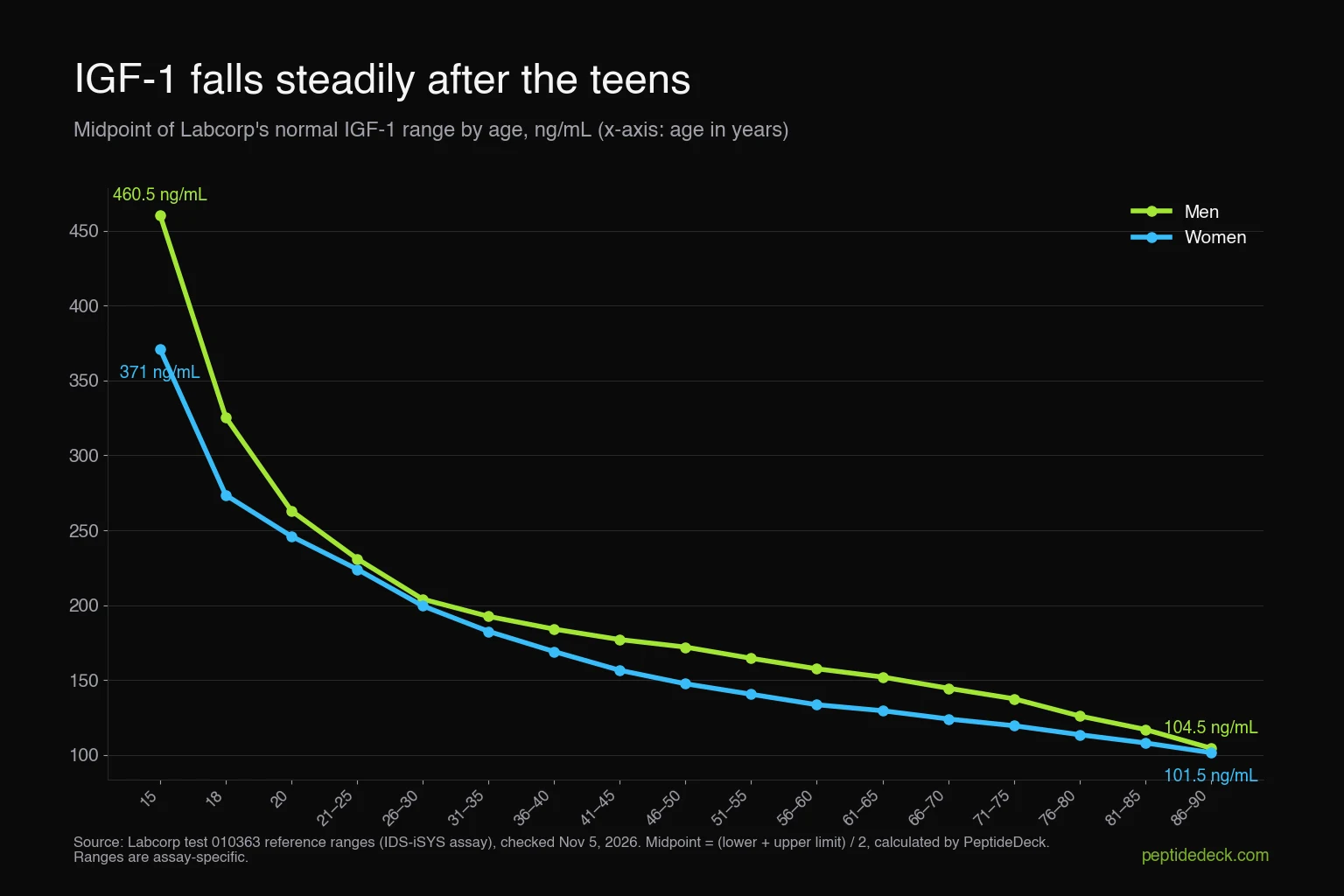
Ranges are lab-specific. Different assays give different numbers for the same blood. Even with the same assay, a Labcorp-led study found US upper limits ran about 20% higher than European ones for adult men and about 14% higher for adult women (Bidlingmaier 2022). Always read your result against the range printed on your own report, and repeat tests at the same lab where you can.
ng/mL, nmol/L and the Z-score
Results come in one of two units, ng/mL or nmol/L. To convert, divide ng/mL by 7.65 (or multiply by 0.131). So 200 ng/mL is about 26 nmol/L, and 20 nmol/L is about 153 ng/mL.
Some reports add a Z-score or SDS, which tells you how far you sit from the average for your age and sex. Zero is average. A reference range usually covers roughly the middle 95% of people, which works out to a Z-score between about -2 and +2. Labcorp offers a separate IGF-1 test that reports a Z-score.
What a High IGF-1 Level Means
A high result usually points to too much GH. In an adult, the leading cause is acromegaly, most often from a tumor in the pituitary gland. In a child, it's gigantism (MedlinePlus).
A high number on its own doesn't make the diagnosis. The Endocrine Society recommends confirming it with an oral glucose tolerance test: in acromegaly, GH fails to fall below 1 µg/L after a glucose drink. If it's confirmed, an MRI of the pituitary comes next (Endocrine Society 2014).
Other reasons for a high reading include pregnancy and late adolescence, which the same guideline flags as causes of false positives. GH injections, tesamorelin and other GH-raising drugs push it up too.
What a Low IGF-1 Level Means
Low IGF-1 has more possible causes than high. In a child, a low result with slow growth suggests GH deficiency or GH insensitivity. In an adult, it can be a normal part of aging, a sign of GH deficiency, or the result of something else entirely (MedlinePlus).
That "something else" list is long. Labcorp notes that malnutrition lowers IGF-1 even when GH is normal. The Endocrine Society names poorly controlled diabetes, liver disease and oral estrogen as conditions that make a low result hard to read (Endocrine Society 2011).
A normal result doesn't clear you. According to the Endocrine Society's adult guideline, a normal IGF-1 does not exclude adult GH deficiency. It makes a GH stimulation test necessary to settle the question. The exception is someone already missing three or more other pituitary hormones, where a low IGF-1 strongly suggests GH deficiency on its own (Endocrine Society 2011).
What Raises and Lowers IGF-1
Food and hormones move IGF-1 the most. Each row below names the study and how many people were in it, so you can judge how much weight it deserves.
Most of these studies are small, and the fasting studies are 40 years old and used an older assay that reported in U/mL, so treat the percentages as direction and rough size rather than precise figures. The body-fat result comes from observational data, which can't show cause and effect.
If you want to nudge your own level up through diet, training and sleep, our guide on how to increase IGF-1 naturally ranks each lever by the human evidence. Among drugs, tesamorelin is the GH-releasing peptide with the clearest label data; see our tesamorelin review. Sermorelin works through the same GHRH receptor, and prescription GH itself is covered in our somatropin guide.
Mecasermin (Increlex): The FDA-Approved IGF-1 Drug
There is one FDA-approved IGF-1 drug in the US. Mecasermin, sold as Increlex, is recombinant human IGF-1 with the same amino acid sequence as the hormone your body makes. It was first approved in 2005, and it's one of the entries on our list of FDA-approved peptides.
Its approved use is narrow. According to the label, it's for growth failure in children aged 2 and older with severe primary IGF-1 deficiency, or with a GH gene deletion who have developed antibodies that block GH treatment (Increlex label). Severe primary IGF-1 deficiency means height and IGF-1 both at least 3 standard deviations below average, with normal or high GH.
- Not a substitute for GH. The label says it is not for GH deficiency, malnutrition, an underactive thyroid or long-term steroid use.
- Label dose. 0.04 to 0.08 mg/kg twice daily under the skin, raised if tolerated to a maximum of 0.12 mg/kg twice daily, given shortly before or after a meal.
- Results. Five studies (four open-label, one placebo-controlled) included 71 children. In the 58 with growth data, mean growth rose from 2.8 cm a year before treatment to 8.0 cm in the first year, then settled at about 4 to 6 cm a year through year 8.
- Main risk. Hypoglycemia, reported at least once by 42% of the children in the trials, with five severe cases.
The limitation is plain: those results come from a small, mostly uncontrolled group of children with a rare condition. There are no approved adult uses, and nothing on the label supports it for muscle, fat loss or aging.
IGF-1 LR3 and IGF-1 DES: The Modified Versions Sold Online
These are not the hormone in your blood test. Both are altered forms of IGF-1, and neither is approved by the FDA for any human use.
IGF-1 LR3 (Long R3 IGF-1) has two changes. The glutamic acid at position 3 is swapped for arginine, and a 13-amino-acid tail is added to the front, making 83 amino acids in total. In lab cell cultures, these changes made it more potent than natural IGF-1, mainly because it slips past the binding proteins that normally hold IGF-1 in check. In cells that make no binding proteins, it was actually weaker (Francis 1992). It has no published human trials that we could find.
IGF-1 DES, or des(1-3)IGF-1, is IGF-1 missing its first three amino acids. It occurs naturally and has been found in human brain and in cow colostrum. In cell cultures it was about 10 times more potent than IGF-1, again because it binds carrier proteins poorly. A 1996 review noted that its clinical uses had not been tested (Ballard 1996), and we found no human trials since.
Since IGF-1 itself lowers blood sugar, hypoglycemia is the risk to take most seriously with any IGF-1 product. Claims, typical doses and side effects for LR3 are covered in our IGF-1 LR3 benefits and results and IGF-1 LR3 dosage and cycle guides. Prices and testing vary widely between sellers, and our IGF-1 LR3 for sale page compares 10 vendors by price per mg.
What to Ask Your Doctor About Your IGF-1 Result
Bring these questions to your next appointment.
- Which age and sex range was my result compared with, and is it this lab's own range?
- Was I taking biotin, oral estrogen, or eating much less than usual when the blood was drawn?
- If my IGF-1 is high, do I need a glucose suppression test or a pituitary MRI?
- If it's low, could liver disease, diabetes control, thyroid function or diet explain it?
- If it's normal but I still have symptoms, do I need a GH stimulation test?
- Should my repeat test be at the same lab so the numbers are comparable?
Frequently Asked Questions
Sources
- Labcorp. Insulin-like Growth Factor 1 (IGF-1), test 010363: reference ranges, specimen and biotin notes. labcorp.com (checked November 5, 2026)
- MedlinePlus. IGF-1 (Insulin-like Growth Factor 1) Test. US National Library of Medicine. medlineplus.gov
- Increlex (mecasermin) injection, prescribing information, May 2026. DailyMed
- Egrifta WR (tesamorelin), prescribing information, 2026. DailyMed
- Katznelson L, et al. Acromegaly: an Endocrine Society clinical practice guideline. J Clin Endocrinol Metab. 2014. PubMed 25356808
- Molitch ME, et al. Evaluation and treatment of adult growth hormone deficiency: an Endocrine Society clinical practice guideline. J Clin Endocrinol Metab. 2011. PubMed 21602453
- Bidlingmaier M, et al. Differences in the distribution of IGF-I concentrations between European and US populations. J Endocr Soc. 2022. PubMed 35673402
- Sjögren K, et al. Liver-derived IGF-I is the principal source of IGF-I in blood but is not required for postnatal body growth in mice. PNAS. 1999. PubMed 10359843
- Lissett CA, Shalet SM. The impact of dose and route of estrogen administration on the somatotropic axis in normal women. J Clin Endocrinol Metab. 2003. PubMed 14557438
- Bellantoni MF, et al. Effects of oral versus transdermal estrogen on the GH/IGF-I axis in younger and older postmenopausal women. J Clin Endocrinol Metab. 1996. PubMed 8768841
- Clemmons DR, et al. Reduction of plasma immunoreactive somatomedin C during fasting in humans. J Clin Endocrinol Metab. 1981. PubMed 7197688
- Isley WL, Underwood LE, Clemmons DR. Dietary components that regulate serum somatomedin-C concentrations in humans. J Clin Invest. 1983. PubMed 6681614
- Colakoğlu O, et al. Serum IGF-1 and IGFBP-3 levels in liver cirrhosis. Turk J Gastroenterol. 2007. PubMed 18080921
- Hynes MC, et al. Associations of body composition measures with circulating IGF-I, testosterone, and SHBG concentrations in 16,000 men. Int J Obes. 2024. PubMed 39433891
- Older SA, et al. The effects of delta wave sleep interruption on pain thresholds and fibromyalgia-like symptoms in healthy subjects; correlations with IGF-I. J Rheumatol. 1998. PubMed 9632083
- Endogenous Hormones and Breast Cancer Collaborative Group; Key TJ, et al. IGF1, IGFBP3, and breast cancer risk: pooled individual data analysis of 17 prospective studies. Lancet Oncol. 2010. PubMed 20472501
- Francis GL, et al. Novel recombinant fusion protein analogues of IGF-I indicate the relative importance of IGF-binding protein and receptor binding for enhanced biological potency. J Mol Endocrinol. 1992. PubMed 1378742
- Ballard FJ, et al. Des(1-3)IGF-I: a truncated form of insulin-like growth factor-I. Int J Biochem Cell Biol. 1996. PubMed 8930132
Medical Disclaimer: This article is for informational purposes only and does not constitute medical advice. IGF-1 results must be read against the reference range of the lab that ran the test and in the context of your symptoms and other results. IGF-1 LR3 and IGF-1 DES are not approved by the FDA for any human use. Talk to your doctor or an endocrinologist about any abnormal result before changing medicines, supplements or diet.