Published August 13, 2026Updated September 2, 2026
Quick Brief
Viking's dual GLP-1/GIP agonist reached 14.7% weight loss by injection and 12.2% as a daily tablet in 13-week Phase 2 trials. Mechanism, results, dosing, tolerability against placebo, and why you cannot buy it.
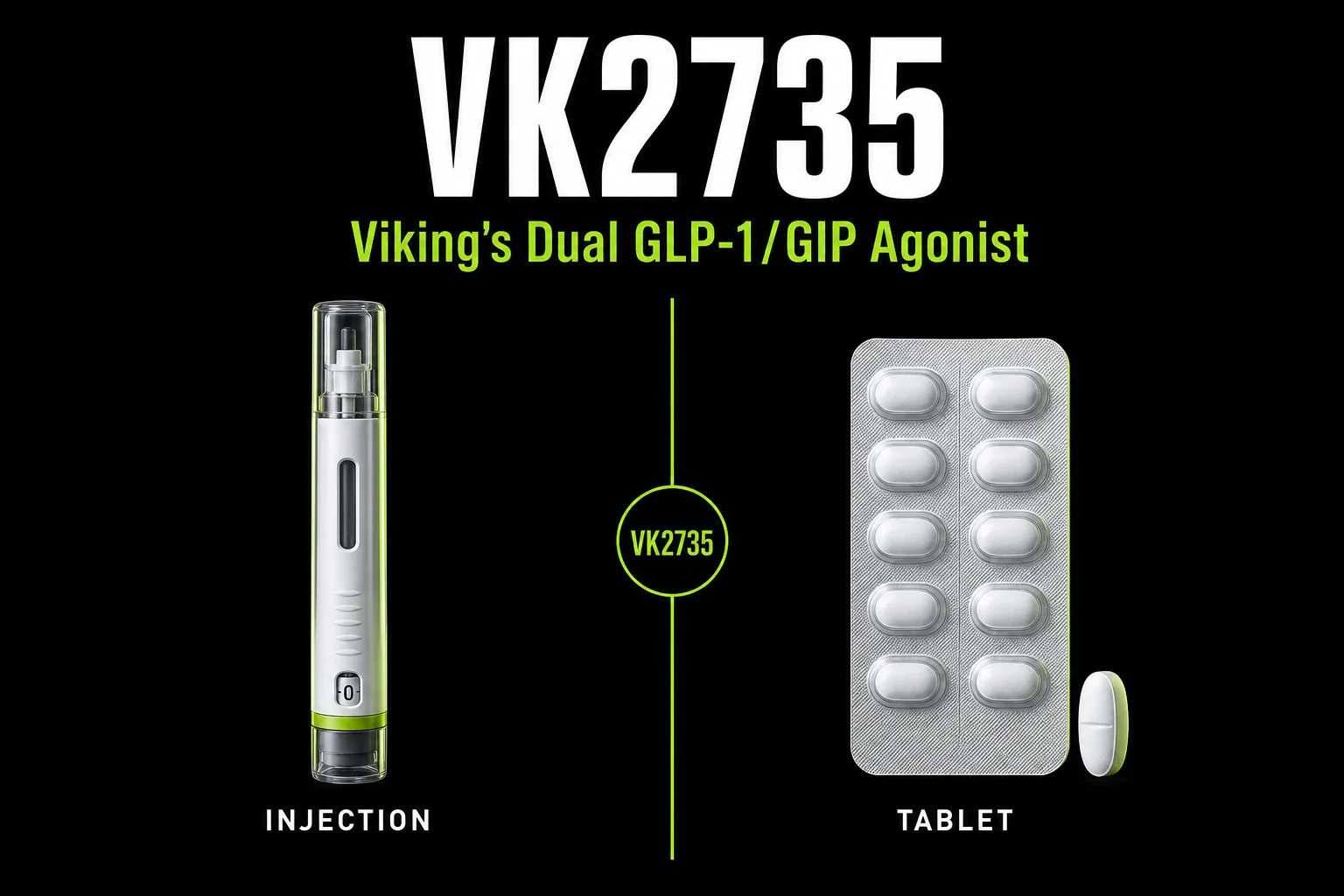
VK2735 is Viking Therapeutics' dual GLP-1/GIP receptor agonist — the same receptor combination tirzepatide uses. What makes it unusual is that Viking is developing it in two formulations at once: a weekly subcutaneous injection and a daily oral tablet, both of which have now reported Phase 2 data.
The oral version is the reason people are watching. An effective GLP-1 pill has been the industry's target for years, and VK2735's tablet posted double-digit weight loss in 13 weeks.
🔑 Key Facts
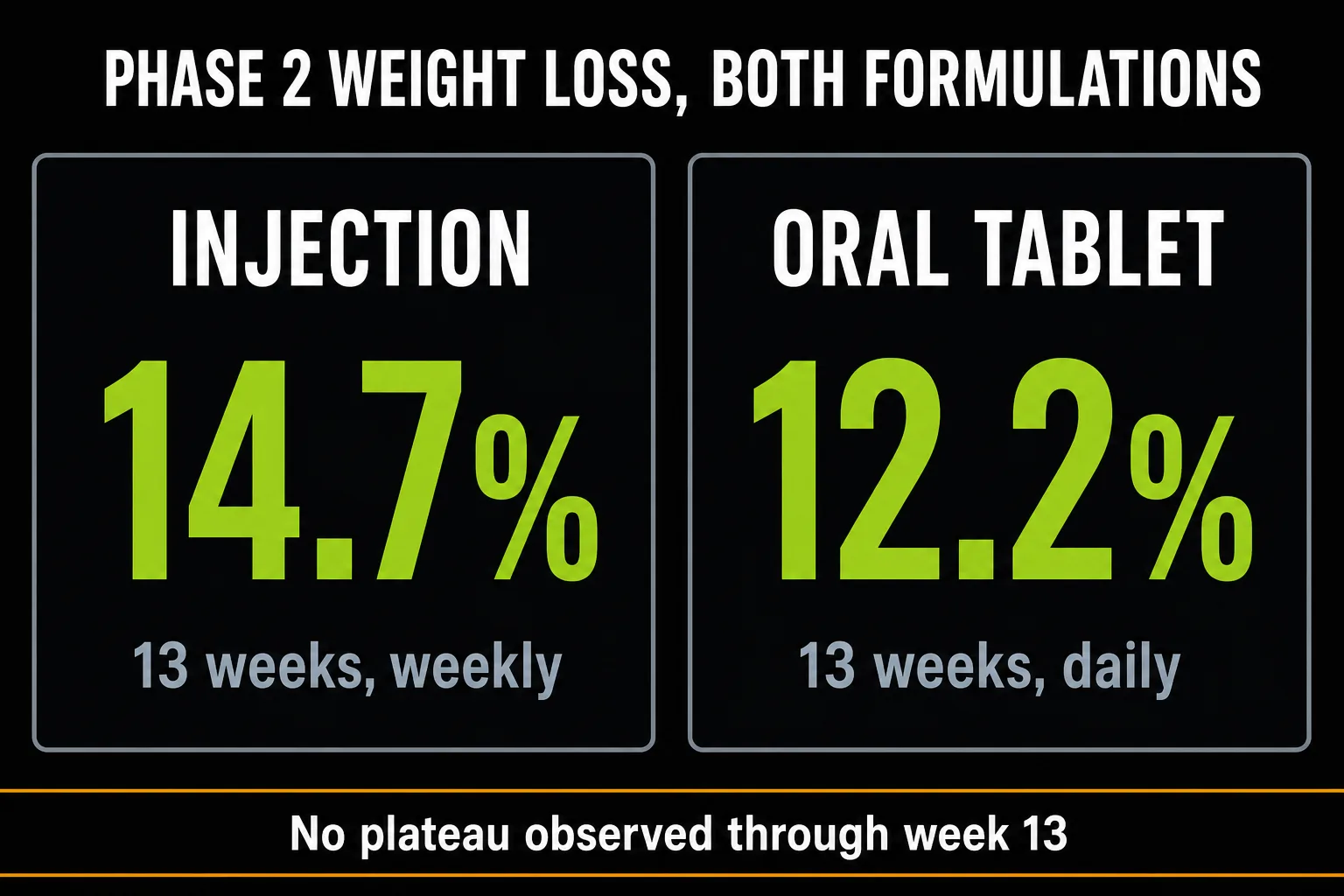
Up to 14.7% weight loss with the weekly injection at 13 weeks in Phase 2 VENTURE
Up to 12.2% with the daily tablet at 13 weeks — roughly 26.6 lbs — in VENTURE-Oral
Dual GLP-1/GIP agonist, the same receptor pair as tirzepatide
No weight-loss plateau through week 13 in either formulation
Not approved and not purchasable. Phase 3 is underway; anything sold as "VK2735" is unverifiable
What Is VK2735?
VK2735 is an investigational peptide that activates both the GLP-1 and GIP receptors. GLP-1 activation drives satiety and slows gastric emptying; adding GIP appears to improve both weight loss and tolerability relative to GLP-1 alone, which is the mechanism behind tirzepatide's edge over semaglutide.
Viking is running it as two programs. The subcutaneous version is dosed weekly. The oral version is a daily tablet — a genuinely hard problem, since peptides are normally destroyed in the gut, which is why most GLP-1s are injectables.
VK2735 Benefits
Benefit
What the data shows
Why it matters
Confidence
Weight loss
14.7% injection, 12.2% oral at 13 weeks
Double-digit in a short window
High — Phase 2, both formulations
An oral option
Daily tablet reached 12.2%
Removes the injection barrier entirely
High
Speed of onset
Separation from placebo by week 1 above 15 mg
Early feedback aids adherence
Moderate
No plateau
Loss still progressing at week 13
Ceiling not yet reached
Moderate — trial ended, not the curve
Response rate
~97% lost 5%+, ~80% lost 10%+
Few non-responders
High, oral trial
Manageable dropout
13% discontinued vs 14% placebo
Side effects did not drive quitting
High
Weight loss
What the data shows
14.7% injection, 12.2% oral at 13 weeks
Why it matters
Double-digit in a short window
Confidence
High — Phase 2, both formulations
An oral option
What the data shows
Daily tablet reached 12.2%
Why it matters
Removes the injection barrier entirely
Confidence
High
Speed of onset
What the data shows
Separation from placebo by week 1 above 15 mg
Why it matters
Early feedback aids adherence
Confidence
Moderate
No plateau
What the data shows
Loss still progressing at week 13
Why it matters
Ceiling not yet reached
Confidence
Moderate — trial ended, not the curve
Response rate
What the data shows
~97% lost 5%+, ~80% lost 10%+
Why it matters
Few non-responders
Confidence
High, oral trial
Manageable dropout
What the data shows
13% discontinued vs 14% placebo
Why it matters
Side effects did not drive quitting
Confidence
High
The oral row is the one with commercial weight behind it. Injection aversion keeps a real share of eligible patients off GLP-1s entirely, and every approved option in this class is an injectable. A tablet delivering 12.2% in 13 weeks addresses that directly.
VK2735 Results
Both formulations at 13 weeks. The oral figure is the one that matters commercially.
Injection (VENTURE). The Phase 2 subcutaneous trial ran 13 weeks of once-weekly dosing and reported up to 14.7% mean weight loss from baseline. Results were published in the journal Obesity.
Oral (VENTURE-Oral). The 13-week daily tablet trial reported up to 12.2% mean reduction — about 26.6 lbs — with data presented at the European Congress on Obesity in May 2026. Roughly 97% of participants achieved at least 5% weight loss and about 80% reached 10%. Statistically significant separation from placebo began as early as week 1 at all doses above 15 mg.
The detail worth flagging in both: weight loss was continuous and progressive through week 13 with no plateau. Trials this short capture the steep part of the curve, so the honest read is that the ceiling is unknown rather than that these numbers extrapolate linearly. For context on what longer trials produce, see retatrutide's Phase 3 results.
Both programs used dose escalation rather than a fixed dose from day one, which is standard for this class and is how tolerability is managed. There is no approved label, so there is no dosing protocol to follow — the trial doses exist inside a monitored study with titration, bloodwork and dropout criteria, none of which transfer to self-administration.
VK2735 Side Effects
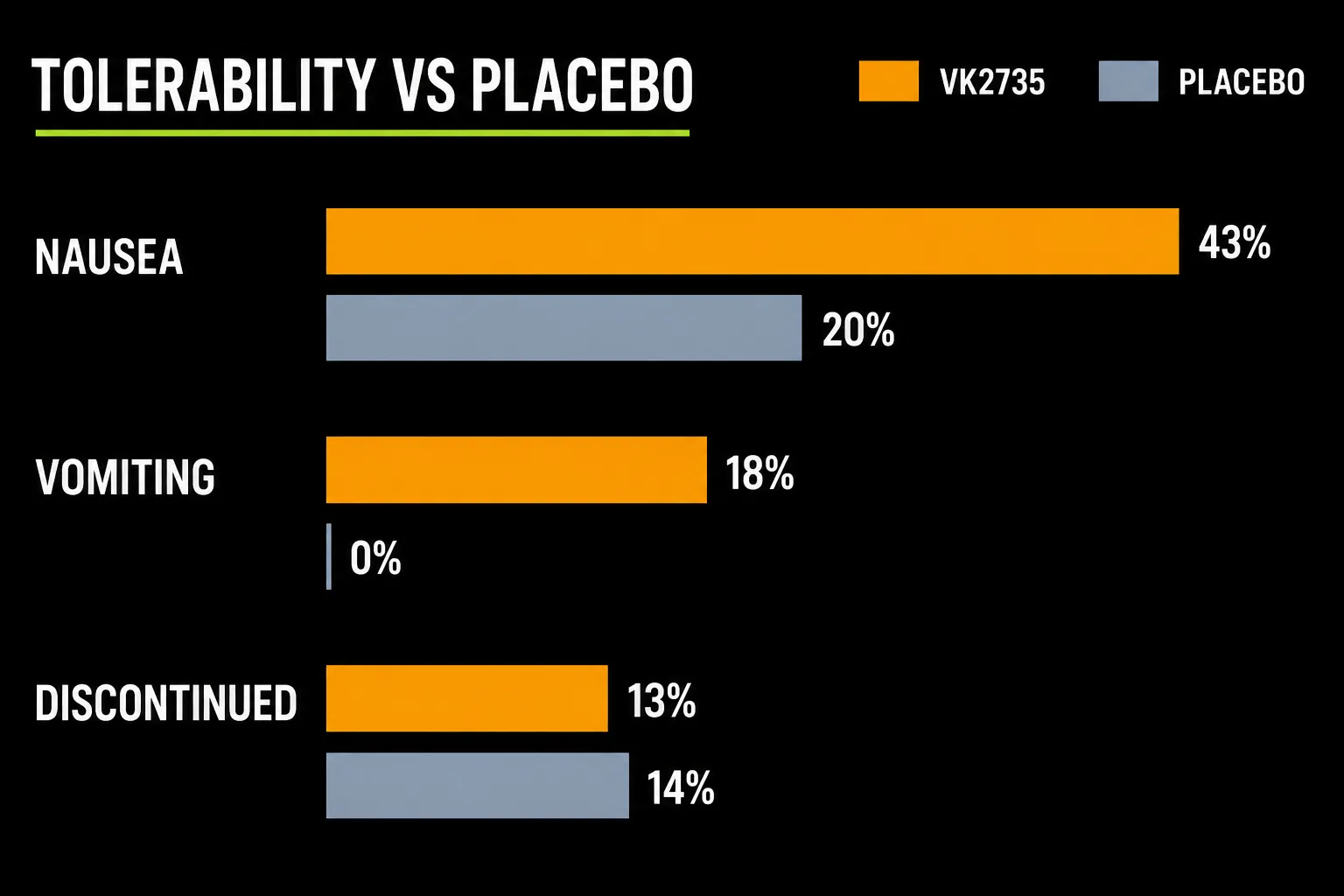
Nausea and vomiting separate clearly from placebo. Discontinuation does not — which is the more telling number.
Effect
VK2735
Placebo
Notes
Nausea
43%
20%
68% mild, 32% moderate, none severe
Vomiting
18%
0%
Clear separation from placebo
Discontinuation
13%
14%
Essentially balanced
Withdrawal from adverse event
9.1%
n/a
Nausea, vomiting, diarrhea, headache
Drug-related events mild or moderate
92%
n/a
95% of GI events mild or moderate
Nausea
VK2735
43%
Placebo
20%
Notes
68% mild, 32% moderate, none severe
Vomiting
VK2735
18%
Placebo
0%
Notes
Clear separation from placebo
Discontinuation
VK2735
13%
Placebo
14%
Notes
Essentially balanced
Withdrawal from adverse event
VK2735
9.1%
Placebo
n/a
Notes
Nausea, vomiting, diarrhea, headache
Drug-related events mild or moderate
VK2735
92%
Placebo
n/a
Notes
95% of GI events mild or moderate
The nausea rate more than doubles placebo, and vomiting appears where placebo shows none — this is a GLP-1-class drug and it behaves like one. But two figures soften that. Weekly nausea rates did not exceed 5% at any point after the first week, so the burden is concentrated in early titration. And discontinuation was 13% on drug against 14% on placebo — people were not quitting over it.
Worth being straight about the oral program specifically: its tolerability profile drew a cooler reception than the injectable's when the data landed, and GI burden is the central question for any daily oral GLP-1. The comparison across this whole class is in GLP-1 side effects compared.
The durations make this table misleading if read as a leaderboard: VK2735's numbers come from 13 weeks, tirzepatide's from 72. A 13-week figure of 14.7% with no plateau is arguably the more impressive trajectory. What it is not is a demonstrated endpoint. See retatrutide vs tirzepatide and survodutide for the neighbours.
Can You Buy VK2735?
No. VK2735 is not FDA approved, has no prescription route, and has no legitimate supply outside Viking's clinical trials.
Vendors do list it, and that listing is the problem. A compound this early has no established reference standard, so a certificate of analysis cannot establish that a vial contains VK2735 rather than a cheaper GLP-1 relabelled. The usual COA checks that work for well-characterised peptides do not transfer here.
If the goal is a supervised weight-loss option available now, approved and compounded GLP-1s are the route that exists. What is GLP-1 covers the landscape and the retatrutide approval timeline shows how long these pipelines actually take.
Frequently Asked Questions
What is VK2735?
An investigational dual GLP-1/GIP receptor agonist from Viking Therapeutics, in development as both a weekly subcutaneous injection and a daily oral tablet. It uses the same receptor pair as tirzepatide and is not approved anywhere.
How much weight do people lose on VK2735?
In Phase 2, the weekly injection produced up to 14.7% mean weight loss at 13 weeks and the daily tablet up to 12.2%, about 26.6 lbs. In the oral trial roughly 97% of participants lost at least 5% and around 80% reached 10%.
Is VK2735 an oral GLP-1?
There is an oral version — a daily tablet — alongside the weekly injection. The tablet reported 12.2% weight loss over 13 weeks in Phase 2, which is why it draws attention: an effective oral GLP-1 has been a long-standing industry goal.
What are VK2735 side effects?
Predominantly gastrointestinal. Nausea affected 43% against 20% on placebo, though 68% of cases were mild and none severe, and weekly rates stayed under 5% after the first week. Vomiting was 18% versus 0% on placebo. Discontinuation was 13% on drug and 14% on placebo.
VK2735 vs tirzepatide — which is better?
They share a mechanism, so the honest comparison is stage rather than superiority. Tirzepatide is approved with ~22.5% weight loss over 72 weeks; VK2735 has 14.7% over 13 weeks in Phase 2. The trajectory looks competitive, but a 13-week result is not comparable to a 72-week one and no head-to-head exists.
Is VK2735 FDA approved?
No. It is investigational, with Phase 3 underway following Phase 2 results in both formulations. There is no approval, no prescription route and no legal supply.
Where can I buy VK2735?
Nowhere legitimate. Research vendors list it, but a compound at this stage has no established reference standard, meaning no lab can verify a vial actually contains VK2735. That makes the usual purity-testing safeguards ineffective here.
This article is for educational purposes and is not medical advice. VK2735 is an investigational drug not approved in any country and not available for purchase. Phase 2 results described here may not replicate in Phase 3.
Recommended Supplier
In StockShips from USA
Embody Compounded Semaglutide
Embody Compounded Semaglutide via licensed US telehealth. Flat $69/month, normally $299. Includes all doses, provider visits and fast free shipping. No long-term commitment.