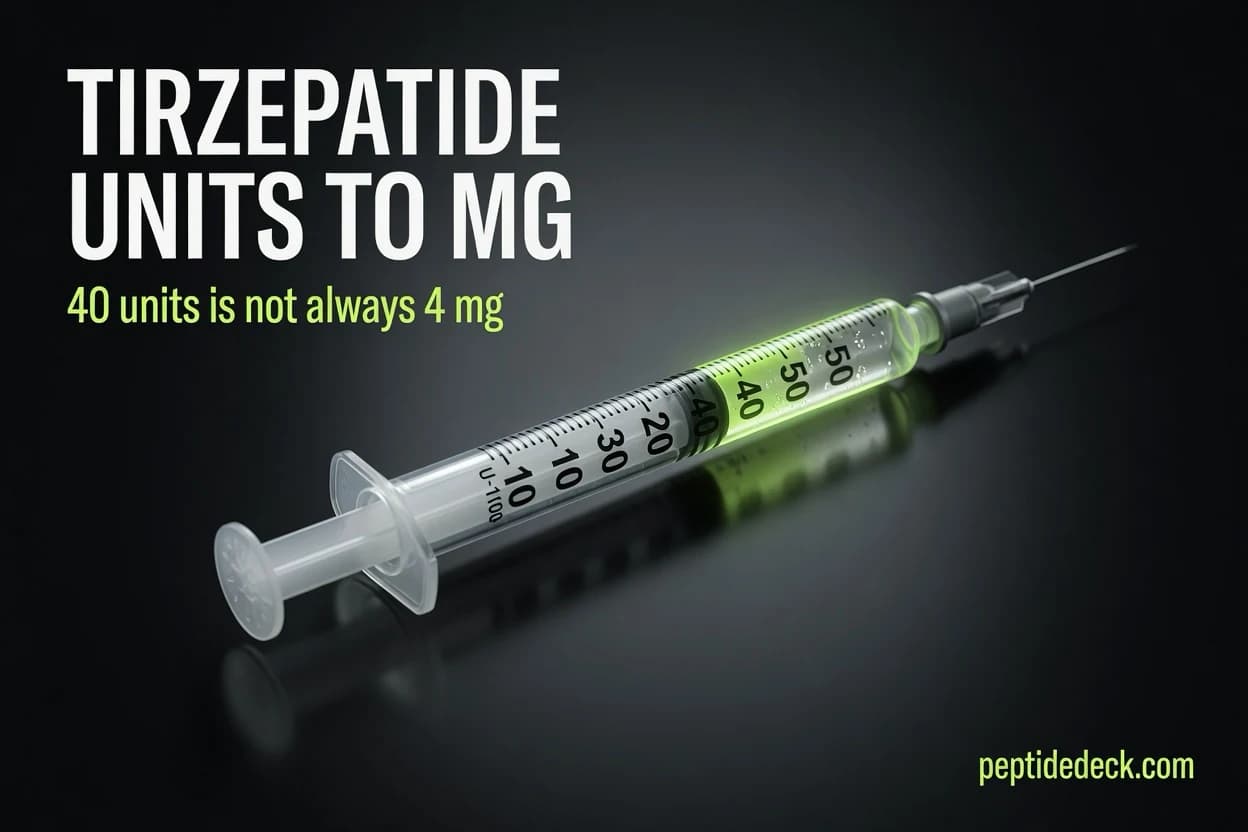

Forty units is a volume, not a dose.
If you have a vial and an insulin syringe in front of you, you already know the frustrating part. The syringe is marked in units. The dosing guidance is written in milligrams. Nothing on either of them tells you how to get from one to the other, and the answer you find online usually assumes a concentration you may not have.
This page does the tirzepatide units to mg conversion properly: the one formula, the one number you have to read off your own vial before the formula means anything, and a chart for every concentration people actually use. If you came here for "40 units to mg", that answer is below, and it is not a single number.
🔑 Key Takeaways
- Units measure volume. Milligrams measure drug. The bridge between them is the concentration on your vial, and it is different for a Zepbound vial, a reconstituted 10 mg powder, and a compounded multi-dose vial.
- The formula is one line long. Once you have it, you never need a calculator again, and you will spot a wrong chart in seconds.
- "40 units to mg" has at least four correct answers depending on the vial, which is why so many charts online disagree with each other. They are not wrong; they are silently assuming different concentrations.
- The most common dosing mistake is not maths. It is one specific thing people do when reconstituting a powder vial, and it doubles the dose without anyone noticing.
- There is a simple sanity check that catches a bad conversion before it goes into a syringe.
If you want the full dose schedule rather than the conversion, that lives on the tirzepatide dosage chart. This page is only about turning a milligram dose into a syringe reading, and doing it for your vial rather than someone else's.
Why units and mg are not the same thing
A unit is a hundredth of a millilitre.
That is all it is. Insulin syringes are marked in "units" because insulin is standardised at 100 units per millilitre, so on a U-100 syringe 100 units is exactly 1 mL, 50 units is 0.5 mL, and 40 units is 0.4 mL. The syringe knows nothing about tirzepatide. It only knows volume.
Milligrams, on the other hand, measure how much drug is in that volume. And how much drug is in 0.4 mL depends entirely on how concentrated the liquid is. A vial at 10 mg/mL holds twice as much tirzepatide in every unit as a vial at 5 mg/mL. Draw the same 40 units from each and you have injected two different doses.
So the syringe marking is only half the information. The other half is printed on the vial, usually as "mg/mL", and if you are reconstituting a powder yourself, you created that number when you chose how much water to add.
The tirzepatide units to mg formula
One line, and it works in both directions.
From units to milligrams
mg = units ÷ 100 × concentration (mg/mL)
Example: 40 units from a 10 mg/mL vial. 40 ÷ 100 = 0.4 mL. 0.4 × 10 = 4 mg.
From milligrams to units
units = mg ÷ concentration (mg/mL) × 100
Example: you want 5 mg from a 10 mg/mL vial. 5 ÷ 10 = 0.5 mL. 0.5 × 100 = 50 units.
Notice the concentration appears in both. There is no version of this conversion that works without it. Any chart or calculator that gives you a units figure without asking for mg/mL has picked a concentration for you and not told you which.
How many mg is 40 units of tirzepatide?
It depends on the vial, and here is every common answer.
Forty units is 0.4 mL. Multiply that by your concentration:
Same 40 units, a four-fold range in dose. That is the whole reason this page exists. If somebody tells you "40 units is 4 mg" without asking what you are drawing from, they are assuming a 10 mg/mL vial, and they may be right or may be doubling you.
Full conversion chart: every tirzepatide dose at every concentration
Find your dose on the left and your vial across the top.
Rows marked * exceed a standard 1 mL (100-unit) syringe. If your dose lands there, you either split it across two draws or, more sensibly, you are on the wrong concentration for that dose. A 15 mg dose from a 5 mg/mL vial is 3 mL of liquid, which is a lot to inject subcutaneously in one place. Higher doses want higher concentrations.
The reconstitution mistake that silently doubles a dose
It happens at the mixing step, not the drawing step.
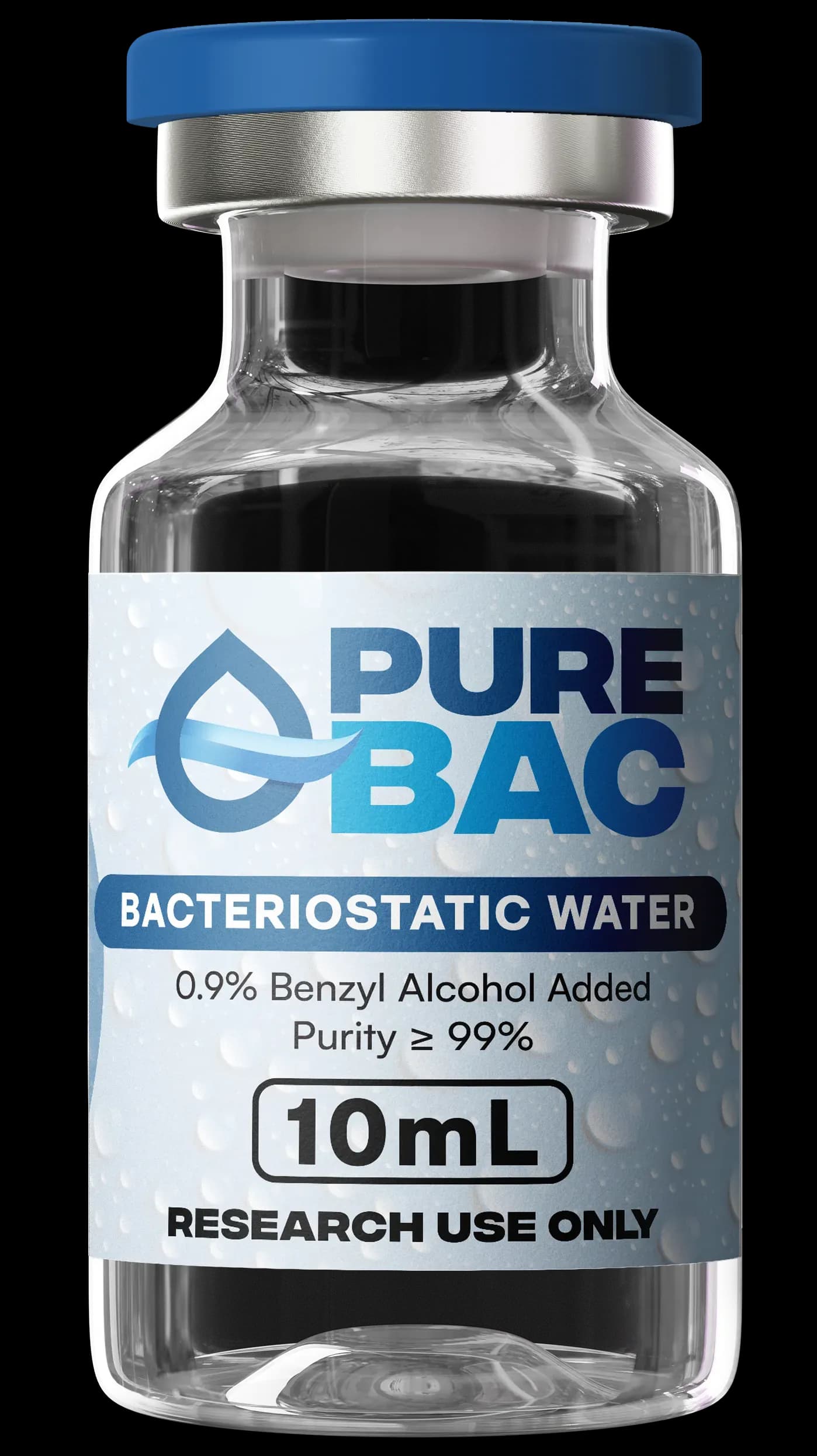
A lyophilised vial arrives as powder with a total milligram figure on the label, say 10 mg. You add bacteriostatic water, and the amount you add sets the concentration. Add 1 mL and the vial is now 10 mg/mL. Add 2 mL and it is 5 mg/mL. Both are legitimate. The problem is what happens next.
Someone reads a chart written for 10 mg/mL, sees "5 mg = 50 units", and draws 50 units from the vial they mixed with 2 mL. They inject 2.5 mg and wonder why nothing happens. Or, worse, they mix with 1 mL, follow a chart written for 5 mg/mL, and draw 100 units for what they think is 5 mg. That is 10 mg, the whole vial, in one injection.
The sanity check that catches this
Before you draw, ask one question: how many doses should this vial contain? A 10 mg vial holds four 2.5 mg doses, two 5 mg doses, or one 10 mg dose. If your units figure would empty the vial in fewer doses than that, the conversion is wrong.
Write the concentration on the vial in marker the moment you mix it. "10 mg / 1 mL = 10 mg/mL." Then every conversion afterward starts from a number you can see, not one you have to remember.
Our reconstitution guide walks through the mixing itself. This page assumes the vial is already mixed and you are standing there with a syringe.
Reading a Zepbound vial versus a compounded vial
They print the number differently.
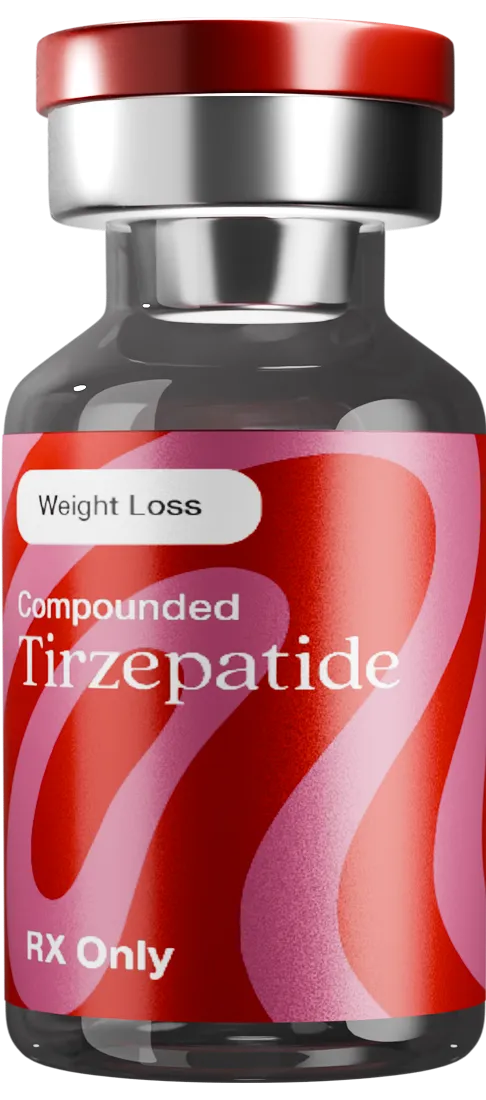
LillyDirect Zepbound vials state a dose per volume: 2.5 mg per 0.5 mL, 5 mg per 0.5 mL, and so on up the ladder. To get concentration, divide: 2.5 ÷ 0.5 = 5 mg/mL; 5 ÷ 0.5 = 10 mg/mL. Each strength is a different vial, and each holds a single dose, so units matter less because you draw the whole thing.
Compounded multi-dose vials usually print mg/mL directly, commonly 10, 17 or 20 mg/mL, and hold several doses. This is where the conversion actually matters, because you are drawing a fraction of the vial each week and the fraction depends on the concentration.
Powder vials print a total milligram figure and no concentration, because there is none until you add water. That is the case from the previous section, and the one where a marker pen earns its keep. For where each of these comes from and what they cost, see compounded tirzepatide.
Frequently Asked Questions
Medical disclaimer. This article is informational and does not replace individual medical advice. Tirzepatide is a prescription medicine, and the dose and concentration you use should be set by the clinician or pharmacist who prescribed or dispensed it. The conversions above are arithmetic and assume the concentration printed on your vial is accurate; a compounded or self-reconstituted product carries the additional uncertainty of that label. Never adjust a dose based on a chart without confirming the concentration first, and speak to your prescriber if a calculation gives a result that does not match what you were told to take.