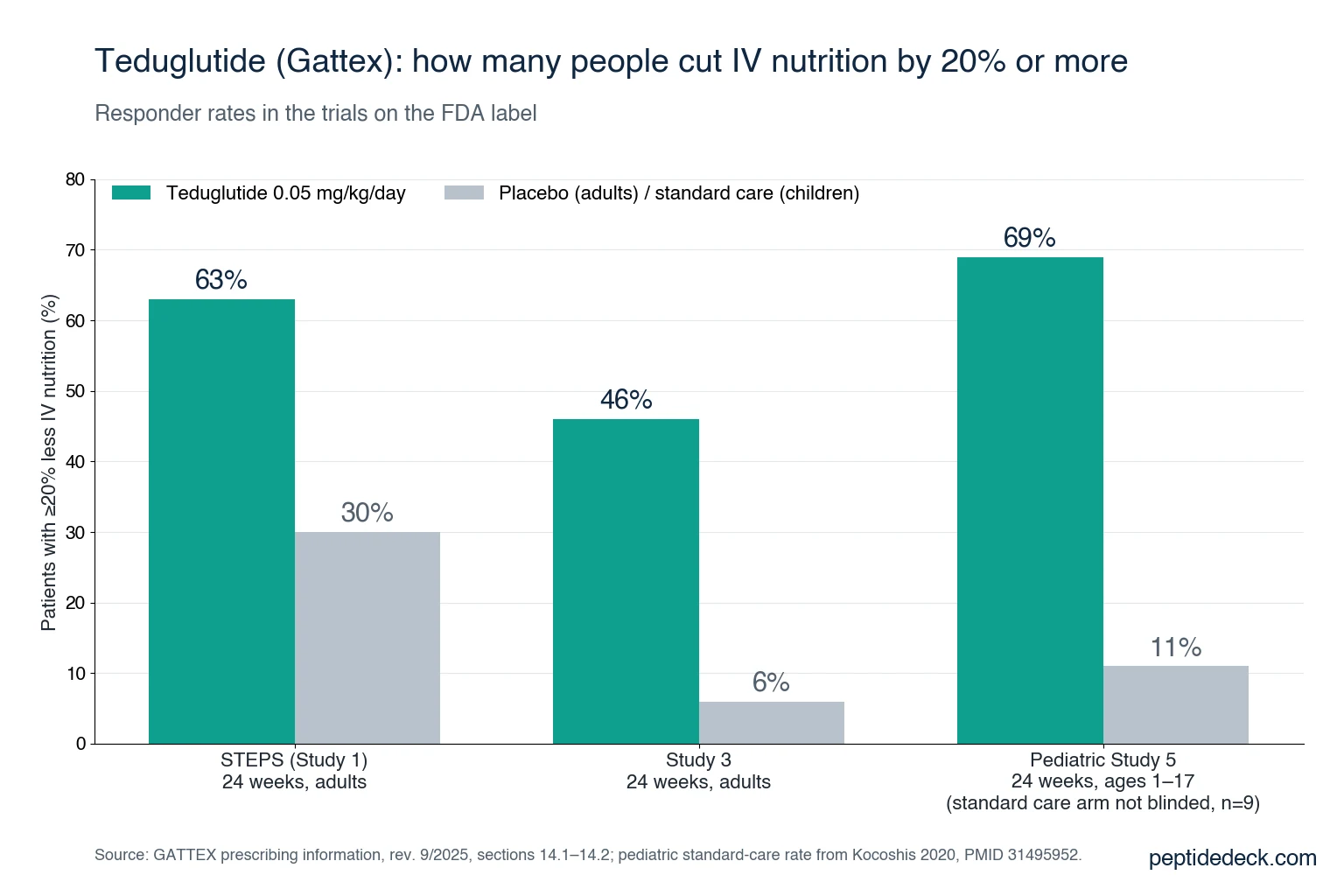

Teduglutide makes a short gut absorb more. That is the whole job of Gattex, the daily injection approved for short bowel syndrome: people who live on IV nutrition get more out of the intestine they still have. In the trial that got it approved, 63% of adults on teduglutide cut their weekly IV volume by at least a fifth, against 30% on placebo (PMID 22982184). Below is what the drug is, what each trial found, the dose for every body weight, the warnings on the label and what a vial costs.
🔑 Key Takeaways
- Why one changed amino acid turns a 7-minute gut hormone into a once-a-day drug.
- What happened to the people who stayed on it for two and a half years.
- The body weight at which one vial stops covering the dose, and the table for every weight below and above it.
- The four tests the label wants before the first injection, and why the colonoscopy is one of them.
- Two newer GLP-2 drugs, one dosed twice a week and one weekly, and where each stands in October 2026.
If you or your child depend on IV nutrition, you already know the cost in hours. Nights attached to a pump. A central line that has to stay clean. Every litre the gut cannot absorb has to go in through a vein. Teduglutide is the one approved drug in the US whose aim is to shrink that number, and the trials show how far it usually gets.
What is teduglutide (Gattex)?
Teduglutide is a copy of a gut hormone. Your intestine already makes glucagon-like peptide-2 (GLP-2) after meals, from L-cells near its far end. Teduglutide is that 33-amino-acid peptide with one swap: glycine replaces alanine at position 2 (Jeppesen, Ther Adv Gastroenterol 2012).
That swap matters more than it sounds. Natural GLP-2 is cut apart by the enzyme DPP-4 within minutes; the same review gives it a half-life of about 7 minutes. The swapped version resists DPP-4, so one injection lasts long enough to be useful. The FDA label puts teduglutide's half-life at about 2 hours in healthy people and 1.3 hours in people with short bowel syndrome (Gattex label, rev. 9/2025).
The FDA approved Gattex for adults in December 2012 and extended it to children 1 year and older in May 2019 (Takeda, 2019). Takeda sells it today. It comes as a 5 mg powder vial that you mix with 0.5 mL of sterile water just before the injection.
How teduglutide works in the gut
It grows the absorbing surface. GLP-2 receptors sit on certain hormone-making cells in the gut lining, on the cells under the lining and on the gut's own nerves. When teduglutide binds them, those cells release IGF-1, nitric oxide and keratinocyte growth factor, and the label lists the results: more blood flow to the intestine, less stomach acid, taller villi and deeper crypts.
The label quantifies it. In a 21-day dose-finding study in 17 adults with short bowel syndrome, every dose except the lowest raised the gut's fluid absorption by roughly 750 to 1,000 mL a day. That is close to a litre a day that no longer has to go in through a vein.
If you are wondering how this differs from Ozempic-type drugs: they share a name, not a job. GLP-1 drugs act on appetite and blood sugar; GLP-2 acts on the gut lining. We cover the two hormones side by side in GLP-1 vs GLP-2: what's the difference.
Who teduglutide is approved for
The label has one indication. Gattex is approved for adults and children 1 year and older with short bowel syndrome (SBS) who depend on parenteral support, meaning IV nutrition, IV fluids or both.
Short bowel syndrome usually follows surgery. In the main adult trial, the most common reasons for losing intestine were blood-supply problems (34%) and Crohn's disease (21%). In the children's trial, the leading causes were gastroschisis, midgut volvulus and necrotising enterocolitis.
It is not approved for leaky gut, IBS, inflammatory bowel disease without short bowel syndrome, or weight loss. If you arrived here from the wider question of which gut peptides have human evidence behind them, our guide to gut health peptides ranked by evidence puts teduglutide next to linaclotide, BPC-157 and KPV.
Teduglutide results: what the trials showed
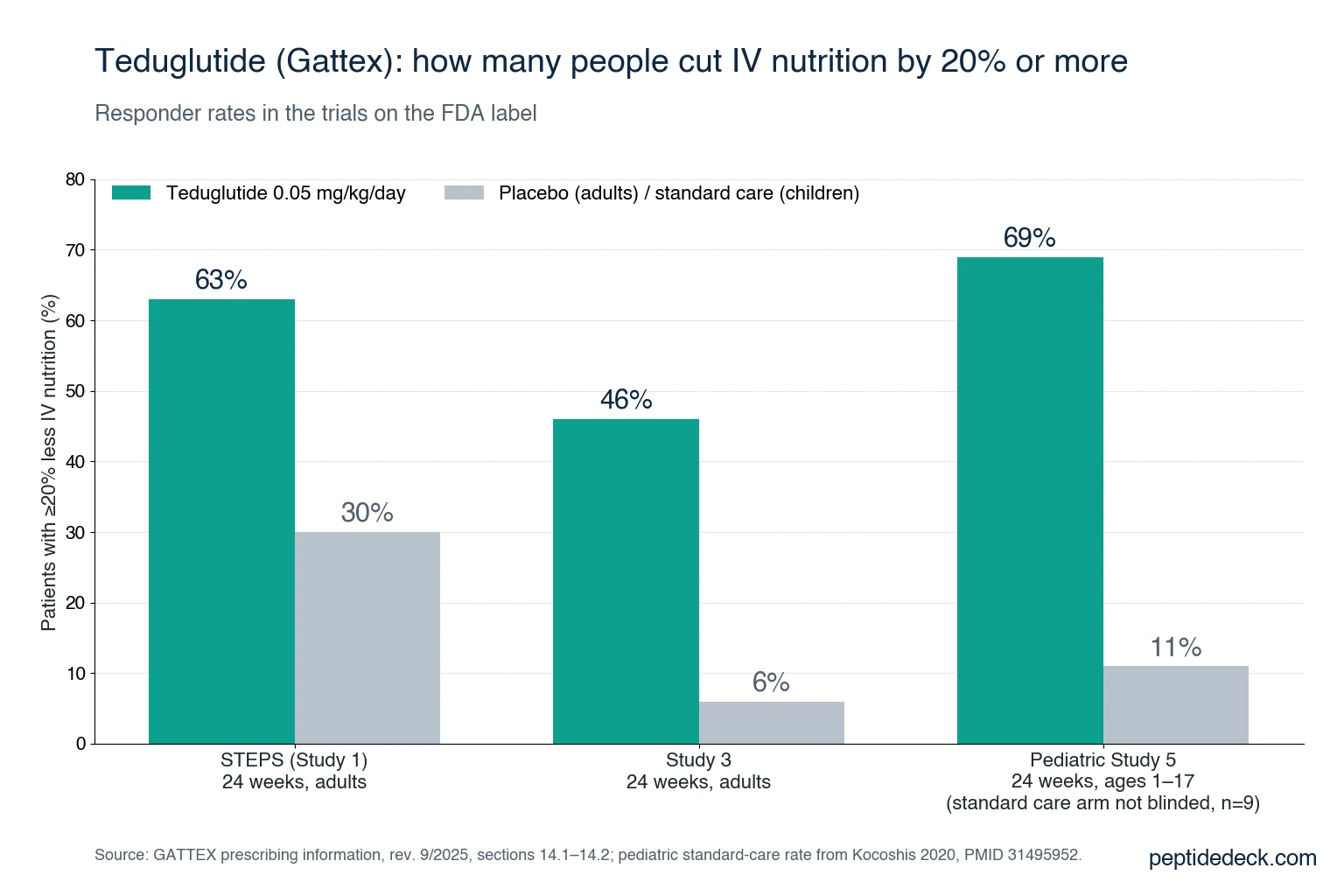
Every number on the label comes from people on IV support. The trials adjusted IV volumes down every few weeks when urine output showed the gut was absorbing more. A "responder" was anyone whose weekly IV volume fell by 20% or more by weeks 20 and 24.
STEPS: the trial behind the approval
STEPS randomised 86 adults, 43 to teduglutide 0.05 mg/kg a day and 43 to placebo, for 24 weeks (Jeppesen, Gastroenterology 2012). They had needed IV support for a mean of 6 years.
- Responders: 27 of 43 (63%) on teduglutide vs 13 of 43 (30%) on placebo.
- IV volume: down 4.4 L a week from a baseline of 12.9 L, against 2.3 L on placebo.
- Days off the pump: 54% on teduglutide dropped at least one IV day a week, against 23% on placebo.
Study 3: the earlier trial
Study 3 tested two doses in 83 adults. At the approved 0.05 mg/kg dose, 46% responded against 6% on placebo, and both doses cut IV needs by 2.5 L a week against 0.9 L on placebo. Two people on the approved dose came off IV support by week 24. Its main score, a graded response scale, was significant for the approved dose (16 of 35) but not for the double dose (8 of 32), which is why the double dose is not on the label (Jeppesen, Gut 2011).
STEPS-2: two and a half years on the drug
This is the result most people want. Thirty adults stayed on teduglutide for 30 months in total (Schwartz, Clin Transl Gastroenterol 2016).
- 28 of 30 (93%) reached the 20% cut.
- Weekly IV volume fell by a mean of 7.6 L, a 66% reduction.
- 10 of the 30 came off IV support completely. They had needed it for between 1.2 and 15.5 years.
- 70% dropped at least one IV day a week, and 60% dropped three.
One caution about that 93%. It counts the people who completed 30 months, and people who drop out of long studies tend to be the ones it is not helping. Of all 88 people who entered the extension, 65 (74%) finished.
Children
The children's trial enrolled 59 patients aged 1 to 17 (Kocoshis, JPEN 2020). On the approved dose, 18 of 26 (69%) cut IV support by 20% or more at 24 weeks, against 1 of 9 (11%) on standard care. Three of the 26 reached enteral autonomy, meaning no IV support at all, and IV volume fell by a mean of 42%.
The benefit does not always last after stopping. In the follow-on study, 13 of the 15 children who had responded and then stopped needed the drug again.
What the evidence does not show. These are small trials: 86, 83 and 59 people. They were company-run: employees of NPS Pharmaceuticals and Shire, both now part of Takeda, are among the authors of the long-term and children's papers. The children's comparison group was not blinded. And a 20% cut, the bar for "response", still leaves most people on some IV support. None of this makes the results doubtful, but it is why the label talks about reducing IV support rather than replacing it.
Teduglutide dose by body weight
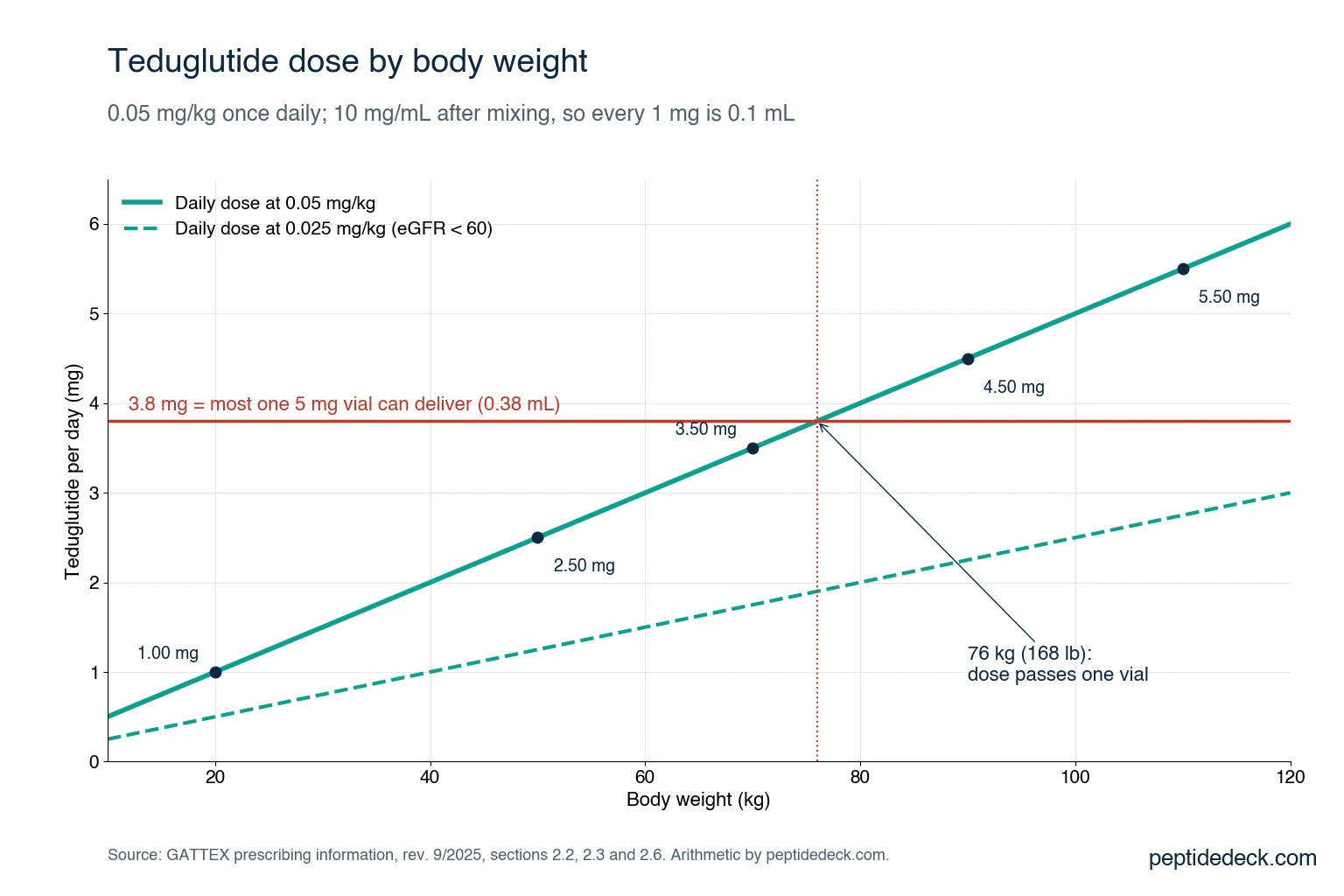
The dose is one number times your weight. The label dose is 0.05 mg per kilogram once a day, for adults and children alike. With moderate or severe kidney impairment (eGFR under 60), it is halved to 0.025 mg/kg.
After mixing, each vial holds 10 mg per mL, so every 1 mg is 0.1 mL. The table below is that arithmetic for common weights; your prescription and the pharmacy's dosing sheet are what count.
Notice the row at 76 kg. The label says a maximum of 0.38 mL, holding 3.8 mg, can be drawn out of one vial after mixing. At 0.05 mg/kg, anyone heavier than about 76 kg (168 lb) needs more than that. The label does not spell out how those doses are supplied, so ask the prescriber or the specialty pharmacy how many vials your daily dose uses; it also changes the cost.
How the injection is given
- Mixing: inject the 0.5 mL of sterile water slowly, let it stand 30 seconds, roll the vial gently for 15 seconds, then let it stand 2 minutes. Never shake it.
- Timing: inject within 3 hours of mixing and throw away what is left.
- Where: under the skin of the belly, thigh or upper arm, rotating sites.
- Missed dose: take it as soon as you can that day. Never two doses in one day.
- Storage: once dispensed, the kits keep at room temperature up to 25°C (77°F) with a 90-day use-by date. Do not freeze.
- Children under 10 kg: the label does not recommend the 5 mg kit.
Teduglutide side effects and warnings
Most side effects sit in the belly. The table shows the reactions that were at least 5% more common on teduglutide than placebo in the two adult placebo trials (77 people on the drug, 59 on placebo).
Among people with a stoma, stoma complications were also more common on the drug. The bigger questions are the five warnings on the label.
1. Growth of polyps and tumours
A drug that makes gut lining grow could also feed growth that is already there. So the label asks adults for a colonoscopy and an upper endoscopy, with any polyps removed, within 6 months before starting. Both are repeated after 1 year, then at least every 5 years. Children get a stool blood test before starting and every year, and a colonoscopy or sigmoidoscopy after 1 year and every 5 years after. If a gut cancer is found, teduglutide is stopped.
In the adult placebo trials, polyps turned up in 1 of 109 people on teduglutide 0.05 mg/kg and 1 of 59 on placebo. Twelve more cases appeared in the longer extensions, and postmarketing reports include polyps of the colon, stomach and small intestine.
2. Intestinal obstruction
The label reports blockages of the intestine or stoma in trials. If one happens, the drug is paused while it is assessed.
3. Gallbladder, bile duct and pancreas
Bilirubin, alkaline phosphatase, lipase and amylase are checked before starting and every 6 months. Gallbladder and pancreas problems were reported in the trials.
4. Fluid overload and heart failure
Absorbing more fluid can mean too much fluid. In the adult placebo trials, swelling of the legs was reported in 10% on the drug against 3% on placebo, and there were 2 cases of congestive heart failure on teduglutide. IV volumes are adjusted as absorption improves, which is why the dose of IV support is reviewed regularly.
5. Other medicines absorb better too
If the gut absorbs more fluid, it can absorb more of your tablets. The label names benzodiazepines as an example and says doses of other oral medicines may need lowering.
Two more points sit on the label. Antibodies to teduglutide were found in 48% of adults by month 30, with no link to side effects or lost effect. And stopping the drug can upset fluid and electrolyte balance, so the label calls for monitoring after it ends.
How much does Gattex cost?
One vial is one day. On 27 October 2026, WebMDRx listed a single 5 mg Gattex kit at $1,957 to $1,979 with its coupon at three national pharmacy chains, against $3,452 to $3,489 without it (WebMDRx).
At the coupon price, 30 days is about $59,000 and a year about $715,000, before any second vial for people over 76 kg. Almost nobody pays that in cash. Gattex is usually covered through insurance and dispensed by a specialty pharmacy after prior authorisation, so ask the prescriber's office about coverage and the manufacturer's patient support before the price decides anything.
Teduglutide vs BPC-157 for the gut
The two get searched together a lot. Both are peptides people link to "healing the gut". They are not alternatives, and the gap between them is large.
BPC-157's gut story rests on lab and early data, which we lay out in BPC-157 for gut health. If BPC-157 is the reason you are reading, our guide on where to buy BPC-157 legally explains the compounding-pharmacy route and its limits. Nobody with short bowel syndrome should swap a prescribed GLP-2 drug or IV support for it.
Newer GLP-2 drugs: glepaglutide and apraglutide
The daily injection may not be the last word. Two longer-acting GLP-2 drugs are close, and neither is approved in the US.
- Glepaglutide (Zealand Pharma), twice weekly. The FDA turned it down in December 2024 and asked for another trial (Zealand, 2024). In Europe it went the other way: on 17 September 2026 the EMA's committee recommended approval, under the name Zeydovio, as a 10 mg pre-filled pen for adults with short bowel syndrome (EMA). The European Commission's final decision was still pending in late October 2026. The US confirmatory trial, EASE-5, is enrolling.
- Apraglutide (Ironwood), once weekly. Its Phase 3 STARS trial in 163 adults cut weekly IV volume by 26% against 13% on placebo at 24 weeks (AGA News, October 2026). In April 2025 the FDA asked for a confirmatory trial, because the doses actually delivered in STARS were lower than planned (Ironwood, April 2025). That trial, STARS-2, is now recruiting (Ironwood, August 2026).
For now, teduglutide is still the only GLP-2 drug you can be prescribed in the US.
What to ask your doctor about teduglutide
- Is my IV support stable enough to start, and how will my volumes be adjusted?
- When are my baseline colonoscopy, endoscopy and blood tests, and who books the follow-ups?
- Does my kidney function call for the 0.025 mg/kg dose?
- How many vials does my daily dose use at my weight?
- Which of my other medicines might need a lower dose as absorption improves?
- What signs of fluid overload or blockage should make me call you the same day?
- What is the plan if I respond, and what happens if I stop?
Do not stop or change prescribed IV support, or any medicine, without your care team.
Frequently Asked Questions
Sources
- GATTEX (teduglutide) for injection, prescribing information, revised 9/2025. accessdata.fda.gov
- Jeppesen PB et al. Teduglutide reduces need for parenteral support among patients with short bowel syndrome with intestinal failure (STEPS). Gastroenterology 2012;143:1473-1481. PMID 22982184
- Jeppesen PB et al. Randomised placebo-controlled trial of teduglutide in reducing parenteral nutrition and/or intravenous fluid requirements in patients with short bowel syndrome. Gut 2011;60:902-914. PMID 21317170
- Schwartz LK et al. Long-term teduglutide for the treatment of patients with intestinal failure associated with short bowel syndrome (STEPS-2). Clin Transl Gastroenterol 2016;7:e142. PMID 26844839
- Kocoshis SA et al. Safety and efficacy of teduglutide in pediatric patients with intestinal failure due to short bowel syndrome: a 24-week, phase III study. JPEN 2020;44:621-631. PMID 31495952
- Jeppesen PB. Teduglutide, a novel glucagon-like peptide 2 analog, in the treatment of patients with short bowel syndrome. Ther Adv Gastroenterol 2012;5:159-171. PMC3342570
- Takeda. U.S. FDA approves GATTEX for children 1 year of age and older with short bowel syndrome, May 2019. takeda.com
- WebMDRx. Gattex prices, checked 27 October 2026. webmdrx.com
- Zealand Pharma. FDA issues Complete Response Letter for glepaglutide, 19 December 2024. globenewswire.com
- European Medicines Agency. Zeydovio (glepaglutide): opinion adopted 17 September 2026. ema.europa.eu
- AGA GI and Hepatology News. Weekly apraglutide cuts parenteral support in phase 3 short bowel syndrome trial, October 2026. news.gastro.org
- Ironwood Pharmaceuticals. Clinical and regulatory update on apraglutide, 14 April 2025 (Form 8-K, exhibit 99.1). sec.gov
- Ironwood Pharmaceuticals. Second quarter 2026 results, 6 August 2026 (Form 8-K, exhibit 99.1). sec.gov
Medical Disclaimer: This article is for educational purposes only and is not medical advice. Teduglutide is a prescription medicine for a serious condition that needs a specialist's diagnosis, regular endoscopy and blood tests, and supervised adjustment of IV support. Do not start, stop or change any treatment because of this page.