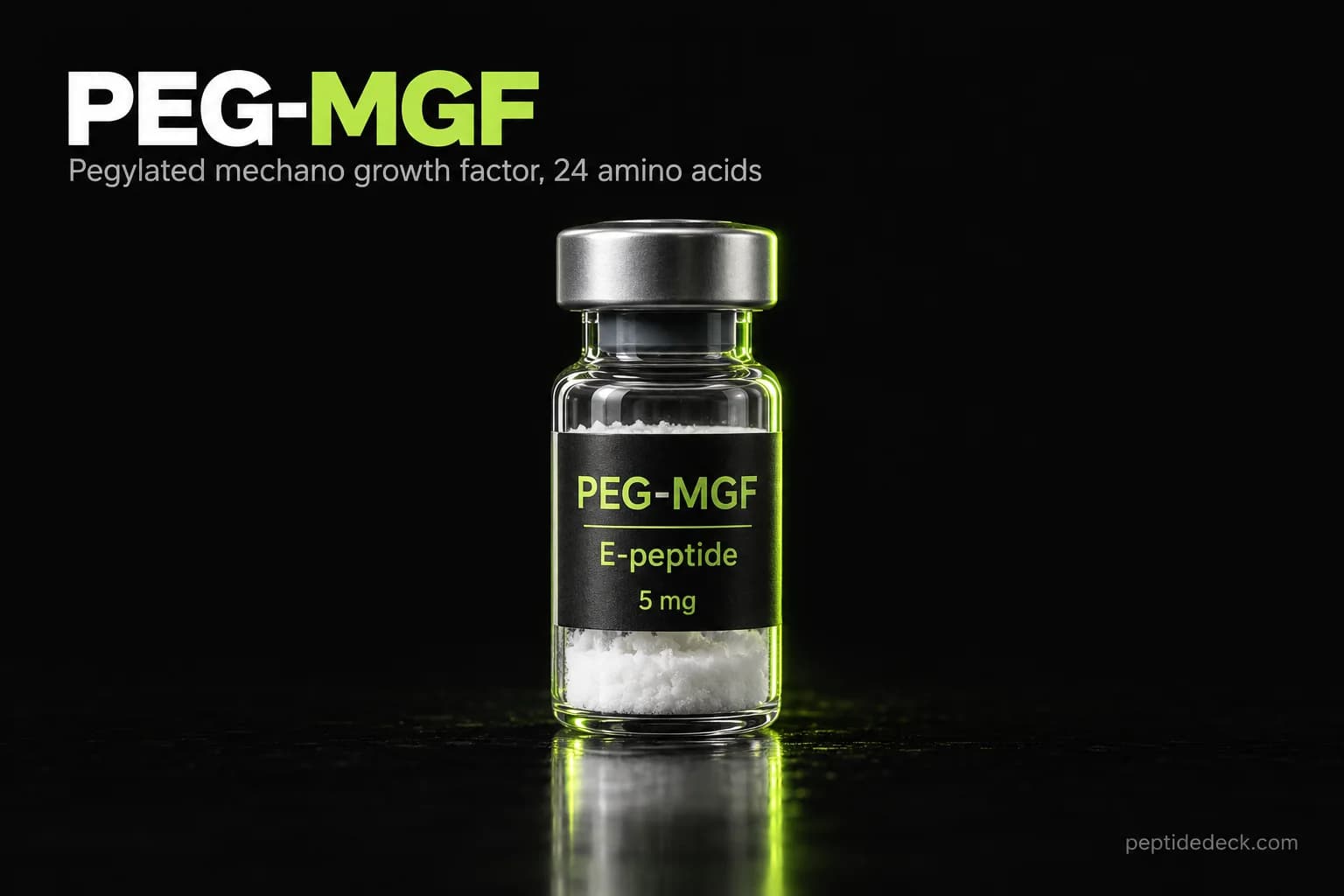

Two drug companies tried to make it work. Nothing happened.
In 2014, scientists at Novartis and a second pharmaceutical company took the 24-amino-acid peptide sold as PEG-MGF peptide — native and a stabilised version — and ran it through the exact experiments its reputation rests on: muscle cell proliferation, muscle cell fusion, primary muscle stem cells, heart-cell signalling. At concentrations up to 500 nanograms per millilitre, it did nothing on any of them, while ordinary IGF-1 worked every time. Their paper ends by asking whether the peptide has any physiological role at all.
If you train hard, you already know the frustrating part of recovery: the signal your body sends to repair a damaged muscle is loud, brief, and then it is over. PEG-MGF is sold as that signal, engineered to stay in the room. Whether the vial contains that signal, and whether the signal does what the guides say, are two different questions — and every page that ranks above this one answers only the first.
🔑 Key Takeaways
- Mechano growth factor is real: your muscle makes a special splice variant of IGF-1 within hours of hard training, and older muscle makes less of it. That part is confirmed in human biopsies.
- What is sold as PEG-MGF is not that growth factor. It is the 24-amino-acid tail clipped from the end of it, with a polyethylene glycol chain attached — a fragment whose activity has been disputed for more than a decade.
- The cell studies the guides quote come from one laboratory tradition. A 2014 replication by two pharmaceutical companies found no effect at all, and independent work found the tail only acts through the IGF-1 receptor it was said to bypass.
- The "5–7 minutes" and "48–72 hours" half-lives on every page have no source. No pharmacokinetic study of PEG-MGF exists.
- Real dosing, real 5 mg vial arithmetic, the one sheep heart study worth knowing, and the honest case for who might still try it, below.
Start with the parent molecule, because the gap between MGF and what is in the vial is the whole story.
What PEG-MGF Peptide Is — and What It Isn't
MGF is a splice variant. PEG-MGF is a fragment of it.
Mechano growth factor, or IGF-1Ec, is a version of the IGF-1 gene that muscle transcribes when it is mechanically strained. The protein it produces has two parts: a mature IGF-1 section, identical to ordinary IGF-1, and a different tail — the E-domain — that gets clipped off during processing. That tail, 24 amino acids long, is what Geoffrey Goldspink's laboratory named "MGF peptide" in the early 2000s, and it is what every vendor sells.
So the vial does not contain mechano growth factor. It contains the fragment that is cut off mechano growth factor, with PEG chains attached. The sequence on the certificate of analysis should read YQPPSTNKNTKSQRRKGSTFEERK, mass about 2,868 daltons before the PEG. The full growth factor, with its IGF-1 half intact, is a different and much larger molecule — one that a 2014 doping-control paper found circulating on the black market precisely because it was undetectable, and that no vendor offers.
Why the distinction matters. The evidence that MGF matters in your body — the exercise response, the age-related decline — is evidence about the whole splice variant being made in muscle. The evidence for the vial is evidence about the 24-amino-acid tail, injected on its own. Those are different claims, and as the next two sections show, the second one is in trouble.
The 2014 Replication Every PEG-MGF Guide Skips
Two companies, every claimed effect, no result.
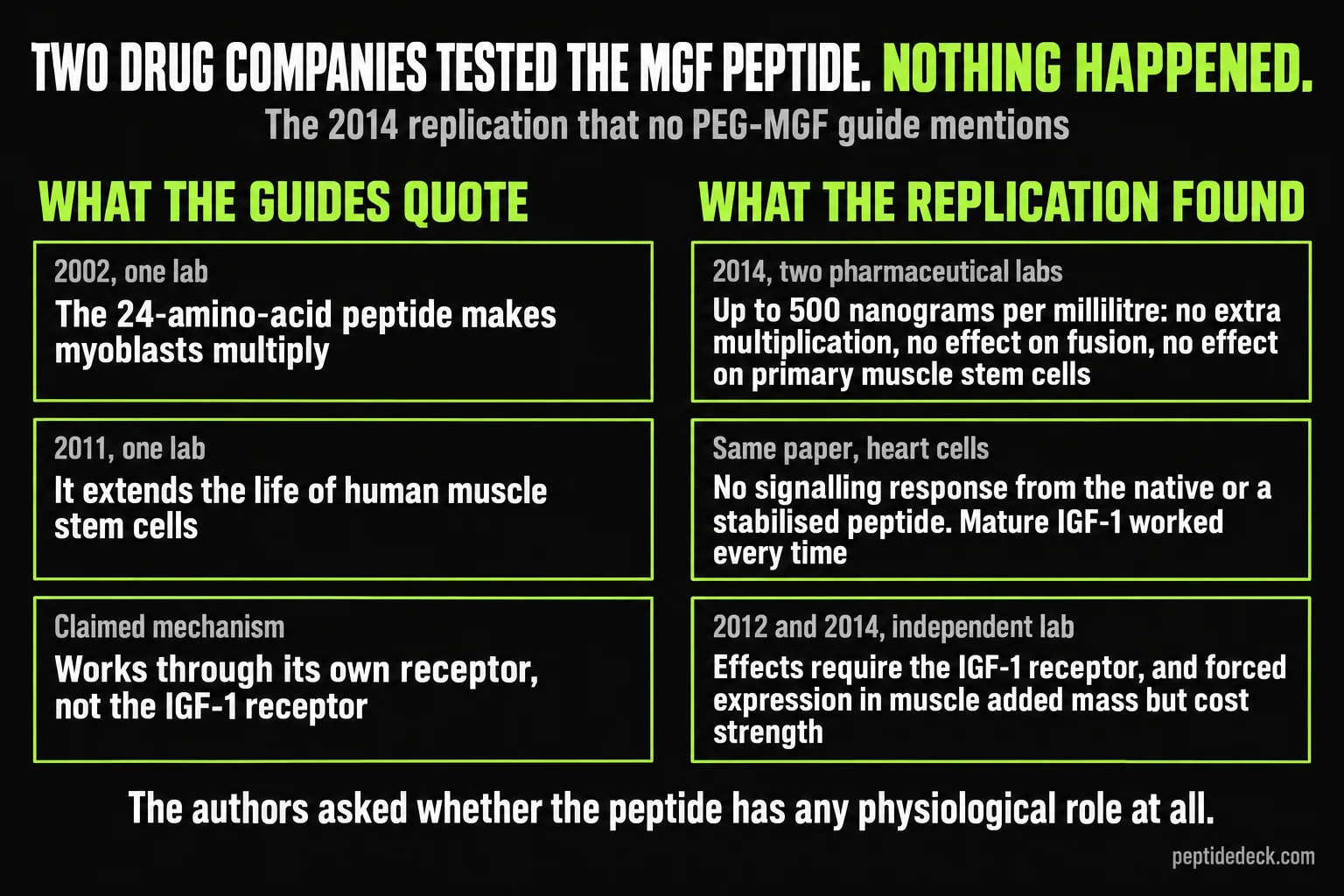
The case for the peptide rests on cell work from the Goldspink group and collaborators. In 2002, the E-domain made mouse myoblasts multiply and delayed their fusion into fibres, and — because an IGF-1 receptor antibody did not block it — was said to act through a different receptor. In 2011, Kandalla and colleagues reported that the 24-amino-acid peptide extended the proliferative life of human muscle stem cells from neonatal and young donors, though notably not from old ones. Those two papers are the source of "satellite cell activation," the phrase on every guide.
In 2014, a team from Novartis Institutes for Biomedical Research and a second pharmaceutical company published an attempt to reproduce them, in the American Journal of Physiology. Their summary is worth reading in full, because no vendor will show it to you:
- At concentrations up to 500 ng/mL, the peptide did not increase proliferation of mouse C2C12 myoblasts or primary human muscle myoblasts. Mature IGF-1 and full-length IGF-1Eb did, in every cell type.
- It did not inhibit myoblasts differentiating into myotubes.
- In primary mouse muscle stem cells — the "satellite cells" of the marketing — it had no significant effect on proliferation or differentiation.
- In heart muscle cells, neither the native peptide nor a stabilised version produced the signalling response previously reported for it. IGF-1 did.
- Their conclusion: the results "call into question whether there is a physiological role for MGF."
Two independent findings sit alongside it. In 2012, Brisson and Barton showed that the E-peptides' effects on myoblasts depend on the IGF-1 receptor after all — they raise the receptor's availability at the cell surface rather than signalling through a receptor of their own. And in 2014 the same group forced muscle to express the E-peptide using a viral vector: the muscle grew larger, but it got weaker. More mass at the expense of strength is not the trade most people buying this are after.
None of this proves the peptide is inert in a person. It means the mechanism the guides describe — a repair signal with its own receptor that wakes satellite cells — did not survive attempts to reproduce it, and the people who tried were the ones with the most to gain from it working.
What the Evidence Does Show
Three things hold up. None of them is the vial.
- Your muscle makes MGF after training, and less of it with age. Hameed and colleagues in 2003 biopsied the thighs of eight young and seven elderly volunteers two and a half hours after heavy knee extensions. MGF transcripts rose significantly in the young and not in the elderly. This is the human biology the whole category leans on, and it is solid — but it is about a gene your muscle switches on, not about a fragment you inject.
- The E-domain protected sheep hearts after an induced infarct. In a 2008 study, sheep given the MGF E-domain after a heart attack kept more cardiac function and had 35% less compromised heart muscle than controls. Later work delivered the peptide from polymer microrods into the heart wall with similar results. This is the strongest live-animal result for the fragment, and it is a cardiology finding with local delivery, not a bodybuilding one.
- The E-peptide did things in rabbit bone and in ischaemic brain. A 2011 rabbit study reported faster bone-defect healing, and a 2005 study reported neuroprotection after brain ischaemia. Both are single studies, neither in muscle.
What does not exist: any human trial of PEG-MGF, any measurement of strength or muscle size after injecting it in anyone, and any pharmacokinetic study of the pegylated molecule. A 2026 review in Frontiers in Endocrinology that tiered performance peptides by evidence placed PEG-MGF alongside IGF-1 LR3 in the group defined by the complete absence of human studies.
The Half-Life Nobody Measured
Forty-eight to seventy-two hours. Says who?
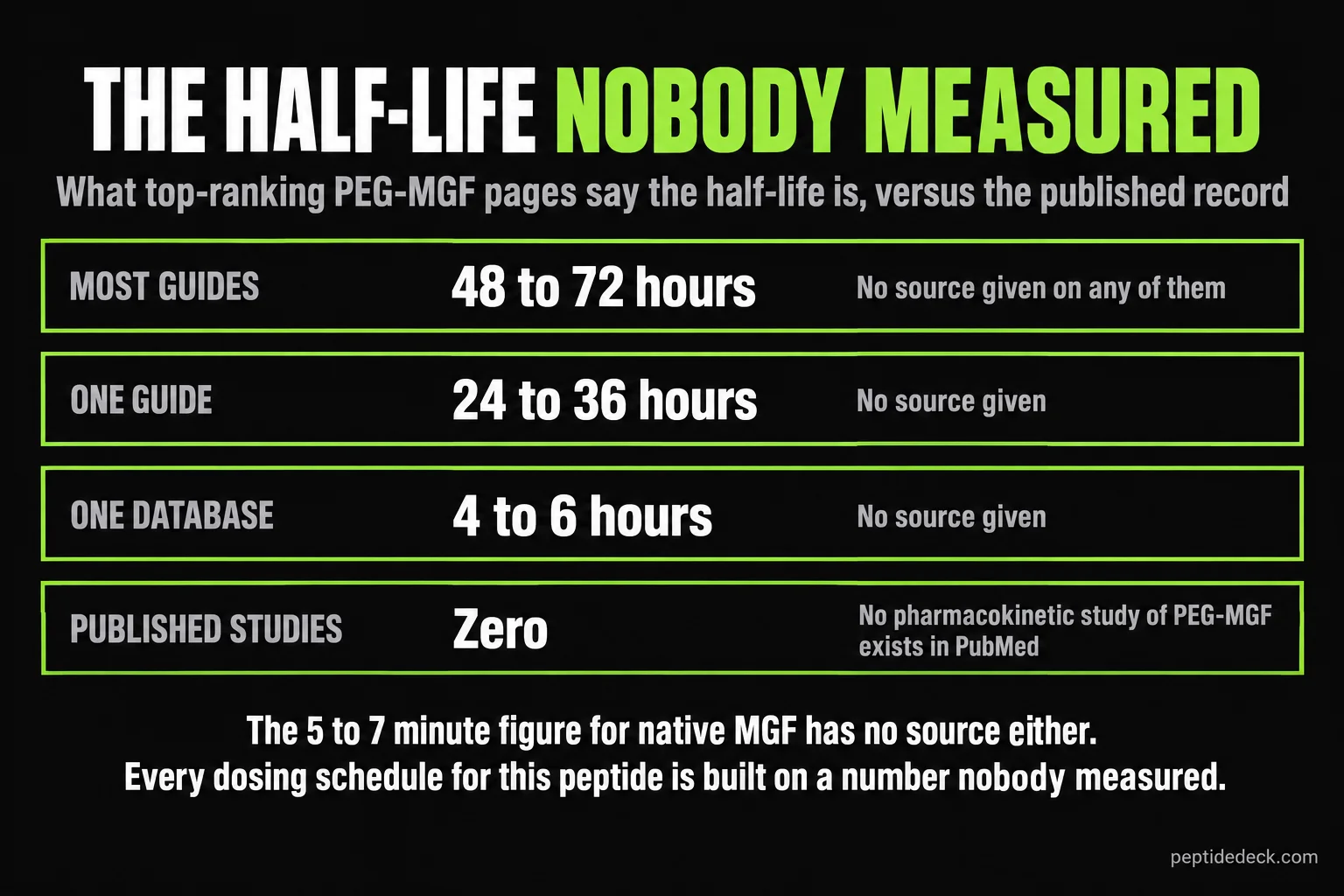
Every guide on the first page gives native MGF a half-life of five to seven minutes and PEG-MGF a half-life of 48 to 72 hours. One gives 24 to 36 hours. A peptide database gives four to six. None cites a source, and there is none to cite: a search of the literature for PEG-MGF turns up one paper, the 2026 review above, which mentions it in a list. The pegylated IGF-1 that has been studied in people is a different molecule from a different company.
Pegylation does extend the life of small peptides — that principle is well established and is why the guides' numbers are plausible. But plausible is not measured, and the whole architecture of "two to three times a week" is built on top of a figure somebody once estimated. Treat the schedule below as convention, not pharmacology.
PEG-MGF vs MGF vs IGF-1 LR3
These three get treated as interchangeable. They are not.
If the goal is more muscle across the whole body, IGF-1 LR3 is the more direct tool and has the better-characterised pharmacology; our IGF-1 LR3 dosage and cycle guide goes deeper than this page does. PEG-MGF is sold as the targeted repair partner to it. That pairing has a rationale, and no data.
What People Take PEG-MGF For
The list is long. The support is thin.
Satellite Cell Activation
The core claim: waking the muscle stem cells that donate new nuclei to repaired fibres. Reported by one lab tradition in 2002 and 2011, not reproduced by two drug companies in 2014.
Heart Protection
The one live-animal result that holds: 35% less compromised heart muscle in sheep given the E-domain after an infarct. A cardiology finding, delivered locally, in sheep.
Aging Muscle
The clearest theoretical case, since older muscle makes less MGF after training. But in the 2011 cell study, the peptide extended the life of young donors' stem cells and not old donors' — the opposite of what the use case needs.
One more claim needs its own line. A page ranking for this term promises "8 to 18 pounds of muscle" in an eight-to-ten-week cycle with "80 to 90 percent retained." That number comes from nowhere. No study has ever weighed a person before and after PEG-MGF. The best-known guide in the category, from a writer who sells peptides for a living, ends with the sentence that he does not endorse PEG-MGF for anyone seeking serious muscle gains. He is right.
PEG-MGF Dosage Protocol
Protocols cluster tighter than the evidence would justify.
The range below is what people actually do, drawn from the pages that rank and the forums behind them. It is not derived from a study, because there is none, and the frequency is derived from a half-life nobody measured.
Cycle length. Four to six weeks is the common block, with eight as the ceiling most guides set. The claimed multi-day half-life is the argument against dosing more than three times a week: you stack an active compound on itself. A typical pattern is four weeks on, four off, rotating with IGF-1 LR3 or BPC-157 depending on the goal.
Warning: PEG-MGF has no approved medical use anywhere and no established human dose. Everything above reflects what people do, not a clinical recommendation. It has been on the World Anti-Doping Agency's prohibited list since 2005, so anyone who competes in tested sport should treat a positive as the likely outcome. Work with a qualified clinician before starting, particularly if you manage blood sugar.
Mixing a 5 mg Vial: The Actual Numbers
Vial arithmetic is where most people stall.
A 5 mg vial holds 5,000 mcg. How much bacteriostatic water you add does not change the total — it changes how many units on the syringe equal a dose. Two mixing volumes cover almost every protocol.
The 2 mL mix gives cleaner round numbers; the 3 mL mix gives finer control between steps. How long the vial lasts:
- 200 mcg, 2×/week = 400 mcg weekly → about 12 weeks per vial.
- 300 mcg, 3×/week = 900 mcg weekly → about 5.5 weeks per vial.
- 400 mcg, 3×/week = 1,200 mcg weekly → about 4 weeks per vial.
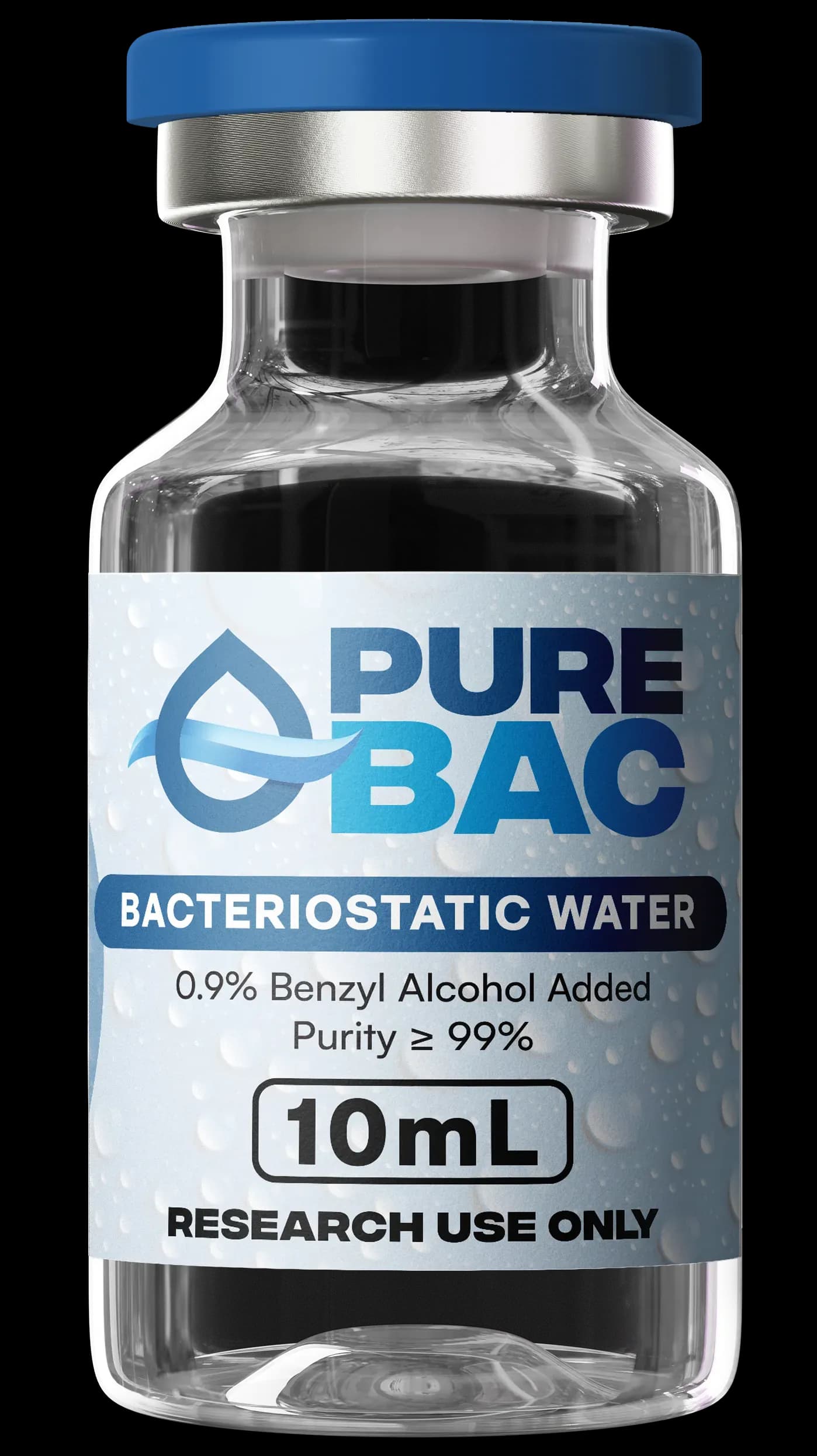
A single 5 mg vial covers a full four-to-six-week block even at the top of the range. Reconstituted peptide keeps for roughly four weeks refrigerated, so at the conservative end you may finish the vial after it has passed its useful window — plan the mix around the protocol, not the other way round. Our reconstitution guide covers the technique, and the bacteriostatic water guide explains why the preservative matters.
Side Effects
The track record is short, and what exists is self-reported.
- Injection site reactions. Redness and mild swelling, usually settling within a day or two. The PEG chain itself can provoke a reaction in people sensitised to it.
- Low blood sugar. The most practically relevant one. If the peptide does what its sellers say and raises IGF-1 receptor activity, it can pull glucose down; if it does nothing, it will not. Dose around a meal rather than fasted either way.
- Fatigue and mild water retention. Commonly reported in the first week or two, and typical of the IGF-1 family generally.
- Unwanted tissue growth. A theoretical concern with anything that touches IGF-1 signalling, and the reason people with a cancer history are told to stay away. Not documented for PEG-MGF at these doses, but nothing about PEG-MGF is documented at these doses.
- Mass without strength. The one live-animal muscle result for the E-peptide, from 2014, was larger muscles that were weaker. It came from forced gene expression rather than injection, so its relevance is uncertain — but it is the only in-vivo muscle finding there is, and it points the wrong way.
Is PEG-MGF Worth It?
For most people, no — and the reason has changed.
The old argument against it was the absence of human data, which is true of nearly every peptide in this category. The stronger argument is that the cell-level mechanism, the only evidence the product ever had, did not reproduce when two pharmaceutical companies tried, and that the receptor story underneath it turned out to be wrong. BPC-157 and TB-500 are also unproven in people, but their animal record is broad and repeatedly replicated across laboratories. PEG-MGF's is narrow and contested at the source.
Where a case remains:
- You are working through a muscle–tendon junction injury that has stalled in the remodelling phase, BPC-157 or TB-500 has already done its part, and you are prepared to run an experiment on yourself with an honest baseline.
- You already run a structured protocol, you track outcomes, and you have room for something speculative at $95 for a six-week block.
If neither describes you, put the money into training, sleep and protein. The one human finding in this entire story — that heavy resistance exercise switches on MGF in your own muscle — is available at no cost.
Where to Buy PEG-MGF Peptide
Fewer vendors stock it than stock BPC-157, and purity varies more.
Pegylated compounds are harder to make consistently, and the PEG chain is where quality slips. Before buying, insist on three things:
- A lot-matched certificate of analysis. Not a generic PDF for the product line — one tied to the number on your vial. How to read a peptide COA covers what a real one shows.
- The sequence on it. YQPPSTNKNTKSQRRKGSTFEERK, base mass about 2,868 daltons. A vendor that cannot tell you what is in the vial is selling the name.
- Independent testing. In-house numbers are a starting point, not verification.
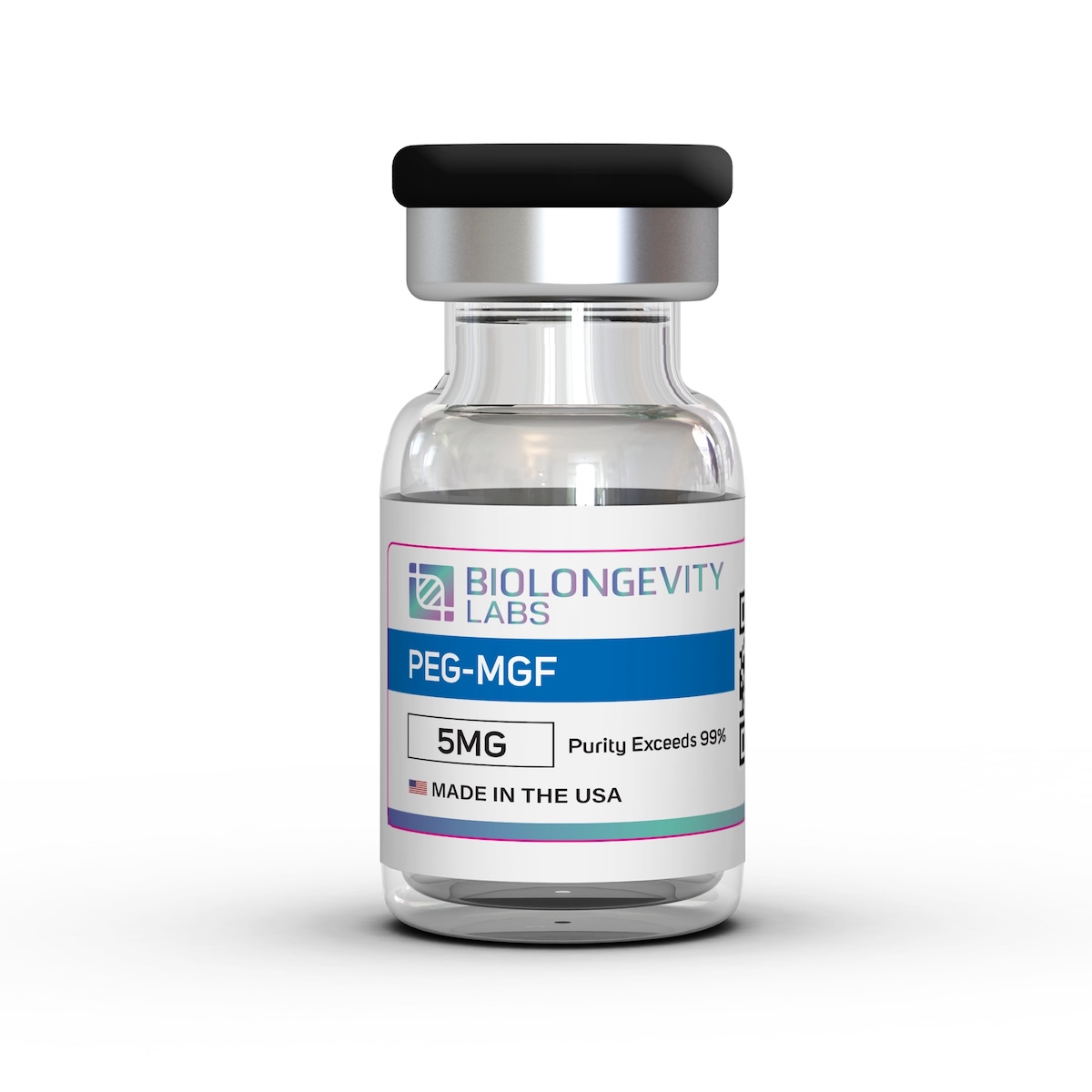
BioLongevity Labs lists PEG-MGF as a 5 mg vial at $94.97, with the sequence stated on the page and certificates from three named laboratories. It is also honest about the vial: its listing describes a 24-residue peptide from the E-domain, which is more than most vendors admit. For a wider view of who is worth ordering from, our peptide vendor comparison covers the sources we have checked directly.
Before you order: PEG-MGF is not an approved medication anywhere, its legal status for personal purchase varies by country, and it is prohibited in tested sport. Check the rules where you live, and speak to a clinician who knows your history first.
The Bottom Line on PEG-MGF Peptide
Real gene, disputed fragment, unmeasured half-life.
The fair version: mechano growth factor is a genuine piece of muscle biology, your body makes less of it as you age, and the E-domain fragment has one solid animal result in sheep hearts and single studies in bone and brain. The vendor we link states the sequence and tests the vial, which is more than most.
The equally fair version: what you inject is a 24-amino-acid tail, not the growth factor; the satellite-cell mechanism it is sold on did not reproduce in two pharmaceutical laboratories; the receptor it was said to use turned out to be the IGF-1 receptor after all; the only muscle result in a living animal was mass without strength; and every dosing schedule, including the one above, sits on a half-life no one has measured.
If you buy it, buy it as an experiment with a baseline, not as a shortcut. The one part of this story with human evidence is the part you get from lifting.
Frequently Asked Questions
Medical Disclaimer: This content is for informational purposes only and does not constitute medical advice. PEG-MGF has no approved medical use, no established human dose, and no published human safety data. Always consult a qualified healthcare provider before starting any new supplement, medication, or treatment. PeptideDeck may earn a commission from affiliate links at no additional cost to you.