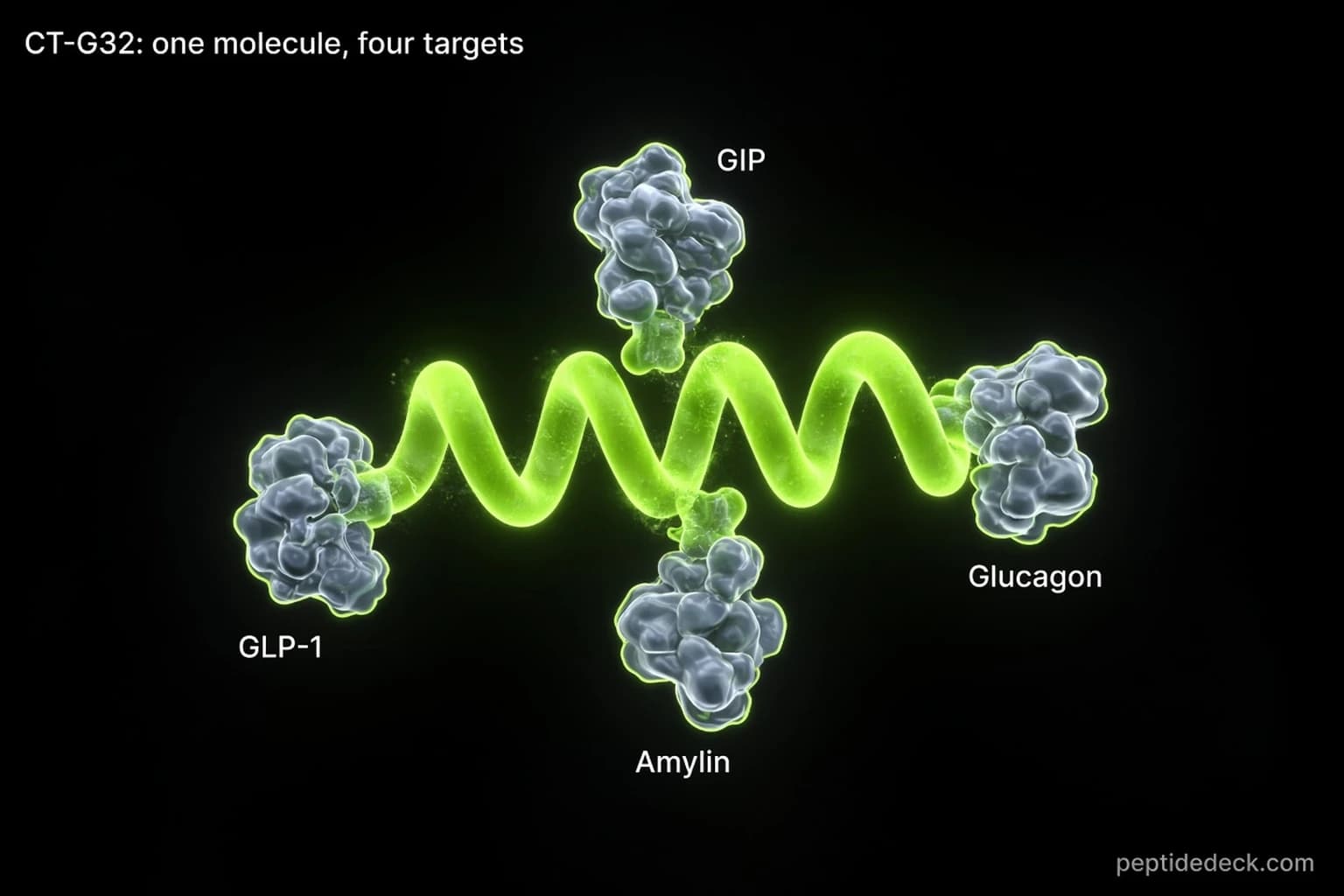
Nobody has taken CT-G32 yet. Not in a trial, not anywhere. CT-G32 is the obesity drug candidate from South Korea's Celltrion and Japan's SCOHIA Pharma, designed as one molecule that switches on four appetite and metabolism hormones at once: GLP-1, GIP, glucagon and amylin. Its first data were shown on November 3–5, 2026 at TIDES Europe in Amsterdam, and the first human dose is planned for the second quarter of 2027 (SCOHIA Pharma, Nov 4 2026; Celltrion, Nov 4 2026).
🔑 Key Takeaways
- CT-G32 (also coded SCO-940) is an injectable, planned once-weekly peptide from Celltrion (Incheon, South Korea) and SCOHIA Pharma (Fujisawa, Japan).
- The TIDES Europe data compared it with retatrutide in lab animals. The one word SCOHIA used that Celltrion's Korean release left out changes how strong that claim is.
- Neither company has published a single efficacy percentage. We list exactly what was and was not disclosed.
- The human bar it has to clear: retatrutide's −25.0% at 80 weeks in NEJM, and a lean-mass share below roughly 25–35%.
- Three things reported about CT-G32 in the Korean press contradict each other. We untangle them, with sources.
If you have followed the weight-loss drug race, you already know the pattern. Each new generation adds a hormone, and each one has lost more weight in trials than the last: semaglutide hits one receptor, tirzepatide two, retatrutide three. CT-G32 is the first publicly named candidate built to hit these exact four in a single molecule, and it is why attention, and trading volume, jumped on a company best known for biosimilars in the two days after the data.
This page collects every verifiable number about CT-G32 in one place, from Celltrion's and SCOHIA's own releases, Korean-language press, Korea's DART disclosure system, Naver Finance price data and the peer-reviewed trials it will be judged against. Each figure links to its source. Where reports conflict, we say so.
What is CT-G32?
CT-G32 is a peptide. More precisely, it is a single engineered peptide chain that acts as an agonist (an activator) at four receptors that gut and pancreatic hormones normally switch on after a meal. Celltrion calls it a "first-in-class" drug and SCOHIA's partner code for the same molecule is SCO-940, which is why most recent coverage writes it as CT-G32/SCO-940 (SCOHIA).
It is being developed for obesity first, with metabolic disease as the stated next step. Celltrion has said it wants the drug to tackle two problems with today's GLP-1 medicines: the wide spread in how much individual patients lose, and the muscle that goes with the fat (Celltrion KR release).
What Celltrion and SCOHIA showed at TIDES Europe 2026
The headline is a comparison with retatrutide. Retatrutide is Eli Lilly's GLP-1/GIP/glucagon triple agonist and the strongest weight-loss drug yet reported in a Phase 3 trial, so it is the obvious benchmark.
The presentation covered three sets of results (SCOHIA, Nov 4 2026):
- Receptor activity. Cell-based tests of how strongly CT-G32 activates each of its four receptors.
- Weight, body composition and insulin in diet-induced obese (DIO) lab animals, compared with retatrutide at the same molar dose.
- Pharmacokinetics in non-human primates, which showed "prolonged systemic exposure" and, in SCOHIA's words, "the potential for the development of a once-weekly dosing formulation".
Here is the detail that matters if you are going to quote the result. SCOHIA's English release says CT-G32 "achieved numerically greater weight loss at the same molar dose compared with retatrutide". Celltrion's Korean release says only "더 큰 체중 감량 효과" ("a greater weight-loss effect"), without the "numerically" qualifier (Celltrion KR, Nov 4 2026). "Numerically greater" is the phrase companies use when a difference was seen but was not shown to be statistically significant.
No efficacy percentage has been published. A Celltrion spokesperson told Korea Biomedical Review that "detailed numerical results were disclosed only at the conference" (KBR, Nov 4 2026). Financial Post Korea reported the same day that Celltrion did not disclose the weight-loss rate, the number of animals or statistical significance (FP Korea). As of November 6, 2026, we found no poster or abstract text online.
One more piece of context. Before November, Celltrion's comparator was anonymous. In May it was "a benchmark candidate previously under development", and in July "a triple agonist being developed by a global pharma company". TIDES is the first time retatrutide was named (Celltrion, May 29; Biospectator, Jul 29).
Why four hormones instead of one?
Each hormone pulls a different lever. That is the whole bet. GLP-1 drugs mostly work by making you less hungry, and adding partners lets a single injection also act on fullness, energy use and fat burning in the liver. Here is what each of CT-G32's four targets does, and which approved or late-stage drug already uses it.
Every combination in that table except the full set of four has already been tested in people. Amylin is the piece retatrutide lacks, and amylin-based drugs are being developed partly in the hope of a better ratio of fat to muscle lost, which is the same claim Celltrion is now making for CT-G32. Our guides to retatrutide, amycretin and CagriSema cover each of the ingredients in human trials.
The bar CT-G32 has to clear in people
Animal wins often shrink in humans. So the useful comparison is not CT-G32 against retatrutide in a lab, but against what the drugs ahead of it achieved in large trials. The figures below are the paper's primary (treatment-regimen) results, which count people who stopped treatment. Company headlines often quote the higher "efficacy estimand" instead: Lilly's 28.3% for retatrutide and 22.5% for tirzepatide are that kind of number.
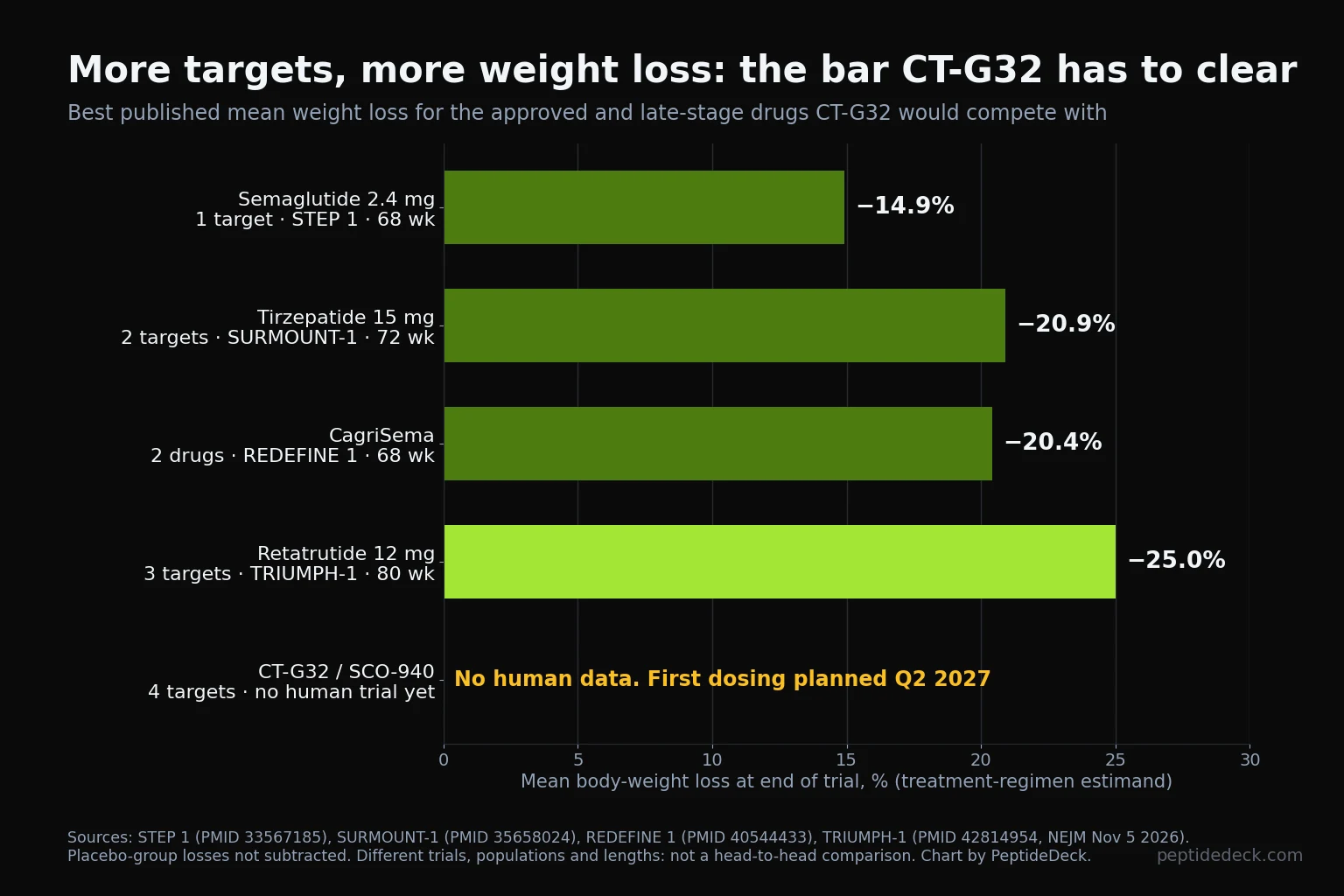
Two honest caveats. These are different trials in different populations and lengths, so the column is a ladder, not a head-to-head league table. And the amycretin figure comes from a small early trial; early numbers usually fall in larger Phase 3 studies. Even so, the takeaway is plain: by the time CT-G32 could finish Phase 3, a quarter of body weight will be the number reporters compare it to.
The muscle question: Celltrion's main selling point
Losing weight fast means losing some muscle. Anyone who has watched a friend on a GLP-1 drug get thinner in the face and arms has seen it. Scans measure this as "lean mass", which also includes water and organs, and the share of weight lost that comes from lean mass is how trials compare drugs.
A 2026 meta-analysis of 20 randomised trials with 15,782 people put the lean-mass share at 35.2% for semaglutide, 25.4% for tirzepatide and 26.8% for liraglutide, against 26.2% for diet-and-exercise programmes and 17.5% when resistance training was added (Diabetes Obes Metab 2026, PMID 41877354). In the SURMOUNT-1 body-scan substudy of 160 people, tirzepatide users lost 33.9% of their fat mass and 10.9% of their lean mass, so about 75% of the weight lost was fat and 25% lean (PMID 39996356). A separate systematic review of 35 trials found a median of 28.3% (Ann Intern Med 2026, PMID 41996180).
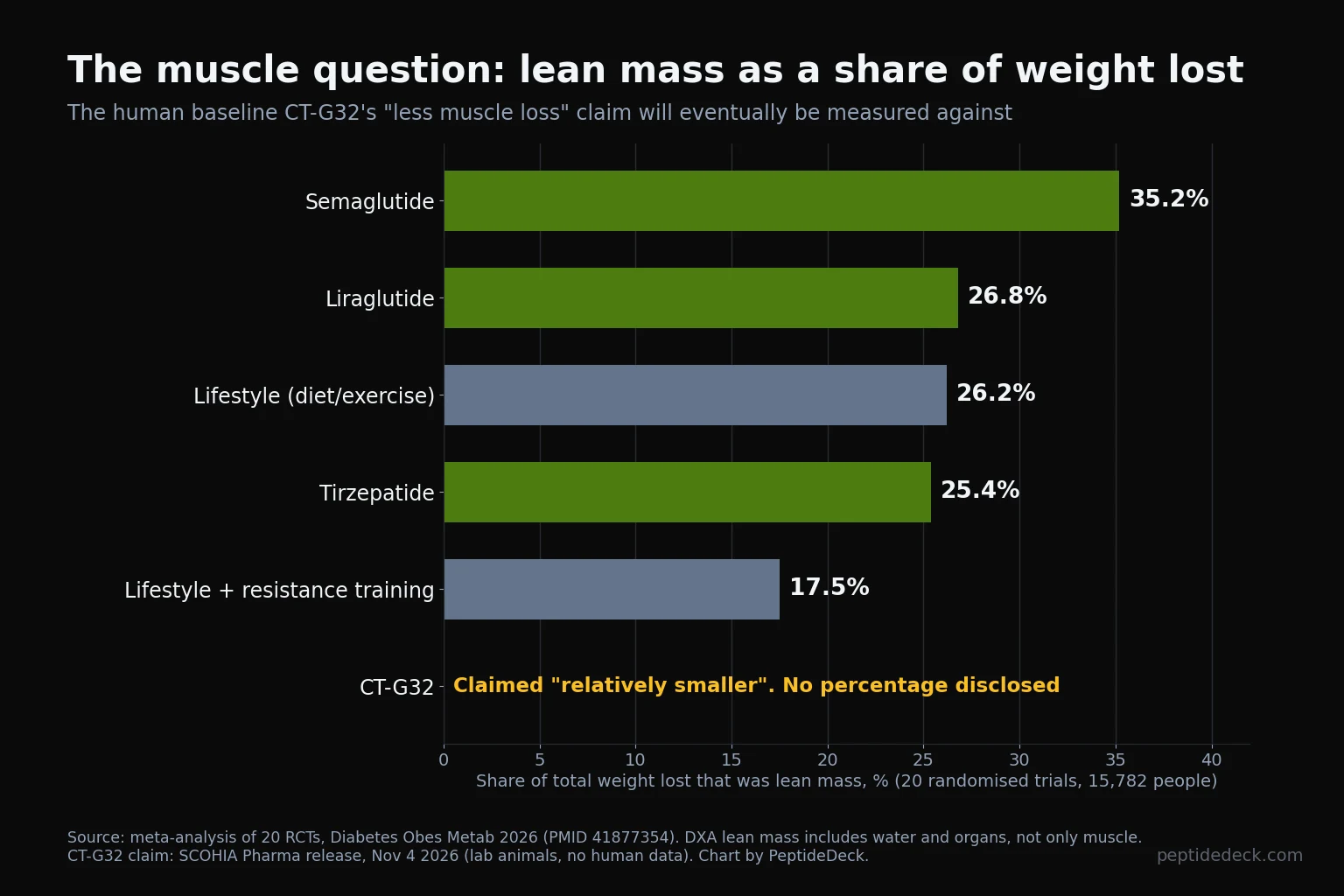
So what would "less muscle loss" have to mean in people? Roughly, a lean-mass share clearly below the 25% tirzepatide already achieves. CT-G32's evidence for that so far is one phrase about lab animals. That is a reason to watch the Phase 1 body-composition data in 2027, not a result. If muscle preservation is the problem you care about, our page on HM500197, Hanmi's muscle-sparing candidate, covers a different approach to the same goal.
CT-G32 timeline: every dated milestone
The schedule has moved forward twice. At the J.P. Morgan conference in January 2026, Celltrion pointed to an IND in the second half of 2027 (Biospectator, Jan 2026). From February to May the target was the first half of 2027, and since July it has been February 2027 (Celltrion, Feb 24; Asia Business Daily, Jul 29).
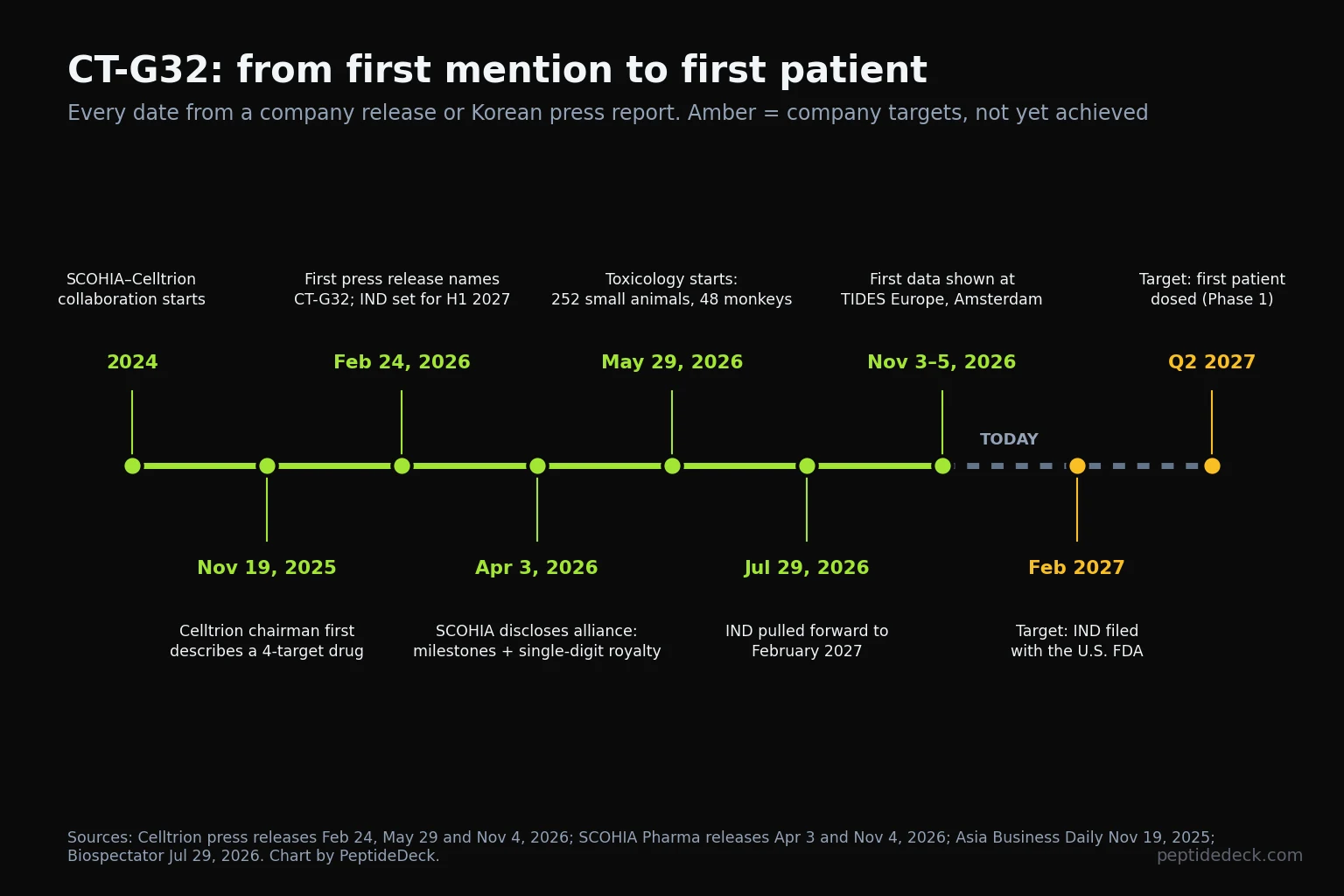
When could it reach pharmacies? Neither company has named a year. The industry average from the start of Phase 1 to approval is 10.5 years, and 9.5 years for metabolic drugs, according to the largest public dataset on drug development (BIO, Informa and QLS, 12,728 phase transitions, 2011–2020; PDF). Applied to a Q2 2027 start, the average points to the mid-2030s. Obesity drugs have recently moved faster than average, so treat that as a reference point, not a forecast.
The same dataset puts the chance that a drug entering Phase 1 is eventually approved at 7.9% across all diseases, 15.5% for metabolic and 6.6% for endocrine drugs. CT-G32 has not yet entered Phase 1.
The Celltrion–SCOHIA deal
The money terms are thin. SCOHIA's April 2026 Japanese-language release says it is entitled to "multiple milestone payments according to R&D progress" and a "single-digit percent royalty" on Celltrion's future sales (SCOHIA, Apr 3 2026). No upfront payment or milestone total has been disclosed. The licence does not appear in the licensing tables of Celltrion's 2025 annual report or its 2026 half-year report on DART, Korea's corporate filing system (FY2025; H1 2026).
The roles have shifted over time. In April, SCOHIA was described as leading discovery and the lab work up to the IND. By November, SCOHIA said Celltrion "is leading its IND-enabling studies" and will run clinical development, regulatory work, manufacturing and worldwide sales (SCOHIA, Nov 4). For scale, SCOHIA licensed a different program to Neurocrine Biosciences in April 2026 for $20 million upfront and up to $550 million in milestones (SCOHIA, Apr 10 2026).
Celltrion by the numbers
Celltrion built its business on copies. It is one of the world's largest makers of biosimilars, lower-cost versions of biologic drugs such as Remicade and Herceptin, and CT-G32 is part of its push into original medicines.
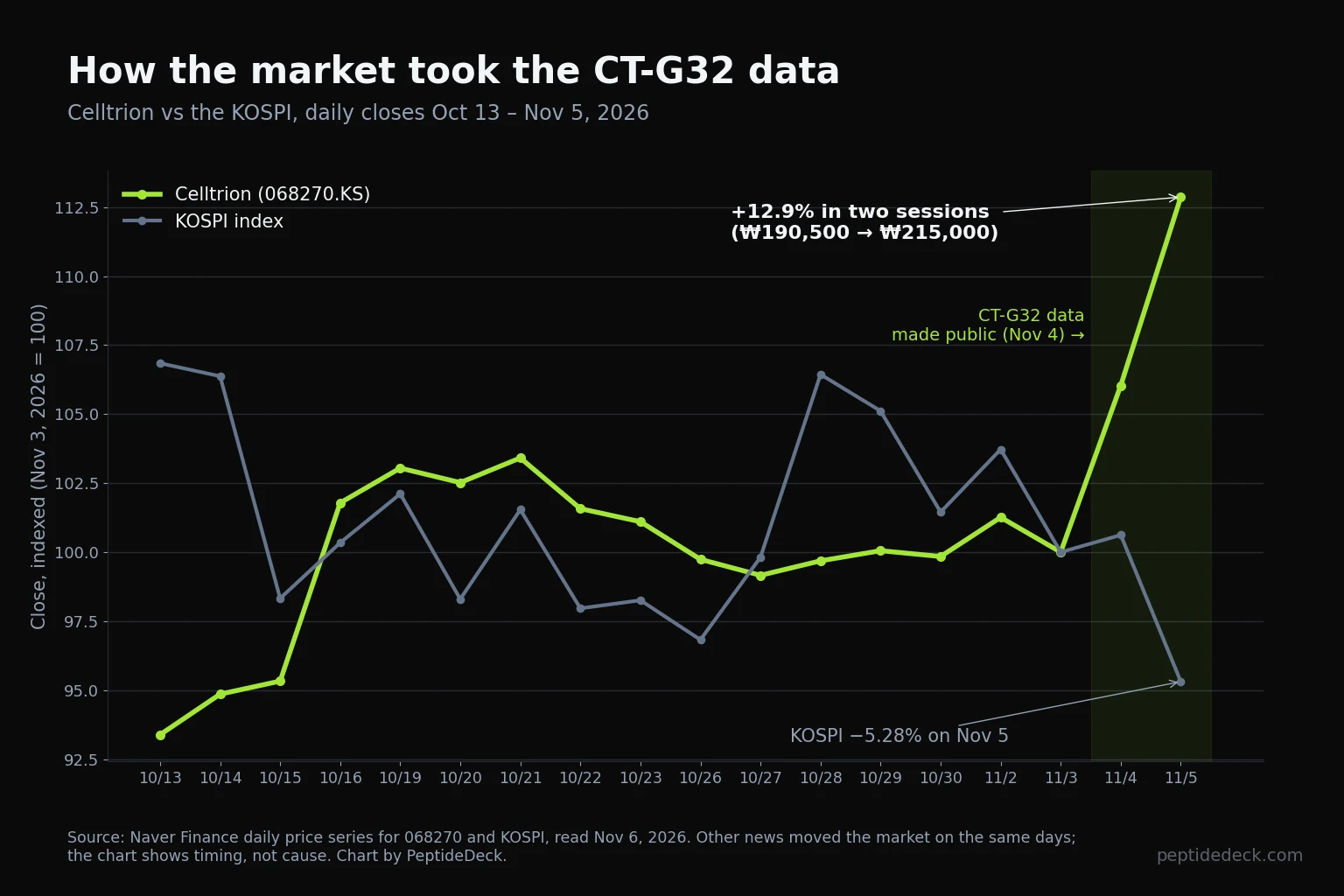
Read the stock move with care. Celltrion gained 6.0% on November 4 and 6.4% on November 5, on volume of 1.09 million and 2.00 million shares against 0.31 million on November 3. On November 5 the KOSPI fell 5.28% to 5,383.80 (Naver Finance). Namdonews, which reported the move, noted that it was not confirmed whether the CT-G32 results alone explained the rise (Namdonews, Nov 5). Timing is not cause.
Korea's obesity drug race
Korea has a big and growing problem. In the national health survey for 2025, 39.5% of Korean adults had obesity by Korea's own cut-off (BMI 25 or higher), up from 34.8% in 2016. Among men it was 49.1%, and among men in their 30s, 59.0% (KDCA, Sep 30 2026). Korea's threshold is lower than the WHO's BMI 30, so these figures are not comparable with Western obesity rates.
The imported drugs moved fast. Wegovy launched in Korea on October 15, 2024 and sold ₩467.0 billion in 2025; Mounjaro overtook it in the fourth quarter of 2025 with ₩187.1 billion in a single quarter (IQVIA data via Dailypharm). On October 7, 2026, Korea's drug regulator approved Hanmi's efpeglenatide, the country's first home-grown GLP-1 obesity drug, which cut weight 9.75% vs 0.95% on placebo at 40 weeks in 448 people (Dailypharm).
The global market CT-G32 is aiming at
The prize is large, and so are the incumbents. These are the figures most often cited, with their sources:
- 940 million adults were living with obesity in 2024, 16% of all adults, out of 2.6 billion who were overweight (WHO fact sheet, updated Oct 2026).
- $114 billion: Goldman Sachs's July 2026 forecast for global obesity drug sales in 2030 (Goldman Sachs).
- $150 billion: Morgan Stanley's forecast for peak annual sales by 2035 (Morgan Stanley).
- $173.5 billion by 2031: the GlobalData figure Celltrion itself cited when announcing CT-G32 (Celltrion, Feb 24 2026).
- $36.5 billion: Eli Lilly's 2025 sales of Mounjaro ($22.97 billion) and Zepbound ($13.54 billion) combined (Lilly 8-K).
- DKK 79.1 billion: Novo Nordisk's 2025 Wegovy sales, up 36% (Novo annual report).
Is CT-G32 really the world's first quadruple agonist?
Mostly, with an asterisk. Celltrion's Korean release qualifies the claim itself: it calls CT-G32 the world's first "based on publicly disclosed development status" (공개된 개발 현황을 기준으로) to combine these four pathways in one candidate (Celltrion KR). That wording matters, because other multi-target molecules exist:
- Five-receptor candidates. At the American Diabetes Association meeting in June 2026, at least two lab-stage compounds were presented that hit all four of CT-G32's targets plus calcitonin: VRX-0075 and Oban BioPharma's oral OBT-676.
- Different four-way combinations. Pep2Tango's PTT-A (GLP-1/GIP/amylin/calcitonin, no glucagon), Biomed Industries' NA-931 (IGF-1/GLP-1/GIP/glucagon, in Phase 2) and Daewon's GLP-1/GIP/glucagon/gastrin molecule all target four receptors, just not the same four.
The fair description: CT-G32 is the first publicly named candidate to target exactly GLP-1, GIP, glucagon and amylin in a single molecule. It is not the only drug designed to hit four or more receptors.
Three things the coverage got wrong or left unclear
Reporting on CT-G32 has been inconsistent. If you are writing about it, these are the points to check.
- Oral or injection? In November 2025, KED Global described CT-G32 as "orally administered", and Herald Business quoted Chairman Seo calling the four-target drug oral (KED Global; Herald Business). Since February 2026, every Celltrion release describes CT-G32 as an injectable; the oral drug is a separate, uncoded program with an IND target of H2 2028 (Celltrion, Feb 24).
- When does the first patient get dosed? Both companies say the second quarter of 2027. At least one English-language report said the second half of 2027, and one Korea Herald subhead printed "H1 2026" for the IND while the body said 2027.
- What test species, and how big the win? One English-language report named a different test species than the one in both companies' releases. And "greater weight loss than retatrutide" without the word "numerically" overstates what SCOHIA actually claimed.
A fourth figure to handle carefully: the "roughly 5% non-responder rate" and "up to 25% weight reduction" targets appear only in KED Global's November 2025 report on the chairman's briefing, described there as based on modelling, not on trial data (KED Global).
Can you get CT-G32?
No. Not legally, and not safely. CT-G32 has not been given to a single person, there is no trial to join, and the companies have not said where the first Phase 1 study will run. Any product sold online as "CT-G32" or "SCO-940" is not Celltrion's molecule, because the sequence has not been published.
If you are on a GLP-1 medicine now and the muscle-loss angle is what caught your eye, there are things you can do today that the evidence supports. Ask your prescriber:
- Should I be doing resistance training two or three times a week while on this drug? (Trials show it lowers the lean share of weight lost.)
- How much protein should I eat per day at my current dose and weight?
- Would a body-composition scan be useful before and during treatment?
Do not stop or change a prescribed medication because of news about a drug that is years from approval. For a wider view of what long-term GLP-1 use does to muscle and other organs, see our guide to GLP-1 long-term risks.
How to cite this page
Suggested citation: PeptideDeck Editorial. "CT-G32 (SCO-940): Celltrion's Four-Hormone Obesity Drug, by the Numbers." PeptideDeck, November 6, 2026. https://www.peptidedeck.com/peptides/ct-g32
All figures were checked against the linked primary sources on November 6, 2026. Share-price figures are Naver Finance daily closes. The charts on this page are original and free to republish with a link back to this page. We will update the page when Celltrion files the IND or publishes human data.
Frequently Asked Questions
Sources
- Celltrion. Press release (Korean), November 4, 2026: first disclosure of CT-G32/SCO-940 results at TIDES Europe. celltrion.com
- SCOHIA PHARMA. Announces presentation of first research results for quadruple-agonist obesity drug candidate SCO-940/CT-G32 at TIDES Europe 2026, November 4, 2026. scohia.com
- Celltrion. Press release, February 24, 2026: two-track obesity strategy (CT-G32 injectable, oral multi-target program). celltrion.com
- Celltrion. Press release, May 29, 2026: CT-G32 toxicology studies begin in 252 small lab animals and 48 monkeys. celltrion.com
- SCOHIA PHARMA. Strategic alliance with Celltrion on SCO-940 (Japanese), April 3, 2026. scohia.com
- SCOHIA PHARMA. Fundraising announcement (Japanese), May 28, 2026. scohia.com
- Financial Post Korea, November 4, 2026. financialpost.co.kr
- Korea Biomedical Review, November 4, 2026. koreabiomed.com; and May 29, 2026. koreabiomed.com
- Asia Business Daily, November 19, 2025 and July 29, 2026. asiae.co.kr · asiae.co.kr
- Biospectator, January 2026 (JPM) and July 29, 2026. biospectator.com · biospectator.com
- KED Global, November 19, 2025. kedglobal.com; Herald Business, November 21, 2025. heraldk.com
- SCOHIA PHARMA. License agreement with Neurocrine Biosciences (Japanese), April 10, 2026. scohia.com
- Namdonews, November 5, 2026. namdonews.com
- Celltrion Inc. Annual report FY2025 (filed March 16, 2026) and half-year report H1 2026 (filed August 14, 2026), DART. FY2025 · H1 2026
- Naver Finance, Celltrion (068270) and KOSPI daily price series, read November 6, 2026. finance.naver.com
- Jastreboff AM, et al. Retatrutide, a triple hormone receptor agonist, for treatment of obesity (TRIUMPH-1). N Engl J Med. 2026;395(18):1781-1793. PMID 42814954
- Retatrutide in adults with obesity and type 2 diabetes (TRIUMPH-2). Lancet. 2026;408:1455-1472. PMID 42810372
- Wilding JPH, et al. Once-weekly semaglutide in adults with overweight or obesity (STEP 1). N Engl J Med. 2021. PMID 33567185
- Jastreboff AM, et al. Tirzepatide once weekly for the treatment of obesity (SURMOUNT-1). N Engl J Med. 2022. PMID 35658024
- Garvey WT, et al. Coadministered cagrilintide and semaglutide in adults with overweight or obesity (REDEFINE 1). N Engl J Med. 2025;393:635-647. PMID 40544433
- Amycretin Phase 1b/2a, Lancet. 2025. PMID 40550231
- le Roux CW, et al. Survodutide once weekly for the treatment of adults with obesity. N Engl J Med. 2026;395:776-787. PMID 42253238
- Ji L, et al. Once-weekly mazdutide in Chinese adults with obesity or overweight (GLORY-1). N Engl J Med. 2025;392:2215-2225. PMID 40421736
- SURMOUNT-1 DXA substudy. Diabetes Obes Metab. 2025. PMID 39996356
- Lean mass loss with incretin agonists vs lifestyle: meta-analysis of 20 RCTs. Diabetes Obes Metab. 2026. PMID 41877354
- Batsis JA, et al. Effect of incretin-based and nonpharmacologic weight loss on body composition: a systematic review. Ann Intern Med. 2026;179(7):996-1013. PMID 41996180
- BIO, Informa Pharma Intelligence, QLS. Clinical Development Success Rates 2011–2020. February 2021. PDF
- World Health Organization. Obesity and overweight fact sheet, updated October 2026. who.int
- Korea Disease Control and Prevention Agency. 2025 Korea National Health and Nutrition Examination Survey release, September 30, 2026. kdca.go.kr
- Dailypharm: Wegovy and Mounjaro Korean sales (IQVIA) link; efpeglenatide approval link; Daewon quadruple agonist link
- Goldman Sachs, July 2026 goldmansachs.com; Morgan Stanley morganstanley.com
- Eli Lilly, Form 8-K Exhibit 99.1, Q4 and full-year 2025 results, February 4, 2026 sec.gov; Novo Nordisk, Form 6-K, FY2025, February 4, 2026 sec.gov
Medical Disclaimer: This article is for educational and news purposes only and is not medical advice. CT-G32 (SCO-940) is an investigational drug that has not been tested in humans or approved by any regulator. Weight-loss medicines should only be used under the care of a qualified clinician. Do not start, stop or change any prescribed medication because of information on this page. PeptideDeck has no financial relationship with Celltrion or SCOHIA Pharma, and nothing in this article is a product recommendation.