They were never meant to compete.
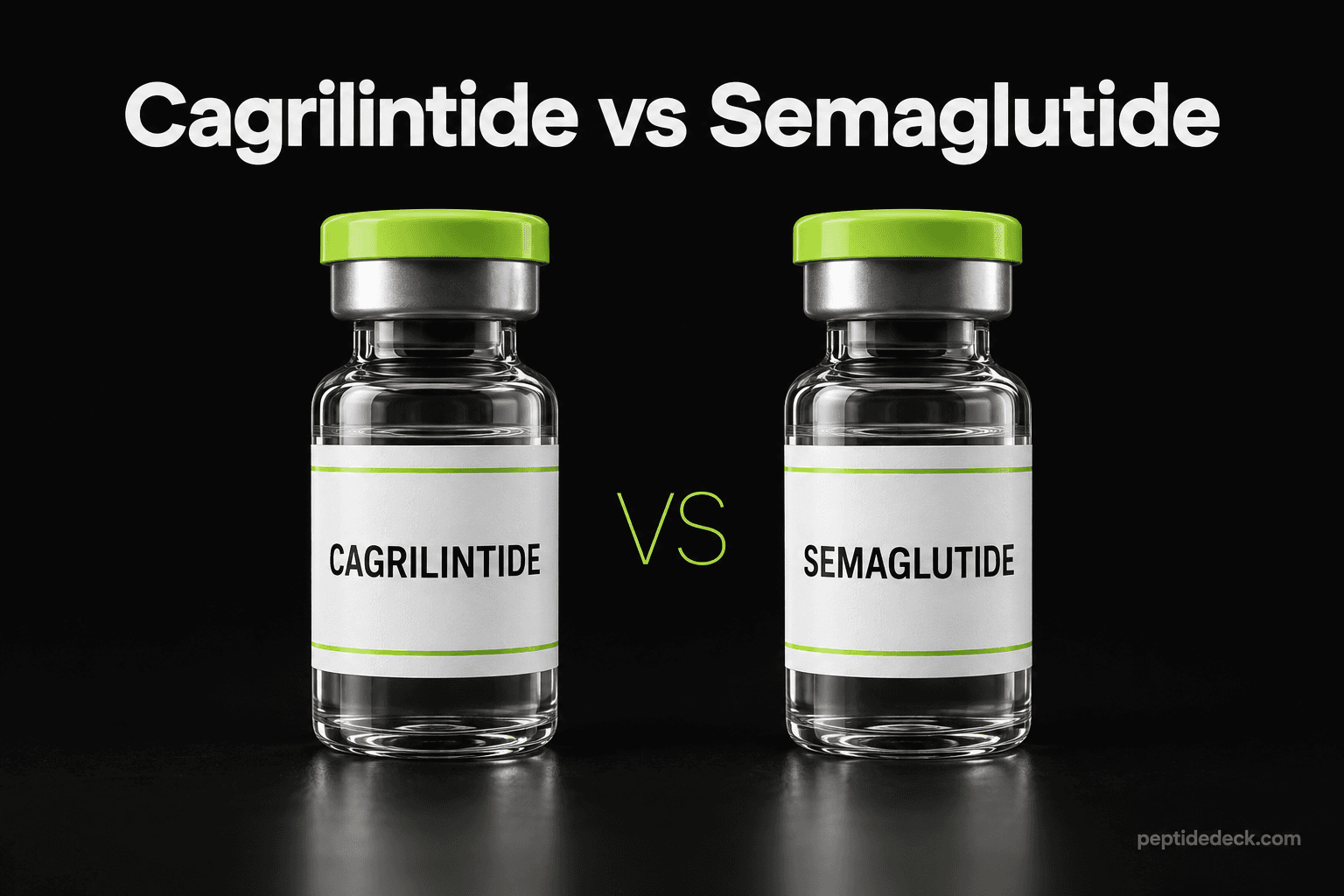
Cagrilintide vs semaglutide is an odd comparison, because Novo Nordisk built cagrilintide to be injected alongside semaglutide, not instead of it. The combination is CagriSema, and it is the product heading for approval. But the trial that tested CagriSema also ran each drug on its own against placebo in the same people, for the same 68 weeks. That gives us something rare: a clean, head-to-head read on what an amylin analogue does versus what a GLP-1 does, and it is not the result most people expect.
🔑 Key Takeaways
- Semaglutide mimics GLP-1. Cagrilintide mimics amylin. Different hormone, different receptors, overlapping effect on appetite.
- Head to head over 68 weeks, semaglutide won by about 3.4 percentage points. That gap is real but smaller than the approval gap suggests.
- Cagrilintide's phase 2 result, 10.8% at 26 weeks, beat liraglutide in the same trial. As a standalone it is a credible drug, not a booster.
- The side-effect profiles overlap almost completely. Nausea is the price of both.
- Whether cagrilintide alone is ever worth choosing over semaglutide comes down to one scenario, covered in the section on who each one suits.
This page is the direct comparison. For the compounds on their own, see the cagrilintide guide and the semaglutide dosing guide. For the combination, see CagriSema.
Cagrilintide vs Semaglutide at a Glance
Two Different Satiety Hormones
Your body has more than one way to say "stop eating".
GLP-1 is released from the gut after a meal. It slows stomach emptying, boosts insulin release when glucose is high, and acts on the brain to reduce appetite. Semaglutide is a modified GLP-1 with a fatty-acid side chain that lets it bind albumin and survive for about a week in circulation, which is how a once-weekly injection works.
Amylin is released from the pancreas together with insulin. It also slows gastric emptying and reduces appetite, but it does so through amylin receptors and the calcitonin receptor in the brainstem, a different set of doors from GLP-1. Natural amylin is unstable and prone to clumping, which is why the first amylin drug, pramlintide, had to be injected with every meal. Cagrilintide solved that with a lipidated, stabilised design that lasts about a week.
Because the two hormones use different receptors, their appetite effects are at least partly additive. That is the rationale for CagriSema. But it also means each one is a real drug in its own right, and the trials treated them that way.
Cagrilintide vs Semaglutide for Weight Loss
The numbers come from the same room.
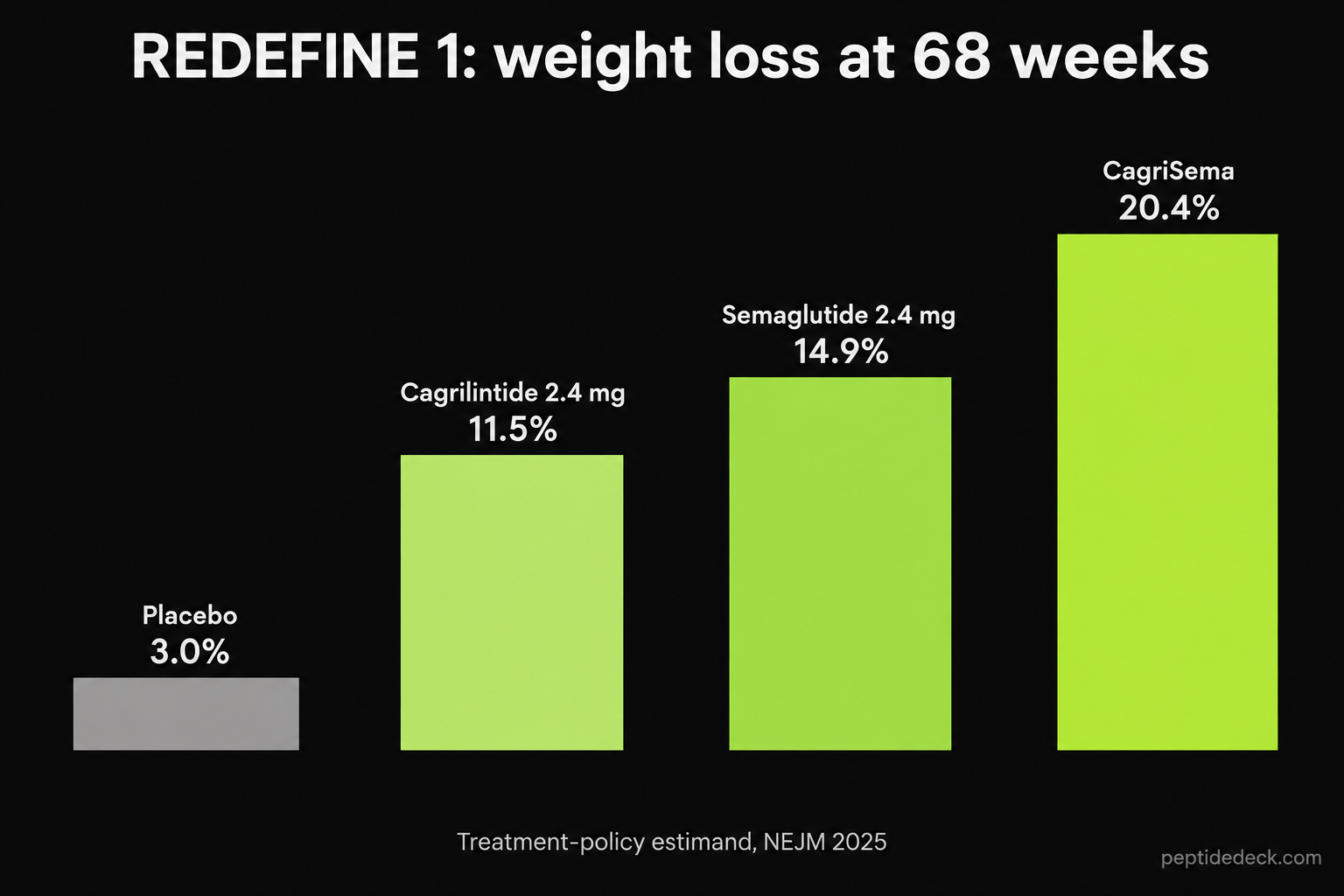
REDEFINE 1, published in the New England Journal of Medicine in 2025, enrolled about 3,400 adults with obesity or overweight and randomised them to CagriSema, semaglutide 2.4 mg alone, cagrilintide 2.4 mg alone, or placebo, for 68 weeks. Using the treatment-policy estimand, which counts everyone regardless of whether they stayed on drug:
- Placebo: 3.0%
- Cagrilintide 2.4 mg: 11.5%
- Semaglutide 2.4 mg: 14.9%
- CagriSema: 20.4%
On the trial-product estimand, which assumes people stay on treatment, the figures are 11.8%, 16.1% and 22.7%. Either way, semaglutide alone beat cagrilintide alone by around three to four percentage points. Cagrilintide alone still produced weight loss in the range of the first-generation GLP-1 drugs, and its phase 2 trial had already shown that: 10.8% at 26 weeks on 4.5 mg, against 9.0% on liraglutide 3.0 mg and 3.0% on placebo.
The instructive number is the combination. Add 11.5 and 14.9 and you get 26.4. CagriSema delivered 20.4. Amylin and GLP-1 signalling overlap enough that stacking them is worth about 5.5 extra points over semaglutide alone, not 11.5. That is still a large gain, and it is the entire commercial case for CagriSema, but it tells you the two hormones are not independent levers.
Blood Sugar and Other Effects
Semaglutide has a second job.
GLP-1 agonists were diabetes drugs before they were weight-loss drugs. Semaglutide's effect on HbA1c is well established and is why Ozempic exists. Cagrilintide's glucose effects are more modest and come mainly through slower gastric emptying and weight loss rather than direct insulin stimulation. In REDEFINE 2, which enrolled people with type 2 diabetes, the combination outperformed semaglutide on both weight and HbA1c, but that is a statement about CagriSema rather than cagrilintide alone.
One effect that may favour amylin: some data suggest amylin analogues preserve lean mass somewhat better than GLP-1 agonists for the same weight lost. The evidence is thin and mostly from the combination trials, so treat it as a hypothesis rather than a reason to choose.
Dosage Compared
The schedules are the same on purpose.
Both drugs titrate weekly from a low starting dose up to 2.4 mg over about 16 weeks. Semaglutide's steps are 0.25, 0.5, 1.0, 1.7 and 2.4 mg, each held for four weeks. Cagrilintide's steps in REDEFINE 1 were escalated in parallel over the same window. Novo designed it that way so the two could eventually ship in one pen.
For anyone using vials, the practical difference is concentration. A 10 mg cagrilintide vial reconstituted with 2 mL of bacteriostatic water gives 5 mg/mL, so 0.25 mg is 5 units on a U-100 syringe. Semaglutide 5 mg vials reconstituted with 2 mL give 2.5 mg/mL, so 0.25 mg is 10 units. The semaglutide and cagrilintide stack guide works through the full titration for people running both.
Side Effects Compared
If you have tolerated one, you will probably tolerate the other.
Both are gastrointestinal drugs at heart. Nausea, constipation and reduced appetite that can tip into aversion are the common complaints for each. In the cagrilintide phase 2 trial, nausea was the most frequent adverse event, similar in rate to liraglutide. In REDEFINE 1, 79.6% of people on the combination reported a gastrointestinal event, which is roughly what you would expect from two appetite drugs at once.
Two differences worth knowing. Injection-site reactions were reported more often with cagrilintide than with semaglutide, likely a property of the lipidated amylin molecule. And semaglutide carries a boxed warning about thyroid C-cell tumours seen in lab studies, not in humans, along with the class cautions about pancreatitis and gallbladder disease. Cagrilintide, as a newer molecule with less exposure, does not have an established warning list yet, which is a statement about data volume rather than safety. The cagrilintide side effects guide covers what the trials reported.
Availability Is the Real Difference
One is in every pharmacy. The other is not sold on its own.
Semaglutide is FDA approved as Ozempic, Wegovy and Rybelsus and is available through prescription, telehealth and, in restricted circumstances, compounding. Cagrilintide has never been filed for approval as a standalone drug. Novo submitted CagriSema in December 2025, and if it is approved, cagrilintide will be available only as half of that fixed-dose pen.
That leaves the vial market as the only place cagrilintide exists on its own. For people who go that route, the cagrilintide buying guide covers what to check. The usual caveats apply harder than usual here: there is no reference product to compare purity against, and there is no approved standalone dose to anchor to.
Which One Should You Choose?
For most people this is not a real choice.
Choose semaglutide if you want the larger weight loss, the option with an approved product and a prescription path, the glucose benefit, or a compound with years of post-marketing safety data behind it. That is almost everyone.
Cagrilintide alone makes sense in one scenario: you cannot tolerate GLP-1 agonists specifically. Some people get GI effects from semaglutide and tirzepatide that never settle, and for them an amylin analogue is a different mechanism that may sit better, at the cost of a few percentage points of efficacy. Even then, the vial route is the only route.
The combination is where cagrilintide earns its keep. If you are already on semaglutide and have plateaued, adding cagrilintide is what the phase 3 programme actually studied. The CagriSema guide covers the trial results and the launch timeline, and the cagrilintide plus tirzepatide vs CagriSema comparison covers the question of pairing it with tirzepatide instead.
Frequently Asked Questions
The Verdict
Semaglutide wins the head-to-head. Cagrilintide wins the partnership.
Alone, the amylin analogue is a good drug that loses to the GLP-1 by a few points and has no approval to fall back on. Paired, it adds more to semaglutide than any dose increase could, which is why Novo is betting the next decade on the combination rather than on either half. If you are choosing one, choose semaglutide. If you are already on semaglutide and want more, cagrilintide is what the evidence says to add.
References
- Garvey WT, et al. Coadministered cagrilintide and semaglutide in adults with overweight or obesity (REDEFINE 1). N Engl J Med 2025. NEJM
- Davies MJ, et al. Cagrilintide-semaglutide in adults with overweight or obesity and type 2 diabetes (REDEFINE 2). N Engl J Med 2025. NEJM
- Lau DCW, et al. Once-weekly cagrilintide for weight management in people with overweight and obesity: a multicentre, randomised, double-blind, placebo-controlled and active-controlled, dose-finding phase 2 trial. Lancet 2021;398(10317):2160-2172. PubMed
- Wilding JPH, et al. Once-weekly semaglutide in adults with overweight or obesity (STEP 1). N Engl J Med 2021;384(11):989-1002. PubMed
- Enebo LB, et al. Safety, tolerability, pharmacokinetics, and pharmacodynamics of concomitant administration of multiple doses of cagrilintide with semaglutide 2.4 mg for weight management: a randomised, controlled, phase 1b trial. Lancet 2021;397(10286):1736-1748. PubMed
Medical Disclaimer: This content is for informational purposes only and does not constitute medical advice. Always consult a qualified healthcare provider before starting any new supplement, medication, or treatment. PeptideDeck may earn a commission from affiliate links at no additional cost to you.