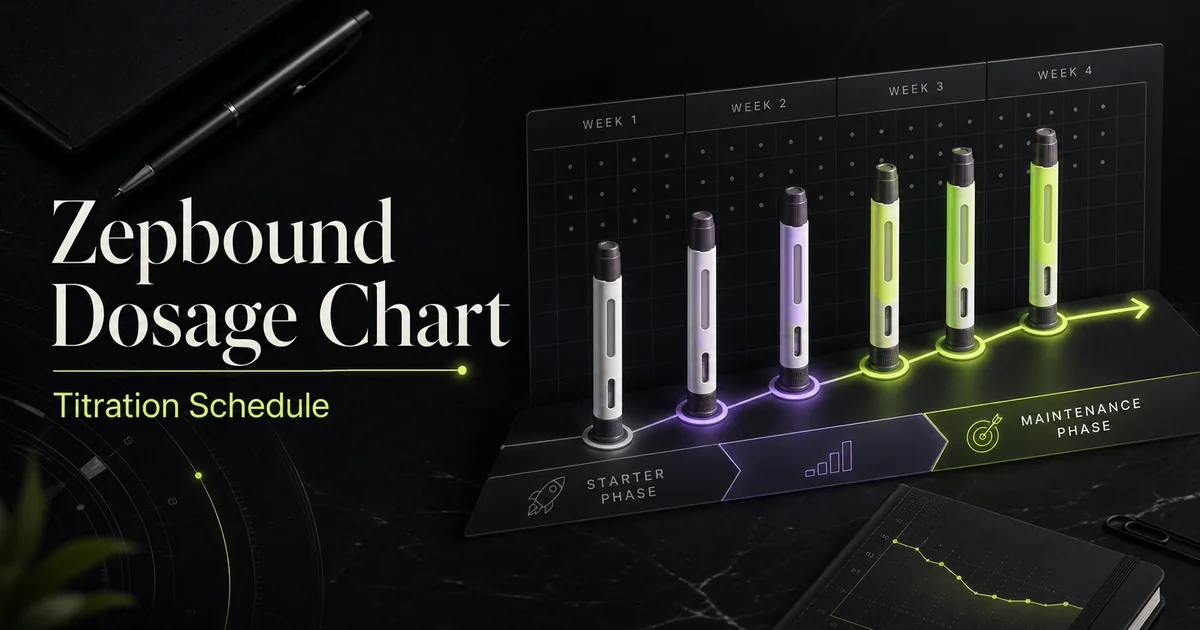
Zepbound starts at 2.5 mg once weekly for 4 weeks, then usually moves to 5 mg in week 5. From there, your prescriber may increase by 2.5 mg no faster than every 4 weeks until you reach a maintenance dose of 5 mg, 10 mg, or 15 mg. The maximum Zepbound dose is 15 mg once weekly.
Best next step: If you are comparing Zepbound dosing because of price, availability, or prescription access, check GLP-1 telehealth options before you commit to a pharmacy route. Compounded tirzepatide uses the same active molecule as Zepbound and can be easier to access when brand pricing is too high. See our cheapest tirzepatide guide for the lowest verified prices.
Key Takeaways
- Do not rush the titration. Moving up faster than every 4 weeks raises the chance of nausea, vomiting, diarrhea, reflux, and appetite crash.
- 5 mg, 10 mg, and 15 mg are the main maintenance doses for chronic weight management; 7.5 mg and 12.5 mg are often transition doses.
- If you miss a dose, take it within 4 days. If more than 4 days have passed, skip it and resume your regular weekly schedule.
- You do not have to reach 15 mg. Many people stay at a lower dose when weight loss and side effects are both manageable.
- If you are still checking access, compare this page with our Zepbound coupon guide and GLP-1 qualifications guide.
The Zepbound Dosing Chart: Every Strength and When to Increase
Tirzepatide, the active drug in both Zepbound and Mounjaro, is escalated slowly because nausea, vomiting, and diarrhea are most likely during dose increases. The FDA label calls 2.5 mg a "treatment initiation" dose that is "not intended for chronic weight management" or sleep apnea on its own. Its only job is to let your digestive system adapt before you reach a dose that actually drives meaningful results.[1]
Here is the full FDA-approved titration schedule. Each step requires staying on the current dose for at least 4 weeks before moving up.[1][7]
So the fastest you can legitimately reach the 15 mg ceiling is roughly week 21, about five months in. There is no rule that you must climb that fast or that high. Many people lose plenty on 5 mg or 10 mg and never need the top dose. The label is explicit that the maintenance dose should be chosen based on response and tolerability, and that if a higher dose is not tolerated you can drop back to a lower one.[1]
The 7.5 mg and 12.5 mg doses are "bridge" doses, not destinations. The official maintenance options for weight loss are 5, 10, and 15 mg. The 7.5 mg and 12.5 mg strengths exist mainly to soften the jump between them. If 10 mg feels rough, your prescriber may park you at 7.5 mg longer rather than forcing the next increase. Slower is allowed; faster than every 4 weeks is not.[1]
Starting Dose: Why You Begin at 2.5 mg
Everyone begins Zepbound at 2.5 mg once weekly, injected under the skin of the abdomen, thigh, or upper arm, on the same day each week. You can take it with or without food, and you can inject at any time of day.[1][9] The 2.5 mg dose is deliberately too low to produce much weight loss. Its purpose is purely tolerability: tirzepatide slows stomach emptying and acts on appetite signaling, and starting low gives those systems four weeks to calibrate before the dose that actually moves the scale.[1]
If you found Mounjaro or compounded tirzepatide tolerable in the past, you still start at 2.5 mg on a fresh Zepbound prescription. The body's adaptation is dose-specific, and the label does not provide a shortcut for prior exposure. For a deeper look at how the molecule works on both the GLP-1 and GIP receptors, see our explainer on how Zepbound works.
When to Increase Your Zepbound Dose
The trigger to step up is a combination of time and tolerance, not the scale. The rule is simple: you may increase by 2.5 mg only after at least 4 weeks at your current dose, and only if you are tolerating it reasonably well.[1] If you are still nauseated or your appetite is well controlled and you are losing weight steadily, there is no obligation to go higher just because four weeks have passed.
Reasons to hold instead of increase:
- You are still having meaningful nausea, vomiting, or diarrhea at the current dose.
- You are losing weight at a healthy pace (about 1 to 2 lb, roughly 0.5 to 1 kg, per week) and feel satisfied with appetite control.
- You hit a tolerability wall and your prescriber wants more time at the current step.
Reasons your prescriber may move you up:
- Weight loss has clearly stalled for several weeks and side effects are mild.
- Appetite suppression has faded and hunger has returned strongly.
- You have not yet reached a maintenance dose (5, 10, or 15 mg) and tolerance is good.
This same titrate-to-tolerance logic applies across the tirzepatide family. For the branded Mounjaro side of the molecule, our tirzepatide dosing guide covers the type 2 diabetes context, and the tirzepatide dosage chart includes the mL and unit conversions.
Maximum and Maintenance Doses
The maximum approved Zepbound dose is 15 mg once weekly for every indication. You should never exceed it. The maintenance dose, the one you settle on long term, depends on what you are treating:[1][5]
The "best" maintenance dose is not automatically 15 mg. It is the lowest dose that keeps your appetite controlled and your weight where you want it without unacceptable side effects. Many people maintain comfortably on 5 mg or 10 mg. Pushing to 15 mg buys, on average, a few more percentage points of weight loss but also more gastrointestinal side effects, so it is a personal trade-off worth discussing with your clinician.[2]
What Each Dose Actually Delivers (Original Effect-Size Table)
Dosing decisions are easier when you can see what the numbers translate to in real pounds. The pivotal SURMOUNT-1 trial in adults with obesity (or overweight plus a weight-related condition), without diabetes, measured average weight loss at 72 weeks by dose. Below, those percentages are converted into pounds for a representative 230 lb (104 kg) starting weight, so the doses stop being abstract.[2]
Two things stand out. First, even the lowest maintenance dose (5 mg) produced roughly 16% average weight loss, far beyond what most lifestyle programs achieve alone. Second, the jump from 10 mg to 15 mg is relatively small on average (about 1 percentage point), which is exactly why so many people stay at 10 mg if higher doses bother their stomach.[2] For the broader timeline of how fast these results accrue week by week, see our GLP-1 weight loss results overview.
For obstructive sleep apnea, the SURMOUNT-OSA trials used 10 mg or 15 mg and cut the apnea-hypopnea index by roughly 25 to 29 fewer breathing interruptions per hour versus about 5 to 6 with placebo, alongside about 18% to 20% weight loss. That data underpinned the December 2024 FDA approval of Zepbound as the first drug for moderate-to-severe OSA in adults with obesity, and explains why OSA maintenance starts at 10 mg rather than 5 mg.[3][4][5] The off-label and approved expansions of tirzepatide are covered in our piece on tirzepatide for sleep apnea.
Zepbound Doses in Units: Vials vs Pens
Zepbound comes two ways, and the format changes how you measure a dose. The single-dose pen and KwikPen deliver a fixed milligram amount, so you never count units. Single-dose vials, sold through the manufacturer's self-pay channel, are drawn up with an insulin-style U-100 syringe, which is where unit math appears.[1][7][8]
Each Zepbound single-dose vial holds the full labeled dose in 0.5 mL, so the conversion to U-100 units (where 100 units = 1 mL) is straightforward: a full vial is 50 units on the syringe, regardless of the milligram strength.
Do not confuse FDA Zepbound vials with compounded tirzepatide. Branded single-dose vials hold one fixed dose in 0.5 mL, so you draw the whole vial. Compounded tirzepatide from a pharmacy or research vial is reconstituted to a concentration you choose, and the unit math is entirely different. If you are using a compounded product, follow that vendor's concentration, and use a dedicated reconstitution calculator rather than the table above.[7]
Missed a Dose? The Decision Rules
Because tirzepatide is dosed weekly and has a long half-life of about 5 days, a missed dose is rarely a crisis, but the timing rules matter. The FDA label gives a clear two-part rule built around a 4-day window and a 72-hour minimum gap between any two doses.[1]
The single hard rule that should never be broken: do not take two doses within 72 hours of each other. Doubling up to "catch up" stacks drug levels and sharply raises the risk of severe nausea and vomiting.[1] For more practical handling questions like refrigeration after first use and travel, our tirzepatide storage and timing FAQ is a useful companion.
Stopping or Pausing Zepbound
There is no mandatory taper schedule for Zepbound in the label, and stopping abruptly does not cause a dangerous physical withdrawal. What it can cause is the return of appetite and, over time, weight regain, because tirzepatide treats obesity as a chronic condition rather than curing it. Studies of stopping GLP-based therapy consistently show that a substantial portion of lost weight comes back once the drug is discontinued.[6]
Because of that, many clinicians favor a gradual wind-down rather than a hard stop:
- Step down by one dose level (for example, 15 mg to 10 mg, then 10 mg to 5 mg) over a few weeks to gauge how appetite responds.
- Hold at the lowest effective dose long term if maintenance, not maximum loss, is the goal.
- Lock in habits first. Reinforcing protein intake, resistance training, and meal structure before stopping gives you a better chance of holding results.
If side effects are the reason for stopping, dropping back a dose level often resolves them without abandoning the drug entirely. For the rebound-appetite dynamics in detail, see what happens when you stop semaglutide, which covers the same chronic-disease principle that applies to tirzepatide.
Special Situations: Kidney, Liver, and Side-Effect Adjustments
The Zepbound label does not require a different dose for kidney or liver impairment; no dosage adjustment is recommended on that basis alone. However, because gastrointestinal side effects like vomiting and diarrhea can cause dehydration and acute kidney injury, prescribers monitor kidney function during dose increases, especially in people with existing kidney disease.[1][10]
If side effects are the limiting factor at any step, the label permits dropping to a lower maintenance dose rather than discontinuing.[1] The most common side effects are gastrointestinal and tend to be worst right after a dose increase, then ease over the following weeks, which is the entire reason the titration is so gradual. Our full breakdown of Zepbound side effects covers how to manage each one and when to call your clinician.
Frequently Asked Questions
References
- FDA. ZEPBOUND (tirzepatide) injection, full prescribing information. U.S. Food and Drug Administration, accessdata.fda.gov.
- Jastreboff AM, Aronne LJ, Ahmad NN, et al. Tirzepatide Once Weekly for the Treatment of Obesity (SURMOUNT-1). N Engl J Med. 2022. PMID: 35658024.
- Malhotra A, Grunstein RR, Fietze I, et al. Tirzepatide for the Treatment of Obstructive Sleep Apnea and Obesity (SURMOUNT-OSA). N Engl J Med. 2024. PMID: 38912654.
- FDA. FDA Approves First Medication for Obstructive Sleep Apnea (Zepbound), December 2024. U.S. Food and Drug Administration.
- Tirzepatide for the Treatment of Obstructive Sleep Apnea and Obesity: clinical review. PMC11598664, National Library of Medicine.
- NIDDK. Prescription Medications to Treat Overweight and Obesity. National Institute of Diabetes and Digestive and Kidney Diseases.
- Eli Lilly. Zepbound Dosage Options, Schedules and Missed Doses (Healthcare Professional resource). zepbound.lilly.com.
- Eli Lilly. Zepbound single-dose pens and vials via LillyDirect. lilly.com.
- MedlinePlus. Tirzepatide Injection. U.S. National Library of Medicine.
- Drugs.com. Zepbound Dosage Guide (professional).