Most peptide affiliate programs pay you once. Someone clicks your link, buys a vial, you get a percentage, and the relationship ends there. That is the wrong shape for this market, because peptide buyers are the most repeat-heavy customers in supplements: a vial lasts weeks, protocols run months, and anyone who gets a result reorders.
This is a working comparison of what peptide affiliate programs actually pay in 2026, which terms matter, and why the recurring-commission structure is the only number worth optimising for.
Join the Ascension partner program free →
What actually matters in a peptide affiliate program
Commission rate is the number every program advertises and the one that matters least. Rank offers on these instead:
- Lifetime vs first-order commission. The single biggest variable. A 15% first-order-only deal loses badly to 10% lifetime the moment your referral reorders once.
- Payout speed. Net-60 is common and brutal for anyone reinvesting in traffic. Look for a fixed monthly date.
- Stock depth. A commission on an out-of-stock product is zero. Programs with thin catalogues leak conversions you already paid to generate.
- A discount for your audience. Your click-through rate depends on the offer, not your copy. A real discount code converts warm traffic far better than a bare link.
- Whether the rate moves. Published rates are a starting position. Programs that renegotiate on volume are worth more than their advertised number.
Ascension Peptides: the numbers
Ascension publishes its terms, which is already unusual in this space. Here is what the partner program pays:
| Term | What you get |
|---|---|
| First-order commission | 10% |
| Lifetime commission | 10% on every future order that customer places |
| Sub-affiliate tiers | 5% / 3% / 2% / 1% across four tiers |
| Your audience gets | 50% off their first purchase |
| Payout schedule | Calculated on the 5th, paid on the 7th, every month |
| Cost to join | Free, no setup fee |
| Tools | Custom links, vanity coupon codes, QR codes, real-time dashboard, creative assets |
Why lifetime commission is the whole argument
Run the arithmetic on a single referral. Say they buy a $150 order and reorder every six weeks for a year, which is unremarkable for someone running a BPC-157 or GLP-1 protocol.
- First-order-only at 15%: $22.50. Total, forever.
- Lifetime at 10%: $15 on the first order, then $15 again roughly eight more times. About $135 from the same referral.
The higher advertised rate pays six times less. That gap widens every month the customer stays, and it compounds across your whole referred base rather than resetting each time you send new traffic. It is the difference between affiliate income that decays when you stop publishing and income that accrues.
Start earning lifetime commissions →
What this actually pays: three scenarios
Because commission is lifetime, your income is not a function of this month's traffic. It is a function of how many referred customers you have accumulated and whether they keep reordering. That changes the shape of the earnings curve completely: it climbs while you publish and keeps paying after you stop.
The table below assumes a $150 average order, a reorder roughly every six weeks (about 8.7 orders a year, which is normal for someone running a protocol) and the standard 10% lifetime rate.
| Your scale | New referrals / month | Monthly income at month 12 | Year one total |
|---|---|---|---|
| Side project | 5 | $650/mo | $4,225 |
| Established blog | 20 | $2,600/mo | $16,900 |
| Large site | 50 | $6,500/mo | $42,250 |
Two things worth reading off that table. First, month-12 income is double month-6 income at every scale, because the base keeps compounding rather than resetting. Second, the year-one total is roughly 6.5 times the month-12 figure, so anyone judging the program on their first month or two is looking at the worst point on the curve.
The same three scenarios on a first-order-only 15% program pay $900, $3,600 and $9,000 for year one. The lifetime structure earns more than four times as much from identical traffic.
And if you negotiate up: at 20% the established-blog row becomes about $33,800 in year one, at 25% about $42,250, from exactly the same referrals.
These are illustrations, not promises. They assume referred customers keep reordering; real retention decays, and your actual figure depends on your niche, traffic quality and how many customers stay on protocol. Use them to compare program structures, not to forecast income.

The rate is a starting position, not a ceiling
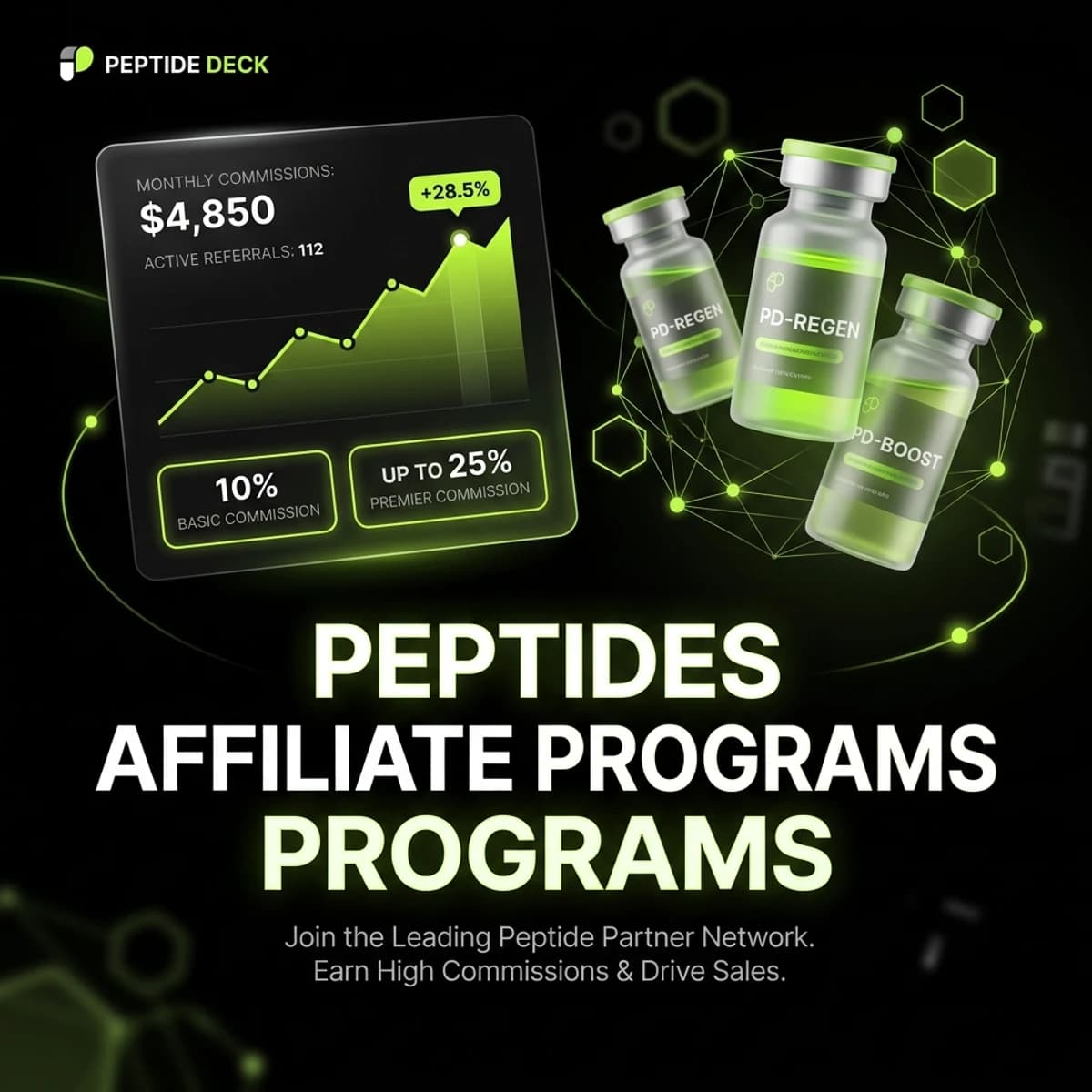
10% is where partners begin. It is negotiable on performance, and established partners sending consistent volume have moved well above it, into the 20 to 25% range. That is not published on the signup page because it is agreed case by case, so if you are driving real traffic, ask rather than assuming the advertised number is fixed.
Practically: sign up at 10%, build a few months of tracked volume in the dashboard, then open the conversation with numbers in hand.
Payout speed and why it matters
Commissions are calculated on the 5th of each month for the prior month and paid on the 7th. Two days between calculation and payment is fast for this industry, where net-30 and net-60 are normal and "pending" balances can sit for a quarter.
If you buy traffic, that cycle is the difference between reinvesting monthly and financing someone else's cash flow.
Stock depth and conversion
Ascension runs a wide catalogue across the categories people actually search: BPC-157, TB-500, GHK-Cu, retatrutide, cagrilintide, sermorelin, ipamorelin, MOTS-c, tesamorelin, KPV and blends like KLOW and GLOW. Everything is third-party tested with COAs, and shipping is domestic US.
That breadth matters commercially. If you publish about ten compounds and your vendor stocks four, six of your articles convert at zero. A deep catalogue lets one partner relationship cover an entire content library, which is also why a single vanity code across your site is worth more than scattered one-off links.
How to get started
- Register. Sign up on the Ascension partner page. Free, no fees.
- Pick your username carefully. It becomes your coupon code and your affiliate URL, and it cannot be changed afterwards. Choose the one you want on every page you will ever publish.
- Lead with the 50% discount. Your audience gets half off their first order. That offer converts far harder than a plain link, so put the code where people see it.
- Track by page. Use a distinct source or code per article so you can see which content earns and which does not.
- Renegotiate once you have data. Bring your dashboard numbers when you ask for a higher rate.
Register as an Ascension partner →
Frequently asked questions
What is the best peptide affiliate program in 2026?
For recurring income, the one that pays lifetime commission rather than first-order only. Ascension pays 10% on every future order a referred customer places, which outearns higher first-order-only rates within about two reorders.
How much can you earn promoting peptides?
It depends almost entirely on repeat rate, not traffic volume. One referral on a long protocol is worth more than several one-off buyers, which is why lifetime commission and catalogue depth matter more than the headline percentage.
Does it cost anything to join?
No. Registration is free with no setup fee, and you get custom links, coupon codes, QR codes and a real-time dashboard.
When do I get paid?
Commissions are calculated on the 5th of each month for the previous month and paid on the 7th.
Can I negotiate a higher commission?
Yes. 10% is the starting rate, and it moves with performance. Partners sending consistent volume have reached the 20 to 25% range, agreed individually rather than published.
Do I need a website to join?
The registration form asks for a website URL and how you plan to promote, so having somewhere to send traffic helps. Social audiences and newsletters work too.