Nobody outside the company knows what is in the vial.
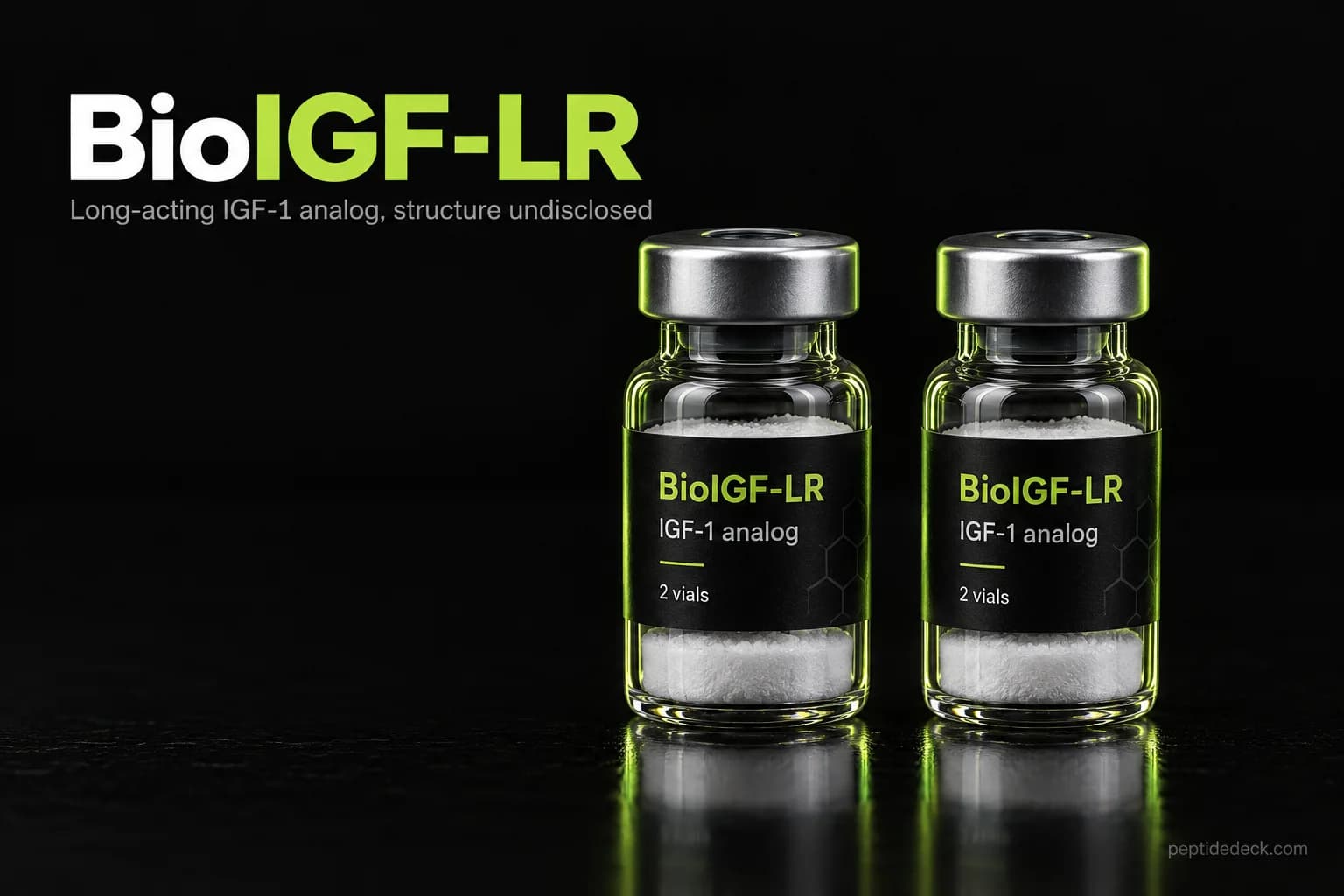
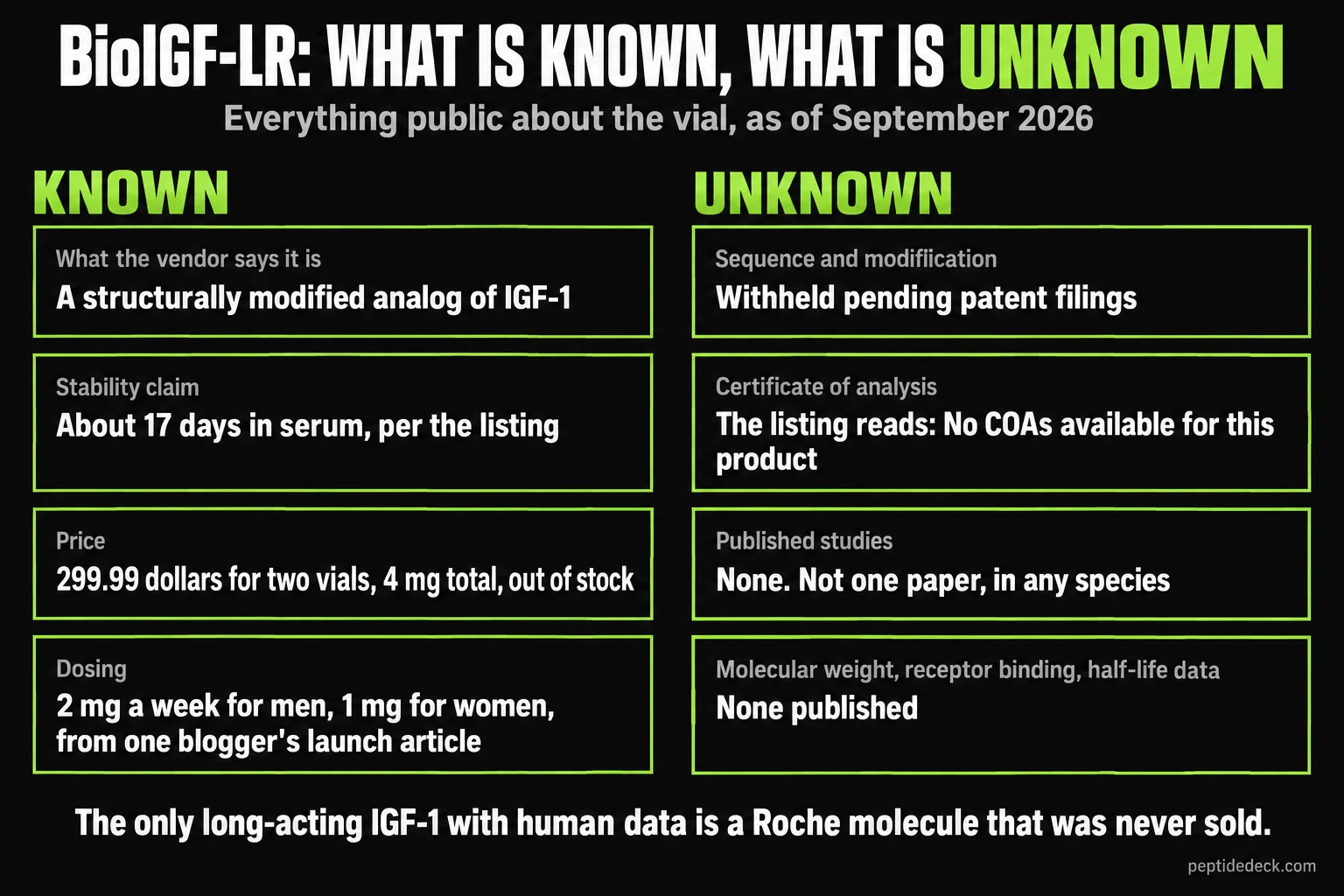
That is not a figure of speech. BioIGF-LR is sold as "a structurally modified analog of insulin-like growth factor 1," and that sentence is the entire public description of its chemistry. The sequence, the modification, the molecular weight — all withheld, according to the one blogger who launched it, "pending patent filings." The listing's certificate-of-analysis section reads "No COAs available for this product." It launched on 7 September 2026 at $299.99 for two vials, and by the time I checked it was out of stock with a waiting list.
If you have been chasing growth hormone benefits — deeper sleep, better recovery, a leaner look — and someone has told you this is the shortcut that skips the GH pathway entirely, the pitch is appealing. The question is whether you can evaluate it at all. Here is everything that can actually be known about BioIGF-LR, next to the two long-acting IGF-1s that came before it.
🔑 Key Takeaways
- BioIGF-LR is BioLongevity Labs' brand name for a long-acting IGF-1 analog. What has been modified, and how, is not public; the developer says the structure is withheld until patents are filed.
- The listing claims about 17 days of serum stability, states 99% purity, and in the same breath says no certificate of analysis is available. Those two statements cannot both be checked.
- Every page that ranks for the name traces back to the vendor or to one affiliate writer, whose dosing protocol — 2 mg a week for men, 1 mg for women — is the only one that exists.
- Two long-acting IGF-1s came before it. IGF-1 LR3 has a published 83-amino-acid structure and thirty years on the market; Roche's PEG-IGF-1 has the only human pharmacokinetic data, a half-life of six to eight days, and was never sold.
- The "replaces growth hormone" claim, what a week of it costs, the blood-sugar and feedback risks any potent IGF-1 carries, and what to do while it is out of stock — below.
Start with what the vendor actually says, because it is shorter than you would expect for a $300 product.
What BioIGF-LR Is, According to the Only Source
One paragraph. That is the whole description.
The product page states that BioIGF-LR "is a structurally modified analog of insulin-like growth factor 1 (IGF-1), produced under controlled synthesis and purification conditions," that "the modification is intended to extend the compound's serum stability period relative to native IGF-1," and that it "is supplied as a lyophilized powder in two single-use research vials." The specifications list a reported serum stability of approximately 17 days, purity of at least 99% by HPLC, and 4 mg per pack.
Nothing else. No sequence, no molecular weight, no explanation of what "LR" stands for — the affiliate who launched it glosses it as "long-release" — and no indication of whether the modification is the 13-residue extension used in IGF-1 LR3, a PEG chain, an albumin-binding tail, or something else. The same vendor's other "LR" product, alphaKlothoLR, is described on its own page as a protein fused to a 29-amino-acid albumin-binding construct; whether BioIGF-LR uses the same approach is nowhere stated.
The COA line. BioLongevity's listings normally carry lot-matched certificates from three named laboratories, and the vendor makes a point of it. The BioIGF-LR page keeps the boilerplate describing that process and then says: "No COAs available for this product." A 99% purity figure with no certificate behind it is a claim, not a measurement — and for a molecule whose identity is secret, the certificate is the only thing a buyer could ever have checked.
Where Every BioIGF-LR Claim Comes From
Two sources. One is selling it; the other is paid when it sells.
Search the name and the first page is the vendor's product listing, the vendor's best-sellers category, two articles and two LinkedIn posts by the same affiliate writer, a video stream, and then pages about IGF-1 LR3 — a different, well-characterised molecule — because the search engine has nothing else to show. There is no forum history, no independent review, no third-party test, and no paper.
The affiliate articles are where the specifics live. From them:
- The structure is "withheld pending patent filings," attributed to the company's chief science officer.
- The half-life is "reported around 17–19 days."
- The protocol is 2 mg weekly for men (0.5 mL at 4 mg/mL) and 1 mg weekly for women, subcutaneous, morning, four to six weeks on and two to four off, no titration.
- The equivalence claim is that "2 mg/week ≈ 2–4 IU/day" of growth hormone.
- The evidence is a handful of named early users reporting deeper sleep, more strength, a leaner look without water retention, and no carpal tunnel symptoms.
To the writer's credit, the same articles say plainly that this is "not independent clinical equivalency data" and that comparisons "reflect personal experience, not clinical verification." Read that as the honest summary it is. Everything specific about BioIGF-LR — the half-life, the dose, the GH equivalence, the benefits — is a statement by the seller or by someone paid by the seller, and none of it has been measured by anyone else.
The Two Long-Acting IGF-1s That Came Before It
This is not the first attempt to make IGF-1 last. It is the third, and the first two are instructive.
IGF-1 LR3: published, cheap, thirty years old
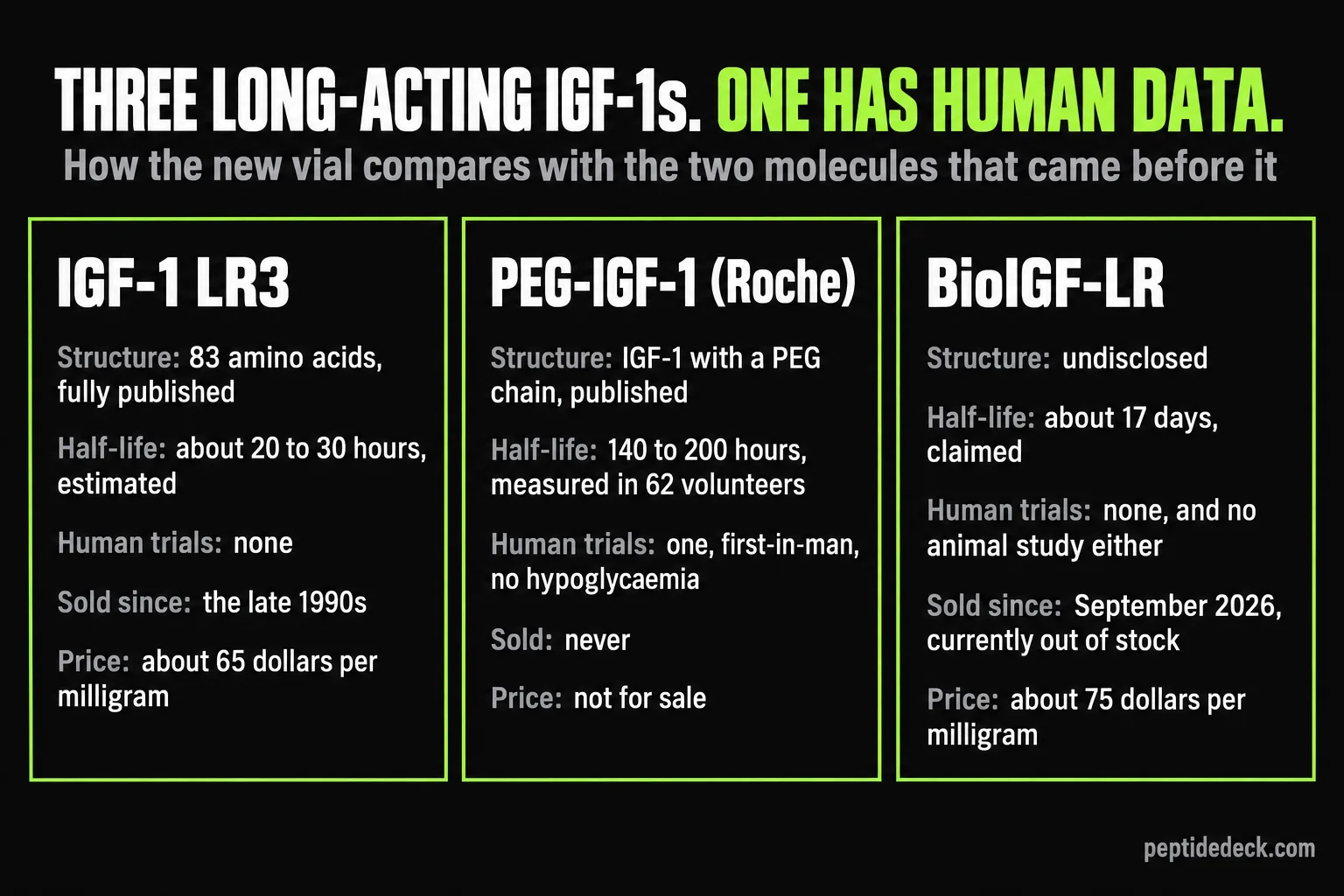
Long-R3 IGF-1 is the analog the entire category is built on. It is 83 amino acids — native IGF-1's 70, with glutamic acid swapped for arginine at position 3 and a 13-residue extension on the front end. Those changes cut its affinity for the binding proteins that normally sequester IGF-1 in blood, which is why it is roughly three times as potent in cell assays and why its half-life is estimated at 20 to 30 hours rather than minutes. Every one of those facts is published, every vendor's certificate can be checked against the sequence, and the common dose has settled at 20 to 80 micrograms a day. It still has no human trials. Our IGF-1 LR3 guide and vendor comparison cover it in full.
PEG-IGF-1: the only one tested in people
Roche attached a polyethylene glycol chain to recombinant IGF-1 and ran a first-in-man study — 62 healthy volunteers, single ascending doses, double-blind, placebo-controlled. The pegylated molecule had a half-life of 140 to 200 hours, six to eight days. It caused no hypoglycaemia, suppressed growth hormone far less than unmodified IGF-1 did, and its most common side effect was redness at the injection site. It was safe, it worked as designed, and it was never brought to market. That study is the only human pharmacokinetic data for any long-acting IGF-1, and it belongs to a molecule you cannot buy.
BioIGF-LR: the newest, and the least known
Which brings the comparison to its point. BioIGF-LR claims a stability period of about 17 days — more than twice the measured half-life of the Roche molecule — from a modification nobody has seen, with no animal data, no human data, and no certificate. If the claim is true, it is a more significant piece of pharmacology than anything else in the category, and it has been announced by a blog post.
BioIGF-LR Dosage: The Launch Protocol and the Arithmetic
Two milligrams a week is a lot of IGF-1.
There is exactly one protocol in circulation, and it is the launch article's: 2 mg subcutaneously once a week for men, 1 mg for women, in the morning, for four to six weeks, then two to four weeks off. The rationale offered is the long half-life — one injection covers the week. Set that beside the analog people already use, and the numbers are worth a pause.
Two milligrams of a modified IGF-1 each week is three and a half to fourteen times the weekly mass of a typical IGF-1 LR3 schedule. A longer-lasting molecule does need a bigger dose per injection to cover the interval — that is the logic — but it also means more total IGF-1 receptor exposure over the week, and the only way to know what that does is to measure it, which no one has. The affiliate protocol also says "no titration recommended," which for a potent IGF-1 analog at an untested dose is the opposite of the usual advice.
The cost follows. At $299.99 for 4 mg, the men's protocol is a pack every two weeks: roughly $900 for a six-week block, before the weeks off. IGF-1 LR3 at $65 a milligram covers the same six weeks for $55 to $220. Whatever BioIGF-LR turns out to be, it is priced as a premium on convenience and on a stability claim, not on evidence.
Does It "Replace Growth Hormone"?
The pitch is direct: skip GH, go straight to IGF-1.
The biology behind it is real. Most of what growth hormone does to muscle and connective tissue, it does by making the liver release IGF-1; a compound that activates the IGF-1 receptor directly bypasses the pituitary, the GH secretagogues, and the GH-specific side effects — water retention and carpal tunnel among them. That is the same argument that has been made for IGF-1 LR3 for twenty years.
The specific claim — that 2 mg a week "equals" 2 to 4 IU of growth hormone a day — has nothing behind it but the sentence itself. Its author labels it a personal comparison. And the bypass carries costs the GH route does not:
- Blood sugar. IGF-1 acts on insulin receptors too, and hypoglycaemia is the classic acute risk of IGF-1 analogs. A 17-day molecule means a 17-day exposure you cannot stop once injected. Roche's pegylated IGF-1 caused no hypoglycaemia in its trial; BioIGF-LR has no trial.
- Feedback. Circulating IGF-1 tells the pituitary to make less growth hormone. Unmodified IGF-1 in the Roche study almost completely suppressed GH secretion; the pegylated version suppressed it only modestly. Where BioIGF-LR falls is unknown.
- Insulin resistance with a surplus. The launch article itself flags that pairing potent IGF-1 signalling with a large calorie surplus is where insulin resistance shows up. That is a fair warning and worth repeating.
- Growth signalling everywhere. IGF-1 receptors are on nearly every tissue. Sustained activation is the mechanism behind every "not with a cancer history" warning in this category, and sustained is precisely what a long-acting analog is designed to be.
Side Effects
None have been recorded, because nothing has been recorded.
The launch article reports that early users noticed no water retention and no carpal tunnel — plausible, since those are GH effects rather than IGF-1 effects — and describes sleep and strength improvements. Those are the impressions of a few people in the first weeks of a product launch, related by the person promoting it. What can be said with confidence comes from the IGF-1 class: injection-site redness is the common one, low blood sugar is the one to actually watch, and the long-term concerns are the growth-signalling ones above. Dose with food, keep glucose in reach the first time, and treat a molecule that lasts two and a half weeks with more caution than one that lasts a day.
Buying BioIGF-LR — and What to Do While It's Out of Stock
You cannot buy it today. That is the first fact.
As of this writing the listing is out of stock with a "notify me" waitlist, eleven days after launch. Before joining it, three things to insist on when it returns:
- A lot-matched certificate of analysis. The listing currently says none is available. For a molecule of undisclosed structure, a real certificate — mass spectrometry showing what the thing weighs — is the only evidence you will ever hold that it is what it says. How to read a peptide COA covers what to look for.
- The structure, once the patent is filed. If the company files, the modification becomes public. Until then, you are buying a name.
- The vial count. The vendor says 4 mg across two vials; the launch article says two 4 mg vials. One of them is wrong by a factor of two, and at $300 you should know which before you reconstitute.
If what you actually want is a long-acting IGF-1 with a structure you can verify, the honest answer is the one that already exists. IGF-1 LR3 has the published sequence, thirty years of vendor certificates to compare against, and a price a fifth to a tenth of the BioIGF-LR protocol. It has the same absence of human trials, but at least you know what you are not-trialling. Our where to buy IGF-1 LR3 guide covers the vial-size trap on that compound, and the dosage and cycle guide covers how it is actually run. For a wider view of vendors, see our peptide vendor comparison.
The Bottom Line on BioIGF-LR
A claim, a price, and a waiting list.
The fair version: BioLongevity is a vendor with a real testing record on its other products, the idea of a long-acting IGF-1 is sound and has worked once in a human trial, and early users say they feel good on it.
The equally fair version: the molecule is secret, the certificate is missing, the half-life is asserted, the dose comes from one affiliate article, the growth hormone equivalence is one man's impression, and the only comparable molecule with human data was developed by a pharmaceutical company and never sold. At $75 a milligram, BioIGF-LR asks you to pay a premium for a claim you cannot check over a molecule you can.
Wait for the certificate. Wait for the structure. If both appear and hold up, this page will be updated to say so.
Frequently Asked Questions
Medical Disclaimer: This content is for informational purposes only and does not constitute medical advice. BioIGF-LR has no approved medical use, no published studies, and no established human dose. Always consult a qualified healthcare provider before starting any new supplement, medication, or treatment. PeptideDeck may earn a commission from affiliate links at no additional cost to you.