Alprostadil vs PT-141: Peripheral Vasodilator vs Central Desire Pathway
Two FDA-Approved Compounds, Two Completely Different Philosophies
Sexual dysfunction is not a single problem. It encompasses failures of desire, arousal, and mechanical erection — and these failures can occur independently or in combination. Most treatments on the market, from sildenafil (Viagra) to alprostadil, address the mechanical side: getting blood into the corpus cavernosum. PT-141 is the outlier — the first compound to gain FDA approval by targeting desire rather than mechanics.
Alprostadil is a synthetic prostaglandin E1 analog that has been FDA-approved since 1995. It works directly on penile smooth muscle tissue to produce vasodilation, generating an erection independent of arousal, desire, or sexual stimulation. It is a purely peripheral drug — the brain is not involved.
PT-141 (bremelanotide, marketed as Vyleesi) is a melanocortin-4 receptor agonist approved in 2019 for hypoactive sexual desire disorder (HSDD) in premenopausal women. It works in the hypothalamus — the brain's desire center — to amplify sexual motivation through dopaminergic and oxytocinergic signaling. It has no direct effect on blood vessels or erectile tissue.
Understanding this distinction is the foundation of the entire comparison. If you want erection mechanics, alprostadil is purpose-built for that. If you want rekindled desire and arousal, PT-141 is the only approved compound targeting that pathway.
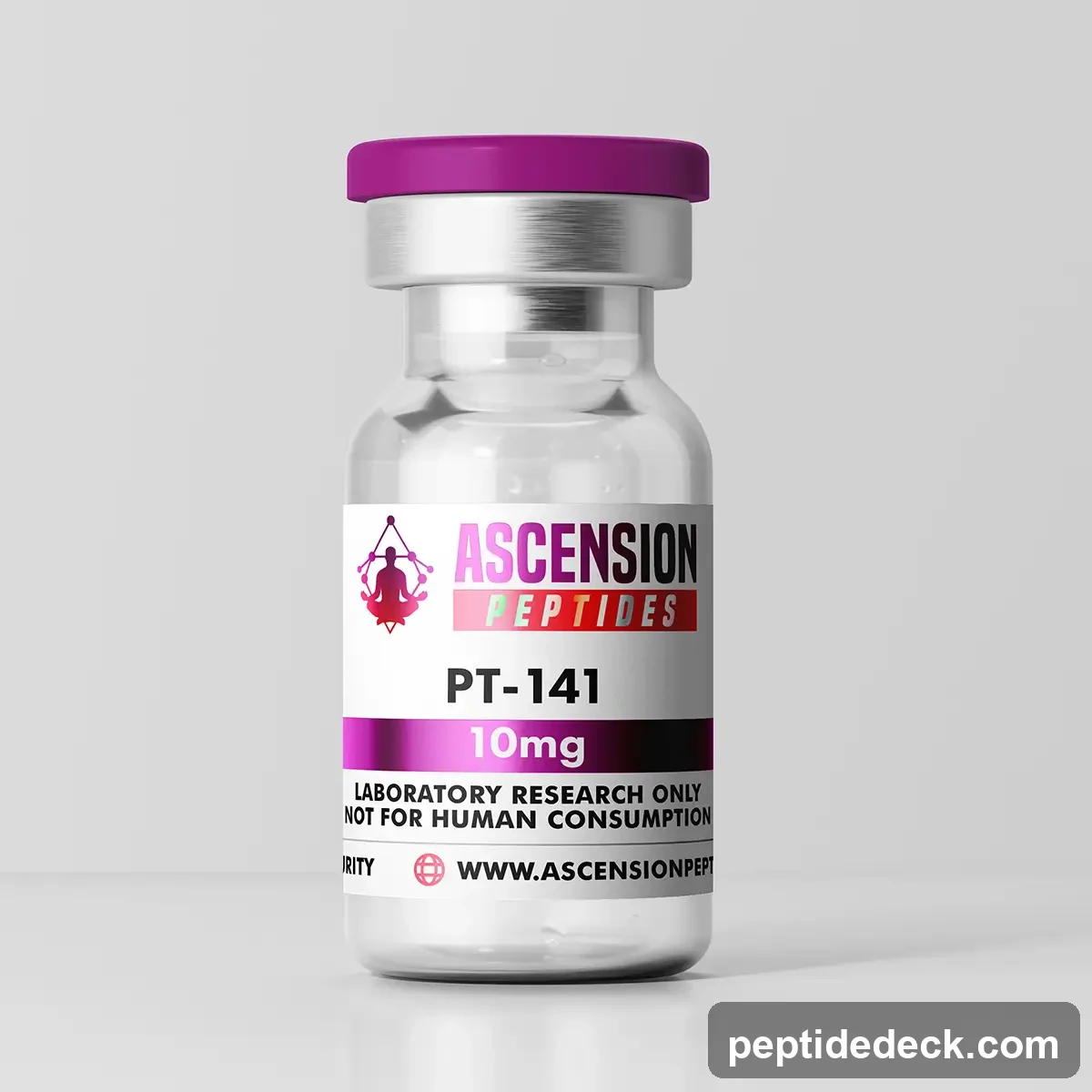
PT-141 is the easier of the two to source. See where to buy PT-141 for the current vial price and its lab certificate.
How Each Compound Works Inside the Body
Alprostadil: The Direct Vascular Trigger
Alprostadil binds to EP2 and EP4 prostaglandin receptors on the smooth muscle cells of the corpus cavernosum. This activates adenylate cyclase, raising intracellular cyclic AMP (cAMP), which causes smooth muscle relaxation and arterial dilation. Blood floods into the penile chambers, and an erection occurs — typically within 5–20 minutes of administration.
Crucially, this mechanism bypasses every upstream signal: no sexual stimulation is needed, no desire, no arousal cascade, no nitric oxide pathway. The erection is a direct pharmacological consequence of smooth muscle relaxation. This makes alprostadil uniquely effective for men whose erectile dysfunction stems from vascular insufficiency, nerve damage (post-prostatectomy, diabetic neuropathy), or failure to respond to PDE5 inhibitors.
PT-141: The Central Desire Activator
PT-141 activates MC4R (melanocortin-4 receptors) in the hypothalamus, paraventricular nucleus, and other limbic structures. This triggers dopamine release in reward circuits and modulates oxytocin pathways — the neurochemical signature of genuine sexual motivation. Unlike vasodilators, PT-141 does not produce an erection directly. Instead, it raises the motivational drive and arousal state that, in men, naturally leads to erection through normal physiological signaling.
Phase 2 clinical trials in men with ED showed that PT-141 produced erections in a significant proportion of PDE5 inhibitor non-responders — presumably because desire-pathway activation can restore downstream erectile function in men whose central motivation circuits had gone quiet, even when peripheral vascular function is compromised.
What the Research Actually Shows
Alprostadil: 30+ Years of Evidence
Alprostadil has one of the longest evidence trails of any ED treatment. FDA-approved in 1995, it has been studied across thousands of patients in controlled trials and real-world settings. Response rates in clinical studies consistently exceed 80% across diverse etiologies — including men who failed PDE5 inhibitors, men with post-prostatectomy ED, and men with severe vasculogenic dysfunction.
The intracavernosal injection formulation (Caverject, Edex) is generally more effective than the intraurethral pellet (MUSE), with the latter showing lower response rates (approximately 30–65%) due to less direct tissue delivery. For men who can tolerate the injection protocol, alprostadil is one of the most reliable on-demand ED therapies available.
PT-141: Newer Approval, Unique Indication
PT-141's FDA approval in women was based on the Phase 3 RECONNECT trials, which demonstrated statistically significant improvements in satisfying sexual events and reduction in distress related to low desire in premenopausal women with HSDD. The effect size was moderate but clinically meaningful, particularly given that no alternative pharmacological treatments targeting desire had previously been approved.
Phase 2 male ED studies showed promising results, including responses in men who had failed sildenafil — a finding with significant clinical implications. However, the manufacturer did not pursue a male ED indication to Phase 3 completion. As a result, male use of PT-141 remains off-label despite these encouraging data points.
Safety Profiles: How the Risk Differs
The side effect profiles of these two compounds reflect their mechanistic differences almost perfectly. Alprostadil's risks are local and vascular; PT-141's risks are systemic and neurological.
Alprostadil Side Effects
- Penile pain at injection site: Reported in 11–44% of users — the most common complaint and the primary reason men discontinue.
- Priapism: Erection lasting more than 4 hours occurs in 1–3% of cases. This is a medical emergency requiring immediate treatment to prevent permanent tissue damage.
- Penile fibrosis: Chronic injection use causes scarring in 2–12% of long-term users, potentially affecting erection quality over time.
- Urethral discomfort (MUSE): The intraurethral pellet formulation causes burning or discomfort in 24–32% of users.
- Hypotension: Systemic absorption can cause mild blood pressure drops, particularly with higher doses.
PT-141 Side Effects
- Nausea: The most common side effect, reported in approximately 40% of users — typically mild to moderate and transient.
- Facial flushing: Warmth or redness of the face and neck shortly after injection.
- Headache: Mild, usually resolving within a few hours.
- Blood pressure elevation: Transient, modest increases in systolic and diastolic BP — relevant for patients with hypertension.
- Focal hyperpigmentation: With repeated use, some users develop darkening of facial skin or gums — an on-target melanocortin effect.
- FDA dosing limit: The label restricts use to no more than 8 doses per month.
How Each Compound Is Administered

Alprostadil Intracavernosal Injection (Caverject/Edex)
Dose is individually titrated, typically starting at 1.25–2.5 mcg and adjusting up to a maximum of 60 mcg. Injected directly into the corpus cavernosum using a fine needle. Onset is 5–20 minutes. Training with a healthcare provider is required before self-injection. Use no more than 3 times per week, with at least 24 hours between doses.
Alprostadil Intraurethral Pellet (MUSE)
A small medicated pellet inserted into the urethra via applicator. Available in 125, 250, 500, and 1000 mcg doses. Lower efficacy than injection but avoids needle use. Urethral discomfort is common. Onset is approximately 10–20 minutes.
PT-141 Subcutaneous Injection (Vyleesi autoinjector)
Fixed 1.75 mg dose administered via pre-filled autoinjector into the abdomen or thigh. Should be given at least 45 minutes before anticipated sexual activity. Nausea risk is higher on an empty stomach — eating beforehand can reduce it. Maximum 8 doses per month per FDA label.
PT-141 Research Use (Subcutaneous, Off-Label)
In research contexts, PT-141 is sometimes dosed at 1–2 mg subcutaneously, 60–90 minutes before activity. Off-label male use for ED or libido falls outside FDA-approved indications. Always consult a physician before pursuing off-label protocols.
Alprostadil vs PT-141: Direct Comparison Table
Which Compound Is Right for Your Situation?
Choose Alprostadil If:
- You have confirmed vasculogenic, neurogenic, or mixed-etiology ED
- You have failed PDE5 inhibitors (sildenafil, tadalafil) and need a reliable mechanical solution
- You have post-prostatectomy or diabetic neuropathy-related ED where nerve signaling is compromised
- You need a fast, predictable erection within 15–20 minutes
- Desire and libido are not your primary complaint — erection quality is
- You are comfortable with injection technique or intraurethral pellet administration
Choose PT-141 If:
- Your primary issue is low sexual desire, motivation, or libido rather than mechanics
- You are a premenopausal woman with diagnosed HSDD
- You are a man exploring off-label options for desire and have discussed this with a physician
- You want to avoid any risk of priapism or local penile side effects
- You are a PDE5i non-responder willing to try a central-pathway approach
- You prefer subcutaneous injection over penile injection
Consider Both Together If:
In cases of combined low desire AND mechanical erectile dysfunction, some clinicians explore combining a centrally-acting compound like PT-141 with alprostadil to address both dimensions simultaneously. This approach is not FDA-studied in combination and should only be considered under close medical supervision with careful dose management.
Sourcing PT-141 for Research Use
Alprostadil is available only by prescription through licensed pharmacies (brand names Caverject, Edex, MUSE, and compounded versions). For PT-141, the FDA-approved Vyleesi autoinjector also requires a prescription. Research-grade PT-141 is available from peptide vendors for laboratory and investigational purposes.
When evaluating a research peptide vendor for PT-141, prioritize the following criteria:
- Third-party tested purity: Look for HPLC and mass spectrometry results confirming ≥98% purity
- Certificate of Analysis (COA): Should be batch-specific and available on request or publicly posted
- US-based fulfillment: Domestic shipping reduces customs risk and delivery time
- Transparent ingredient sourcing: Reputable vendors disclose synthesis and testing methodology
- No proprietary blends: PT-141 should be the only active ingredient — avoid multi-compound vials of unknown composition
Ascension Peptides is one vendor that meets these standards, offering third-party tested PT-141 with publicly available COAs and domestic shipping. Always verify current COA documentation before purchasing from any research supplier.
Frequently Asked Questions
Alprostadil vs PT-141: The Bottom Line
These two compounds are not competing treatments — they are complementary tools addressing different dimensions of sexual dysfunction. The decision framework is straightforward:
- Mechanical erection failure (vasculogenic, neurogenic, post-surgical)? → Alprostadil is your compound. It is proven, reliable, and bypasses the entire arousal cascade to deliver predictable erections.
- Low desire, motivation, or arousal (HSDD, libido decline)? → PT-141 is the only FDA-approved pharmacological option targeting this dimension, with a growing body of data supporting off-label use in men as well.
- PDE5 inhibitor failure with unclear etiology? → Both have Phase 2/3 evidence in this population. A clinician evaluation to determine whether the failure is primarily vascular or central will guide which agent is more appropriate.
For most men with straightforward ED who have failed oral PDE5 inhibitors, alprostadil remains the gold standard second-line therapy. For individuals — male or female — whose primary complaint is loss of desire rather than mechanics, PT-141 represents a genuinely novel and clinically validated option that no other approved compound can replicate.