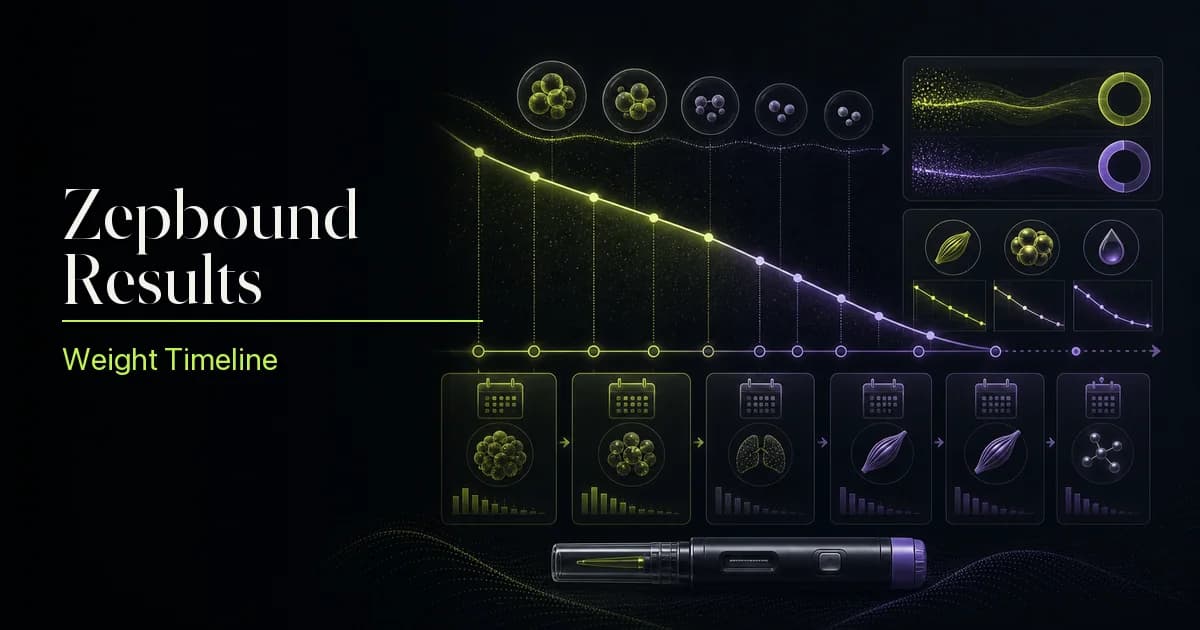
Search for "Zepbound before and after" and you will find thousands of dramatic transformation photos, but very few that tell you what is actually typical, what the clinical trials measured, and how long it took. This guide separates the marketing-grade success stories from the real, published numbers. Zepbound (tirzepatide) is the FDA-approved version of tirzepatide for chronic weight management, and across its phase 3 SURMOUNT program it produced some of the largest weight-loss results ever recorded for a non-surgical obesity treatment, with averages of roughly 16% to 22.5% of starting body weight over 72 weeks depending on dose.[1][4] Below you will find a realistic month-by-month timeline, the head-to-head data versus Wegovy, an effect-size table that converts trial percentages into real pounds and kilograms, who tends to respond best, and what happens to those before-and-after results if you stop.
🔑 Key Takeaways
- In the pivotal SURMOUNT-1 trial, adults without diabetes lost an average of 16.0% (5 mg), 21.4% (10 mg) and 22.5% (15 mg) of body weight at 72 weeks, versus 2.4% on placebo.[1][3]
- Head-to-head, Zepbound beat Wegovy: 20.2% average loss versus 13.7% over 72 weeks, a difference of about 6.5 percentage points, or roughly 17 extra pounds (7.7 kg) for an average participant.[5][6]
- Results build gradually: expect roughly 2% by week 4 and meaningful change by 3 to 6 months, with most people approaching their maximum near 72 weeks rather than in the first month.[1]
- About 1 in 3 people on the highest Zepbound dose lost at least 25% of their body weight, a category once associated only with bariatric surgery.[1][5]
- "Before and after" is not permanent on its own. After stopping, participants regained an average of 14% of body weight within a year, so most clinicians treat Zepbound as long-term therapy.[7][8]
Does Zepbound Really Work? What the Trial Data Actually Shows
The honest answer is yes, and the evidence is unusually strong. Zepbound is the obesity brand of tirzepatide, a once-weekly injection that activates two gut-hormone receptors at once, GIP and GLP-1, which is why it is described as a dual agonist. The FDA approved it for chronic weight management in adults with obesity (BMI 30 or higher) or overweight (BMI 27 or higher) plus a weight-related condition such as high blood pressure, type 2 diabetes, dyslipidemia, obstructive sleep apnea, or cardiovascular disease.[2]
The "before and after" results everyone references come mainly from the SURMOUNT clinical program. In SURMOUNT-1, a 72-week trial of 2,539 adults with obesity or overweight (without type 2 diabetes), average weight reduction was 16.0% on the 5 mg dose, 21.4% on 10 mg, and 22.5% on 15 mg, compared with just 2.4% in the placebo group.[1][3] Even more striking, 36% (10 mg) and 40% (15 mg) of participants lost at least 25% of their starting body weight, versus essentially nobody on placebo.[1] In SURMOUNT-2, which studied adults who also had type 2 diabetes, the average loss was lower (around 12.8% to 14.7%), because diabetes blunts weight-loss response.[12] That gap is worth remembering when you look at strangers' photos online: their starting point, diabetes status, and dose all change the result.
Why online before-and-after photos can mislead
Most viral transformation posts show the very best responders, often the people who hit the 25%-plus club. They rarely mention the starting weight, the dose, how many months passed, or whether diet and resistance training were part of the plan. The trial averages above are a fairer benchmark for what to expect, because they include everyone, not just the standout cases.
Zepbound Weight-Loss Timeline: Month by Month
One of the most common questions is what to expect with Zepbound week by week. Weight loss is gradual by design, because the dose is titrated upward slowly to limit nausea. You start at 2.5 mg weekly (a starting dose, not a treatment dose), then step up every 4 weeks toward a maintenance dose of 5, 10, or 15 mg.[9] The table below reflects the trajectory seen in SURMOUNT-1 and the FDA-approved titration schedule, not a guarantee for any individual.
Two practical notes. First, the early weeks are usually the hardest on side effects but not the most productive for the scale, which frustrates people who expect rapid drops. Second, weight loss does not stop abruptly at a "wall," it gradually slows as your body approaches a new set point. If you stall well before 72 weeks, that often signals a need to optimize dose, protein intake, or activity rather than a sign the drug stopped working. Our guide on why you may not be losing weight on a GLP-1 walks through the usual fixes.
Zepbound vs Wegovy: How Effective Is It Compared to the Alternative?
The most useful "does it work" comparison is the head-to-head SURMOUNT-5 trial, which randomized 751 adults with obesity (without diabetes) to maximum tolerated doses of Zepbound or Wegovy for 72 weeks. Zepbound won on every measured endpoint.[5][6]
The 6.5-percentage-point gap is not just a statistic. For a 200 lb (90.7 kg) starting weight, 20.2% is about 40 lb (18.3 kg) versus about 27 lb (12.4 kg) on Wegovy, a real-world difference of roughly 13 to 17 lb (6 to 8 kg).[6] That said, Wegovy still produces large, clinically meaningful loss, and individual response varies. For a deeper breakdown including cost and insurance, see our dedicated Zepbound vs Wegovy comparison and the broader tirzepatide vs semaglutide guide.
Before-and-After in Real Terms: Pounds and Kilograms by Starting Weight
Percentages are abstract. The table below converts the SURMOUNT-1 averages into the actual weight you might expect to lose at 72 weeks, by starting weight and dose. These are mean trial outcomes, so roughly half of people did better and half did less.
Figures are calculated from the SURMOUNT-1 mean percentage reductions and rounded.[1] They assume a full 72 weeks at the listed maintenance dose plus reduced-calorie eating and increased activity, exactly the conditions the trial used.
Zepbound Reviews and Success Rate: What "Worth It" Looks Like
"Is Zepbound worth it" is partly a clinical question and partly a personal one. Clinically, the success rate is high: in SURMOUNT-1, about 9 in 10 people on the 10 mg and 15 mg doses lost at least 5% of body weight, the threshold considered clinically meaningful for improving blood pressure, blood sugar, and cardiometabolic risk.[1][10] Beyond the scale, tirzepatide has earned additional FDA approvals that reflect real health gains: in December 2024 it became the first drug ever approved for moderate-to-severe obstructive sleep apnea in adults with obesity, based on the SURMOUNT-OSA trials.[11]
The trade-off is side effects and cost. Gastrointestinal symptoms (nausea, diarrhea, constipation, vomiting) are the most common reasons people stop, and most are worst during dose increases.[9] If you are weighing the experience, our Zepbound side effects guide covers what is mild versus serious and how to manage it. For broader, brand-agnostic patient experiences, the tirzepatide reviews page aggregates Mounjaro and Zepbound user reports.
Who tends to respond best (and who should not use Zepbound)
Strongest responders in the trials reached the maintenance dose, paired the drug with adequate protein and resistance training to protect muscle, and stayed on treatment long enough to clear the 36-to-72-week window. Zepbound is not for everyone: it is contraindicated in people with a personal or family history of medullary thyroid carcinoma or MEN 2, and is not approved or recommended during pregnancy. Anyone with a history of pancreatitis, gallbladder disease, or severe GI conditions should review risks with a clinician first.[9]
What Happens to Your Results If You Stop?
This is the part the dramatic photos never show. The SURMOUNT-4 withdrawal trial took participants who had already lost an average of 20.9% during a 36-week lead-in, then randomized them to continue tirzepatide or switch to placebo. Those who continued lost an additional 5.5% on average over the next year. Those who stopped regained an average of 14% of body weight, and the majority of people who had lost at least 10% regained more than a quarter of it within a year.[7][8] Weight regain also reversed much of the improvement in blood pressure, blood sugar, and other cardiometabolic markers.[8]
The takeaway is not that the drug "doesn't last." It is that obesity behaves like a chronic condition, so the before-and-after holds only while treatment (or a deliberate maintenance plan) continues. If you are thinking about coming off, plan it deliberately; our guide on what happens when you stop a GLP-1 outlines tapering and rebound-management strategies that apply to tirzepatide as well.
How to See Zepbound-Style Results: Practical Checklist
- Reach an effective maintenance dose. The 2.5 mg start is not a treatment dose. Most of the trial weight loss came at 10 to 15 mg.[9]
- Give it real time. Judge results at 12 to 16 weeks at maintenance dose, not at week 4.
- Protect muscle. Prioritize protein and resistance training, since rapid loss can cost lean mass. See our overview of GLP-1 before-and-after timelines for what changes each month.
- Plan for the long term. Because stopping triggers regain, decide upfront whether this is a long-term therapy or part of a maintenance strategy.
- Source it safely. Only use FDA-approved Zepbound or a legitimate prescribed product through a licensed pathway, not unverified online sellers.
Frequently Asked Questions
References
- Jastreboff AM, et al. Tirzepatide Once Weekly for the Treatment of Obesity (SURMOUNT-1). N Engl J Med. 2022. PubMed PMID: 35658024.
- U.S. Food and Drug Administration. FDA Approves New Medication for Chronic Weight Management (Zepbound). 2023.
- Eli Lilly and Company. SURMOUNT-1 results published in NEJM: 16.0% to 22.5% weight loss. 2022.
- ZEPBOUND (tirzepatide) injection, for subcutaneous use. FDA Prescribing Information (US label).
- Aronne LJ, et al. Tirzepatide vs Semaglutide for Obesity (SURMOUNT-5). N Engl J Med. 2025. PubMed PMID: 40353578.
- Eli Lilly and Company. Zepbound superior to Wegovy in SURMOUNT-5: 20.2% vs 13.7%. 2025.
- Aronne LJ, et al. Continued Treatment With Tirzepatide for Maintenance of Weight Reduction (SURMOUNT-4). JAMA. 2024. PubMed PMID: 38078870.
- Tirzepatide and Health-Related Quality of Life in Adults With Obesity (SURMOUNT-4 analysis). PMC.
- Zepbound (tirzepatide) US Prescribing Information, including dosing, titration, contraindications and warnings. Eli Lilly.
- National Institute of Diabetes and Digestive and Kidney Diseases (NIDDK). Prescription Medications to Treat Overweight and Obesity.
- U.S. Food and Drug Administration. FDA Approves First Medication for Obstructive Sleep Apnea (Zepbound). 2024.
- Garvey WT, et al. Tirzepatide Once Weekly for Obesity in Adults With Type 2 Diabetes (SURMOUNT-2). Lancet. 2023. PubMed PMID: 37385275.