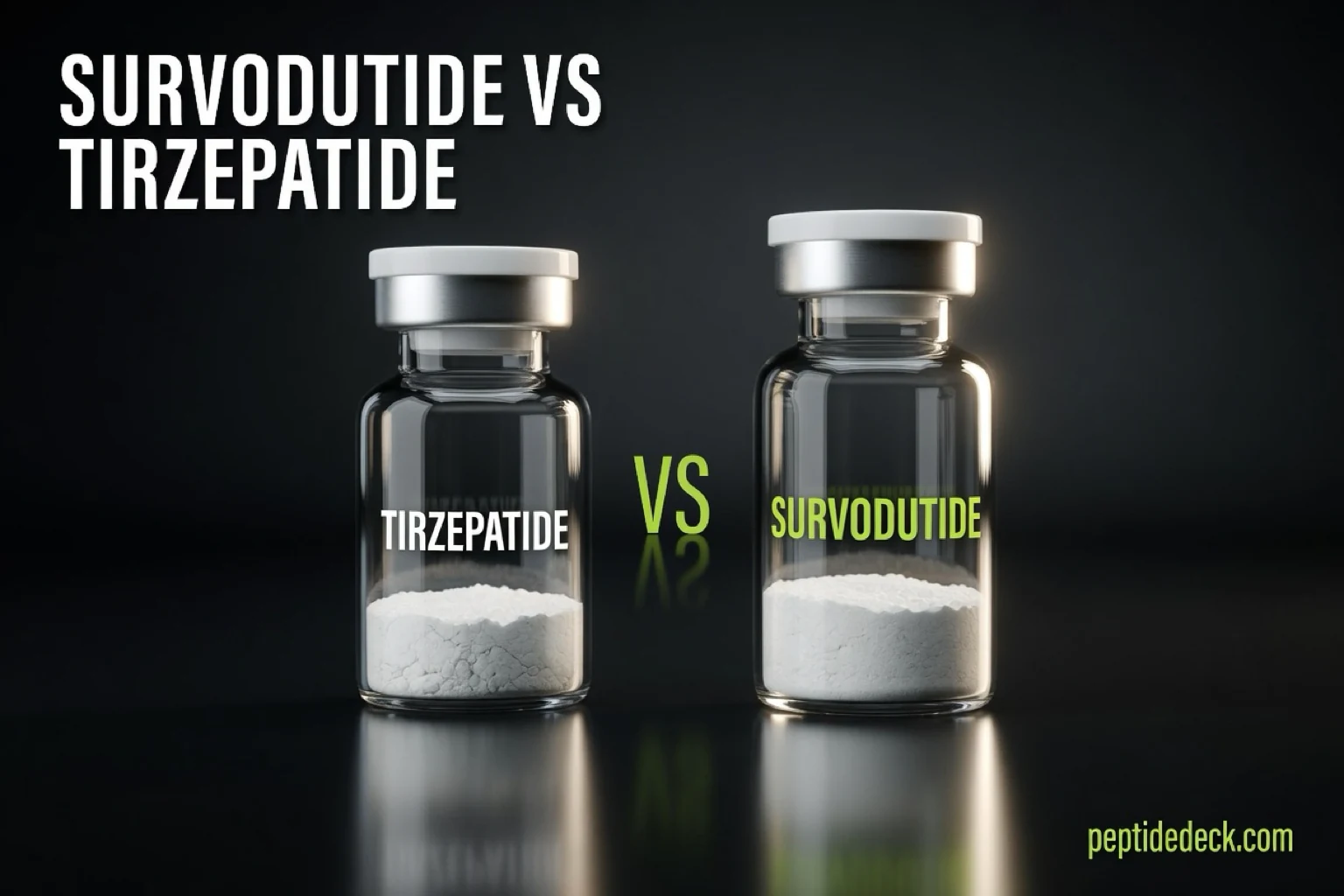

Two duals, one shared receptor, different second halves.
If you have been following the pipeline you know the pattern. Every serious weight-loss drug after semaglutide adds a second receptor to GLP-1, and the whole argument is about which second receptor is the right one. Tirzepatide bet on GIP and won the market. Survodutide bet on glucagon and is still in the trials that will decide whether that bet pays off.
This survodutide vs tirzepatide comparison lays out what each mechanism does, how the trial numbers line up once you correct for duration and dose, where survodutide's glucagon action gives it a real edge, and which of the two you can actually use.
🔑 Key Takeaways
- Both are dual agonists on a GLP-1 base. The second receptor is the only real design difference, and it is a big one.
- Survodutide's phase 2 figure sits closer to tirzepatide's than the trial lengths would suggest, which is why it is being taken seriously. It is still a phase 2 figure from a smaller, shorter study.
- Glucagon does one thing GIP cannot, and the survodutide programme is built around that thing rather than around the scale.
- Tirzepatide's second receptor buys it a tolerability advantage that shows up in discontinuation rates, and survodutide's phase 2 data shows the cost of not having it.
- For almost everyone reading this in 2026, one of these two is a prescription and the other is a wait. That ends most comparisons before the mechanism matters.
Survodutide shares its mechanism with mazdutide, which has its own comparison in mazdutide vs tirzepatide. Retatrutide, which adds both GIP and glucagon, is covered in retatrutide vs tirzepatide.
The mechanism split
One receptor reduces intake. The second decides what else happens.
Tirzepatide adds GIP to GLP-1. GIP's contribution is subtle and still being characterised, but two effects are reasonably well supported: it improves how fat tissue handles incoming energy, and it appears to reduce the nausea that GLP-1 stimulation causes on its own. That second effect matters in practice, because it lets tirzepatide reach a high effective dose while keeping dropout modest.
Survodutide adds glucagon to GLP-1. Glucagon raises energy expenditure and drives the liver to burn fat, which is a lever GIP does not pull. Survodutide is built around that lever: its development programme includes fatty liver disease as a primary target alongside obesity, and the liver data is where it has looked strongest.
The trade is straightforward. Tirzepatide's second receptor helps you tolerate the first. Survodutide's second receptor adds a separate fat-burning pathway but brings its own effects on heart rate and blood sugar that GLP-1 has to counterbalance.
Survodutide vs tirzepatide: the numbers in context
Different trial phases, so read carefully.
The two survodutide figures matter. The 18.7% number that circulates is from people who stayed on the drug for the full 46 weeks. Across everyone randomised, including those who stopped, the figure was closer to 14.9%. That gap is unusually wide, and it is the tolerability story told in numbers: a meaningful share of people did not stay on survodutide long enough to reach the headline result. Tirzepatide's trials report a much smaller spread between those two ways of counting.
Tolerability: where the GIP receptor earns its place
Dropout is the number to watch.
Both drugs produce the class-standard gut effects: nausea, vomiting, diarrhoea and constipation, worst after each dose step. The difference is degree. Survodutide's phase 2 saw a notably higher share of participants stop treatment because of side effects than tirzepatide's phase 3 programme reported, and the trial's own investigators attributed part of that to a titration schedule that was subsequently slowed for phase 3.
Two mechanisms are likely behind it. Tirzepatide's GIP action appears to soften GLP-1 nausea. And glucagon adds its own effects, including increased heart rate and, for some people, a sense of being over-stimulated that GIP does not produce. Whether the slower phase 3 titration closes the gap is one of the results worth waiting for. Tirzepatide's full side-effect picture is in the side effects guide.
Where survodutide could genuinely win
The liver, and possibly the ceiling.
Glucagon receptor activation drives fat oxidation in the liver directly rather than only through weight loss, and survodutide's phase 2 liver disease data showed large reductions in liver fat and improvements in fibrosis measures. For someone whose primary problem is metabolic liver disease rather than the scale, that is a difference in mechanism and not just in marketing.
The second possibility is the ceiling. Adding energy expenditure to appetite suppression is, on paper, a way past the plateau that GLP-1-based drugs reach when intake reduction alone runs out. Retatrutide, which uses glucagon alongside both GLP-1 and GIP, has produced the largest losses yet reported, and that is weak evidence that the glucagon lever is real. Whether survodutide's version of it beats tirzepatide at matched duration is exactly what phase 3 is designed to answer, and it has not answered it yet.

What you can actually use
This is the practical end of the comparison.
Tirzepatide is approved, available on prescription through insurance, LillyDirect, telehealth and compounding, and has been in wide use for several years. The routes and their trade-offs are in compounded tirzepatide. Survodutide is an investigational drug with no approval anywhere, which means it exists outside trials only as a laboratory-labelled peptide from vendors, with no established human dose, no prescriber, and the sourcing risks that come with that route. Our survodutide guide covers what is and is not known.
The honest verdict for 2026
For weight loss, tirzepatide has the higher confirmed number, the deeper safety record, the better tolerability data and a prescription route. Survodutide has a promising phase 2 result with a dropout problem attached and a phase 3 that has not read out.
For metabolic liver disease specifically, survodutide's mechanism is the more interesting one, and following its phase 3 results is reasonable. For everything else, this is a comparison between a drug and a hypothesis.
Frequently Asked Questions
Medical disclaimer. This article is informational and does not replace individual medical advice. Tirzepatide is a prescription medicine and survodutide is an investigational drug with no approval; neither should be started, switched or stopped without a clinician, and survodutide should not be used outside a clinical trial. Trial figures are population averages from studies of different phases, durations and sizes, presented to show scale rather than to predict an individual result. Anyone with a history of pancreatitis, thyroid cancer, gallbladder or cardiovascular disease, or who is pregnant or planning pregnancy, should discuss GLP-1 based treatment with a doctor.