Desire is not a plumbing problem.
That is the part the little blue pill never addressed. Sildenafil and tadalafil widen blood vessels, and if the issue is mechanical they work well. But plenty of people have no mechanical problem at all. The equipment is fine. The wanting is gone.
PT-141 is the one compound built for that gap, and it is the only one with a sexual desire indication approved by the FDA behind it.
🔑 Key Takeaways
- PT-141 works in the brain, not the bloodstream. That single fact explains why it helps some people that Viagra never touched, and why it does nothing for others.
- It has real phase 3 data in over 1,200 women, and an approved product. Almost nothing else in this category does.
- The dosing rules exist for a reason, and the ceiling is lower than most people assume.
- Nausea is the price of admission for roughly four in ten people. There is a way to blunt it, and a dose level where it usually stops.
- Two groups should not take it at all, and one of them will not find out why until their blood pressure spikes.
Here is what the evidence actually supports, what the label actually says, and where the honest limits are.
What is the PT-141 peptide?
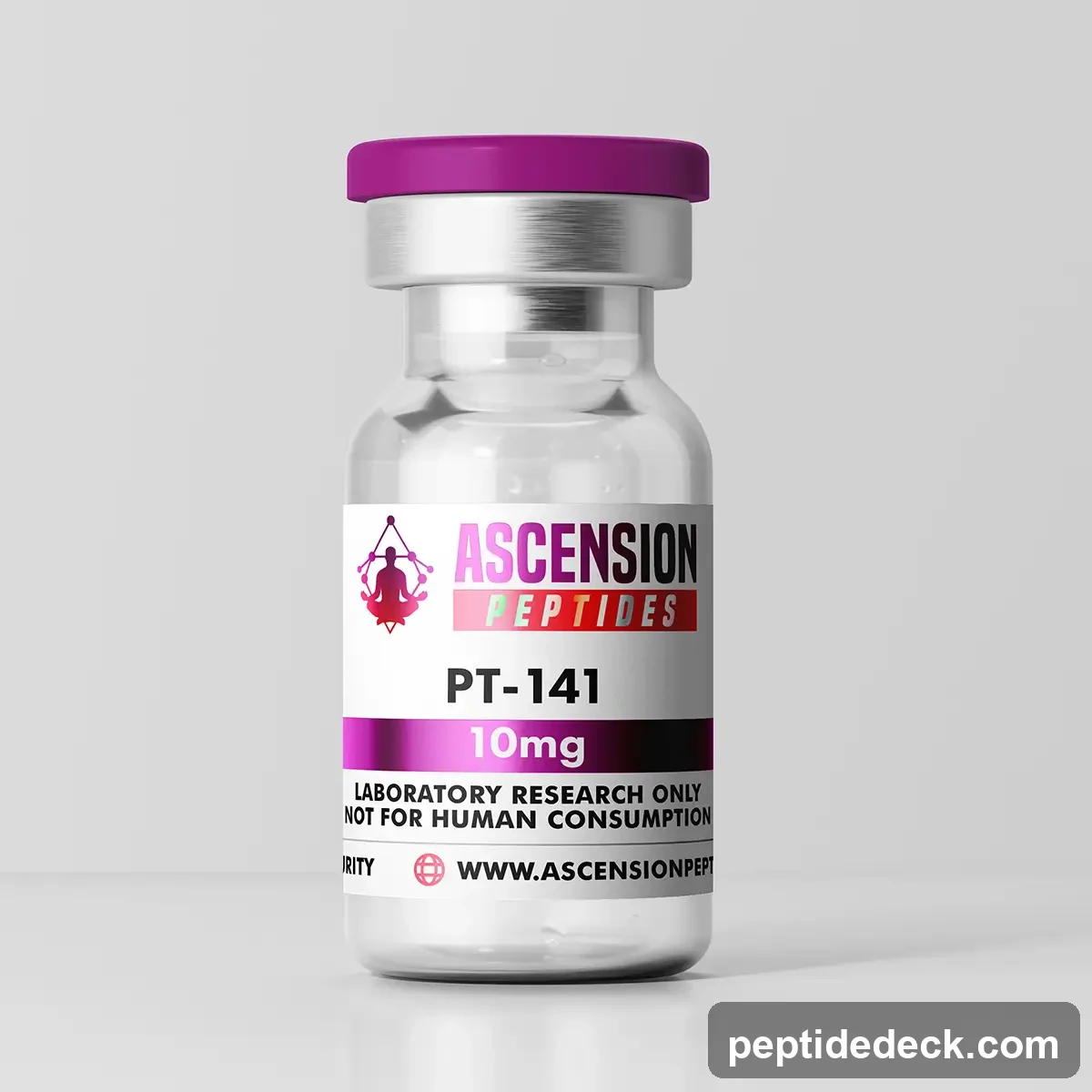
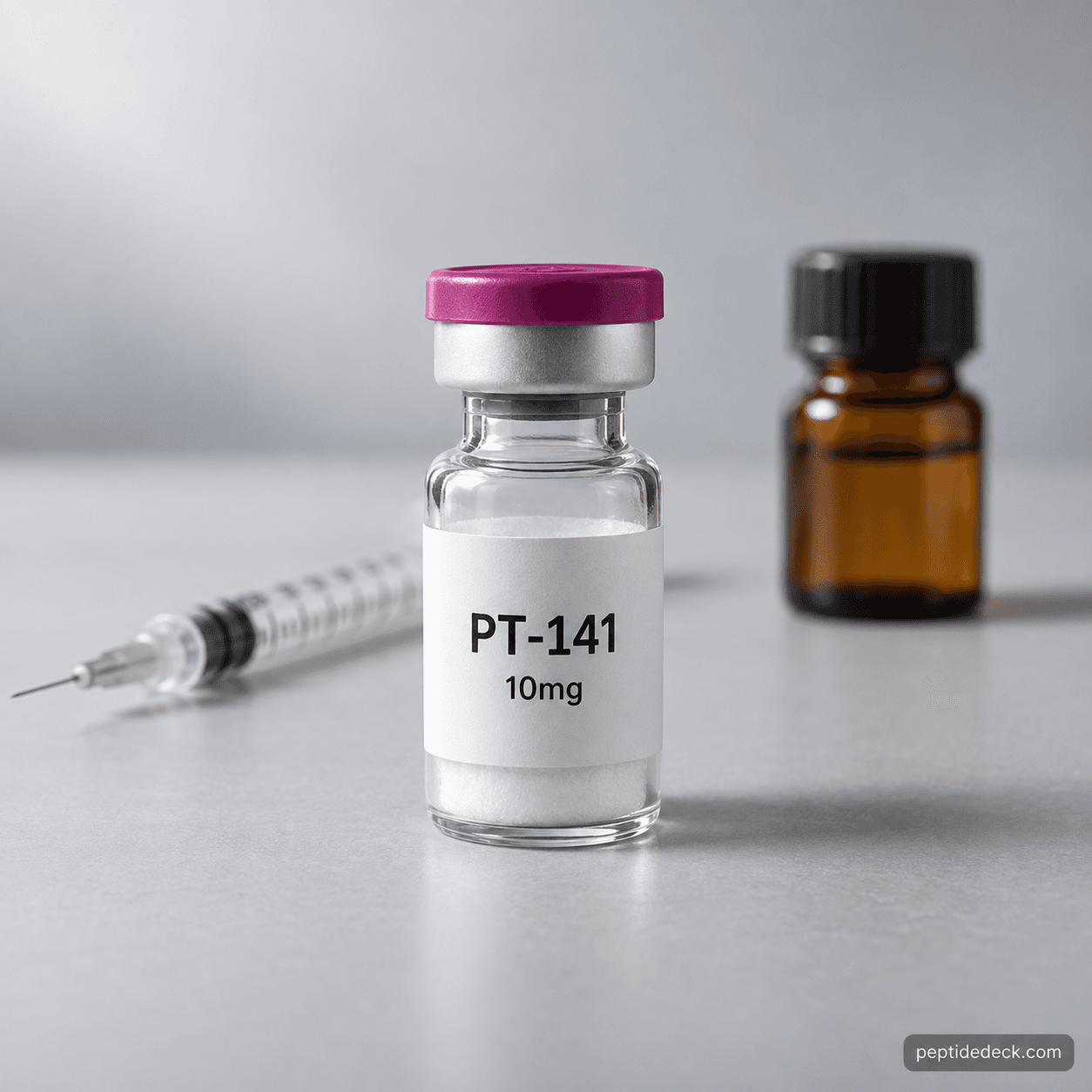
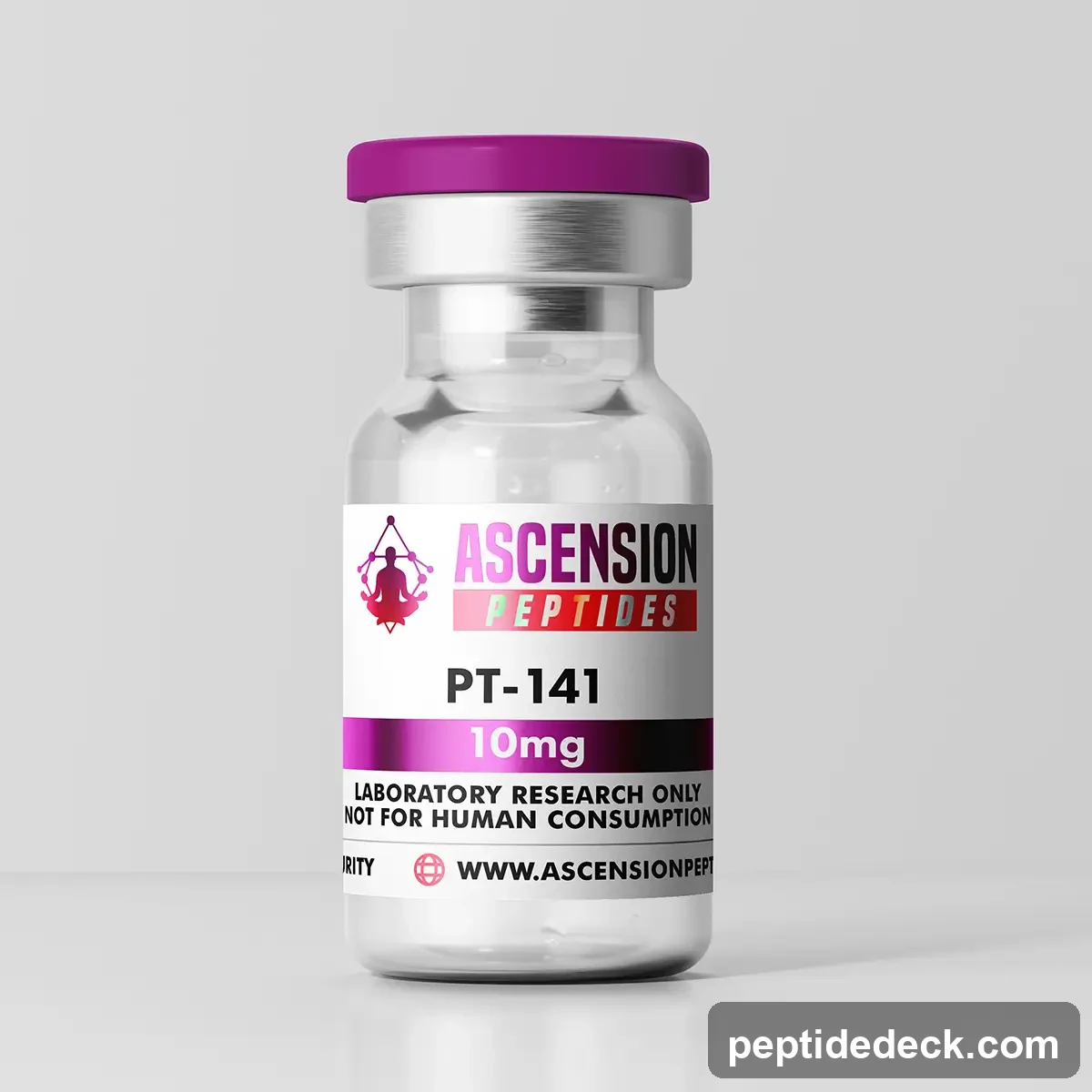
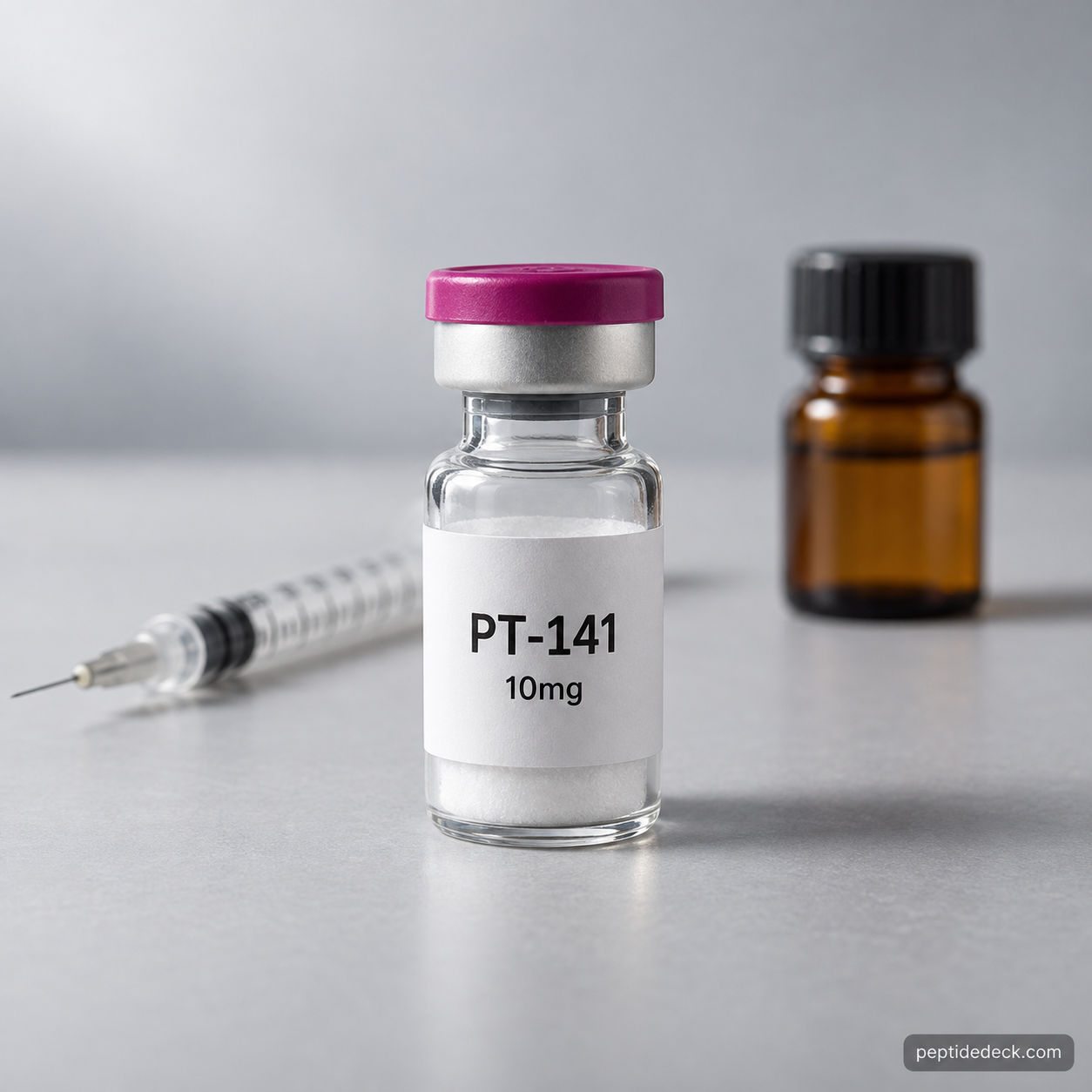
PT-141 is bremelanotide.
It is a synthetic cyclic peptide of seven amino acids, formula C50H68N14O10, with a molar mass of about 1,025 g/mol. It came out of the melanocortin programme at the University of Arizona, developed as a refinement of Melanotan II with the pigmentation activity largely stripped out and the receptor profile pushed toward the brain.
Palatin Technologies carried it through development. In 2019 the FDA approved it under the brand name Vyleesi for generalized hypoactive sexual desire disorder in premenopausal women, specifically the acquired form with no other medical or relationship cause.
That approval matters more than it sounds. It means PT-141 was tested against placebo in properly powered trials, measured on validated scales, and reviewed by a regulator. Most compounds discussed in the same breath have nothing close to that.
How PT-141 works
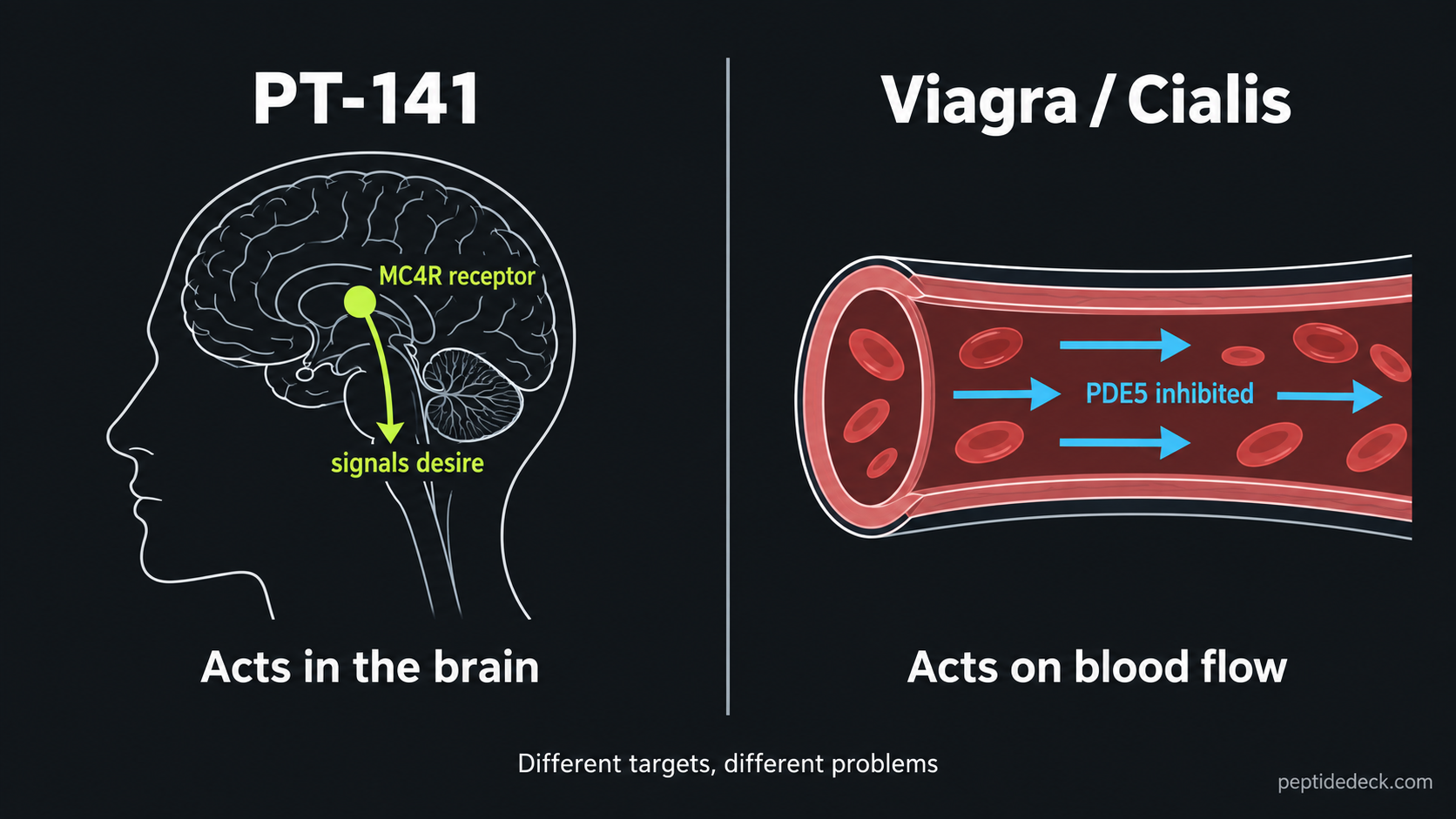
It acts on the brain.
PT-141 is an agonist at melanocortin receptors, with its useful activity at the MC4 receptor. Those receptors sit in the hypothalamus and nearby structures, in circuitry that governs sexual motivation, appetite and autonomic output. Activating MC4R there raises cyclic AMP inside those neurons and changes how they fire.
The practical translation: PT-141 modulates the signal that produces wanting. It does not widen a blood vessel, and it does not need an erection to already be under way.
Subcutaneous bioavailability is close to 100%, protein binding is around 21%, and the compound is broken down by ordinary hydrolysis of its peptide bonds rather than by the liver enzymes that create so many drug interactions. Roughly 65% leaves in urine.
Half-life is about 2.7 hours. Short. It is in and out the same evening, which is exactly why it is dosed before an occasion rather than every day.
What the trials found
The phase 3 programme ran two identical placebo-controlled studies.
627 participants received bremelanotide at 1.75 mg and 620 received placebo. Both trials measured change in sexual desire and in the distress that low desire causes, using validated instruments rather than a satisfaction survey.
Both hit their endpoints. Desire scores rose and distress scores fell against placebo, and the results were consistent across the two studies, which is the part that makes them credible.
The honest caveat, and independent reviewers have made this point repeatedly: the effect sizes were modest. This is not a switch that restores a twenty-year-old libido. It is a real, measurable, statistically solid shift that some people find clearly worthwhile and others find underwhelming. Anyone promising more than that is selling something.
One more limit worth stating plainly. The approval, and the bulk of the phase 3 evidence, is in premenopausal women. Use in men is off-label and rests on smaller studies and the earlier erectile dysfunction work that preceded the HSDD programme.
PT-141 dosage and timing
The approved protocol is narrow, and the ceiling is lower than most people expect.
| Parameter | Label protocol |
|---|---|
| Dose | 1.75 mg subcutaneously |
| Site | Abdomen or thigh |
| Timing | At least 45 minutes before anticipated activity |
| Maximum per day | One dose in any 24 hours |
| Maximum per month | Eight doses |
| Stop rule | Discontinue after eight weeks with no improvement |
Read that monthly cap again. Eight doses. PT-141 is not a daily peptide and it was never studied as one, which is why the "more is better" protocols circulating online have no evidence behind them and a clear mechanism for harm.
The eight-week stop rule is the other piece people skip. If desire and distress have not shifted in two months, the label says to stop rather than escalate. That is unusually direct guidance and it is worth following.
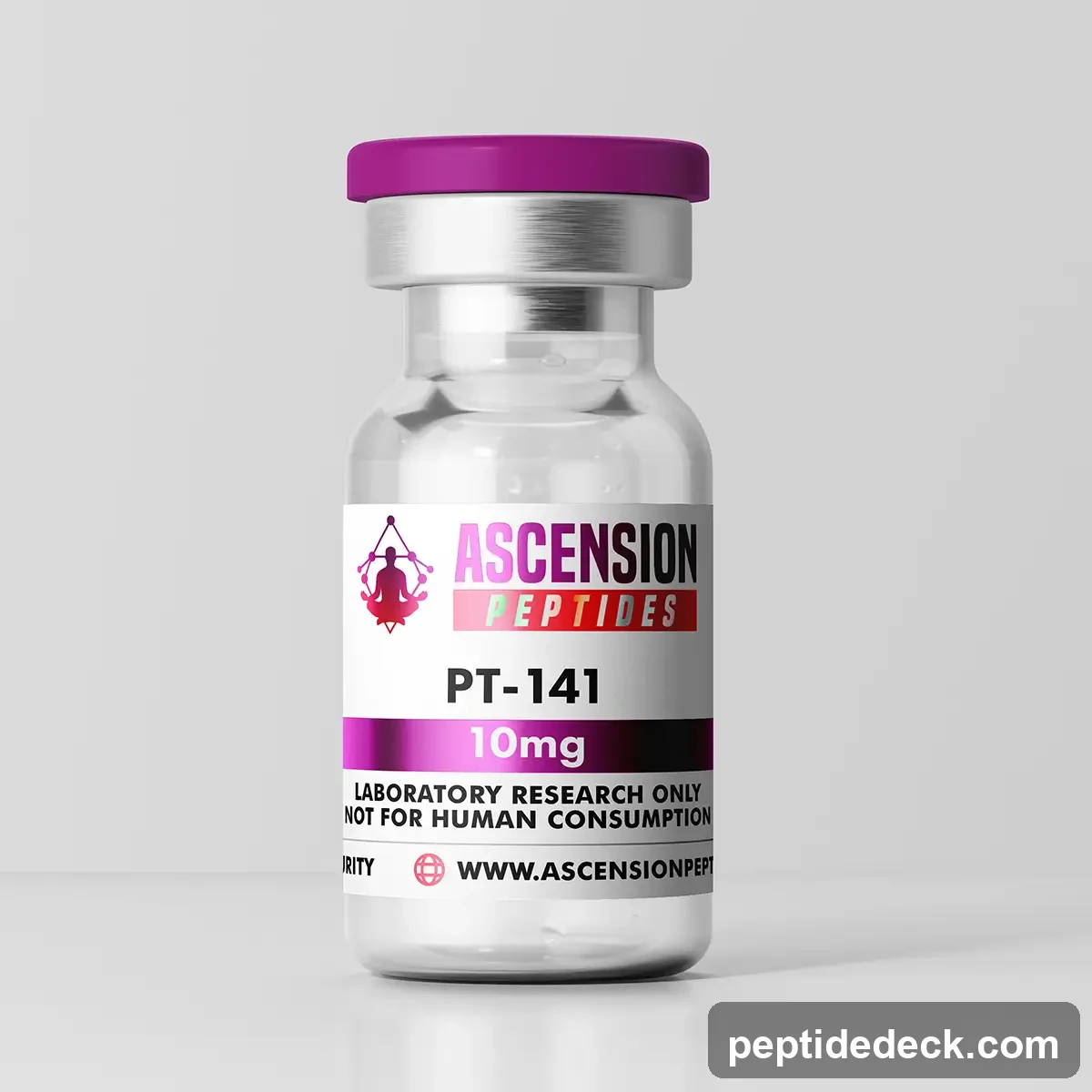
People using vials rather than the branded autoinjector often start lower, around 0.5 mg, specifically to find out how badly the nausea hits before committing to a full dose. That is a sensible instinct, and our PT-141 dosage guide covers titration and timing in detail.
PT-141 side effects
Nausea is the headline, and it is common.
In the phase 3 trials, 40% of people on bremelanotide reported nausea against 1.3% on placebo. That is not a rounding difference. For a minority it was severe enough to stop treatment.
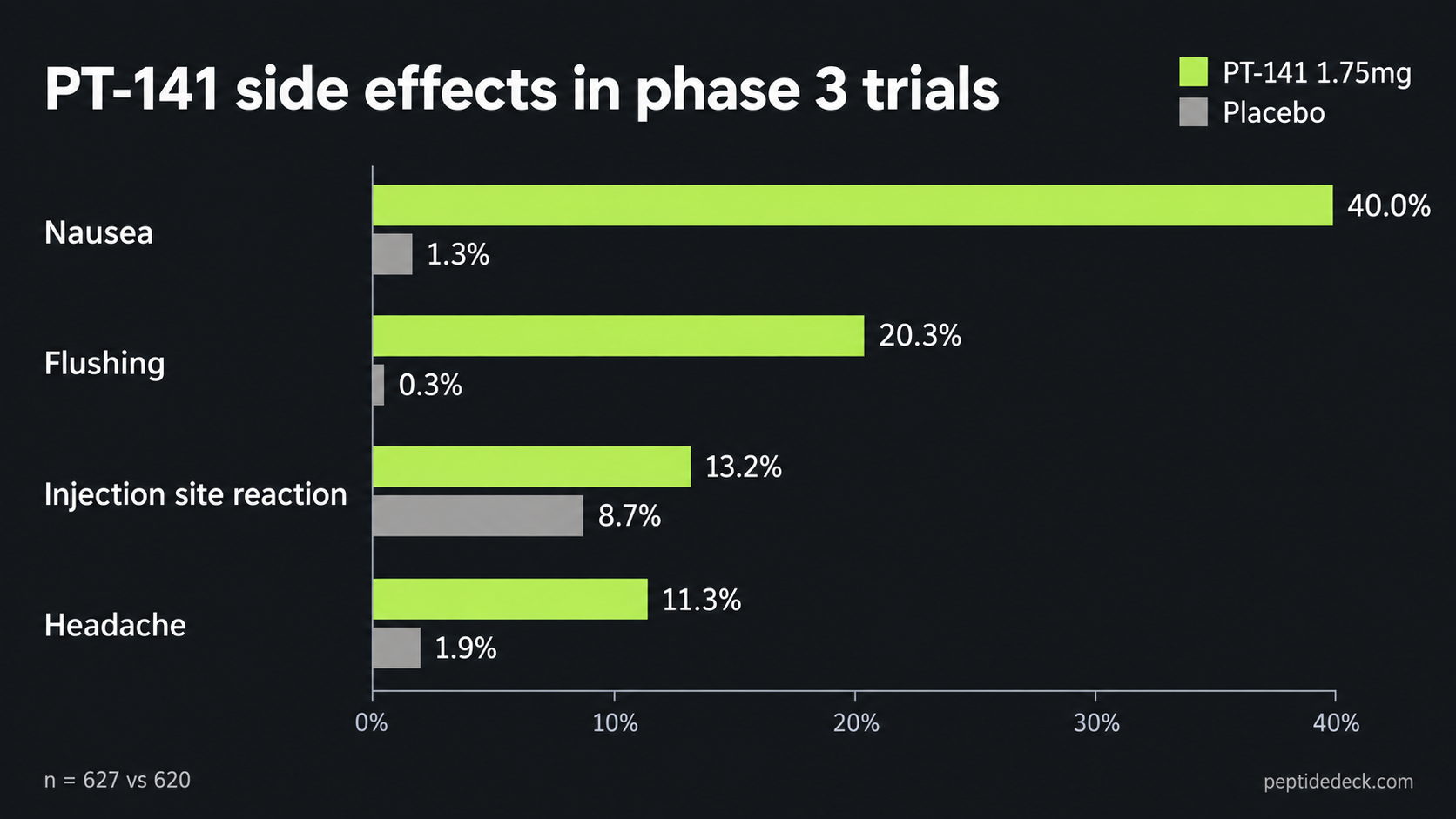
The rest of the profile, with placebo rates for context: flushing 20.3% against 0.3%, injection site reactions 13.2% against 8.7%, headache 11.3% against 1.9%, vomiting 4.8%, cough 3.3%, fatigue 3.2%.
Two things reduce the nausea in practice. An anti-nausea medication such as ondansetron taken before the dose was studied for exactly this purpose. And starting at a lower dose lets most people find the level where the effect is tolerable, since the nausea is dose-related rather than fixed.
There is also a transient rise in blood pressure and a small fall in heart rate after dosing. In healthy people this settles within hours. In the wrong person it is the reason for the contraindications below. Our guide to PT-141 side effects goes through management in more depth.
PT-141 versus Viagra and Cialis
They are not competitors. They are different tools.
| Feature | PT-141 | PDE5 inhibitors |
|---|---|---|
| Site of action | Brain, MC4 receptors | Blood vessels, PDE5 enzyme |
| Affects desire | Yes, that is the point | No |
| Needs arousal present | No | Yes |
| Route | Subcutaneous injection | Oral tablet |
| Onset | About 45 minutes | 30 to 60 minutes |
| Blood pressure | Slight transient rise | Lowers it |
| With nitrates | No interaction | Dangerous, contraindicated |
| Female indication | Yes, approved | No |
The practical rule is simple. A purely mechanical problem points to a PDE5 inhibitor. Low desire, flattening from an SSRI, or arousal that no longer arrives the way it once did points to PT-141. And the nitrate line in that table is the reason some people can take one and not the other at all.
PT-141 for men
The approval is for women. The interest is mostly from men.
That gap is worth being straight about. Bremelanotide began life as an erectile dysfunction candidate, and the early work in men is what pointed the programme toward the brain in the first place. Palatin later shifted focus to the female desire indication, which is where the large trials ran and where the approval landed.
So men using PT-141 are working from a smaller evidence base: the earlier erectile dysfunction studies, the shared mechanism, and a large amount of accumulated user experience. That is weaker than a phase 3 programme, and anyone telling you otherwise is overselling it.
What the mechanism does support is the distinction that matters. If erections are difficult to achieve or maintain and desire is intact, that is a blood flow problem and a PDE5 inhibitor is the better-evidenced answer. If desire itself has flattened, if arousal no longer arrives, or if an SSRI has blunted the whole response, PT-141 is targeting the system actually involved.
The other common reason men reach for it is exactly that SSRI scenario. Antidepressant-related sexual dysfunction is a desire and arousal problem rather than a vascular one, which is why PDE5 drugs so often disappoint in that group.
What to expect, honestly
Set the expectation before the first dose.
The trials measured a real but moderate improvement. In practice that tends to mean desire becomes available again rather than overwhelming, and that the response varies more between people than almost any other peptide discussed in this space.
Expect the nausea to show up on the first dose if it is going to, usually within the first hour. Expect flushing in about one in five cases. Expect the effect to be present for a few hours and gone by morning.
And apply the label's own stop rule. Eight weeks without a clear change is the signal to stop rather than to raise the dose, because the evidence does not support escalating and the side effects scale with the amount.
Who should not take PT-141
Two groups, and one of them will not know until it is too late.
Anyone with uncontrolled high blood pressure should not use it, because the transient pressure rise lands on top of a problem that is already unmanaged. Anyone with known cardiovascular disease should not use it for the same reason.
That second group is where the risk hides. Plenty of people have cardiovascular disease they have not been told about. If you have never had your blood pressure checked properly, that is the thing to do before ordering a peptide, not after.
The label also limits it to premenopausal women for the approved indication, and it is not intended to improve sexual performance in people without the underlying desire disorder.
How to get PT-141
Three routes, with very different prices.
The prescription route is Vyleesi, the branded autoinjector, at roughly $900 for four 1.75 mg doses. That is about $225 per use, and insurance coverage is inconsistent.
Telehealth and compounding pharmacies sit in the middle, prescribing compounded bremelanotide where a clinician judges it appropriate. Our guide to how to get PT-141 walks through what each route involves.
The vial route is what most people actually use. A 10 mg vial runs about $49 before any discount, which works out near $7.50 per 1.5 mg dose, or roughly a thirtieth of the Vyleesi price for the same molecule. The trade-off is that you are responsible for verifying what is in the vial, which means reading a certificate of analysis rather than trusting a label.
If you go that way, check three things: HPLC purity above 98%, mass spectrometry confirming a molecular weight near 1,025 Da, and a batch number on the certificate that matches the one on your vial. Anything sold as an oral tablet or a nasal spray is worth skipping, since bremelanotide has poor bioavailability by both routes.
Our PT-141 buying page lists the current price, the batch certificate for the vial shipping now, and what a vial costs per use against other vendors.
Medical Disclaimer: This content is for informational purposes only and does not constitute medical advice. Always consult a qualified healthcare provider before starting any new supplement, medication, or treatment. PeptideDeck may earn a commission from affiliate links at no additional cost to you.