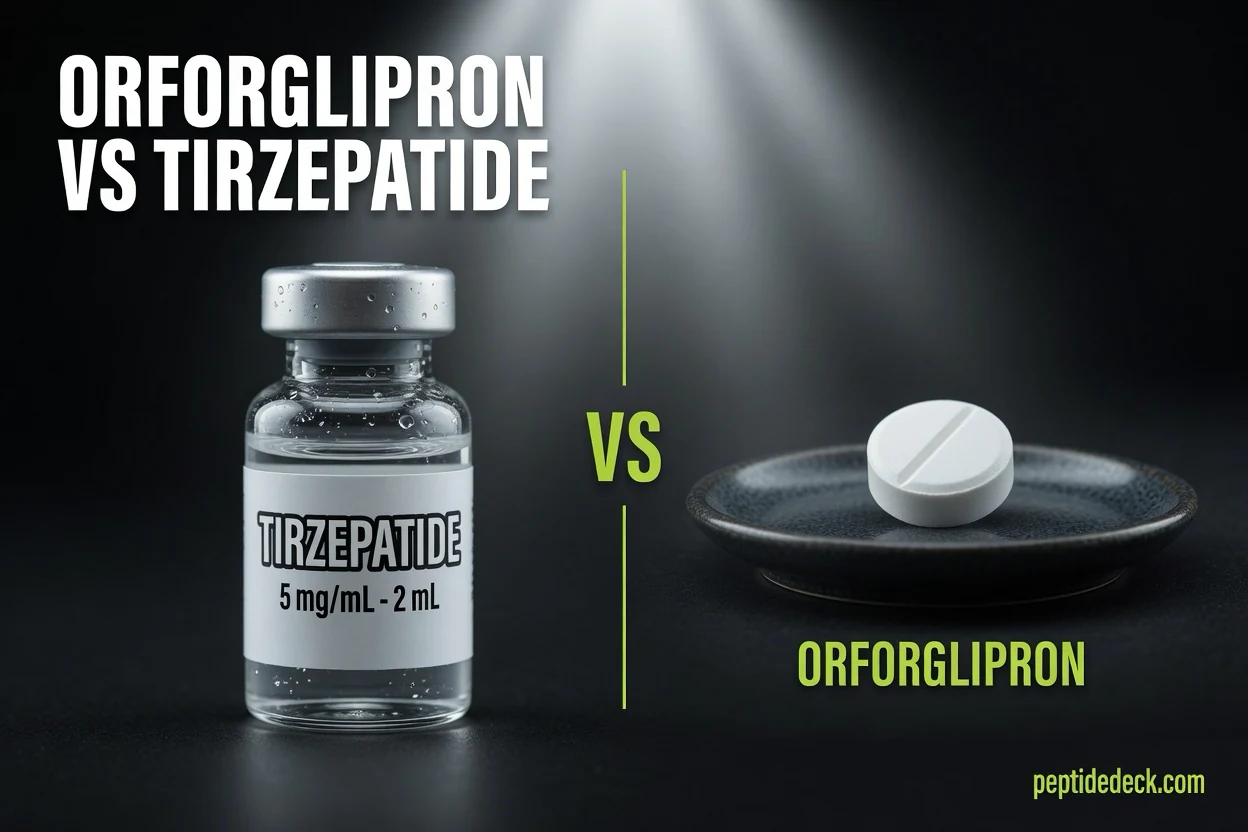
One is a pill. That is the whole pitch.
If you are comparing these two you have probably already decided you want the appetite effect and are trying to work out whether you can have it without the injection. That is a fair question and it has a real answer, but the answer is not "yes, same thing, no needle". The pill gives up something to be a pill, and how much it gives up is the point of this page.
This orforglipron vs tirzepatide comparison covers the mechanism difference behind the format difference, what each drug's pivotal trial showed and over what timeframe, the practical trade-offs of a daily tablet against a weekly shot, and who each one actually suits.
🔑 Key Takeaways
- Orforglipron is not "oral tirzepatide". It is a different kind of molecule hitting one receptor, and the format is possible precisely because of that difference.
- These two trials ran the same length, which makes this one of the few comparisons on the site where the headline numbers can be read side by side without a caveat. The gap is real, and it is large.
- The pill has one advantage that is not convenience, and it is the reason a prescriber might reach for it first.
- Orforglipron carries none of the food-and-water rules that make the existing oral GLP-1 awkward to live with, and that changes who it is for.
- There is a specific person for whom the pill is the better choice despite the smaller number, and a specific person for whom it is the wrong one.
Orforglipron gets its own full guide in our orforglipron page, including dosing and what the tablet's launch looks like. This page is the head-to-head only.
Why one is a pill and the other is not
Peptides do not survive the stomach.
Tirzepatide is a peptide, a chain of amino acids, and stomach acid and digestive enzymes take it apart before it can be absorbed. That is why it is injected. The existing oral semaglutide gets around this with an absorption enhancer and strict rules: empty stomach, small sip of water, wait thirty minutes. It works, but it is a workaround.
Orforglipron is a small molecule, not a peptide. It was designed from the start to survive digestion and be absorbed normally, which means it can be taken with or without food and with as much water as you like. The trade-off is that a small molecule is a blunter instrument than a peptide at the receptor. It activates GLP-1, and only GLP-1, and it does so somewhat differently from the natural hormone.
Tirzepatide's second receptor, GIP, is where the extra weight loss comes from, and there is currently no oral small molecule that hits GIP the same way. So the pill format is not a delivery choice bolted onto the same drug. It is a different drug, and the number difference follows directly.
Orforglipron vs tirzepatide: the trial numbers
Same duration, so read them straight.
The gap of roughly eight percentage points at 72 weeks is close to the gap between tirzepatide and injectable semaglutide, which fits: orforglipron is a GLP-1-only drug and lands roughly where GLP-1-only drugs land. It is a good number for a pill. It is not tirzepatide's number, and nothing about the format changes that.
What the pill gives you that the shot cannot
Not just convenience.
- No cold chain. Tablets travel, sit in a bag, and do not care about a warm car. Injectable peptides degrade with heat and need a fridge, which matters more than people expect once they are on the drug for a year.
- No injection anxiety, and no injection-site reactions. A meaningful share of people who would benefit from a GLP-1 never start one because of the needle. A tablet removes that barrier completely.
- Manufacturing scale. Small molecules are cheaper and faster to make than peptides at volume, which is the reason to expect the pill to be easier to supply and, eventually, cheaper. That is a structural advantage, not a marketing one.
- Easier to stop, easier to adjust. A daily drug clears faster than a weekly one, so side effects resolve sooner after a dose change and a pause takes days rather than weeks to show.
The last point cuts both ways. A weekly injection is forgiving of a forgotten day. A daily tablet is not, and adherence on daily medication is reliably worse in the real world than in trials.
Side effects: same list, different rhythm
Gut effects dominate both.
Nausea, vomiting, diarrhoea and constipation are the main complaints for each, worst around dose increases and improving over time. In ATTAIN-1, discontinuation for adverse events at the top orforglipron dose was somewhat higher than tirzepatide's trials typically report, with nausea and vomiting the drivers. Tirzepatide's GIP component is thought to take the edge off nausea, and that shows up as a modest but consistent tolerability advantage.
The rhythm differs too. A weekly injection produces a wave of side effects after each dose that settles over the week. A daily tablet produces a flatter, steadier exposure, which some people find easier and others find harder because there is no "good end of the week". Tirzepatide's full profile is in the side effects guide.
Who should pick which
The number decides less than you would think.
Orforglipron makes sense when
The needle is the reason you have not started. You travel constantly or cannot manage refrigeration. You are aiming at a moderate loss, in the 10 to 15% range, rather than the maximum available. Or a prescriber wants a GLP-1 that is quick to start and quick to stop.
Tirzepatide makes sense when
You want the largest loss the class currently offers and the strongest evidence base behind it. You have a lot of weight to lose and the extra eight points matter. You prefer a once-a-week task to a daily one. Or you have type 2 diabetes, where tirzepatide's data is deepest.
For the middle of the market, the honest framing is that orforglipron competes with semaglutide, not with tirzepatide. It offers semaglutide-range loss without a needle. Tirzepatide sits a tier above on the scale and stays there. Where each fits in the wider field is covered in tirzepatide vs semaglutide.
Frequently Asked Questions
Medical disclaimer. This article is informational and does not replace individual medical advice. Tirzepatide and orforglipron are prescription medicines and neither should be started, switched or stopped without a clinician. Trial figures are population averages and are shown to illustrate scale, not to predict an individual result. Anyone with a history of pancreatitis, thyroid cancer, gallbladder disease or diabetic retinopathy, or who is pregnant or planning pregnancy, should discuss any GLP-1 treatment with a doctor before starting.