Olatorepatide is the next GLP-1/GIP shot. Its pitch is a calmer stomach.
Also known by its code name HS-20094, it's a once-weekly injection from China's Hansoh Pharma that hits the same two receptors as tirzepatide. If you've lost weight on Zepbound or Mounjaro, or stopped because the nausea wore you down, you already know why that matters. In its phase 3 trial, the top dose took off 19.3% of body weight in 48 weeks, and on average fewer than 1 in 10 people reported nausea. Regeneron has bought the rights to sell it everywhere outside Greater China.
🔑 Key Takeaways
- Olatorepatide is a dual GLP-1/GIP agonist, the same drug class as tirzepatide, built to cause less nausea.
- Its weight loss in Chinese adults lands right next to tirzepatide's in a near-identical Chinese trial. The side-effect gap is the real story.
- The word "biased" in its description explains how the designers tried to get there.
- There is a catch in how the nausea number was reported, and it matters if you plan to compare.
- It cannot be bought as a medicine anywhere yet. What the US timeline looks like is further out than most headlines suggest.
Below, we cover what olatorepatide is, every number from the phase 3 LIGHTEN trial, how its side effects stack up against Zepbound and Wegovy, the doses used in trials, the Regeneron deal, and when (and how) you might actually get it.
What Is Olatorepatide (HS-20094)?
It's a weekly shot with two targets.
Olatorepatide is a 40-amino-acid peptide with a fatty acid attached, developed in-house by Hansoh Pharmaceutical in Shanghai. It switches on two gut hormone receptors: GLP-1, the target of semaglutide, and GIP, the second target tirzepatide added. For most of its development it was known only by its lab code, HS-20094, which some trial records still use. The generic name olatorepatide is now listed as an International Nonproprietary Name in the World Health Organization's naming system.
The fatty acid is what makes weekly dosing work. In Hansoh's early diabetes study, the half-life measured 142 to 168 hours, roughly six to seven days, and blood levels peaked 16 to 24 hours after each injection. That's in the same range as tirzepatide and semaglutide.
By the time Regeneron licensed it in June 2025, the drug had been given to more than 1,000 people across Chinese trials, according to Regeneron's announcement.
How Olatorepatide Works: What "Dual-Biased" Means
The design goal was fewer upset stomachs.
Every GLP-1 drug has the same problem. The signal that cuts your appetite also slows your stomach and can trigger nausea, especially in the first weeks of each dose step. Hansoh's bet is that the balance between the two receptors, and the way the drug activates them, can soften that.
A late-breaking poster from Hansoh's scientists at ENDO 2026 laid out the lab data. Two findings stand out:
- It leans toward GIP. In cell tests, olatorepatide was about 7 times more potent at the GIP receptor than at the GLP-1 receptor (EC50 of 0.0089 nM against 0.062 nM). That matters because GIP signaling in the brainstem appears to dampen nausea and vomiting, including the nausea GLP-1 triggers.
- It's "biased". When a receptor is switched on, it sends a main signal (cAMP) and also recruits a protein called beta-arrestin-2, which pulls the receptor inside the cell and turns it off for a while. Olatorepatide sends the full cAMP signal but recruits only part of the beta-arrestin response: 31% of the maximum at GLP-1 and 58% at GIP, compared with the natural hormones. Receptor internalization dropped too.
In plain terms, the drug is built to keep its receptors active at the cell surface while pushing the GIP side harder. Whether that is really why nausea was low in people is still a theory. These are lab cell results from the company that makes the drug, and no head-to-head human trial has tested it.
Olatorepatide Phase 3 Results: The LIGHTEN Trial
Here's what 48 weeks produced.
LIGHTEN enrolled 604 adults at 33 sites across mainland China. To get in, you needed a BMI of 28 or higher, or a BMI of 24 to 28 plus a weight-related condition such as prediabetes, high blood pressure, high cholesterol, fatty liver or sleep apnea. People with diabetes were excluded. These are Chinese BMI cutoffs, which sit lower than the US definition of obesity (30). Participants were split evenly across weekly 5 mg, 10 mg, 15 mg or placebo, and 90.1% finished the full 48 weeks.
Both co-primary goals were met: percent weight change at week 48, and the share of people losing at least 5%.
Two numbers per dose need a quick explanation. The efficacy estimand estimates what happens if everyone stays on the drug as planned. The treatment-regimen estimand counts everyone who was randomized, including people who stopped. The second is the fairer real-world number, and here the two are close: 18.7% against 19.3% at 15 mg. A small gap like that usually means few people dropped out.
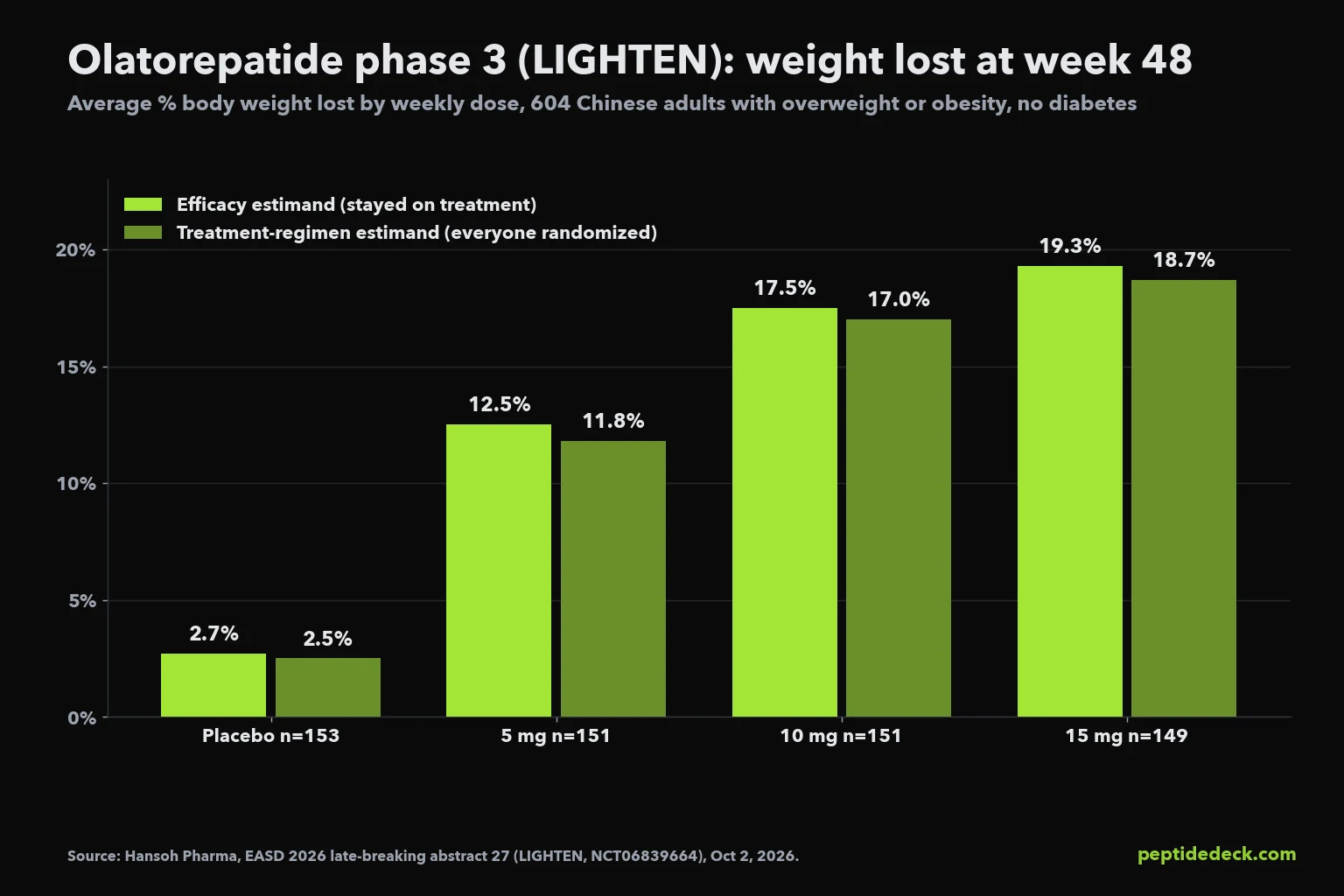
The responder numbers tell you more than the averages. On 15 mg, 95.2% lost at least 5%, 88.9% lost at least 10%, and 71.7% lost at least 15% of their body weight. On placebo, those figures were 28.6%, 14.6% and 3.2%. The 10 mg dose came close to 15 mg on most measures, and 5 mg trailed well behind.
Hansoh also reported that the weight loss curve was still heading down at week 48 with no plateau, and that blood pressure, cholesterol, HbA1c, insulin resistance, kidney albumin and uric acid all improved. The release does not give numbers for those.
Now the limitations. These results come from company press releases and a conference talk (EASD 2026, presented October 2). As of October 21, 2026, there is no peer-reviewed paper on PubMed for any olatorepatide trial, so baseline weight, dropout reasons and the full side-effect tables are not yet public. The trial was run and analyzed by Hansoh. And every participant was a Chinese adult, so the results may not carry over exactly to heavier Western populations.
Olatorepatide Side Effects and GI Tolerability
This is where it tries to win.
If you've been on a GLP-1, you know the drill: queasy for a day or two after each injection, worse after each dose step, sometimes bad enough to quit. Across the three olatorepatide doses in LIGHTEN, average rates were 7.8% for nausea, 4.9% for vomiting, 16.9% for diarrhea and 5.1% for constipation, against 2.6%, 2.0%, 7.8% and 1.3% on placebo. Hansoh says no one stopped treatment or left the trial because of a treatment-related side effect.
The fairest comparison is SURMOUNT-CN, Lilly's tirzepatide trial in 210 Chinese adults with almost the same entry criteria.
On paper, olatorepatide's nausea rate is roughly a quarter of tirzepatide's in the Chinese trial and a sixth of Wegovy's. That is a big gap. Three caveats keep it honest:
- The olatorepatide figures are averages across three doses. The 15 mg arm on its own is likely higher than 7.8%, and Hansoh hasn't published per-dose rates yet. The tirzepatide figures above are per dose.
- "Treatment-related" is a narrower filter. The tirzepatide trials report everyone who stopped for any adverse event. Hansoh reports zero stops for events judged related to the drug. Those aren't the same measure.
- Diarrhea was still common. At 16.9%, it was the most frequent GI effect, more than double placebo. Less nausea doesn't mean no stomach issues.
The trial's exclusion list also tells you who it hasn't been tested in: people with a history of pancreatitis, a personal or family history of medullary thyroid cancer or MEN2, moderate to severe depression, a past suicide attempt, or diabetes. Expect the same warnings tirzepatide carries if olatorepatide is ever approved.
Olatorepatide Dosage: What the Trials Used
The phase 3 doses were 5, 10 and 15 mg.
Each was a single under-the-skin injection once a week. Hansoh hasn't published the step-up schedule it used in LIGHTEN. The clearest public schedule is from the earlier phase 2 obesity trial (NCT06118021), which ran 24 weeks and moved up in 4-week steps starting at 5 mg:
Notice the starting dose. Tirzepatide starts at 2.5 mg and climbs by 2.5 mg every 4 weeks, reaching 15 mg at week 20. In phase 2, olatorepatide started at 5 mg and reached 15 mg at week 9, a faster climb. That it still produced low nausea rates is part of why the tolerability claim gets attention.
The final dosing isn't settled. Regeneron's 360-person US phase 2 trial (NCT07685808), which began in July 2026, is testing five olatorepatide arms with "different doses and drug-titration algorithms" over 52 weeks. Milligram numbers on olatorepatide won't carry over to tirzepatide or semaglutide, since each molecule has its own potency.
Olatorepatide vs Tirzepatide, Semaglutide and Retatrutide
On weight loss, it's a tirzepatide match.
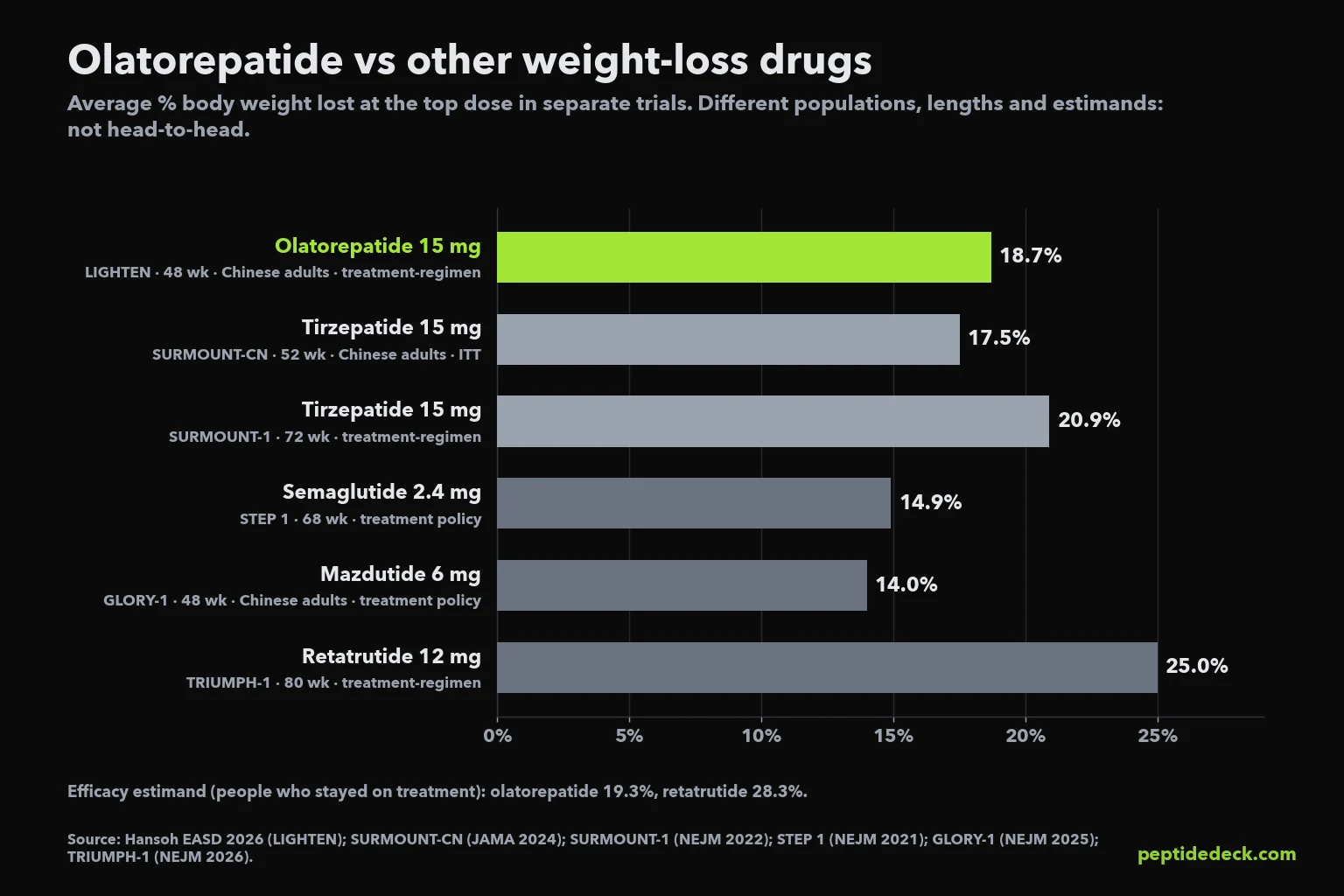
None of these drugs have been tested against each other, so read the table as context, not a race. The closest match is tirzepatide in SURMOUNT-CN: Chinese adults, similar BMI rules, 15 mg, 17.5% at 52 weeks. Olatorepatide's 18.7% at 48 weeks is in the same place. Fierce Biotech summed up the March topline as "Zepbound-like efficacy", and that's fair.
Against semaglutide, olatorepatide looks stronger on both weight and stomach comfort, which is what you'd expect from a dual agonist. Against retatrutide, the triple agonist from Lilly, it falls well short on weight: 25.0% at 80 weeks in TRIUMPH-1. Our retatrutide clinical trials guide covers that program, and mazdutide vs retatrutide compares the other Chinese-developed incretin with it.
So olatorepatide is not trying to be the strongest drug. It's trying to be the tirzepatide that more people can stay on.
The Regeneron Deal and Approval Timeline
Two companies, two territories.
On June 2, 2025, Regeneron licensed olatorepatide for every market outside mainland China, Hong Kong and Macau. It paid $80 million upfront in July 2025 and could pay up to $1.93 billion more in development, regulatory and sales milestones, plus low double-digit royalties. Hansoh kept Greater China. Regeneron's angle is combinations: it wants to pair the drug with its own muscle-preserving antibodies and other medicines for obesity-linked conditions.
China is first in line. Hansoh says China's National Medical Products Administration accepted its new drug application for long-term weight management in June 2026. A decision date hasn't been announced. A separate phase 3 program in type 2 diabetes is under way in China, including a registered trial against dulaglutide.
The US is years behind. Regeneron's July 2026 quarterly filing lists "initiate Phase 3 program in obesity in patients with and without Type 2 diabetes" as a second-half 2026 milestone. As of October 21, 2026, no Regeneron phase 3 trial of olatorepatide appears on ClinicalTrials.gov. Obesity phase 3 trials usually run more than a year, then FDA review adds about another year. Our estimate: a US filing is unlikely before 2028, and approval later than that. Treat that as a projection, not a company date.
Can You Buy Olatorepatide?
No, not as a medicine.
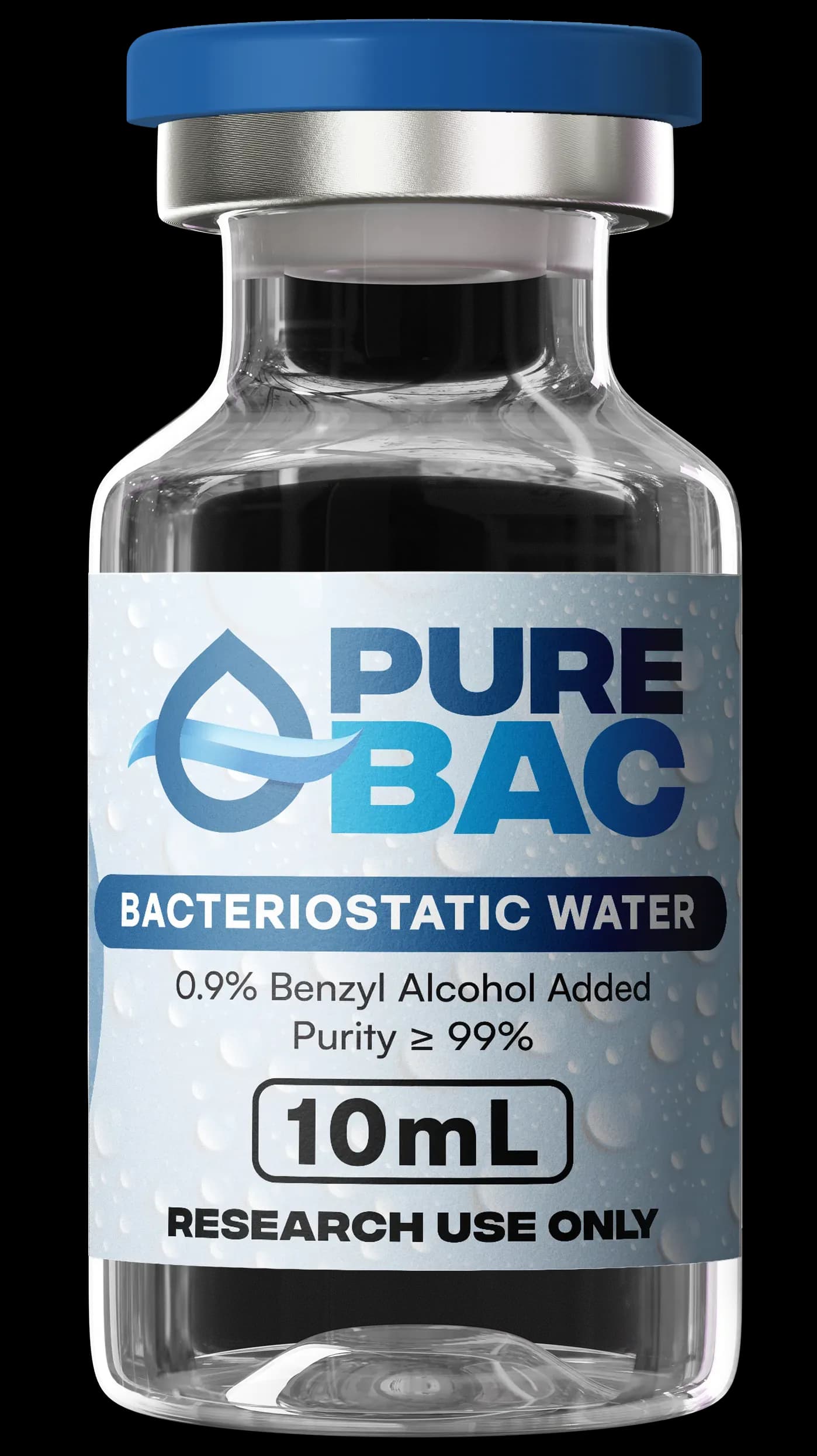
Olatorepatide is not approved by the FDA, the EMA, or China's NMPA, so no pharmacy can dispense it and no doctor can prescribe it. There's no legal compounded version either, because compounding pharmacies can't make copies of a drug that has never been approved. You may see "olatorepatide" listed by chemical suppliers in milligram vials labelled for laboratory use only. Those listings are not medicines, nobody has verified what is in them, and the name on the label is no proof of the contents.
There are two real routes. The first is a trial: Regeneron's US phase 2 (NCT07685808) was recruiting at 21 US sites in October 2026, for adults without diabetes with a BMI of 30 to 45, or 27 and up with a weight-related condition. A separate Regeneron study in people with hidradenitis suppurativa and a BMI of 27 or more (NCT07830329) is listed as not yet recruiting.
The second route is the drug it's designed to compete with. If what you're after is a GLP-1/GIP dual agonist now, tirzepatide is the approved version, and Zepbound KwikPens or vials cost $299 to $449 a month self-pay through LillyDirect, depending on the dose (October 2026 pricing). If price is the deciding factor, our guide to the cheapest tirzepatide options compares the legitimate ways to pay less, and the full tirzepatide cost breakdown shows what each dose runs with and without insurance. The honest downside: tirzepatide's nausea rates are higher than what olatorepatide has reported, and a slow dose climb is the main tool you have to manage them.
Is Olatorepatide Worth Waiting For?
It depends on your stomach.
If tirzepatide works for you and the side effects are manageable, olatorepatide offers no clear weight advantage. Its numbers so far match tirzepatide's, not beat them.
If you quit tirzepatide or semaglutide because of nausea, olatorepatide is the drug to watch. Its reported nausea rate is among the lowest published for this drug class. The fine print still matters: pooled dose averages, no journal paper yet, and only Chinese participants. Regeneron's US trials will show whether the low nausea holds in a different population. Until then, the drug is a promise backed by one strong trial.
Frequently Asked Questions
Sources
- Hansoh Pharma. EASD 2026: Phase III (LIGHTEN) data of olatorepatide presented as a late-breaking oral presentation, October 2, 2026 (includes responder table and NMPA filing). Hansoh release and PR Newswire
- Hansoh Pharma. Olatorepatide (HS-20094) achieves up to 19.3% weight loss at week 48 in phase 3 study, March 7, 2026. Hansoh release
- Regeneron. Olatorepatide obesity treatment licensed by Regeneron demonstrates positive phase 3 results in Chinese patients, March 9, 2026. Regeneron release
- Regeneron. Regeneron expands clinical-stage obesity portfolio with strategic in-licensing of novel dual GLP-1/GIP receptor agonist, June 2, 2025. Regeneron release
- Regeneron Pharmaceuticals. Form 10-Q for the quarter ended June 30, 2026 (olatorepatide milestones and Hansoh payment). SEC filing
- Wang T, Sun DC, et al. HS-20094 (olatorepatide): a dual biased GLP-1 and GIP receptor agonist for obesity. ENDO 2026, poster SAT-684, June 13, 2026. ENDO 2026 abstract
- Hansoh Pharma. 2024 ADA: phase II data of HS-20094 in type 2 diabetes (poster 733-P), July 3, 2024. Hansoh release
- ClinicalTrials.gov. NCT06839664: Phase III study of HS-20094 in Chinese adults with overweight or obesity (LIGHTEN). Record
- ClinicalTrials.gov. NCT06118021: Phase II study of HS-20094 in overweight and obese Chinese adults (dose titration schedule). Record
- ClinicalTrials.gov. NCT07685808: Study of olatorepatide in adults living with overweight or obesity without diabetes (Regeneron). Record
- ClinicalTrials.gov. NCT07431086: Study of olatorepatide in adults living with overweight or obesity in the US (Regeneron). Record
- ClinicalTrials.gov. NCT07830329: Olatorepatide in adults with hidradenitis suppurativa living with overweight or obesity (Regeneron). Record
- ClinicalTrials.gov. NCT07156539: Phase 3 study of HS-20094 versus dulaglutide in type 2 diabetes. Record
- ChEBI (EMBL-EBI). Olatorepatide, CHEBI:760070 (INN from WHO MedNet). ChEBI
- Zhao L, et al. Tirzepatide for weight reduction in Chinese adults with obesity: the SURMOUNT-CN randomized clinical trial. JAMA. 2024;332(7):551-560. PMID 38819983. PubMed
- Jastreboff AM, et al. Tirzepatide once weekly for the treatment of obesity (SURMOUNT-1). N Engl J Med. 2022;387:205-216. PMID 35658024. PubMed
- Wilding JPH, et al. Once-weekly semaglutide in adults with overweight or obesity (STEP 1). N Engl J Med. 2021;384:989-1002. PMID 33567185. PubMed
- Ji L, et al. Once-weekly mazdutide in Chinese adults with obesity or overweight (GLORY-1). N Engl J Med. 2025;392:2215-2225. PMID 40421736. PubMed
- Jastreboff AM, et al. Retatrutide for the treatment of obesity (TRIUMPH-1). N Engl J Med. Published online September 29, 2026. doi 10.1056/NEJMoa2604169. PMID 42814954. PubMed
- Eli Lilly. Zepbound (tirzepatide) prescribing information, Table 1 adverse reactions (DailyMed, September 2026). DailyMed
- Novo Nordisk. Wegovy (semaglutide) prescribing information, adverse reactions table (DailyMed, June 2026). DailyMed
- Eli Lilly. Zepbound coverage and savings, self-pay KwikPen and vial pricing (accessed October 21, 2026). Lilly
- Taylor NP. Regeneron's obesity drug shows Zepbound-like efficacy in phase 3. Fierce Biotech, March 9, 2026. Fierce Biotech
Medical Disclaimer: This content is for informational purposes only and does not constitute medical advice. Olatorepatide is an investigational drug that has not been approved by the FDA or any other regulator. Always consult a qualified healthcare provider before starting any new medication or treatment. PeptideDeck may earn a commission from affiliate links at no additional cost to you.