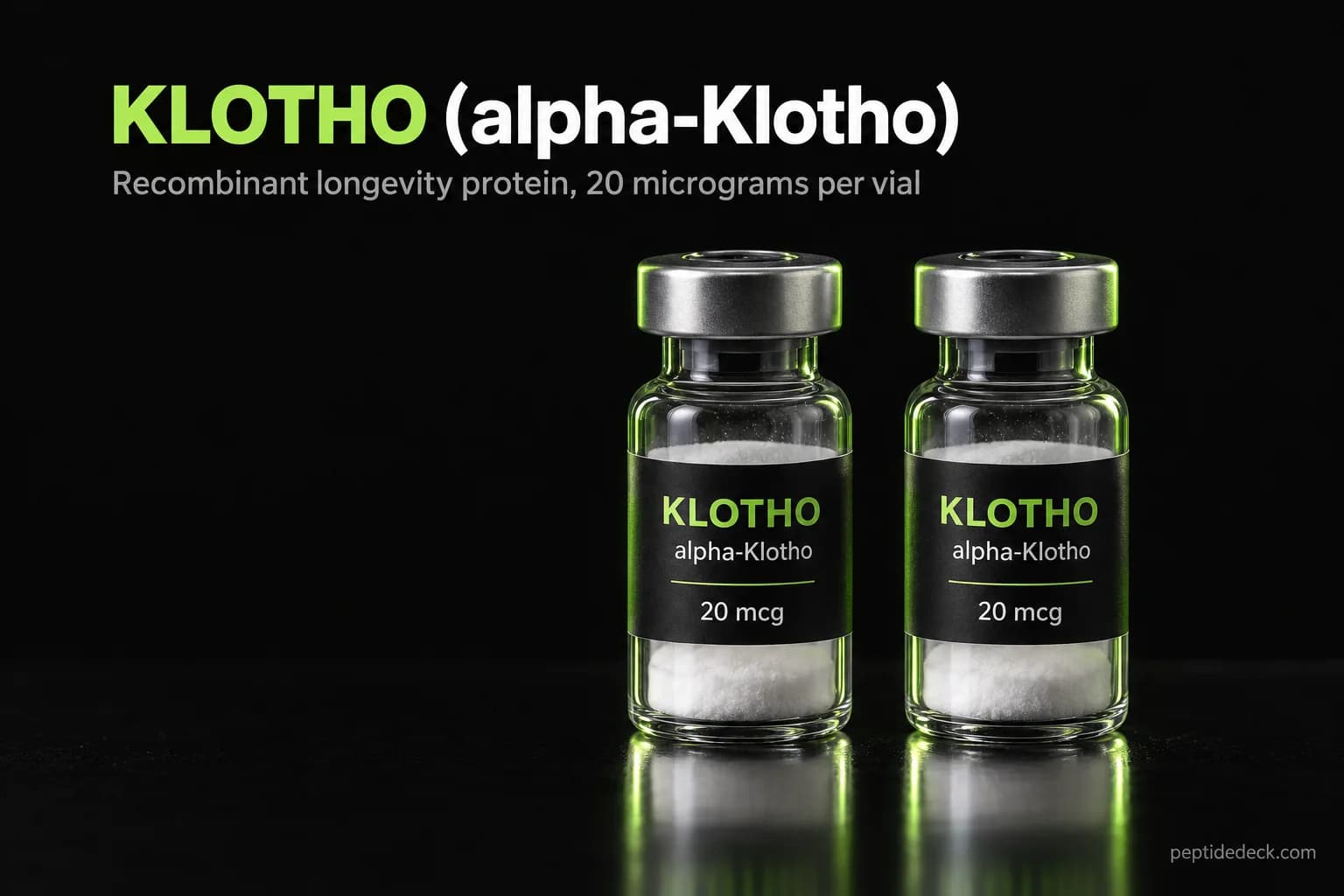

The dose that worked is forty vials.
That is the arithmetic nobody selling klotho peptide puts on the page. The only injected-klotho experiment that ever improved memory in a primate used 10 micrograms per kilogram — 800 micrograms for an 80 kg adult. The product on sale is 20 micrograms a vial, at $499 a pair. Forty vials for one study-equivalent dose, roughly $10,000, and the "10 mcg every two weeks" protocol circulating online is one eightieth of the dose that did anything.
If you are looking at klotho because you have read the mouse lifespan papers — and they are real, and they are striking — you deserve to see the whole ledger before you spend $499 on it. That is what this guide is.
🔑 Key Takeaways
- Klotho is a protein your kidneys and brain make, not a peptide. Delete the gene in mice and they age fast and die by two months; overproduce it and they live 19 to 31 percent longer. That pair of results is real and heavily cited.
- In people, the evidence is genetic and observational: one copy of the KL-VS variant tracks with better cognition and lower Alzheimer's risk in APOE4 carriers. Nobody has injected klotho into a person in a published study.
- The one primate experiment used 10 micrograms per kilogram, raised blood klotho fivefold, and improved memory for two weeks. Higher doses did nothing. Every dose sold or shared online is a small fraction of it.
- What is actually sold is not plain klotho either: it is a recombinant klotho fused to a 29-amino-acid albumin-binding tail, with a half-life claim that has never been published.
- Two human klotho trials now exist — a plasmid gene therapy in 14 people and an mRNA trial in 21 — and neither injects the protein. What they mean for the vial, below.
- Oral "klotho supplements" cannot contain klotho. What they contain, what exercise actually does to your levels, and what to check before paying $499, all covered.
Start with the molecule, because the word "peptide" in the search box is the first thing that is wrong.
What Klotho Peptide Actually Is
It is a protein, not a peptide.
Klotho is a 1,012-amino-acid glycoprotein of roughly 130 kilodaltons, made mainly in the kidney and in the choroid plexus of the brain. It sits in the cell membrane, where it acts as the co-receptor for FGF23 and controls how much phosphate your kidneys let go of. Enzymes then clip the outer portion off and release it into the blood, where it circulates as a hormone. The outer portion has two halves, KL1 and KL2, each about 450 amino acids long — either half alone is about thirty times the size of BPC-157.
In humans the circulating, soluble form is the dominant one. In healthy adults it sits around 560 picograms per millilitre — 240 to 1,270 in one reference cohort of 142 people — and it falls with age, which is the whole reason anyone wants to add it back.
It was named after Clotho, the Greek Fate who spins the thread of life. Given what it does in mice, the name was not as immodest as it sounds.
Three things called "klotho" are on sale or in the literature, and they are not interchangeable. Recombinant alpha-klotho protein — the whole hormone, made in cell culture — is what one vendor sells. "Klotho-derived peptides" KP1 and KP6 are 30-amino-acid fragments designed by a kidney lab, tested only in mice with kidney fibrosis, and sold by nobody. "Klotho supplements" in capsules contain no klotho at all. When a page says klotho peptide, ask which of the three it means.
Why Klotho Became a Longevity Target
Two papers did all the work.
In 1997, Makoto Kuro-o's group was trying to make a hypertension model and instead produced mice whose insertion had wrecked a then-unknown gene. Those animals aged in fast-forward — arteriosclerosis, osteoporosis, skin atrophy, lung emphysema, infertility — and died at around two months instead of two to three years. The gene was named klotho.
In 2005, Kurosu and colleagues ran it the other way in Science. Mice engineered to overproduce klotho lived 19 to 31 percent longer than normal, and the paper showed the protein works as a circulating hormone that dampens insulin and IGF-1 signalling — the same pathway that turns up in nearly every long-lived organism ever studied.
Delete it, aging accelerates. Add it, lifespan extends. In a field full of marginal effects, that is an unusually clean pair, and it is why klotho keeps resurfacing almost thirty years later.
What the Human Evidence Says
Nobody has injected klotho into a person in a published study.
What exists in humans comes in three kinds, and the difference between them is where the honest guides separate from the sales pages.
Levels fall with age, and low levels track with worse outcomes
Circulating klotho declines across adulthood and collapses in chronic kidney disease, because the kidney is where most of it is made. In older adults, lower plasma klotho is associated with more frailty and higher all-cause mortality; in kidney patients it tracks with arterial stiffness and calcification. Association, not proof of cause — the kidney disease that lowers klotho also does a great deal else.
A gene variant raises it, and one copy helps
This is the strongest human thread. People carrying one copy of the KL-VS variant of the KLOTHO gene have higher circulating klotho, and in Dubal's 2014 work they scored better on cognitive tests regardless of age. Since then: a 2020 JAMA Neurology analysis found KL-VS heterozygotes who carry APOE4 have a lower risk of Alzheimer's disease; a 2021 study found less brain amyloid in at-risk APOE4 carriers with the variant; a 2024 paper tied it to less age-related neuroinflammation and synaptic dysfunction. The protective effect appears in people with one copy. Two copies do not help, which is an early hint that the dose-response for klotho is not a straight line.
Higher klotho, higher testosterone — in a survey
One study every vendor quotes deserves its numbers. In 767 US men from the 2015–16 NHANES survey, mean testosterone rose from 306.9 ng/dL in the lowest klotho quartile to 436.6 in the highest. That is a real, published association. It is also a cross-section of a national survey, so it cannot tell you whether klotho raised testosterone, testosterone raised klotho, or being younger and healthier raised both. Nobody has given klotho to a man and measured what his testosterone did.
The Monkey Study, and the Dose Arithmetic
Ten micrograms per kilogram, once, under the skin.
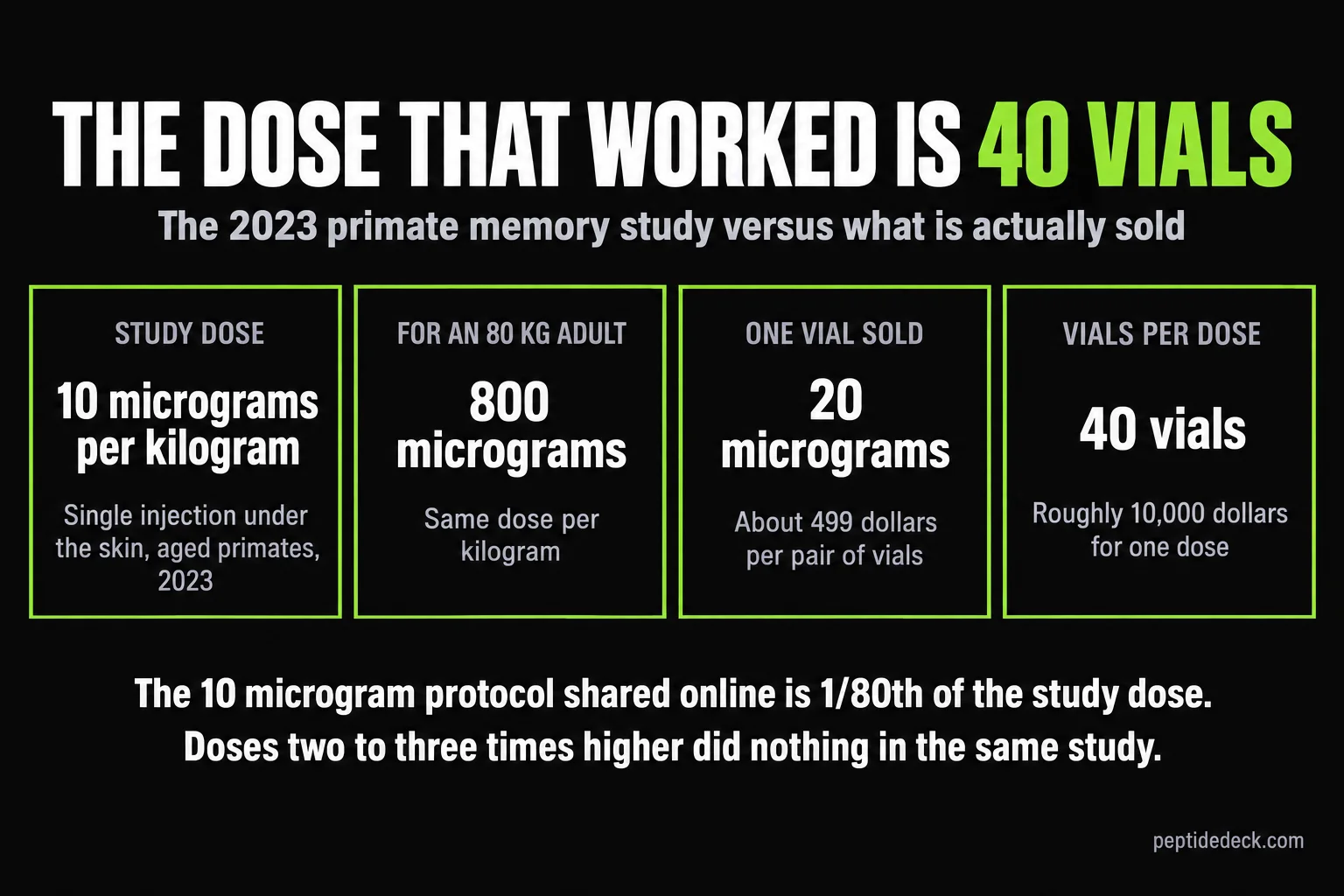
In 2023, Dena Dubal's group at UCSF published in Nature Aging the study every klotho page now leans on. Aged rhesus macaques — 15 to 28 years old, roughly a 65-year-old human — were given a single subcutaneous injection of rhesus klotho at 10 micrograms per kilogram. Blood klotho rose about fivefold. Four hours later the animals did better on a spatial memory task, and on the harder version of that task the improvement was still there two weeks after the one injection.
Three details from that paper matter more than the headline.
- Higher doses did nothing. In the same animals, 20 and 30 micrograms per kilogram produced no significant improvement on either version of the task. The effect is a narrow window, not a slope — the same inverted U the KL-VS genetics hinted at.
- The dose was ten micrograms per kilogram. For an 80 kg adult that is 800 micrograms. A vial is 20 micrograms. The "10 mcg every two weeks" protocol that circulates online — a whole vial split in half — is 0.125 micrograms per kilogram, one eightieth of what the monkeys got.
- The money behind it. The study was funded in part by Unity Biotechnology; the University of California holds a patent on klotho for cognition with Dubal as inventor; several authors consult for or hold stock in Unity. None of that makes the result wrong. It does mean the group with the best data on injected klotho is trying to build a drug from it, not a vial.
There is one honest caveat to the arithmetic, and it belongs to the vendor. The product sold is not plain klotho; it carries an albumin-binding tail meant to keep it in circulation longer, and if it really lasts as long as claimed, the per-dose comparison could shift. But that claim has no published data behind it, which brings us to what is actually in the vial.
What Is Actually in the $499 Vial
Not klotho. Klotho plus a tail.
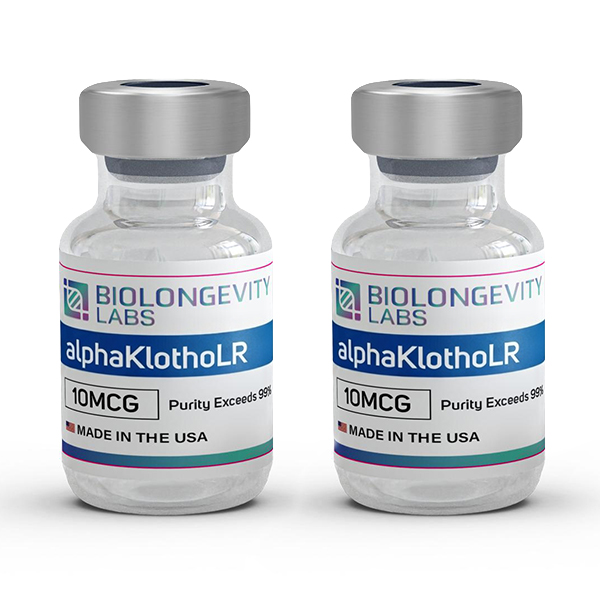
The one injectable on the market, sold as alphaKlothoLR, is described by its vendor as recombinant alpha-klotho fused to a 29-amino-acid albumin-binding construct, GGSGGSGGSGGRLIEDICLPRWGCLWEDD, giving a total of about 133 to 135 kilodaltons. The idea is sound in principle — bolting an albumin binder onto a protein is how several long-acting drugs are made — and the vendor claims activity "up to 19 days" in cells, an albumin affinity under 20 nanomolar, and preserved FGF23 binding.
What you should know before treating any of that as fact:
- Every number above comes from the vendor's own page. No paper describes this construct, its half-life in an animal, or its activity anywhere.
- The vendor's product page and its own article disagree about the klotho portion — 998 amino acids on one, 1,012 on the other.
- The monkey study used unmodified rhesus klotho with a half-life of hours, not a fusion protein with a half-life of days. Nothing about that result transfers automatically to a different molecule.
- It is sold as a laboratory reagent, lyophilised, 20 micrograms a vial, in pairs at $499, with certificates from two named testing labs. At that price a single microgram costs about $12.50.
The most-read guide on this compound tells you the product was on a waiting list because of tariffs and gives a 10-microgram fortnightly protocol. The product page, when I checked, listed it in stock and said nothing about dose at all — the protocol is the guide's, not the manufacturer's.
Klotho Dosage: What Every Number Is Actually Based On
There is no human dose, because there has never been a human study.
What circulates is extrapolation, so here is each extrapolation next to its source. Doses are given per kilogram and converted for an 80 kg adult.
Two things follow. The doses people are actually taking sit far below the only dose shown to do anything in a primate — so if you take a vial and feel nothing, the study would have predicted that. And the doses that would match the study are so expensive that, in practice, nobody is taking them either. The vendor's long-acting claim is the only thing that could close that gap, and it is unpublished.
What "more is not better" means here. In the monkeys, doubling and tripling the effective dose erased the effect. In humans, two copies of the high-klotho gene variant do not carry the benefit one copy does. Whatever klotho does for cognition, it appears to do inside a narrow band. That is an argument for caution in both directions — it is not a molecule where a bigger vial is a safer bet.
The Two Human Klotho Trials — and Why Neither Helps the Vial
Two human trials exist. Neither injects klotho.
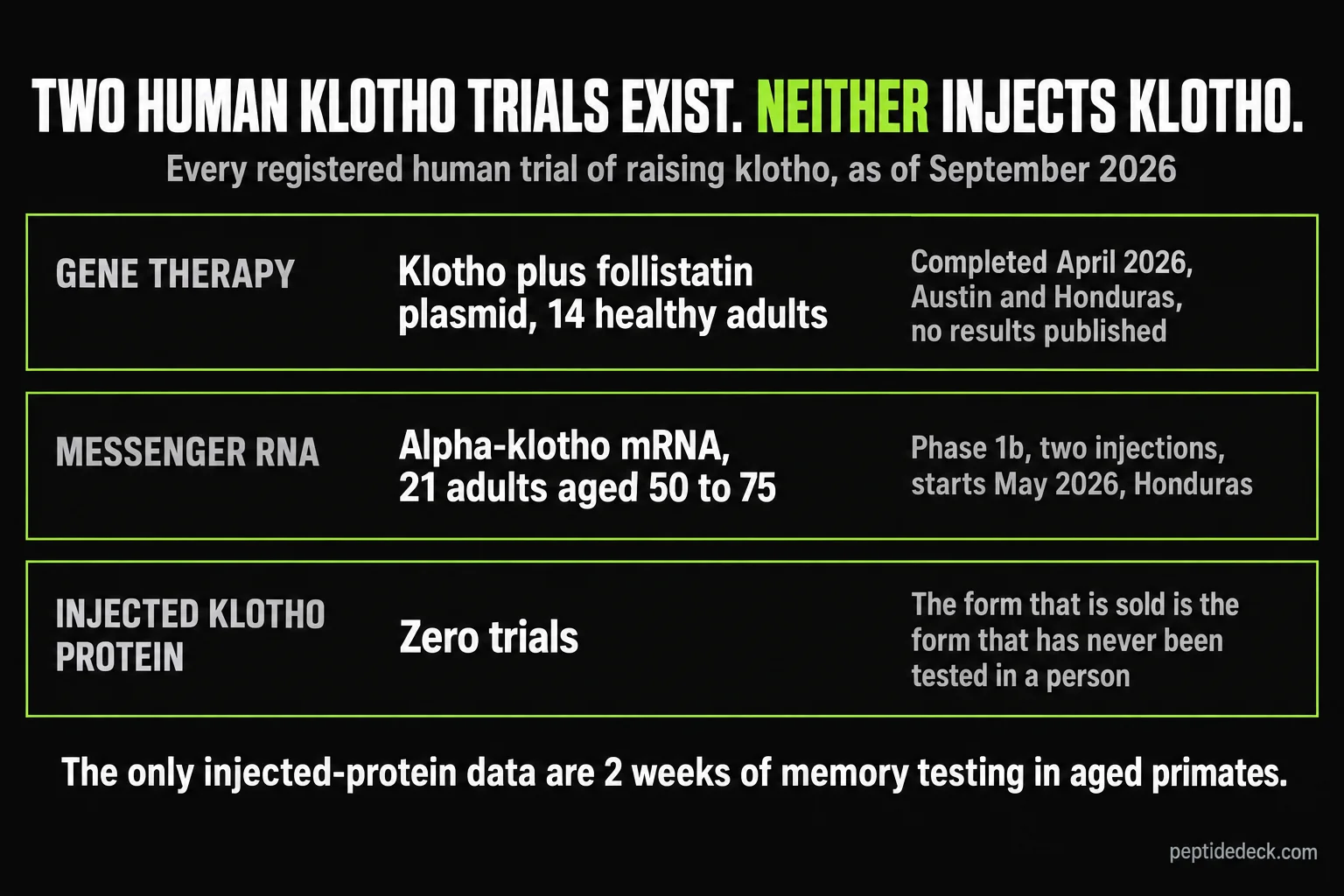
I searched the clinical-trials registry for every study that gives klotho to a person, rather than just measuring it. There are two.
- A plasmid gene therapy. Minicircle's pilot study injected a non-viral plasmid carrying both the klotho and follistatin genes into 14 healthy adult volunteers, at sites in Austin, Texas and Roatán, Honduras. It started in December 2025 and was marked complete on 30 April 2026. No results have been posted. It has no placebo group.
- An mRNA. Klothea Bio's Phase 1b trial plans to give 21 adults aged 50 to 75 two injections of 0.5 mg of alpha-klotho messenger RNA in lipid nanoparticles, or saline, randomised two to one. It is registered to start in May 2026, also in Roatán.
Both are about making the body produce its own klotho. Neither tests injected protein, neither has published anything, and both run from an offshore clinic on a Honduran island, which tells you something about how far from an approved medicine this is. One competing guide reports a UCSF Phase 1 trial of injected klotho in adults over 65; I could not find it in the registry as of this writing, and the UCSF group's published human-facing work remains the monkey study.
What People Take Klotho For, and What Holds Up
The shopping list is long. The evidence column is short.
Read down the third column. One primate study, one human survey, and a set of human genetic associations. Everything else is mice — including, notably, the lifespan result the entire category is named for.
Do Klotho Supplements Actually Work?
There is no oral klotho.
Klotho is a 130-kilodalton glycoprotein. Swallow it and your digestive enzymes treat it like any other dietary protein — they take it apart into amino acids, and nothing recognisable as klotho reaches your bloodstream. This is not a formulation problem waiting to be solved; it is why insulin is injected.
So what is in the bottles marketed as klotho supplements? Generally one of three things: plant polyphenols such as curcumin or resveratrol, which have nudged klotho expression in cell and animal work but have not been shown to raise circulating klotho in people at supplement doses; general kidney-support blends of vitamin D and magnesium, which are reasonable nutrition wearing a misleading label; or, occasionally, recombinant protein in a capsule, where the label is the only place the klotho survives.
The things with actual human evidence for raising your own klotho are unglamorous. High-intensity exercise raised serum klotho in healthy volunteers in a 2018 study, and several registered trials in Spain have tested aerobic and interval training as "klotho stimulators." Vitamin D status interacts with the klotho–FGF23 axis, and protecting kidney function protects the organ that makes most of it. None of these produce the fivefold rise the monkeys got. They are also free.
Side Effects and What Nobody Knows
The side effect profile in people is unknown, because there is no human data.
What can be reasoned from klotho's biology, and what the more careful guides warn about, follows from the phosphate axis. Membrane klotho is the FGF23 co-receptor that governs how much phosphate the kidney excretes. Mice without klotho retain phosphate and calcify; the concern in the other direction is that too much klotho signalling wastes phosphate and potassium. Nobody has measured whether injected klotho does that in a person, at any dose. The suggested bloodwork before and during — serum phosphorus, calcium, a metabolic panel, urine protein — is reasonable precisely because nobody knows.
Two further points apply to any injected protein of this size: it can provoke antibodies, and a fusion protein with a novel 29-amino-acid tail is more likely to, not less. And the mechanism through which klotho is proposed to extend life — dampening insulin and IGF-1 signalling — is the same double-edged trade-off that makes IGF-1 reduction a mixed intervention anywhere else.
Where to Buy Klotho, and What to Check
Very few vendors carry it, and the reason is cost.
Recombinant protein at this size is expensive to make, which is why a 20-microgram vial is priced where a 10-milligram peptide vial would be. As of this writing, BioLongevity Labs lists alphaKlothoLR in pairs at $499, in stock, with certificates of analysis from two named laboratories. If you are going to buy it anyway, three checks:
- The certificate should name a protein, not a peptide. Mass near 133 kilodaltons, endotoxin tested, identity confirmed by mass spectrometry. A short synthetic peptide COA on a klotho listing means it is not klotho. How to read a peptide COA covers what a real one shows.
- Know which dose you are buying toward. One vial is a fortieth of the study dose. Decide in advance whether you are testing the vendor's unpublished half-life claim or the monkey paper's dose, because you cannot afford to test both.
- Reconstitution and cold chain. A protein this size is fragile. Lyophilised, refrigerated, gently swirled, never shaken — and a vendor that ships it warm has already told you what it thinks it is selling.
For a wider view of who is worth ordering from, our peptide vendor comparison covers the sources we have checked directly. And if the pull is the longevity angle rather than klotho specifically, the compounds with actual human dosing behind them are a more sensible place to start — Epitalon and the wider bioregulator peptides at least have human data on the dose, and NAD+ has more of it than klotho does. The same vendor's follistatin is the other half of the Minicircle gene-therapy pair, and has its own evidence problems.
The Bottom Line on Klotho Peptide
Real biology, unreal price, untested dose.
The fair version: klotho is one of the best-supported longevity molecules in mouse biology, one copy of a natural high-klotho variant protects human cognition, and a single low dose improved memory in aged primates for two weeks. If you were betting on which protein turns into a genuine anti-aging drug, klotho would be a defensible pick.
The equally fair version: no person has ever been injected with it in a published study; the dose that worked in primates costs about $10,000 per dose at retail; the doses people take are one fortieth to one eightieth of it; the product sold is a different molecule from the one studied, with a half-life claim nobody has published; and higher doses erased the effect in the only experiment that found one.
If you buy it, buy it knowing that. You are not buying the mouse result, or the monkey result. You are buying a hypothesis, at $12.50 a microgram, at a dose the study would predict does nothing. The two human gene trials will tell us more within a year or two. The vial will not.
Frequently Asked Questions
Medical Disclaimer: This content is for informational purposes only and does not constitute medical advice. Klotho has no approved medical use in any jurisdiction, no established human dose, and no published human safety data. Always consult a qualified healthcare provider before starting any new supplement, medication, or treatment. PeptideDeck may earn a commission from affiliate links at no additional cost to you.