The Trulicity Savings Card can bring your cost down to $25 a month, but only if you have commercial drug insurance that already covers Trulicity and a prescription for type 2 diabetes. Everyone else faces a very different number: roughly $1,395 a month at retail for the standard four-pen box. This page lays out the 2026 terms exactly as Lilly writes them, including the annual cap and the fill limit most coupon pages leave out, and what to do if you do not qualify.
If the savings card will not work for you — and for a large share of people it will not — the routes that remain are a different GLP-1, a patient assistance program, or a compounded alternative through a licensed telehealth provider such as Embody. Each is priced below, with the trade-offs stated plainly.
🔑 Key Takeaways
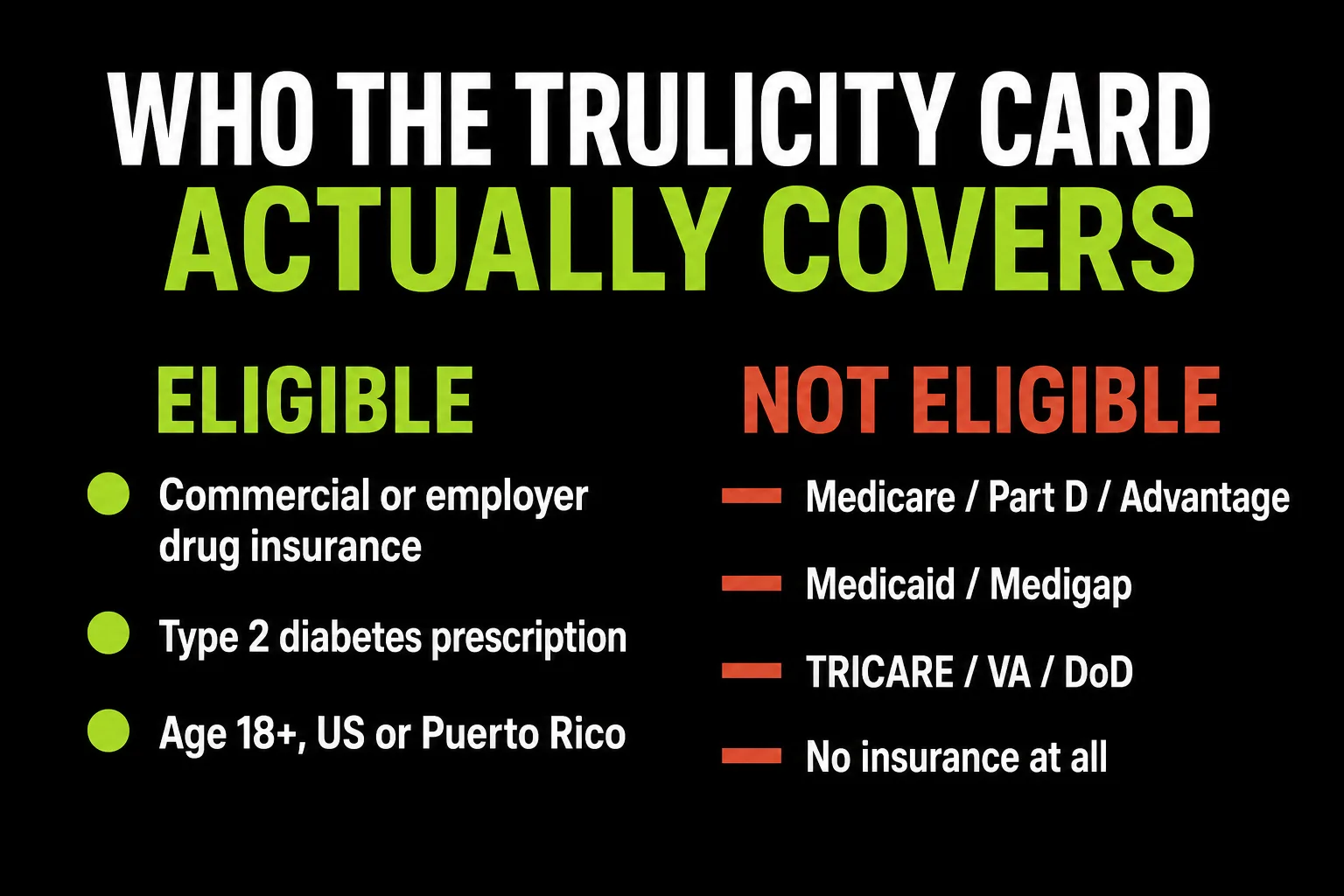
- $25 is real, and it is conditional. You need commercial or employer drug insurance that already covers Trulicity, a prescription consistent with the FDA label, and US or Puerto Rico residency at 18 or older.
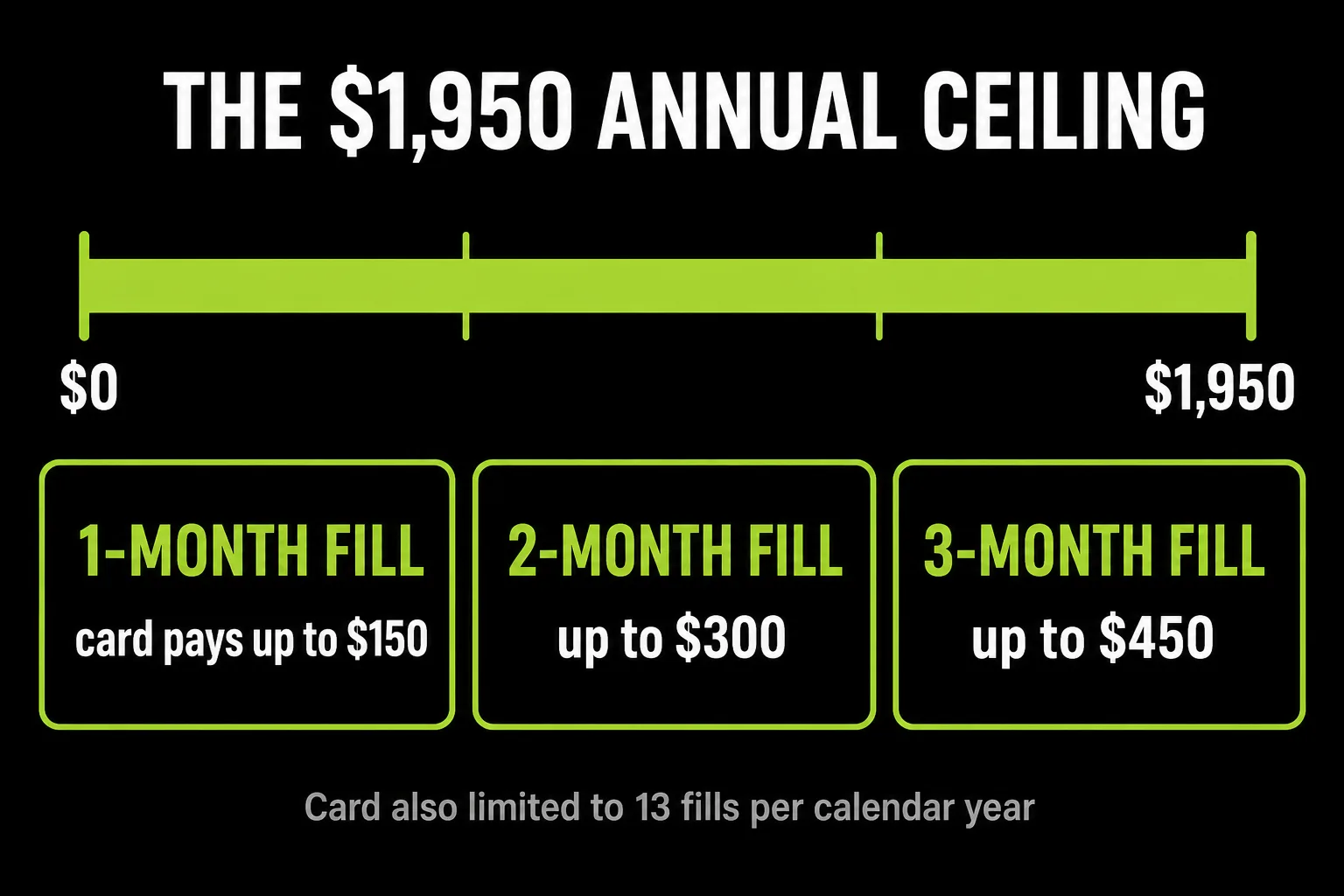
- The cap is the number nobody quotes. The card pays a maximum of $150 on a 1-month fill, $300 on a 2-month, $450 on a 3-month, and no more than $1,950 across the whole calendar year. Heavy users exhaust it before December.
- Government insurance disqualifies you outright. Medicare, Medicare Part D, Medicare Advantage, Medicaid, Medigap, TRICARE, DoD and VA are all excluded. This is the single most common reason people are turned down.
- The card expires 12/31/2026. Lilly reissues terms annually, so a card saved from an earlier year will not scan.
- Trulicity is a diabetes drug, not a weight-loss drug. It is not FDA-approved for weight management, so an off-label weight-loss prescription falls outside the card’s “approved use” requirement.
How much does Trulicity cost in 2026?
Trulicity (dulaglutide) is a once-weekly GLP-1 receptor agonist from Eli Lilly, approved for type 2 diabetes and supplied as four single-dose pens per box — a 30-day supply at any of the four strengths (0.75mg, 1.5mg, 3mg, 4.5mg). Unusually for a GLP-1, the price does not change with dose. A box of 4.5mg pens costs the same as a box of 0.75mg pens, which means titrating up never costs you more.
What you actually pay depends almost entirely on one question: does a commercial insurance plan cover it?
The Trulicity Savings Card: the exact 2026 terms
Lilly publishes these terms on the official Trulicity site, and they are more restrictive than most third-party coupon pages suggest. Read them in full before assuming you qualify.
You may pay as little as $25 for up to a 3-month prescription if all of the following are true:
- You have commercial drug insurance that covers Trulicity
- Your prescription is for an approved use consistent with FDA-approved labeling
- You are 18 or older
- You are a resident of the United States or Puerto Rico
- You are not enrolled in any state, federal or government-funded healthcare program
The annual cap is where this program actually ends
The $1,950 ceiling is separate from the per-fill maximums, and it is the constraint that catches people out. If your plan has Trulicity on a high tier and the card is paying close to $150 every month, you will hit $1,950 somewhere around month thirteen — except the card only allows 13 fills anyway, so in practice a full year of monthly fills sits right at the edge of both limits at once. Someone filling three-month prescriptions and drawing $450 each time exhausts the annual cap after four fills, in early autumn. Plan for the possibility that your cheap prescription stops being cheap before the calendar year does.
Why most people are told no
Three disqualifiers account for the overwhelming majority of rejected Trulicity Savings Card claims, and none of them are obvious from the marketing.
1. You are on Medicare or Medicaid
This is the big one. Type 2 diabetes skews older, so a large share of Trulicity patients are on Medicare — and manufacturer copay cards are barred from federal healthcare programs by anti-kickback law. It is not Lilly being restrictive; it is illegal for them to offer it. If you have Medicare Part D, Medicare Advantage, Medigap, Medicaid, TRICARE, VA or DoD coverage, the card will not process, and no workaround exists. Your route is your plan's formulary, a Part D appeal, or patient assistance.
2. Your plan does not cover Trulicity at all
The headline $25 assumes your plan already covers the drug and the card is only offsetting your copay. If Trulicity is excluded from your formulary, the card has a much smaller list price to work against, and what you pay is whatever the pharmacy charges minus a capped contribution. There is no advertised price for this scenario, which is why you should call the pharmacy and ask before you assume.
3. You have no insurance
The card requires commercial drug insurance. Uninsured patients are not eligible, full stop. The right door is Lilly Cares, the company's patient assistance foundation, which can supply Trulicity at no cost to people who meet income and residency criteria. It is slower — an application, proof of income, a prescriber signature — but the outcome for someone who qualifies is $0, not $25.
Trulicity coupon vs savings card vs discount card
These three terms get used interchangeably online and they are not the same thing. The distinction determines whether you can stack them.
You cannot run the savings card and a pharmacy discount card on the same fill. The pharmacy processes one or the other. If you have commercial insurance and the card works, it is almost always the cheaper of the two. If you are uninsured, the discount card is the only one of the two available to you, and it will still leave you north of $1,000.
Can you use a Trulicity coupon for weight loss?
No, and this trips up a lot of searches. Trulicity is approved for glycemic control in type 2 diabetes and to reduce major cardiovascular events in adults with type 2 diabetes and established cardiovascular disease. It carries no FDA approval for weight management.
The savings card requires a prescription "for an approved use consistent with FDA-approved product labeling." An off-label weight-loss prescription does not meet that condition. Lilly's own weight-loss drug is Zepbound (tirzepatide), which has a separate savings program, and Wegovy (semaglutide) is Novo Nordisk's approved weight-loss option. If weight loss is the goal, those are the products with programs built for it.
What to do if you do not qualify
Being turned down for the savings card is the common case, not the exception. Four routes remain, in rough order of how much they save.
Lilly Cares patient assistance
Free Trulicity for patients who meet income limits and are uninsured or underinsured. It requires an application co-signed by your prescriber and documentation of income. Slow, but it is the only $0 route.
Ask about a formulary exception
If your plan excludes Trulicity but covers another GLP-1, your prescriber can file a formulary exception or prior authorisation arguing medical necessity. This is worth doing before you resign yourself to cash pricing.
Switch to a covered GLP-1
Ozempic, Mounjaro, Victoza and Byetta are all in the same broad class with their own savings programs. Which is cheapest for you is a function of your specific formulary, not of the drugs themselves. Our Ozempic coupon breakdown and Mounjaro coupon guide cover those programs in the same detail as this page.
Compounded GLP-1 through telehealth
Licensed telehealth providers prescribe compounded semaglutide and tirzepatide at a fraction of brand pricing. This is a different molecule from dulaglutide and a different regulatory category from an FDA-approved brand drug, so it is a genuine substitution rather than a discount — read our GLP-1 program reviews before choosing one. Embody is the provider we track most closely on price.
The bottom line
The $25 Trulicity price is genuine but narrow. It requires commercial insurance that already covers the drug, a type 2 diabetes prescription, and it stops paying once the card has contributed $1,950 in a calendar year or covered 13 fills, whichever comes first. If you are on Medicare — as a great many type 2 diabetes patients are — the card is closed to you by law rather than by policy, and Lilly Cares or a formulary appeal are the routes that remain.
Before you accept a cash price, do two things: ask your pharmacist to run the claim both with the savings card and as a discount-card cash transaction, and ask your prescriber whether a formulary exception is worth filing. Those two calls are worth more than any coupon code you will find online.
References
- Eli Lilly and Company. Trulicity Savings Card, Cost and Resources. Official savings card terms and eligibility. Accessed August 16, 2026.
- Eli Lilly and Company. Trulicity Savings Card and Formulary Coverage. Prescriber-facing programme detail. Accessed August 16, 2026.
- U.S. Food and Drug Administration. Drugs@FDA: Trulicity (dulaglutide) approved labeling. Indication and approved use.
- Lilly Cares Foundation. Patient Assistance Program eligibility. Income and coverage criteria.