💡 Quick Answer
Retatrutide peptide (LY3437943) is a triple agonist targeting GLP-1, GIP, and glucagon receptors simultaneously — making it the most potent weight loss compound in clinical development. Phase 2 trials showed up to 24.2% body weight loss at 48 weeks, and the Phase 3 TRIUMPH-4 trial showed 28.7% at 68 weeks on the highest dose. It's not yet FDA-approved, but research-grade retatrutide is available for laboratory use through vendors like Ascension Peptides.
If you've been following the GLP-1 space, you already know how wild the last few years have been. Semaglutide felt like a revolution. Then tirzepatide came along and raised the bar. Now retatrutide peptide — the first true triple agonist in clinical development — is sitting in late-stage trials, and the clinical data is genuinely hard to ignore.
Twenty-eight point seven percent average body weight loss over 68 weeks at the highest dose. To put that in context: that's roughly double what Ozempic produces. It's not a marginal improvement — it's a different category entirely.
This guide covers everything you need to know about retatrutide: what it is, how this triple agonist works at the receptor level, what the clinical trials actually showed (including data most articles miss), how it compares to semaglutide and tirzepatide, and what the dosing protocols look like based on Phase 2 research. We'll also cover side effects honestly, who it's best suited for, and how researchers are currently sourcing it.
Related guides: Retatrutide Dosing Guide · Retatrutide Side Effects Guide 2026 · Retatrutide vs Tirzepatide: Weight Loss Comparison
🔑 Key Takeaways
- Retatrutide peptide is a triple agonist (GLP-1R + GIPR + GCGR) — the only compound in development that targets all three receptors simultaneously
- Phase 2 NEJM trial: up to 24.2% body weight reduction at 48 weeks; the Phase 3 TRIUMPH-4 trial showed 28.7% at 68 weeks on the highest dose
- Outperforms both semaglutide (~15%) and tirzepatide (~20%) on average weight loss in trials
- The glucagon receptor component adds direct fat-burning and energy expenditure effects not found in other GLP-1 drugs
- Side effects are primarily GI and dose-dependent — similar profile to other GLP-1 class drugs
- Not FDA approved: Phase 3 (TRIUMPH) results are in, and Lilly plans to file with the FDA in Q1 2027
- Research-grade retatrutide is available as R-10 (10mg) and R-30 (30mg) from Ascension Peptides
What Is Retatrutide?
Retatrutide peptide — also known by its development code LY3437943 — is a synthetic 39-amino acid peptide developed by Eli Lilly. It was engineered from a GIP peptide backbone with several non-coded residues added (Aib at positions 2 and 20, alpha-methyl leucine at position 13) plus a C20 fatty diacid side chain that extends its half-life by allowing albumin binding. Basically: Lilly built something that could hit three different receptors at once and stay active long enough to be dosed weekly.
The molecular weight is 4,731.33 Da, and its CAS number is 2381089-83-2 for researchers looking it up in databases. In HPLC-purity testing, pharmaceutical-grade retatrutide comes in at 99.4%+ purity.
What makes retatrutide genuinely different from every GLP-1 drug before it is the triple receptor mechanism. Semaglutide hits one receptor (GLP-1R). Tirzepatide hits two (GLP-1R and GIPR). Retatrutide hits all three — GLP-1R, GIPR, and the glucagon receptor (GCGR). That third receptor is where things get really interesting, because glucagon doesn't just affect appetite. It directly drives energy expenditure and fat oxidation in the liver. More on that below.
Lilly moved retatrutide from discovery to clinical proof-of-concept rapidly — the landmark preclinical paper by Coskun et al. was published in Cell Metabolism in September 2022, and Phase 2 human data appeared in the New England Journal of Medicine less than a year later. That's fast for a molecule this structurally complex.
How Retatrutide Works: The Triple Mechanism
Understanding what retatrutide actually does at the receptor level matters a lot here — because the glucagon agonism is the piece most articles gloss over, and it's arguably what separates retatrutide peptide from everything else in the pipeline.
GLP-1 Receptor Agonism
GLP-1 (glucagon-like peptide-1) receptor agonism is the foundation. It's what every drug in this class — from Ozempic to Victoza to Mounjaro — does. When activated, GLP-1R slows gastric emptying (you feel full longer), reduces appetite by signaling the hypothalamus, and improves insulin secretion in a glucose-dependent manner. The result: you eat less, blood sugar stabilizes, and you lose weight. Retatrutide hits GLP-1R with high potency, providing a strong appetite-suppression and glycemic-control base.
GIP Receptor Agonism
GIP (glucose-dependent insulinotropic polypeptide) receptor agonism is the second layer — the same one tirzepatide added over semaglutide. GIPR activation amplifies insulin response, reduces nausea at higher doses (which is counterintuitive but well-documented), and appears to enhance the metabolic effects of GLP-1R agonism synergistically. Tirzepatide's impressive results were largely attributed to adding GIPR on top of GLP-1R. Retatrutide includes this dual action as its baseline.
Glucagon Receptor Agonism — The Differentiator
Here's where the triple agonist mechanism of retatrutide gets genuinely novel. The glucagon receptor (GCGR) normally drives the liver to release stored glucose and burn fat for energy. That sounds counterproductive for weight loss at first — glucagon is often framed as the "anti-insulin" hormone. But at the doses used in metabolic research, GCGR agonism does something valuable: it increases resting energy expenditure and drives hepatic fat oxidation directly.
In plain terms: glucagon activation tells your liver to burn fat. Combined with GLP-1's appetite reduction and GIP's metabolic synergy, the triple agonist approach simultaneously reduces how much you eat AND increases how much energy your body burns at rest. That's a two-front attack on body fat that single-agonist drugs simply can't replicate.
There's also early evidence that GCGR agonism has specific benefits for liver fat (MASLD/NAFLD) that go beyond what GLP-1 alone achieves — the 2024 Nature Medicine study by Sanyal et al. showed significant liver fat reduction in a Phase 2a trial of retatrutide in patients with metabolic dysfunction-associated steatotic liver disease.
Appetite Suppression (GLP-1R)
Signals the hypothalamus to reduce hunger, slows gastric emptying so you stay full longer — the same mechanism behind Ozempic and Wegovy.
Insulin Amplification (GIPR)
Enhances glucose-dependent insulin secretion and synergizes with GLP-1R to improve metabolic outcomes — the dual-agonist layer tirzepatide added.
Fat Burning (GCGR)
Drives direct hepatic fat oxidation and increases resting energy expenditure — the third layer no other approved drug in this class has.
Cardiometabolic Effects
Reduces triglycerides, blood pressure, and visceral fat — with heart outcomes still unproven (TRIUMPH-3 was inconclusive).
Retatrutide vs Semaglutide vs Tirzepatide
The honest comparison here is stark. Retatrutide peptide's triple agonist design isn't marginally better than what came before — it's in a different tier by the numbers. That said, all three are different compounds with different approval statuses, side effect profiles, and use cases.
A few things worth noting about this comparison. The weight loss percentages aren't directly comparable because the trials used different populations, durations, and endpoints. But the trend is clear: each additional receptor target correlates with meaningfully higher weight loss.
Semaglutide's 12–15% average is still impressive — it changed the obesity treatment landscape. Tirzepatide pushed that to ~20%. Retatrutide appears to push it further again, with the Phase 2 highest-dose group hitting 24.2% at 48 weeks and the Phase 3 TRIUMPH-4 trial reaching 28.7% at 68 weeks on 12mg.
The tradeoff with retatrutide peptide is the side effect profile — it's broadly similar to the other GLP-1 drugs but slightly more pronounced at higher doses, likely because of the glucagon agonism adding to GI effects. And of course, it's not FDA-approved yet, so you're working with Phase 2/3 trial data rather than post-market real-world evidence.
Clinical Trial Results: What the Data Actually Shows
The Phase 2 trial published in the New England Journal of Medicine (Jastreboff et al., 2023) is the landmark study. It enrolled 338 participants with obesity (BMI ≥30) or overweight with weight-related complications, randomizing them across multiple dose groups over 48 weeks. The results were striking enough that the paper got significant media attention.
Phase 2 NEJM Trial Highlights
- At the highest dose (12mg/week), mean weight loss was 24.2% of body weight at 48 weeks
- The 8mg group achieved 22.8% average weight loss
- Placebo group lost ~2.1% — confirming the drug effect is real and large
- Weight loss was still progressing at week 48 in higher-dose groups (hadn't plateaued)
- Significant reductions in waist circumference, blood pressure, triglycerides, and HbA1c across dose groups
- At 4 weeks into treatment, the 4mg+ groups had already lost ~5% body weight
68-Week Follow-Up Data
The 28.7% figure often attributed to a Phase 2 extension actually comes from the Phase 3 TRIUMPH-4 trial (adults with obesity and knee osteoarthritis; topline December 2025): 28.7% average body weight loss at 68 weeks on 12mg vs 2.1% on placebo. The larger TRIUMPH-1 trial (NEJM, September 2026) then reported 28.3% at 80 weeks on 12mg (efficacy estimand; 25.0% counting everyone randomized), with up to 30.3% at 104 weeks in an extension group with BMI 35 or higher.
MASLD/Liver Fat Study
A separate Phase 2a trial published in Nature Medicine (Sanyal et al., 2024) looked specifically at retatrutide in patients with metabolic dysfunction-associated steatotic liver disease (MASLD). The results showed significant liver fat reduction, with some patients achieving resolution of MASLD criteria entirely. This is a field where GLP-1 drugs have already shown benefit, but the glucagon receptor component in retatrutide appears to provide additional hepatic fat-burning that exceeds what GLP-1R agonism alone achieves.
Phase 3 TRIUMPH Trials
The main Phase 3 (TRIUMPH) trials have now reported. TRIUMPH-1 and TRIUMPH-2 were published in NEJM and The Lancet on September 29, 2026, and TRIUMPH-3 and TRIUMPH-4 have topline results; Phase 3 broadly confirmed the Phase 2 weight loss. In July 2026 Lilly said it plans to submit retatrutide to the FDA in Q1 2027, so approval is unlikely before late 2027 and more likely in 2028.
Retatrutide Benefits Beyond Weight Loss
Most coverage of retatrutide peptide focuses on body weight — and reasonably so, given those numbers. But the metabolic effects go well beyond the scale.
Glycemic Control and Type 2 Diabetes
In a dedicated Phase 2 trial (The Lancet, 2023) and again in the Phase 3 TRIUMPH-2 trial (The Lancet, 2026; A1C down 1.4 to 1.6 points), retatrutide significantly reduced HbA1c in participants with Type 2 diabetes. The triple mechanism creates potent glucose regulation: GLP-1R drives glucose-dependent insulin secretion, GIPR amplifies that response, and GCGR's role in hepatic glucose output is modulated. Lilly has stated that retatrutide is being developed for both obesity and Type 2 diabetes indications.
Liver Fat Reduction (MASLD)
The Sanyal et al. 2024 Nature Medicine study is worth dwelling on. MASLD (formerly called NAFLD/NASH) is a condition where excess fat accumulates in liver cells, potentially progressing to fibrosis and cirrhosis. Current treatment options are limited. Retatrutide showed statistically significant reductions in liver fat content — the glucagon receptor mechanism appears to directly drive hepatic lipid oxidation, making it particularly effective here compared to GLP-1-only drugs.
Triglycerides and Lipid Profile
In Phase 2, retatrutide produced notable reductions in triglycerides across all active dose groups. The glucagon receptor drives fatty acid oxidation in the liver, which translates directly to lower circulating triglyceride levels. This lipid-lowering effect is an independent benefit beyond weight loss alone.
Blood Pressure
Systolic blood pressure reductions were observed in the Phase 2 trial, consistent with what's seen across the GLP-1 drug class. The magnitude was dose-dependent and clinically meaningful in higher-dose groups.
Kidney Protection
Early preclinical data (Ma et al., 2024, Endocrine) compared liraglutide, tirzepatide, and retatrutide in a diabetic kidney disease model. Retatrutide showed favorable markers for kidney protection — a finding still needing human validation but worth tracking given the GLP-1 class's emerging renal benefits.
Potential Energy Expenditure Increase
This one's still being characterized, but the glucagon receptor agonism theoretically increases resting energy expenditure by enhancing hepatic fat oxidation. If Phase 3 data confirms this, retatrutide would be the first drug in this class to simultaneously reduce caloric intake AND increase basal metabolic rate — which would explain its superior weight loss numbers.
Retatrutide Dosage Protocol (Week-by-Week)
The table below is a gentler community-style escalation, not the Phase 2 protocol: in the trial, participants were randomized to fixed target doses of 1, 4, 8 or 12mg, and the 12mg group started at 2mg and stepped up every 4 weeks (2 → 4 → 8 → 12mg). Gradual escalation is standard for this drug class and essential to minimizing GI side effects. The three main protocols used in research correspond to different dose targets.
💡 Protocol Note
In Phase 2 research, participants were randomized to a fixed target dose and escalated on a set schedule, with most reaching their target. The 4mg groups still lost about 17% of body weight at 48 weeks. Higher doses aren't necessarily better for everyone.
Administration Route
Retatrutide is administered subcutaneously — injected into the abdomen, thigh, or upper arm. All clinical trial protocols used once-weekly subcutaneous injection. The C20 fatty diacid side chain gives it a half-life suitable for weekly dosing (similar to semaglutide and tirzepatide in that regard).
Reconstitution for Research
Research-grade retatrutide peptide typically comes as a lyophilized powder. For laboratory use, standard reconstitution uses bacteriostatic water — typically 1–2mL per vial depending on target concentration. Storage after reconstitution is at 2–8°C (refrigerator) and should be used within 28 days. Unreconstituted powder should be stored at -20°C or below.
Side Effects & Safety Profile
The side effect profile of retatrutide peptide is broadly similar to other GLP-1 receptor agonists — which is both reassuring (well-characterized drug class) and worth understanding if you're coming at this fresh.
Most Common Side Effects (Phase 2)
- Nausea — most common, typically worst during dose escalation phases; usually improves after 1–2 weeks at a stable dose
- Diarrhea — dose-dependent; more common at 8mg and above
- Vomiting — less common than nausea; occurs more frequently at higher doses
- Constipation — paradoxically common alongside diarrhea; related to gastric motility changes
- Decreased appetite — technically an intended effect but reported as a side effect by some participants
- Fatigue — particularly during initiation and escalation phases
In the Phase 2 trial, most adverse events were rated mild-to-moderate. Severe GI events were uncommon. The side effect burden was dose-dependent — meaning participants at 4mg had fewer and milder effects than those at 12mg.
Less Common / Theoretical Risks
- Injection site reactions — redness, mild pain at injection site; typical for subcutaneous peptides
- Pancreatitis risk — theoretical class risk for GLP-1 agonists; not prominent in Phase 2 data but warrants caution in those with prior pancreatitis history
- Gallbladder effects — rapid weight loss increases gallstone risk generally; standard consideration for any weight loss intervention
- Potential thyroid effects — approved GLP-1 drugs carry a boxed warning based on thyroid C-cell tumors seen in non-human studies (not shown in humans); retatrutide has no label yet, and this is being monitored in Phase 3
Glucagon-Specific Considerations
The GCGR component is worth flagging separately. Glucagon receptor agonism can theoretically increase blood glucose in certain contexts (glucagon normally raises blood sugar). In practice, Phase 2 data showed net glycemic improvement because the GLP-1R and GIPR components dominate — but this interaction is still being characterized, particularly in Type 2 diabetes populations where glucose dynamics are already dysregulated.
Who Is Retatrutide Peptide For?
Purely based on Phase 2 research profiles, retatrutide appears most valuable in a few specific contexts:
High BMI / Significant Obesity
The Phase 2 trial enrolled participants with BMI ≥30 (obesity) or BMI ≥27 with weight-related comorbidities. The absolute weight loss numbers are most dramatic in people with substantial weight to lose — losing 24% of body weight when you're 130kg is far more impactful than the same percentage at 85kg. Retatrutide's strongest clinical case is in significant obesity where current approved drugs haven't achieved the desired response.
Non-Responders or Partial Responders to GLP-1 Drugs
Some people don't lose much weight on semaglutide. Others plateau well short of their target. The retatrutide triple agonist mechanism may produce results in people who didn't respond to single or dual agonists — though this hypothesis hasn't been directly tested in trials yet.
MASLD / Liver Fat Research
Given the Sanyal et al. 2024 data, retatrutide peptide is a significant research interest for MASLD/NAFLD models. The hepatic fat-burning effect from GCGR agonism may make it more effective than GLP-1-only drugs in this specific context.
Type 2 Diabetes with Obesity
The dual glycemic-plus-weight-loss benefit makes retatrutide a strong candidate for the T2D + obesity comorbidity — a very common combination. Phase 2 data showed both HbA1c reduction and substantial weight loss in this population.
Who Should Probably Wait
Anyone currently achieving good results on tirzepatide probably doesn't need to switch to an investigational compound. The marginal benefit of retatrutide over tirzepatide may not justify the unknowns. Similarly, people seeking modest weight loss (under 10%) are probably better served by approved, well-characterized drugs.
How to Get Retatrutide for Research
There are currently two legitimate pathways to access retatrutide peptide in 2026, and one grey-market route worth understanding.
Clinical Trials
Clinical trials are the main context where you can receive retatrutide under fully supervised medical protocols, but the TRIUMPH Phase 3 trials have finished enrolling; as of October 2026 the only retatrutide trial taking new volunteers is SYNERGY-Outcomes, a liver study. Outside trials, Lilly runs a small, free early access program that a physician must request for patients with severe obesity. ClinicalTrials.gov lists active and recruiting studies — search "retatrutide" or "LY3437943" to find current options. Note that most trials are randomized and blinded, meaning you may receive a placebo. Trial locations tend to be at major medical centers in the US and internationally.
Research-Grade Retatrutide Peptide
For laboratory and research use, research-grade retatrutide peptide is commercially available from peptide research suppliers. Suppliers sell it for in vitro research, animal model studies, and laboratory testing, but it is not an approved drug: the FDA says it can't be compounded and advises consumers not to buy unapproved retatrutide, and Lilly has sued 11 sellers since August 2026. It is explicitly not for human consumption outside of clinical protocols.
Ascension Peptides carries this triple agonist retatrutide peptide under two size options:
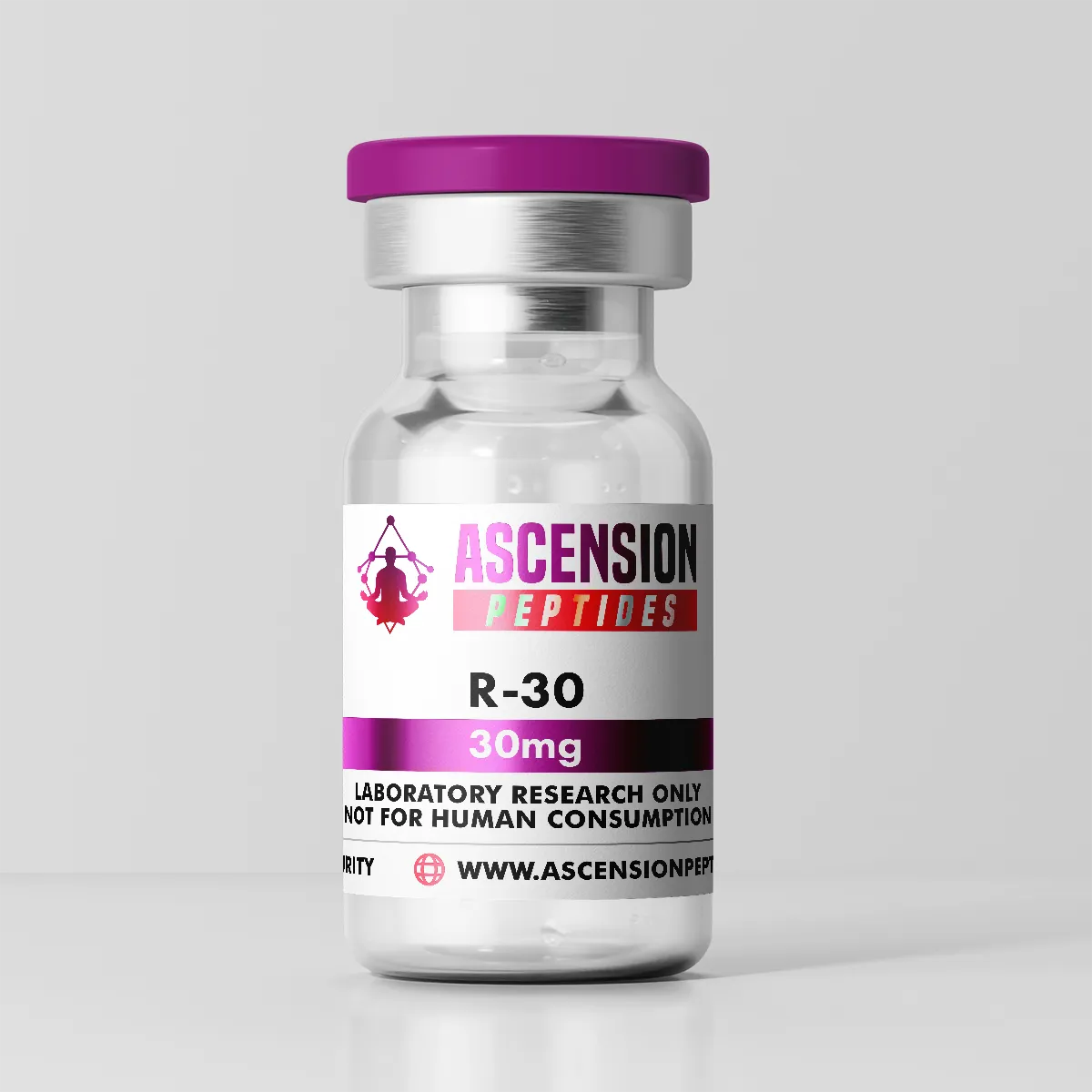
- R-10 (10mg vial) — View R-10 on Ascension Peptides — entry-level research quantity
- R-30 (30mg vial) — View R-30 on Ascension Peptides — larger research supply, better value per mg
Ascension tests their peptides for purity and provides COA documentation. They're one of the more established research peptide vendors currently stocking retatrutide peptide. Their R-30 at 30mg is $250 list, or $125 with code PEPTIDEDECK (about $4.17/mg), which is competitive for a 39-amino-acid peptide this structurally complex.
Timeline: When Will Retatrutide Be Prescribable?
Not before late 2027. Lilly said in July 2026 that it plans to submit retatrutide to the FDA in Q1 2027, later than first indicated because its manufacturing package needed more time. FDA reviews typically take 10–12 months, so approval would come in late 2027 at the earliest and more likely in 2028.
If you arrived looking for a specific strength — 5mg, 10mg, 15mg — read retatrutide doses explained first. Some of those numbers are vial sizes rather than doses, and the difference is several-fold.
What doses did retatrutide trials actually use?
Retatrutide is an investigational compound. It has no FDA approval, no approved label, and therefore no established human dose. Nothing below is a recommendation — it is a summary of what Lilly’s published trial programme administered, which is the only dosing evidence that exists.
The Phase 2 obesity programme titrated participants slowly over months rather than starting at a target dose, with escalation steps used to manage gastrointestinal side effects. Maintenance doses in the published trials were 1, 4, 8 and 12mg per week in Phase 2 and 4, 9 and 12mg in Phase 3. Discontinuation in trials was driven principally by nausea, vomiting and diarrhoea during escalation, which is why the titration schedule was gradual.
Why “how much should I take” has no answer here
For an approved drug, the label answers this question because a regulator has reviewed the dose-response and safety data and set one. Retatrutide has not been through that process. Trial doses were administered under medical supervision, with screening, monitoring and withdrawal criteria that do not exist outside a study. Extrapolating a personal dose from a trial arm discards every one of those safeguards. Anyone considering retatrutide should be speaking to a clinician, not reading a number off a webpage.
Retatrutide in the UK and outside the US
Retatrutide is not approved in the UK, the EU, Australia or anywhere else — its regulatory status is the same everywhere, because it is still in clinical development. Vendors shipping it internationally are supplying a research chemical, not a licensed medicine, and no country’s regulator has assessed what is in the vial.
The practical consequences for a UK or EU buyer are the same as in the US, plus customs exposure: no pharmacopoeial standard, no batch release testing by a regulator, and no recourse. If you are researching sourcing, third-party certificates of analysis matched to your specific lot are the minimum, and our retatrutide sourcing guide covers what a legitimate COA should show.