Most hair loss treatments work on the surface. They block DHT, dilate blood vessels, or coat the scalp with conditioning agents. None of them talk to the cells that actually control whether your follicles live or die.
AHK-Cu does something fundamentally different. This synthetic copper tripeptide — formally known as Copper Tripeptide-3, or Alanyl-Histidyl-Lysine copper — was engineered specifically to communicate with dermal papilla cells, the master regulators sitting at the base of every hair follicle. The research behind it is specific, the mechanism is well-characterized, and the interest from the peptide and cosmeceutical research communities has grown rapidly since its early publications.
This complete guide covers everything you need to know: the science, the mechanisms, how it compares to GHK-Cu, dosage protocols used in research, and what to look for if you're sourcing it.
What Is AHK-Cu Peptide?
AHK-Cu is a synthetic copper-binding tripeptide composed of three amino acids: alanine, histidine, and lysine, chelated to a copper ion. The full chemical name is Copper Tripeptide-3, and it is sometimes written as AHK-Cu or AHK·Cu²⁺ in research literature.
Unlike GHK-Cu (Copper Tripeptide-1), which occurs naturally in human plasma, saliva, and urine and declines with age, AHK-Cu was deliberately engineered in a laboratory setting. Researchers chose the alanine-histidine-lysine sequence because of its specific affinity for growth factor signaling pathways and its ability to interact with anti-apoptotic (cell survival) mechanisms in follicular tissue. That intentional design is what separates AHK-Cu from naturally-derived copper peptides — it was built with a target in mind.
- Full Name: Copper Tripeptide-3 (Alanyl-Histidyl-Lysine Copper)
- Type: Synthetic copper-binding tripeptide
- Primary Research Applications: Hair follicle regeneration, scalp health, skin remodeling
- Mechanism: Dermal papilla cell proliferation, anti-apoptotic signaling, growth factor upregulation
- Key Comparison: Engineered analog of GHK-Cu with superior follicle-targeting profile
- Research Status: Preclinical and in vitro studies; not FDA-approved for human use
How Does AHK-Cu Work? The Science Behind the Peptide
The mechanism of AHK-Cu is one of the most well-defined among cosmeceutical peptides, and understanding it explains why researchers are so interested in its potential.
1. Dermal Papilla Cell Proliferation
Dermal papilla cells (DPCs) are the signaling hubs at the base of each hair follicle. They orchestrate the hair cycle — telling follicles when to grow (anagen), when to regress (catagen), and when to rest (telogen). As DPC populations shrink or become senescent, follicles miniaturize and eventually stop producing hair altogether.
Research published in the Archives of Dermatological Research found that AHK-Cu at concentrations as low as 10⁻¹² molar (picomolar range) stimulated dermal papilla cell proliferation and promoted hair follicle elongation in ex vivo models. This picomolar activity is notable — it suggests the peptide is highly potent at the receptor level even at trace concentrations.
2. Anti-Apoptotic Signaling
Apoptosis — programmed cell death — is one of the primary drivers of follicle miniaturization in androgenetic alopecia and stress-related hair loss. AHK-Cu has been shown to suppress pro-apoptotic signals in follicular cells, effectively extending their functional lifespan. This mechanism parallels some of the research behind BPC-157 in connective tissue, where the peptide preserves cell viability under stress conditions.
3. Growth Factor Upregulation
AHK-Cu promotes expression of key growth factors involved in follicle maintenance, including Vascular Endothelial Growth Factor (VEGF) and Keratinocyte Growth Factor (KGF). VEGF improves microvascular density around follicles — essentially improving their nutrient and oxygen supply. KGF drives keratinocyte proliferation, which is essential for shaft production and follicle structural integrity.
4. Copper Ion Delivery
Copper itself is a critical cofactor in numerous enzymatic processes relevant to hair and skin health, including lysyl oxidase (essential for collagen and elastin cross-linking) and tyrosinase (involved in melanin synthesis). The tripeptide acts as a stabilized carrier, delivering bioavailable copper directly to target tissues without the oxidative risk of free copper ions.
AHK-Cu vs GHK-Cu: What's the Difference?
The most common question researchers and formulators ask about AHK-Cu is how it differs from the better-known GHK-Cu. The answer involves both origin and application profile.
In practical terms: if your primary research interest is hair follicle biology and scalp-level regeneration, AHK-Cu's purpose-built design makes it the more targeted tool. If you're investigating broader skin remodeling, wound healing, and anti-aging applications, GHK-Cu has the deeper evidence base. Many researchers and formulators combine both in topical preparations for synergistic coverage.
AHK-Cu Research Benefits: What the Studies Show
Hair Follicle Elongation and Anagen Extension
The most replicated finding in AHK-Cu research is its ability to stimulate follicle elongation in ex vivo hair follicle organ culture models. Studies demonstrate measurable increases in follicle length over 6–9 day culture periods compared to controls, alongside increased Ki-67 staining (a marker of cellular proliferation) in the dermal papilla and hair matrix regions.
Reduction in Follicle Apoptosis
TUNEL assay data from in vitro studies shows statistically significant reductions in apoptotic cell counts within follicular tissue treated with AHK-Cu versus untreated controls. This supports the hypothesis that the peptide actively prevents the cellular death cascade that drives progressive hair thinning.
Collagen and Extracellular Matrix Support
AHK-Cu stimulates fibroblast activity and promotes collagen synthesis in dermal tissue — a benefit shared with GHK-Cu. This has implications not just for scalp health but for skin firmness, wound healing research, and overall dermal matrix maintenance.
Potential Synergy with Minoxidil Pathways
Early mechanistic comparisons suggest AHK-Cu and minoxidil may act on complementary pathways — minoxidil primarily operating via potassium channel-mediated vasodilation, while AHK-Cu targets cellular survival and growth factor signaling. This has led some researchers to investigate combination topical formulations, though direct comparative clinical trials are not yet published.
- Picomolar concentrations (10⁻¹²M) sufficient to stimulate DPC proliferation in vitro
- Measurable follicle elongation in ex vivo organ culture models
- Reduced apoptotic signaling in follicular tissue
- VEGF and KGF upregulation documented
- Collagen and ECM synthesis stimulation in fibroblast cultures
AHK-Cu Dosage: Research Protocols and Topical Concentrations
Because AHK-Cu is primarily investigated as a topical research compound rather than a systemic peptide, dosing parameters differ significantly from injectable peptides like BPC-157 or Ipamorelin.
Topical Serum Concentrations
Research formulations and cosmeceutical-grade preparations typically use AHK-Cu at concentrations between 0.001% and 0.01% (w/v). Higher concentrations have not consistently demonstrated dose-dependent improvements in vitro, and some copper peptide research suggests a biphasic response — where very high concentrations may become less effective or mildly pro-oxidative.
Application Frequency
In protocols based on available literature, topical AHK-Cu formulations are typically applied once or twice daily to the target area (scalp, periorbital skin, or facial skin depending on the application). Consistency over a minimum 90-day observation window is standard in research designs evaluating hair cycle changes, as a single anagen cycle requires that timeframe to produce measurable data.
Combination Formulations
AHK-Cu is frequently studied alongside GHK-Cu in combination serum preparations. The two peptides appear to complement each other — AHK-Cu driving follicle-level cellular signaling while GHK-Cu supports the broader dermal environment. Penetration enhancers such as niacinamide or certain liposomal carriers are often included to improve transdermal delivery of the copper-peptide complex.
- Concentration: 0.001%–0.01% in topical vehicle
- Application: Once or twice daily to target tissue
- Duration: Minimum 90 days for follicle cycle assessment
- Common Combinations: GHK-Cu, Niacinamide, Biotin, Caffeine
- Delivery Vehicle: Liposomal serum or hydrogel base preferred
AHK-Cu Safety Profile and Tolerability
Copper tripeptides as a class have a well-established tolerability record in topical cosmeceutical research, and AHK-Cu is no exception. The peptide's small molecular size and copper-chelated structure make it generally non-irritating at research concentrations. No significant toxicity signals have been documented in published in vitro or ex vivo studies at concentrations relevant to topical application.
Potential considerations include:
- Copper sensitivity: Individuals with known copper metabolism disorders (e.g., Wilson's disease) should avoid copper peptide compounds.
- Oxidative load at high concentrations: Free copper is pro-oxidant; chelated forms are safer, but formulators should avoid extreme concentrations.
- Interaction with vitamin C (ascorbic acid): High-dose ascorbic acid may reduce copper peptide stability in combined formulations — pH and formulation chemistry matter.
- Skin sensitization: Rare; patch testing is standard practice in cosmeceutical research protocols.
No systemic absorption studies in humans have been published at this time. AHK-Cu is not approved by the FDA for therapeutic use and remains classified as a research compound.
Where to Buy AHK-Cu for Research
AHK-Cu is available from a small number of research peptide suppliers and cosmeceutical raw material vendors. Because the compound is primarily used in topical formulation research, it is sold both as a raw active ingredient and as a pre-formulated serum depending on the supplier.
When sourcing AHK-Cu, look for the following quality indicators:
- Third-party Certificate of Analysis (COA): Should confirm amino acid sequence identity and purity ≥98%
- HPLC purity data: High-performance liquid chromatography is the gold standard for peptide purity verification
- Copper content verification: The copper chelation should be confirmed analytically — not just assumed from the synthesis route
- US-based or GMP-compliant sourcing: Reduces contamination risk and improves supply chain transparency
- Proper cold-chain handling: Peptides should be shipped with appropriate temperature controls
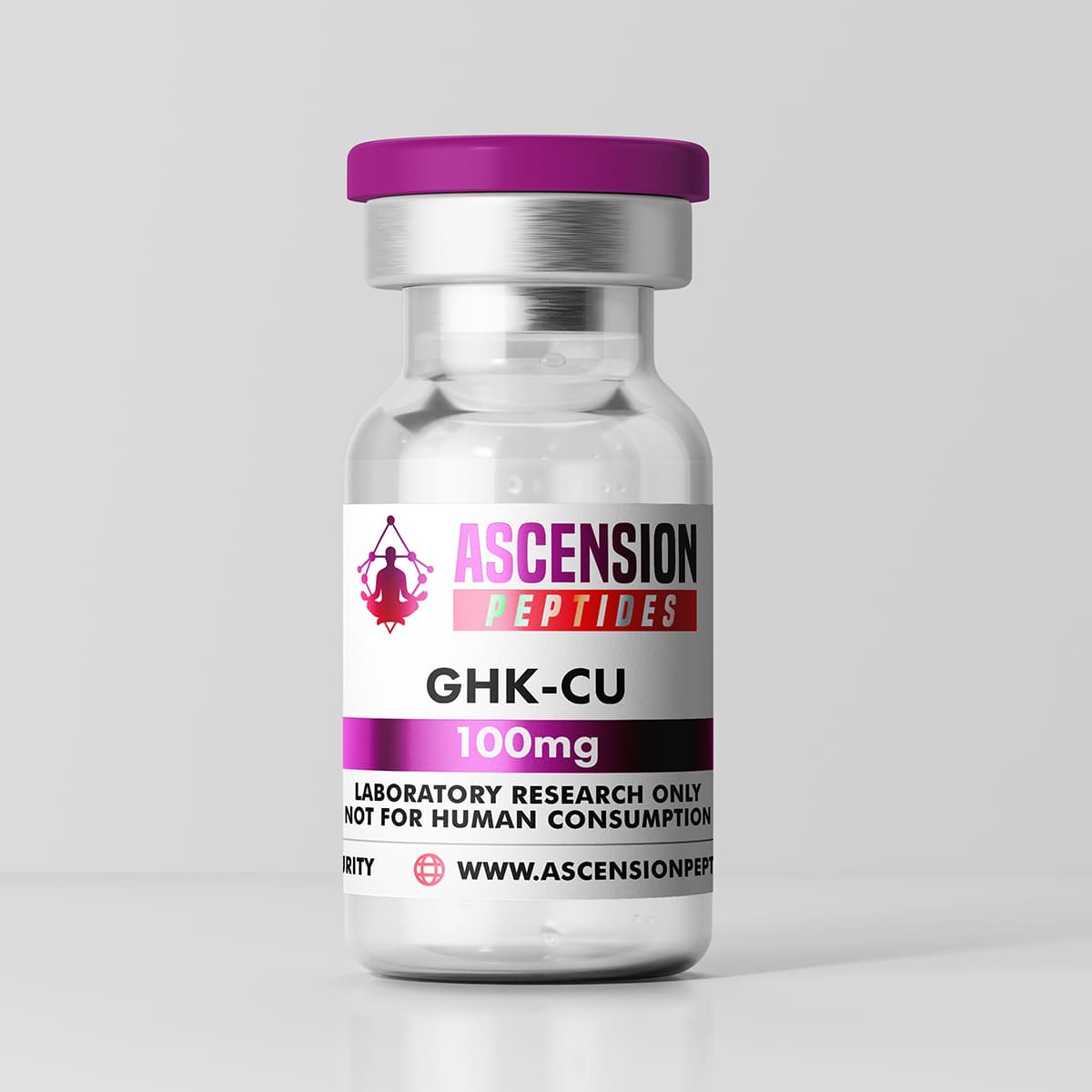
Ascension Peptides is one vendor worth evaluating for AHK-Cu availability, purity documentation, and third-party testing standards. Always request and review the COA before use in any research protocol.