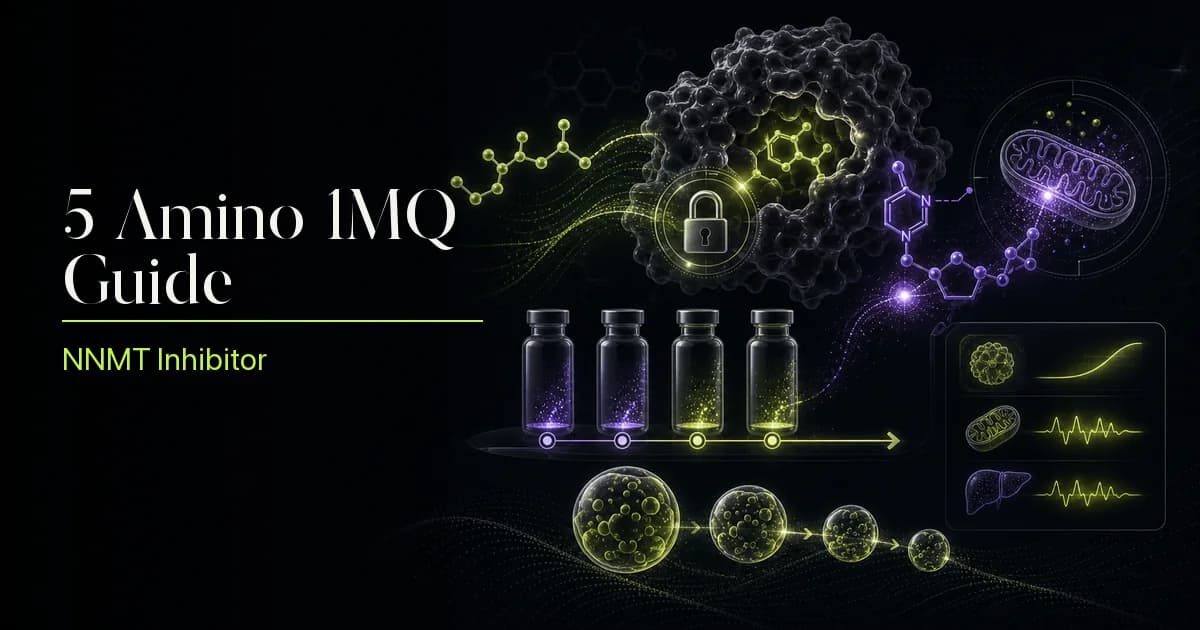
5-Amino-1MQ is one of the most research-backed metabolic compounds in the peptide space — a selective small-molecule NNMT inhibitor with preclinical evidence showing it can reduce white adipose mass, improve insulin sensitivity, and increase cellular energy expenditure. If you're trying to understand what it does, how to dose it, and whether the science holds up, this guide covers everything.
What Is 5-Amino-1MQ? The NNMT Inhibitor Explained
5-Amino-1MQ (5-amino-1-methylquinolinium) is a synthetic small molecule that works by selectively inhibiting an enzyme called nicotinamide N-methyltransferase (NNMT). NNMT is a cytosolic enzyme that catalyzes the methylation of nicotinamide (a form of vitamin B3) using S-adenosyl-methionine (SAM) as a methyl donor. The result of this reaction is 1-methylnicotinamide (MNA) and S-adenosyl-homocysteine (SAH).
Why does blocking NNMT matter? Because when NNMT is overactive — as it is in people with obesity, insulin resistance, and metabolic syndrome — it effectively depletes free NAD+ and disrupts the enzymes that depend on it, including sirtuins (SIRT1–SIRT7), which regulate metabolism, aging, and DNA repair.
The NNMT-Obesity Connection
A 2021 review published in PMC (PMCID: PMC8337113) confirmed that NNMT expression is significantly elevated in the white adipose tissue and liver of obese individuals and diabetic mice. Crucially, NNMT knockdown in animal models induced a 47% reduction in relative fat mass and improved insulin sensitivity — without changes in diet or exercise.
5-Amino-1MQ mimics the effect of NNMT knockdown pharmacologically. By inhibiting this enzyme, it theoretically restores NAD+ availability, reactivates sirtuin signaling, shifts adipocytes from fat-storing to fat-burning mode, and improves the metabolic environment broadly.
5-Amino-1MQ Benefits: What the Research Shows
The majority of research on 5-Amino-1MQ and NNMT inhibition is preclinical — meaning animal studies and in vitro cell work — with no published human clinical trials as of early 2026. That said, the mechanistic evidence is compelling and reproducible across multiple research groups.
1. Fat Loss and Reduced White Adipose Mass
NNMT is highly expressed in white adipose tissue (WAT), especially in obesity-prone individuals. Elevated NNMT activity in fat cells suppresses energy expenditure at the cellular level. Studies show that NNMT inhibition shifts adipocytes toward a more metabolically active phenotype — burning more fat rather than storing it. In mouse models, NNMT knockdown reduced relative fat mass by nearly half without caloric restriction. 5-Amino-1MQ has demonstrated similar effects in preclinical work targeting the same pathway.
2. Improved Insulin Sensitivity and Glucose Metabolism
NNMT expression in WAT is upregulated in patients with insulin resistance and type 2 diabetes, and plasma MNA levels (the product of NNMT activity) positively correlate with the degree of insulin resistance. Blocking NNMT with 5-Amino-1MQ has been shown in animal models to normalize fasting blood glucose levels and improve glucose tolerance — effects that are mechanistically tied to restored NAD+ signaling in metabolic tissues.
3. NAD+ Restoration and Sirtuin Activation
One of the most important downstream effects of NNMT inhibition is the restoration of NAD+ availability. Because NNMT methylates nicotinamide and removes it from the NAD+ biosynthesis pathway, blocking NNMT effectively frees up more nicotinamide to be recycled into NAD+. Higher NAD+ levels support sirtuin activity — particularly SIRT1, which regulates fat metabolism, mitochondrial biogenesis, and inflammation. This is why 5-Amino-1MQ is sometimes compared favorably to NAD+ precursors like NMN or NR, but via a different upstream mechanism.
4. Increased Resting Energy Expenditure
Preclinical models show that NNMT inhibition increases basal metabolic rate — essentially making cells burn more energy at rest. The mechanism involves restored mitochondrial function and upregulated thermogenic gene expression in adipose tissue. In practical terms, this could translate to modestly increased calorie burn without added cardiovascular exercise.
5. Potential Muscle Preservation
Unlike aggressive caloric restriction, NNMT inhibition in animal models tends to preferentially reduce fat mass with minimal impact on lean body mass. Some researchers theorize this is because NNMT expression is relatively low in skeletal muscle compared to WAT and liver, meaning the inhibitory effects are more targeted to fat tissue. This fat-selective action is a key differentiator from many conventional weight-loss interventions.
5-Amino-1MQ Dosage: Protocols Used in Research
There are no FDA-approved human dosing guidelines for 5-Amino-1MQ, and it remains a research compound. The dosage information below reflects protocols used in preclinical studies and researcher community reports — not clinical recommendations.
Important Dosage Context
5-Amino-1MQ is typically administered orally — it is one of the few metabolic research peptides/compounds with reasonable oral bioavailability, which distinguishes it from injection-based peptides. Most protocols use capsule or tablet form.
Standard Research Dose: 50–75 mg/day
The most commonly referenced dose range in research contexts is 50 to 75 mg per day, typically split into one or two doses. This range is derived from allometric scaling of preclinical animal studies to approximate human equivalent doses.
Conservative Starting Protocol: 25 mg/day
For those new to 5-Amino-1MQ, a lower starting dose of 25 mg/day is often recommended for the first 1–2 weeks to assess individual tolerance before increasing to the full research dose.
Cycle Length: 8–12 Weeks
Research protocols typically run for 8 to 12 weeks, followed by an equivalent off period. Continuous long-term use has not been studied in humans, and periodic cycling is recommended from a precautionary standpoint.
Timing: With or Without Food
Oral 5-Amino-1MQ can be taken with or without food. Some researchers prefer taking it in the morning to align with natural circadian metabolic patterns. There is no strong evidence that timing significantly affects efficacy.
It's worth noting that some practitioner-guided protocols use doses up to 100 mg/day for shorter durations, but this is less common and carries a less characterized safety profile. The 50–75 mg range represents the best-evidenced research window based on currently available data.
5-Amino-1MQ Side Effects and Safety Considerations
Because 5-Amino-1MQ has not undergone human clinical trials, its full safety and side effect profile is not established. What is known comes from animal studies and anecdotal researcher reports:
- Generally well-tolerated in preclinical models — no major organ toxicity has been reported at therapeutic doses in animal studies
- Possible gastrointestinal effects — mild nausea or digestive discomfort reported by some users, particularly at higher doses or when taken without food
- Theoretical methylation cycle effects — because NNMT uses SAM (the body's primary methyl donor), inhibiting NNMT may alter methylation dynamics; individuals with MTHFR variants or methylation issues should consult a healthcare provider
- Unknown long-term effects — NNMT has roles beyond fat metabolism (including roles in cancer biology, neurodegenerative disease, and inflammation); prolonged inhibition has not been adequately studied
- Drug interactions unknown — no formal pharmacokinetic interaction studies have been conducted
The compound is not approved for human use and is sold strictly for research purposes. Self-administration carries inherent risks that cannot be fully quantified at this time.
5-Amino-1MQ vs. Other Metabolic Compounds
How does 5-Amino-1MQ compare to other popular metabolic research compounds?
5-Amino-1MQ vs. AOD-9604
AOD-9604 is a fragment of human growth hormone that promotes lipolysis via beta-3 adrenergic receptors. It works through a fundamentally different pathway than 5-Amino-1MQ. While AOD-9604 directly triggers fat cell breakdown, 5-Amino-1MQ works upstream at the metabolic enzyme level. The compounds could theoretically be complementary, but there is no human research on combining them.
5-Amino-1MQ vs. Tesamorelin / GH Secretagogues
Growth hormone secretagogues like tesamorelin or the CJC-1295/ipamorelin stack work by stimulating GH release, which has downstream fat-loss effects. 5-Amino-1MQ operates entirely independently of the GH axis. It's an NNMT inhibitor, not a hormonal compound — making it theoretically suitable for those who cannot or do not want to manipulate growth hormone.
5-Amino-1MQ vs. NMN/NR (NAD+ Precursors)
NMN and NR increase NAD+ by providing precursors that the body converts to NAD+. 5-Amino-1MQ increases NAD+ by blocking the enzyme that depletes it. Both approaches can improve NAD+ availability, but they target different points in the pathway. Some researchers argue NNMT inhibition is more targeted and more potent for metabolic correction, particularly in the context of existing NNMT overexpression.
Who Is 5-Amino-1MQ Best Suited For?
Based on the mechanistic evidence, 5-Amino-1MQ research is most relevant for:
- Individuals with metabolic syndrome, insulin resistance, or difficulty losing fat despite caloric restriction
- Researchers exploring the NNMT pathway and its downstream effects on NAD+ metabolism
- Those interested in fat-selective body recomposition without lean mass loss
- People investigating NNMT's role in type 2 diabetes prevention or reversal
It is not a replacement for lifestyle interventions and does not have proven efficacy in humans. It should be considered a research compound with promising — but still preliminary — evidence.
The PMC8337113 Study: Key Findings Summarized
The 2021 review published as PMC8337113 ("Roles of Nicotinamide N-Methyltransferase in Obesity and Type 2 Diabetes") is frequently referenced in 5-Amino-1MQ discussions and is one of the core papers cited on this topic. Key findings from this review include:
- NNMT expression is elevated in white adipose tissue and liver of obese individuals and diabetic mice
- NNMT knockdown produced a 47% reduction in relative fat mass in animal models
- NNMT inhibition normalizes fasting blood glucose levels and improves glucose tolerance
- MNA levels in urine/serum positively correlate with BMI — meaning NNMT activity scales with obesity severity
- The authors concluded that NNMT represents a "promising therapeutic target" for obesity and T2D, though clinical trials had not yet been conducted
This paper does not specifically study 5-Amino-1MQ as a compound — it reviews NNMT biology broadly. 5-Amino-1MQ's relevance comes from it being one of the most selective small-molecule NNMT inhibitors identified in subsequent compound screening work.
Key Takeaways
Summary: 5-Amino-1MQ at a Glance
Mechanism: Selective NNMT inhibitor → restores NAD+, activates sirtuins, reduces white adipose tissue
Primary benefits: Fat loss, improved insulin sensitivity, increased energy expenditure, potential muscle preservation
Typical research dose: 50–75 mg/day orally, 8–12 week cycles
Evidence level: Preclinical (animal + in vitro) — no published human trials
Key study: PMC8337113 — NNMT roles in obesity and T2D
Frequently Asked Questions
What is 5-Amino-1MQ used for?
5-Amino-1MQ is a research compound used to study NNMT inhibition and its effects on metabolism, fat loss, insulin sensitivity, and NAD+ levels. It is not approved for human therapeutic use but is used in preclinical research exploring obesity and type 2 diabetes mechanisms.
How do you take 5-Amino-1MQ?
5-Amino-1MQ is typically taken orally in capsule or tablet form. Research protocols generally use 50–75 mg per day, either as a single dose or split across two doses. A conservative starting dose of 25 mg/day for the first 1–2 weeks is often recommended before increasing.
Is 5-Amino-1MQ safe?
5-Amino-1MQ appears well-tolerated in preclinical animal studies with no major organ toxicity at research doses. However, human safety data does not exist. Potential considerations include methylation cycle effects, unknown long-term impacts, and possible gastrointestinal discomfort. Always consult a healthcare provider before considering any research peptide protocol.
What is the difference between 5-Amino-1MQ and NMN?
Both compounds can increase intracellular NAD+ levels, but via different mechanisms. NMN (nicotinamide mononucleotide) is a NAD+ precursor that provides raw material for the body to make NAD+. 5-Amino-1MQ inhibits the enzyme (NNMT) that depletes NAD+ precursors. They work at different points in the same pathway and are not directly comparable.
Does 5-Amino-1MQ require injections?
No. Unlike many research peptides that require subcutaneous or intramuscular injection, 5-Amino-1MQ is an orally bioavailable small molecule. It is typically administered as a capsule, which is one of its practical advantages over injection-based peptide compounds.
What does PMC8337113 show about NNMT?
PMC8337113 is a 2021 review study titled "Roles of Nicotinamide N-Methyltransferase in Obesity and Type 2 Diabetes." It found that NNMT expression is elevated in obese individuals, that NNMT knockdown reduced fat mass by 47% in mice, improved insulin sensitivity, and normalized glucose tolerance — establishing NNMT as a target of interest for obesity and metabolic disease treatment.