📊 Retatrutide Dosage Chart — Week-by-Week Protocol
That's the protocol most people follow. Start low at 2mg, increase every 4 weeks if side effects are manageable. The full breakdown — including how to handle nausea, what to do if you miss a dose, and reconstitution math — is below.
📸 Retatrutide Before & After — Community Results



See more in our full retatrutide before & after gallery →
What Is Retatrutide? (Quick Recap)
Retatrutide (LY3437943) is Eli Lilly's investigational triple receptor agonist — simultaneously activating GLP-1, GIP, and glucagon receptors. This triple mechanism is what distinguishes it from semaglutide (GLP-1 only) and tirzepatide (GLP-1 + GIP): the addition of glucagon receptor agonism increases energy expenditure while GLP-1 suppresses appetite and GIP improves metabolic efficiency.
In the landmark Phase 2 trial published in the New England Journal of Medicine (Jastreboff et al., 2023), participants receiving 12 mg weekly lost an average of 24.2% of their body weight over 48 weeks — surpassing every previously approved weight loss medication at time of publication. Phase 3 trials (the TRIUMPH program) are ongoing.
Key Retatrutide Phase 2 Trial Data (NEJM, 2023)
Four retatrutide doses were tested via weekly subcutaneous injection over 48 weeks against placebo. Results: 1 mg → 8.7% weight loss | 4 mg → 17.1% weight loss | 8 mg → 22.8% weight loss | 12 mg → 24.2% weight loss. Placebo group: -1.6%. All active doses significantly outperformed placebo.
Why Dose Escalation Is Non-Negotiable
Retatrutide works on three receptor systems simultaneously, which means the side effect profile — primarily gastrointestinal — can be more pronounced than with single-agonist drugs if you ramp up too quickly. Nausea, vomiting, and diarrhea are the most common adverse events, and they're almost entirely dose-dependent and tied to escalation speed.
The clinical trial used a structured 4-week hold between dose levels specifically to allow GI tolerance to develop. Compressing the escalation schedule is the single most common mistake researchers make — it's the primary driver of discontinuing what would otherwise be an effective protocol. Slow escalation isn't weakness; it's strategy.
The Escalation Principle
Your GI tract needs time to adapt to incremental GLP-1 receptor stimulation. Rushing escalation doesn't make retatrutide work faster — it increases the likelihood of side effects that force a dose reduction anyway. Slow and steady consistently wins with triple agonists.
The Retatrutide Dosage Chart: All Three Protocols
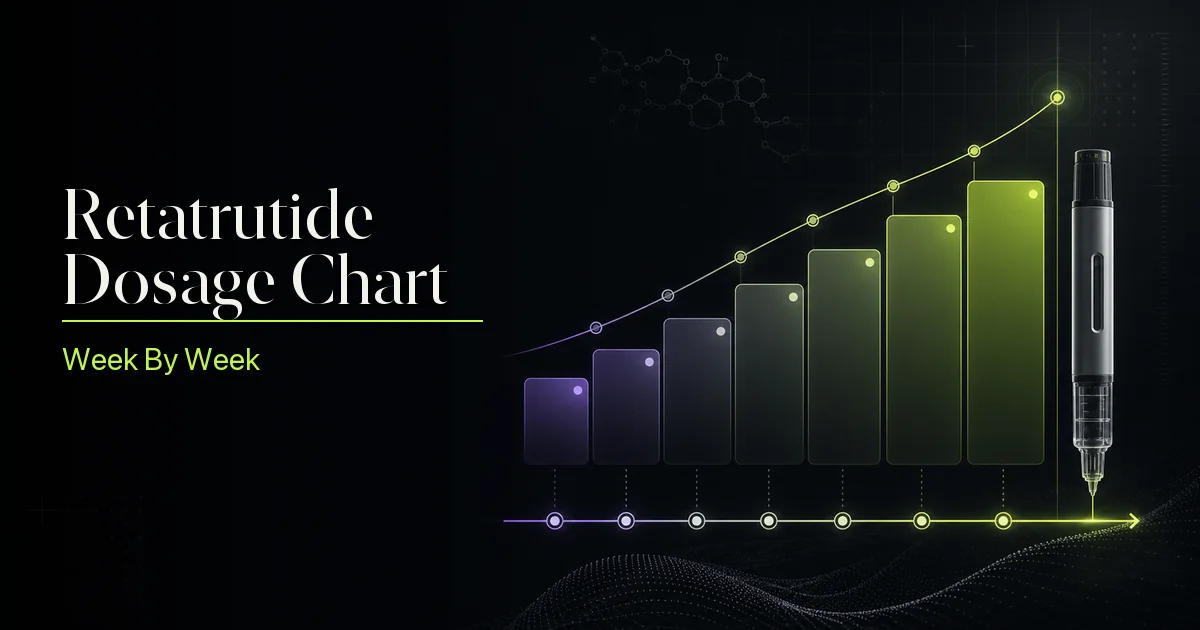
The table below is the retatrutide dosage chart you've been looking for — a week-by-week breakdown for three protocols: Beginner (ultra-conservative, ideal for those new to GLP-1 class drugs), Standard (a slower ramp than the Phase 2 trial, with extra 6 mg and 10 mg steps), and Aggressive (the Phase 2 trial's 2 → 4 → 8 → 12 mg ramp, for experienced researchers with prior GLP-1 exposure).
All doses are administered as a once-weekly subcutaneous injection. Escalation intervals are 4 weeks minimum at each dose level before stepping up.
All doses are once-weekly subcutaneous injections. 12 mg represents the highest dose studied in Phase 2 clinical trials. This chart is for informational purposes only — not medical advice.
Protocol Breakdown: Which One Is Right for You?
🟢 Beginner Protocol (Ultra-Conservative)
Best for: First-time GLP-1 users, individuals with a history of severe nausea on other weight loss medications, or anyone who wants to prioritize GI tolerance over speed of escalation.
The beginner protocol starts at 0.5 mg — half the lowest dose tested in clinical trials. The tradeoff is a longer runway to reach maintenance dose (approximately 20–28 weeks to reach 8–12 mg), but significantly lower risk of GI disruption. If you've never used semaglutide, tirzepatide, or any other GLP-1 agonist before, starting here is a sound approach. You can always escalate faster if you find your tolerance is good.
🔵 Standard Protocol (Slower Than the Trial)
Best for: Most researchers. Especially those with moderate GI tolerance or prior experience with GLP-1 agonists (semaglutide, tirzepatide, or liraglutide).
The standard protocol follows the Phase 2 trial's pattern of starting at 2 mg for 4 weeks, then stepping up every 4 weeks toward 12 mg, but it adds 6 mg and 10 mg steps, so 12 mg arrives at week 21 instead of the trial's week 13. The trial's own schedule (2, 4, 8, then 12 mg from week 13) is the Aggressive column. If you've tolerated semaglutide or tirzepatide without major issues in the past, this is your default protocol. Run to week 24, this schedule uses 168 mg in total, about six 30mg vials, so if you buy retatrutide for the whole run, check the batch COA and the current price per vial first.
🔴 Aggressive Protocol (Experienced Researchers Only)
Best for: Individuals with high GI tolerance who have previously completed a full cycle of a GLP-1 agonist at maximum dose without significant adverse events.
The aggressive protocol compresses the escalation to reach 12 mg by weeks 13–16. This carries a higher risk of GI side effects and is not recommended for beginners. If nausea or vomiting becomes unmanageable, drop back to the previous dose and hold for an additional 2–4 weeks before attempting to escalate again. Pushing through significant GI distress is counterproductive — it leads to dehydration, electrolyte imbalance, and often protocol abandonment.

What to Expect at Each Retatrutide Dose Level
Understanding what each dose level typically delivers helps calibrate expectations — and helps you decide whether to hold at a dose plateau or continue escalating.
1–2 mg Weekly (Induction Phase)
Appetite suppression begins to emerge, particularly in the evening. Most researchers notice they're reaching for less food without consciously trying. GI effects (mild nausea, occasional loose stools) are usually well-managed at this level. Expect 2–5% weight loss over the first 4–8 weeks. The glucagon receptor component begins contributing to increased energy expenditure, though its effects are more pronounced at higher doses.
4–6 mg Weekly (Early Escalation)
Appetite suppression becomes pronounced — many researchers report naturally eating 30–50% less without conscious caloric restriction. This is often described as the sweet spot for tolerability vs. efficacy. The 4 mg dose group in the Phase 2 trial produced an average 17.1% weight loss by week 48. GI adaptation is largely complete for most people by the time they reach this range, and side effects — if they occurred during escalation — typically diminish significantly.
8 mg Weekly (Upper Escalation)
The 8 mg dose group achieved 22.8% weight loss at 48 weeks in the Phase 2 trial. At this level, many researchers report near-complete appetite suppression — extended periods without hunger signals. Attention to adequate protein intake becomes critical at this stage, as dramatically reduced caloric consumption can lead to lean muscle loss if protein targets aren't maintained (aim for 0.7–1g per pound of bodyweight). GI side effects, if present, typically peak during the first 2 weeks after dose escalation to 8 mg.
12 mg Weekly (Maximum Studied Dose)
The highest dose tested in Phase 2 trials produced 24.2% average weight loss at 48 weeks — only about 1.4 percentage points more than the 8 mg group, but significant given the baseline. At 12 mg, caloric restriction becomes almost effortless for most researchers. The glucagon agonist component contributes meaningfully to adipose tissue mobilization at this dose. Not everyone needs to reach 12 mg: given the diminishing returns above 8 mg, many researchers choose to maintain at 8 mg as their maximum dose.
How to Administer Retatrutide
Retatrutide is administered as a once-weekly subcutaneous (under-the-skin) injection. Proper technique minimizes discomfort and ensures consistent absorption:
- Injection sites: Rotate between abdomen (at least 2 inches from navel), front of thigh, and outer upper arm. Rotating sites weekly prevents lipodystrophy and injection site reactions.
- Technique: Pinch the skin, insert the needle at a 45–90 degree angle (45 degrees for leaner individuals, 90 degrees if more subcutaneous fat is present). Inject slowly and hold for 5 seconds before withdrawing.
- Consistency: Choose a fixed day of the week (e.g., every Monday) and stick to it. Retatrutide has a half-life of approximately 6 days, so weekly dosing maintains stable plasma levels.
- Storage: Refrigerate at 36–46°F (2–8°C). May be kept at room temperature (up to 77°F/25°C) for up to 28 days once removed from the fridge. Never freeze. Protect from light.
- Meal timing: Can be injected at any time of day, with or without food. Some researchers prefer evening injection, reporting that any mild nausea peaks overnight while they sleep.
- Missed dose: If less than 4 days late, inject as soon as you remember. If 4+ days have passed, skip the missed dose and resume on your next scheduled injection day. Never double dose.
Managing Side Effects During Escalation
The most common retatrutide side effects are gastrointestinal and are almost entirely related to escalation speed and individual GI sensitivity. Good news: they're predictable and manageable with the right approach.
The GI Management Toolkit
These strategies significantly reduce GI side effects during escalation phases: (1) Smaller, more frequent meals — avoid large meals, especially within 2 hours of injection. (2) Low-fat foods for 48 hours post-injection — fatty meals amplify nausea. (3) Ginger tea or supplements — well-evidenced for nausea reduction. (4) Stay hydrated — diarrhea risk compounds with dehydration. (5) Consider evening injections — many find peak nausea occurs overnight. (6) If vomiting occurs more than once per week: hold your current dose for an additional 2–4 weeks before escalating.
GI side effects with retatrutide follow a predictable arc. They typically peak during the first 1–2 weeks at a new dose level, then diminish significantly as your GI system adapts. Most researchers report that by week 3–4 at a new dose, GI effects are minimal to absent. If you experience persistent vomiting, severe abdominal pain, or signs of pancreatitis (persistent upper abdominal pain radiating to the back), discontinue use and seek medical evaluation immediately.
Retatrutide Dosing: Key Principles at a Glance
- Always start at the lowest dose appropriate for your experience level — never start at maintenance
- Maintain each dose level for a minimum of 4 weeks before escalating
- If side effects are significant, hold at the current dose for an additional 2–4 weeks before attempting to escalate
- The 8 mg dose provides the best efficacy-to-tolerability ratio for most researchers based on Phase 2 data
- 12 mg is the highest dose with clinical evidence — going above this has no data backing and is not recommended
- Track body weight, food intake, and side effects weekly — data helps you make informed escalation decisions
- Prioritize protein intake (0.7–1g per pound of bodyweight) during rapid weight loss to preserve lean muscle mass
- At higher doses (8–12 mg), supplement with a quality multivitamin and electrolytes given dramatically reduced caloric intake
- Do not combine with other GLP-1 agonists (semaglutide, tirzepatide) — there is no evidence this is safe or beneficial
Confused about whether a number like 6mg or 10mg is a weekly dose or a vial size? Retatrutide doses explained separates the two and shows where the 12mg trial ceiling sits.