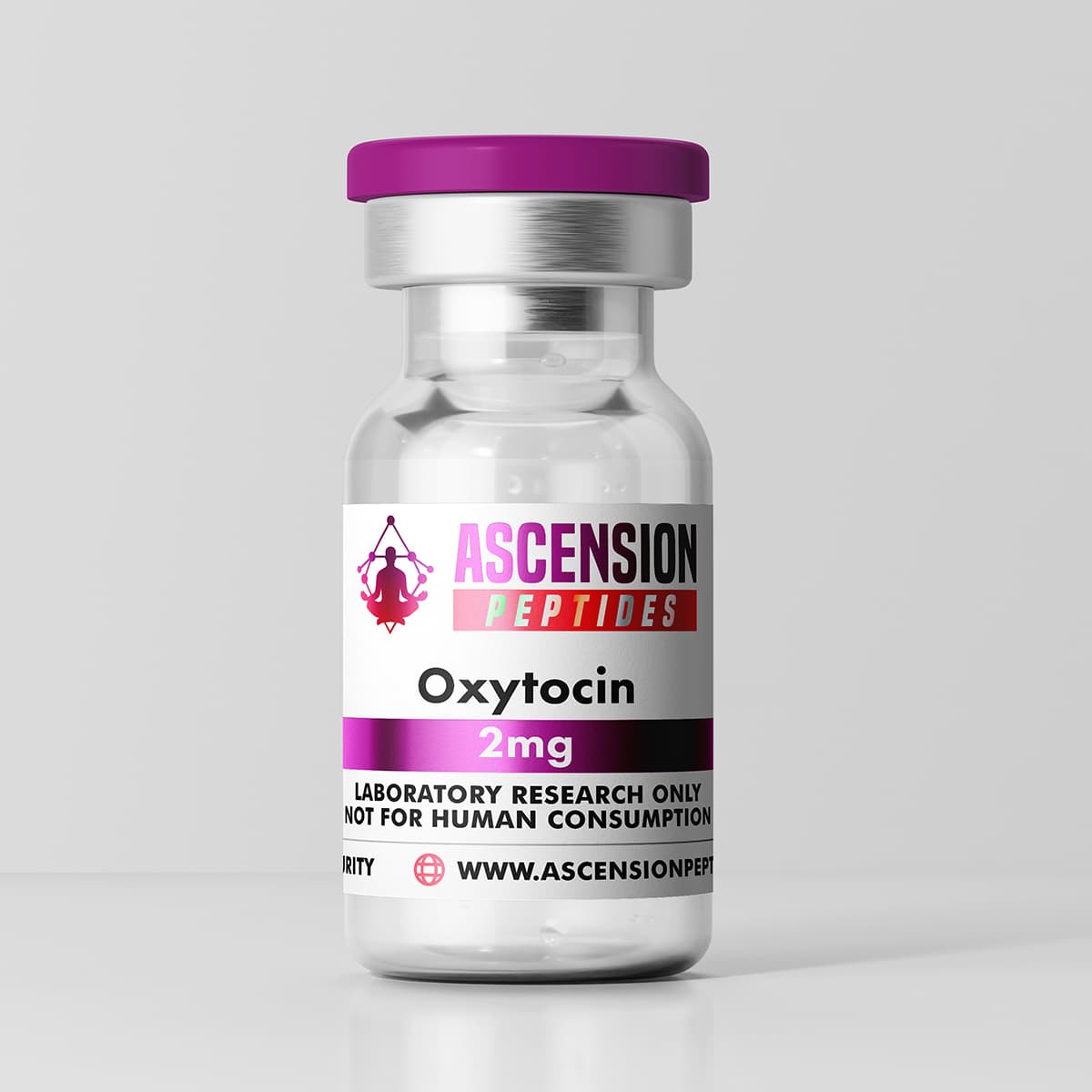
Oxytocin peptide is powerful, but context decides everything.
🔑 Key Takeaways
- Oxytocin peptide is not just a "love hormone." It can support bonding, trust, sexual response, and calm, but it can also amplify social sensitivity.
- Intranasal use dominates the human data. Nasal delivery is the route most often discussed for mood, social connection, and sexual-function goals.
- Dose ranges are route-specific. A 24 IU nasal amount is not the same thing as 24 units on an insulin syringe.
- More is not automatically better. Higher or frequent use can bring headaches, nausea, nasal irritation, mood shifts, or water-retention concerns.
- Pregnancy changes the risk profile. Oxytocin can stimulate uterine contractions and should not be treated like a casual wellness peptide.
Most people search for oxytocin after hearing one of three claims: it can improve bonding, reduce anxiety, or make intimacy feel more connected. Those claims are not imaginary, but they are often oversold. Oxytocin works less like a mood booster and more like a social signal amplifier. If the setting is safe, connected, and relaxed, that can feel useful. If the setting is tense or emotionally loaded, the same signal can feel different.
This guide focuses on practical questions: what oxytocin does, how people compare nasal spray and injections, what dosage ranges appear in human studies and wellness clinics, what side effects matter, and how it compares with peptides like PT-141, kisspeptin, Selank, and Semax.
What Is Oxytocin Peptide?
Start with the simple version.
Oxytocin is a nine-amino-acid peptide hormone and neuropeptide made mainly in the hypothalamus and released through the posterior pituitary. In the body, it is best known for uterine contractions during labor and milk letdown during breastfeeding. In the brain, it helps shape trust, social attention, emotional memory, stress response, bonding, and sexual response.
That split matters. Peripheral oxytocin affects tissues such as the uterus, breast, cardiovascular system, and kidneys. Central oxytocin affects brain regions involved in threat detection, attachment, reward, and social cues. When people talk about oxytocin peptide for bonding, libido, or anxiety, they usually mean central effects.
The phrase "love hormone" is useful but incomplete. Oxytocin can make positive connection feel warmer, but it does not create trust out of nowhere. It can also make social cues feel more important, which is why the same dose may feel calming for one person and emotionally intense for another.
How Oxytocin Works
It does two different jobs.
Oxytocin binds to the oxytocin receptor, usually abbreviated OXTR. These receptors are found in the uterus, mammary glands, heart, kidneys, spinal cord, amygdala, hypothalamus, hippocampus, and other areas involved in emotion and body regulation.
In the brain, oxytocin appears to influence how strongly social information lands. Studies have linked it with reduced amygdala activation to certain threat cues, greater trust in controlled games, altered eye-gaze patterns, and changes in emotional empathy. That does not mean it always makes people nicer or calmer. It means it changes the weight the brain gives to social signals.
For sexual function, oxytocin interacts with arousal, orgasm, nitric-oxide signaling, touch, pair bonding, and post-orgasm satiety. This is why oxytocin is often discussed alongside peptides for erectile dysfunction and libido, even though it works very differently from PT-141.
Oxytocin Peptide Benefits
The benefit depends on context.
Competitor pages often list oxytocin benefits as if they are guaranteed outcomes. That is too simple. The better way to think about oxytocin is by use case: bonding, sexual response, stress reactivity, social comfort, pain perception, and metabolic signaling.
Bonding and Trust
Connection is the headline benefit.
Oxytocin can make eye contact, touch, warmth, and emotional signals feel easier to notice. That is why it shows up in conversations about couples, attachment, and social comfort. It does not force trust, but it may make a safe connection feel more available.
Social Anxiety and Guardedness
Social tension has different causes.
When the issue is guardedness, oxytocin may help some people feel less defended. When the issue is panic, trauma, overstimulation, or a genuinely unsafe setting, the result can be less predictable. This is where oxytocin differs from steadier calming peptides like Selank.
Libido and Orgasm Quality
Desire is not one switch.
Oxytocin is tied more closely to connection, touch, orgasm, and post-orgasm closeness than raw drive. That makes it interesting for intimacy quality, but it is not a direct substitute for PT-141 when the main problem is low desire.
Stress and Threat Processing
Safety changes the response.
In a calm setting, oxytocin may support a more relaxed, connected state. In a tense setting, it can increase attention to social signals instead. That is why "reduces anxiety" is too broad unless the context is explained.
Pain and Body Awareness
Pain overlaps with stress.
Oxytocin pathways interact with pain modulation, touch, and nervous-system tone. This is a secondary benefit category, but it appears often enough in competitor pages that it deserves context rather than a one-line claim.
Appetite and Metabolic Signals
Metabolism is an early angle.
Human studies have explored food intake and metabolic effects after intranasal dosing. The signal is interesting, but oxytocin should not be framed as a practical weight-loss peptide next to GLP-1 medications or dedicated metabolic peptides.
Bonding and trust
Oxytocin can make closeness, eye contact, touch, and emotional connection feel more salient. This is the classic reason people associate it with attachment and relationship chemistry.
Social anxiety support
Some users pursue oxytocin when social situations feel guarded or tense. The goal is usually softer social threat perception, not sedation.
Sexual connection
Oxytocin rises naturally during arousal and orgasm. Supplemental use is usually timed before intimacy, with the aim of improving emotional connection and orgasm quality.
Stress downshift
In the right setting, oxytocin may help the nervous system move away from guardedness and toward safety, touch, rest, and connection.
Pain perception
Oxytocin pathways overlap with pain modulation and stress buffering. This is a secondary interest, not the main reason most people look for it.
Appetite and metabolism
Human studies have explored effects on food intake and metabolic signaling. This area is interesting, but it is not as practical as GLP-1 options covered in our list of peptides and uses.
Oxytocin Peptide Dosage
Dosing depends on the route.
The biggest mistake with oxytocin is mixing up IU, mcg, sprays, and insulin syringe units. Competitors ranking for this keyword spend a lot of space on dosage charts because searchers clearly want practical conversion help. The key point is simple: intranasal IU dosing and injectable mcg dosing are different systems.
IU vs Mcg vs Syringe Units
The labels confuse many people.
IU is an activity-based unit. Mcg is mass. Insulin-syringe units are volume marks. A "10 unit" draw on a U-100 syringe means 0.10 mL, not 10 IU of oxytocin. The actual peptide amount depends on how much oxytocin is in the vial and how much liquid was added.
Intranasal Dose Pattern
Nasal dosing is usually acute.
The most common amount seen in human social-cognition studies is 24 IU intranasally. Lower amounts such as 10 to 12 IU are often discussed as a cautious starting range, while 40 IU is a higher range that may bring more side effects.
Injectable Dose Pattern
Injection requires cleaner math.
Injectable discussions often mention 100 to 300 mcg subcutaneously before a target window. That range only means anything after reconstitution is known. A vial, a water volume, and a syringe mark must all match.
Frequency and Cycling
Repeated use changes the question.
Occasional use before a specific event is different from daily dosing. Repeated protocols should define the goal, dose, frequency, and stop point before starting. Without that, it becomes easy to chase effects and lose track of side effects.
Important distinction
IU means international units. Mcg means micrograms by mass. "Units" on a U-100 insulin syringe are volume marks, not oxytocin IU. If a peptide is reconstituted for injection, use a proper reconstitution calculator and verify the concentration before measuring.
| Use case | Commonly discussed amount | Route | Timing | Notes |
|---|---|---|---|---|
| Introductory nasal use | 10-12 IU | Intranasal | 30-60 minutes before target window | Often used when sensitivity is unknown |
| Standard nasal study pattern | 24 IU | Intranasal | 30-60 minutes before task or event | Most common amount seen across human social-cognition studies |
| Higher nasal range | 40 IU | Intranasal | 30-60 minutes before target window | More side effects are possible; not a better default |
| Injectable wellness discussions | 100-300 mcg | Subcutaneous | 30-60 minutes before target window | Requires concentration math; do not confuse mcg with IU |
| Hospital obstetric use | Titrated by medical protocol | IV infusion | Continuous monitoring | Different category entirely; not comparable to wellness use |
For people comparing peptides, oxytocin is usually not a daily baseline compound. It is more often used acutely around a specific social, emotional, or intimacy window. That is different from daily nootropic-style peptides or longer-cycle recovery compounds.
Intranasal vs Injectable Oxytocin
Route changes the whole experience.
Intranasal oxytocin is the route most people associate with bonding, social comfort, and sexual connection. The idea is that nasal delivery may reach brain-adjacent pathways through the olfactory and trigeminal systems. It is also easier to time because effects are usually discussed in the 30- to 60-minute window.
Injectable oxytocin is different. Subcutaneous or intramuscular use produces more peripheral exposure and requires careful concentration math. It may still create central effects in some users, but it should not be treated as simply "stronger nasal spray."
Nasal Spray
Nasal spray is simplest operationally.
The tradeoff is variability. Spray volume, nostril technique, congestion, and formulation can all change absorption. For that reason, dose-per-spray clarity matters more than the label on the bottle.
Subcutaneous Injection
Subcutaneous use is more technical.
The advantage is a measured liquid volume. The disadvantage is sterile handling, reconstitution accuracy, and a different exposure pattern. It is not the best first route for someone who only wants to understand how oxytocin feels.
Sublingual Troches
Troches are pharmacy-dependent.
Some clinics use sublingual or buccal compounded forms. These are convenient, but they are harder to compare with the intranasal human literature because absorption and dose timing are less standardized.
| Route | Best fit | Pros | Tradeoffs |
|---|---|---|---|
| Intranasal | Bonding, social comfort, intimacy timing | Simple timing, no injection, common in human studies | Nasal irritation, variable absorption, dose-per-spray confusion |
| Subcutaneous | Clinician-directed use when exact volume is known | Measured volume, avoids nasal absorption issues | Requires sterile handling and concentration math |
| Sublingual or troche | Compounded-medication settings | Convenient for some users | Less standardized and harder to compare with nasal studies |
| IV infusion | Labor and postpartum medical care | Precise medical titration | Hospital monitoring; not a wellness route |
Timing, Cycling, and What to Expect
Timing matters more than hype.
Most oxytocin discussions center on acute use. People usually ask about taking it before intimacy, couples time, therapy-style emotional work, or a social situation where guardedness is the problem. The common timing window is 30 to 60 minutes before the target event.
Effects are not always dramatic. Some people describe warmth, easier affection, more eye contact, or stronger emotional tone. Others notice little. A smaller group may feel more sensitive, more tearful, or more aware of social tension. That range is exactly why context matters.
Daily use is a different question. Frequent exposure may reduce the noticeable effect for some people and can make side effects more likely. If a protocol uses repeated dosing, it should have a clear reason, a defined stop point, and medical oversight.
For Intimacy
The setting does real work.
Oxytocin is usually timed before the desired window, not taken randomly in the morning. Sleep, stress, privacy, relationship safety, and expectations often determine whether it feels useful.
For Social Situations
Lower pressure is easier.
A calm dinner with someone trusted is different from a high-stakes confrontation. If oxytocin makes social signals louder, the best setting is one where louder signals are welcome.
For Daily Mood
Daily mood is less clear.
Oxytocin is not usually the first peptide to compare for all-day calm. Selank, Semax, sleep work, therapy, and medication review may be more relevant depending on the actual issue.
Oxytocin Side Effects
Most issues are dose and context related.
Short-term intranasal use is often well tolerated, but "well tolerated" does not mean side-effect free. The most common issues are mild and temporary. The serious risks are usually tied to pregnancy, high exposure, IV use, fluid balance, or using oxytocin when the emotional setting is wrong.
Common Side Effects
Minor effects are still useful signals.
- Headache: one of the most common complaints with nasal use.
- Nasal irritation: burning, congestion, dryness, or sneezing can happen with sprays.
- Nausea or stomach discomfort: more likely with higher exposure or sensitivity.
- Drowsiness or fatigue: some users feel relaxed rather than socially energized.
- Mood changes: warmth, emotional openness, irritability, or anxiety can all occur depending on setting.
- Water retention concerns: oxytocin has vasopressin-like activity at higher exposures, which is why high-dose or prolonged use deserves caution.
- Uterine contractions: this is a core medical effect and a major reason pregnancy requires strict medical supervision.
Higher-Risk Situations
Some situations raise the stakes.
Pregnancy, high-dose exposure, repeated use, IV medical use, fluid-balance issues, and complex psychiatric histories all deserve extra caution. Oxytocin is short, but it is still a hormone with real downstream effects.
Emotional Side Effects
Feelings can become sharper.
This is the side effect many guides underplay. A person may feel warmer and more connected, or more sensitive and emotionally exposed. That does not mean the peptide failed. It means the setting and baseline emotional state mattered.
The overlooked risk
Oxytocin can amplify emotional salience. If a relationship, room, or situation already feels unsafe, it may not create calm. It may make the emotional signal louder.
Who Should Be Extra Careful?
Some people need extra caution.
Oxytocin is not a casual choice during pregnancy or when pregnancy is possible. It can affect uterine contractions and belongs under clinician supervision in that context. Anyone with a history of hyponatremia, fluid-balance problems, significant cardiovascular disease, severe mood instability, or complex psychiatric medication use should be careful as well.
It also deserves caution around alcohol, sedatives, or emotionally intense environments. If the goal is intimacy, the setting matters. Sleep, stress, relationship safety, and expectations can change the outcome as much as the peptide itself.
Pregnancy and Postpartum Context
This is medical territory.
Oxytocin has established clinical uses around labor and postpartum care, but that does not make casual use appropriate. The same biological effect that makes it medically useful can also make it risky outside supervision.
Medication and Mood History
Medication history matters here.
People using psychiatric medications, sedatives, blood-pressure drugs, or hormone therapies should not treat oxytocin as isolated from the rest of their regimen. Mood sensitivity and body-fluid balance are part of the safety picture.
Oxytocin vs PT-141, Kisspeptin, Selank, and Semax
Oxytocin is not a libido stimulant.
That distinction matters because many searchers arrive from sexual-health content. Oxytocin may help connection, orgasm quality, and emotional closeness. PT-141 is more directly tied to sexual desire pathways. Kisspeptin is more upstream in reproductive-hormone signaling. Selank is calmer and more anxiety-focused. Semax is more cognitive and task-focused.
Oxytocin vs PT-141
These solve different problems.
PT-141 is the better comparison for desire and arousal. Oxytocin is the better comparison for connection, closeness, and emotional tone. Some readers compare both because intimacy has both biological and relational layers.
Oxytocin vs Selank
Selank feels more utilitarian.
Selank is usually discussed for calm, focus under stress, and anxiety support without the same intimacy framing. If the target is social ease without emotional amplification, Selank may be the cleaner starting comparison.
Oxytocin vs Semax
Semax is more cognitive.
Semax fits focus, learning, and mental energy. Oxytocin fits social bonding and emotional salience. They may both be nasal peptides, but the user experience is very different.
| Peptide | Primary angle | Best fit | Not ideal for |
|---|---|---|---|
| Oxytocin | Bonding, social salience, intimacy tone | Connection, emotional openness, orgasm quality | Pure desire, gym performance, direct fat loss |
| PT-141 | Sexual desire signaling | Low desire or arousal interest | People prone to nausea or blood-pressure concerns |
| Kisspeptin | Reproductive-hormone signaling | Fertility, testosterone-axis questions, libido context | Immediate intimacy timing |
| Selank | Calm and stress resilience | Social tension, anxious rumination, focus under pressure | Bonding-specific or orgasm-focused goals |
| Semax | Focus and cognitive drive | Mental energy, learning, task execution | Relaxation, intimacy, emotional openness |
Common Mistakes With Oxytocin
Small mistakes change the risk profile.
The first mistake is expecting oxytocin to fix the wrong problem. If libido is low because of hormones, medication side effects, relationship conflict, sleep debt, depression, or performance anxiety, oxytocin may not be the main tool. It can change the emotional tone, but it does not solve every cause of low desire.
The second mistake is chasing a stronger dose. With oxytocin, more can mean more side effects or more emotional intensity. A lower nasal amount may feel cleaner than a higher one, especially for first-time users.
The third mistake is mixing measurement systems. If you are looking at an injectable vial, do not guess based on forum language. Use the PeptideDeck calculator, confirm the vial amount, confirm the bacteriostatic water volume, and then measure from the final concentration.
Storage and Handling
Peptides are sensitive after mixing.
Lyophilized oxytocin is usually stored cold, dry, and protected from light. After reconstitution, many users refrigerate it and avoid repeated temperature swings. Nasal sprays and compounded products should follow their pharmacy label. If the solution changes color, grows cloudy, or has been handled with poor hygiene, do not treat it as usable.
For sterile handling, the same rules apply as other injectable peptides: clean surfaces, new needles, alcohol swabs, and no sharing supplies. If you are new to this, read the basics in our peptides for beginners guide before measuring anything.
Where Oxytocin Fits Best
It works best with a reason.
Oxytocin makes the most sense when the target is emotional connection, social warmth, intimacy quality, or reducing guardedness in a safe setting. It makes less sense when the target is direct fat loss, muscle growth, all-day anxiety control, or stimulant-like motivation.
For skin, repair, and tissue-quality goals, GHK-Cu or related blends are a better category. For direct sexual desire, PT-141 is usually the more relevant comparison. For calm without intimacy framing, Selank is a cleaner match.
What to Ask Before Using Oxytocin
Better questions prevent bad outcomes.
- What problem am I actually trying to solve? Bonding, anxiety, libido, orgasm quality, and social confidence are different goals.
- Which route am I considering? Nasal spray, subcutaneous injection, troche, and IV medical use should not be grouped together.
- What dose system is being used? IU, mcg, sprays, and syringe units are not interchangeable.
- Is pregnancy possible? If yes, oxytocin belongs in a medical conversation only.
- What is the emotional setting? A tense setting can change how oxytocin feels.
- What is my stop point? Acute timing is different from repeated dosing.
Frequently Asked Questions
References
Here are the source notes.
- Kosfeld M, Heinrichs M, Zak PJ, Fischbacher U, Fehr E. Oxytocin increases trust in humans. Nature. 2005. PubMed
- Kirsch P, Esslinger C, Chen Q, et al. Oxytocin modulates neural circuitry for social cognition and fear in humans. Journal of Neuroscience. 2005. PubMed
- Leng G, Ludwig M. Intranasal Oxytocin: Myths and Delusions. Biological Psychiatry. 2016. PubMed
- Quintana DS, Westlye LT, Hope S, et al. Dose-dependent social-cognitive effects of intranasal oxytocin delivered with novel nasal devices in adults with autism spectrum disorder. Translational Psychiatry. 2017. Nature
- Sikich L, Kolevzon A, King BH, et al. Intranasal Oxytocin in Children and Adolescents with Autism Spectrum Disorder. New England Journal of Medicine. 2021. NEJM
- Lawson EA, Marengi DA, DeSanti RL, et al. Oxytocin reduces caloric intake in men. Obesity. 2015. PubMed
The information in this article is for educational purposes only and does not constitute medical advice. Always consult a healthcare professional before starting any new supplement or compound. Results vary by individual.