Matrixyl is collagen signaling in a bottle.
It's a family of synthetic signal peptides, the original Matrixyl (Pal-KTTKS), Matrixyl 3000, Matrixyl Synthe'6, and the newer Matrixyl Morphomics, that mimic the natural collagen-fragment signals your skin uses to tell fibroblasts to lay down new collagen. They're the gentler, no-irritation alternative to retinol, and they're in nearly every modern anti-aging serum on the shelf, from The Ordinary's $10 formulation to the $200 prestige creams. Below is what each variant actually does, how the dosing in a serum translates to results, how Matrixyl honestly compares to retinol, and which serums are worth buying.
🔑 Key Takeaways
- "Matrixyl" is a family, not a single peptide. Original Matrixyl, Matrixyl 3000, Synthe'6, and Morphomics all sit under the same trade name but contain different peptide molecules.
- It works by mimicking collagen breakdown signals. Your skin reads these synthetic peptides as "rebuild here" instructions and increases collagen, elastin, and matrix protein production.
- It's the gentle option, not the strongest one. Honest take: retinol does more in the same timeframe, but Matrixyl gets you partway there without the irritation, peeling, or sun sensitivity.
- Pregnancy-safe and barrier-friendly. The main reason dermatologists recommend Matrixyl: it's one of the few "active" anti-aging ingredients you can use during pregnancy, breastfeeding, or barrier crises when retinol is off the table.
- Consistency matters more than concentration. A 3% Matrixyl serum used twice daily for 8 weeks outperforms a 10% serum used sporadically. Pick something you'll actually apply.
What Is Matrixyl?
Matrixyl is the trade name owned by Sederma, a French specialty ingredient manufacturer, for a series of palmitoylated signal peptides used in topical anti-aging skincare. The original Matrixyl was launched in 2000 as palmitoyl pentapeptide-3 (renamed palmitoyl pentapeptide-4 in 2006 after the INCI naming system updated), abbreviated as Pal-KTTKS. It was the first widely commercialized cosmetic peptide marketed for collagen stimulation, and it kicked off the modern peptide-skincare category.
Every Matrixyl variant since then is essentially a refinement: a new peptide combination, attached to a fatty palmitoyl tail to help it cross the skin barrier, designed to trigger more specific aspects of dermal remodeling. They all share the same basic mechanism (signal peptide tells fibroblasts to rebuild), but the variant you choose matters because they target slightly different parts of the skin matrix.
The Four Matrixyl Variants Explained
If you're new to Matrixyl, the original Pal-KTTKS or Matrixyl 3000 are the right starting points, they have the most published evidence and the most product options at every price tier. Synthe'6 and Morphomics are newer; the clinical data behind them is mostly manufacturer-sponsored.
How Matrixyl Works
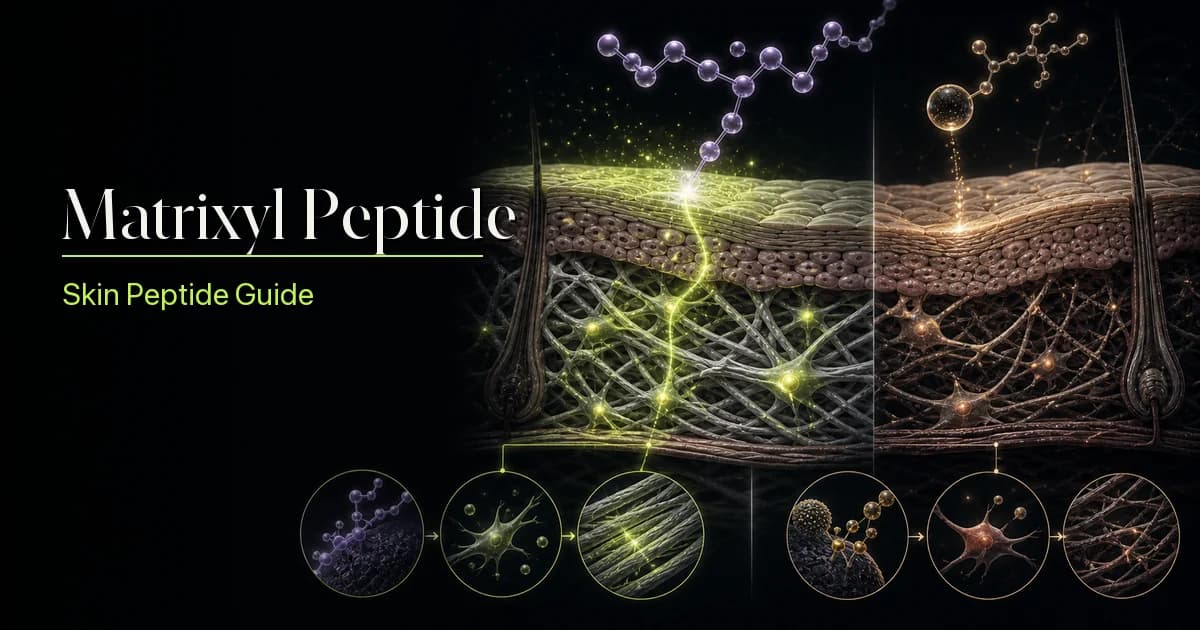
Skin remodels itself constantly. When old collagen breaks down, it releases small protein fragments that fibroblasts (the collagen-producing cells in your dermis) read as "damage detected, build more here" signals. Matrixyl peptides are synthetic versions of those exact fragments. They don't add collagen directly, they trick your skin into building its own.
- The palmitoyl tail penetrates the skin barrier. Naked peptides bounce off the stratum corneum; attaching a fatty acid (palmitic acid) chain makes them lipid-soluble enough to slip through.
- The peptide reaches the dermis and binds receptors on fibroblast cells.
- Fibroblasts upregulate collagen synthesis, specifically Type I (structural) and Type III (early-stage repair) collagen, plus elastin, hyaluronic acid, and other matrix proteins depending on the variant.
- The dermal matrix gradually rebuilds over weeks, reducing fine line depth and improving firmness from below the surface rather than just smoothing it on top.
Critically, Matrixyl does not bind nuclear retinoic acid receptors the way retinol does. It triggers a much narrower set of gene expression changes. That's both its weakness (smaller effect) and its strength (no irritation, no purging, no photosensitivity).
Matrixyl Benefits: What the Research Actually Shows
The clinical evidence for Matrixyl peptides is real but modest. The studies that matter:
- 18% reduction in wrinkle depth and 37% reduction in fold thickness after 28 days of twice-daily application of 0.005% palmitoyl pentapeptide-4 to the periocular area (2005 placebo-controlled study, International Journal of Cosmetic Science).
- ~45% reduction in deep wrinkle area and ~20% improvement in skin tonicity after 2 months of twice-daily Matrixyl 3000 application (Sederma manufacturer-sponsored study; the same one cited on most product pages for the past 20 years).
- Improvements comparable to argireline (acetyl hexapeptide-3) for crow's feet over 12 weeks, with Pal-KTTKS showing slightly better results on overall wrinkle severity (2023 double-blind randomized trial).
- 21% reduction in skin rigidity, suggesting improved suppleness in addition to wrinkle reduction (2005 trial above).
Real-world expectation: noticeable softening of fine lines, improved skin firmness, and better moisture retention after 6-8 weeks of consistent twice-daily use. Don't expect deep wrinkle erasure, don't expect Botox-level dynamic line reduction, don't expect overnight changes.
How to Use Matrixyl in Your Skincare Routine
Matrixyl is the easiest peptide to slot into a routine because it plays well with almost everything.
If retinol is irritating your skin, layer Matrixyl on top.
Matrixyl actually soothes retinoid irritation while adding its own collagen-stimulating effect underneath. Apply your retinol or retinal first, wait 5-10 minutes, then layer a Matrixyl serum on top. This is one of the few peptide-retinoid combinations that improves both ingredients' performance instead of canceling them out.
Matrixyl vs Retinol: The Honest Comparison
This is the comparison the skincare industry tends to muddy. Brands selling Matrixyl call it a "gentle alternative to retinol." Brands selling both keep the language vague. The clinical literature is much clearer than the marketing.
Plain-English version: retinol does more, faster, with more side effects. Matrixyl does less, more gently, with no side effects. The right choice depends on whether you want a stronger result with a learning curve (retinol) or a steady, no-drama improvement you'll actually stick with (Matrixyl). Many dermatologists recommend running both, retinol at night, Matrixyl in the morning, for the cumulative effect.
When Matrixyl Is the Right Choice
Matrixyl earns its spot specifically in these scenarios:
- Sensitive or reactive skin that can't tolerate retinoids without burning, peeling, or eczema flares
- Pregnancy and breastfeeding, when retinoids are off the table entirely
- Maintenance during retinoid breaks, after a chemical peel, during summer when sun exposure is unavoidable, during barrier recovery
- Early intervention for people in their 20s and early 30s who want collagen support before deeper aging starts
- Post-procedure recovery, after microneedling, laser, or other treatments where retinoid use is paused
- Layered with retinol for people who want both the retinoid effect and additional collagen signaling
The Best Matrixyl Serums to Buy
The Matrixyl category has dozens of products. The ones consistently recommended by dermatologists and validated by independent review:
If you're not sure where to start, The Ordinary's Matrixyl 10% + HA is the universally-recommended starting point: high enough concentration to actually work, low enough price to test for 8 weeks without commitment. For more peptide depth, our anti-wrinkle peptides guide compares Matrixyl head-to-head with SNAP-8, Argireline, and other top topical peptides.
Matrixyl Side Effects
One of Matrixyl's main selling points is how few side effects it has. Across the published trials and decades of consumer use:
- No irritation for the vast majority of users at typical 3-10% concentrations
- No photosensitivity, safe for AM use without driving extra sun reactivity
- No purging phase, unlike retinoids or strong AHAs
- Rare allergic contact dermatitis, possible with any cosmetic ingredient but very uncommon for Matrixyl specifically. Patch test on the inner forearm for 24 hours before face use if you have a sensitivity history.
- Mild stinging at very high concentrations (10%+), usually transient and tied to the serum's base formulation rather than the peptide itself.
Matrixyl is well-tolerated enough that it's frequently recommended as the first peptide to try for people new to active skincare ingredients.
Matrixyl vs Other Cosmetic Peptides
Matrixyl isn't the only signal peptide on the shelf. The most common alternatives:
For the deeper comparison and ranking, see our best peptides for skin tightening roundup.
Who Should Skip Matrixyl
Honestly, almost nobody. Matrixyl is one of the safest active ingredients on the market. The only real cautions:
- Anyone with a known allergy to palmitic acid derivatives or specific peptide ingredients (rare)
- Anyone using broken or compromised skin barrier products, fix the barrier first, then add actives
- Anyone expecting dramatic Botox-level dynamic line reduction (wrong tool, use Argireline or actual cosmetic procedures for that)
- Anyone expecting retinol-strength results, Matrixyl is the gentler complement, not the equal
Frequently Asked Questions
Medical disclaimer: This article is for educational and informational purposes only and is not medical advice. Matrixyl peptides are widely used cosmetic ingredients with a strong safety profile, but individual skin reactions vary. If you're pregnant, breastfeeding, recovering from a procedure, or have a history of skin allergies, talk to a dermatologist before adding any new active to your routine. Patch test new products on the inner forearm for 24 hours before full-face application.