Hair follicles are among the most metabolically active structures in your body. When they miniaturize or stop cycling, the fix is never one thing. Peptides are the layer most hair-loss protocols skip, and the best ones now have better evidence behind them than the cosmetic actives you see on every bottle of hair serum.
🔑 Key Takeaways
- GHK-Cu (copper tripeptide-1) is the most evidence-backed hair growth peptide. A 2023 head-to-head study reported GHK-Cu triggered follicle growth at day 6 versus day 9 for 5% minoxidil
- Thymosin beta-4 (and its TB-500 analog) activates hair follicle stem cells and promotes follicle development, supported by peer-reviewed research in animal models
- CJC-1295 + Ipamorelin raises IGF-1, which extends the anagen (active growth) phase of the hair cycle. This is the indirect but durable mechanism behind GH-secretagogue-based hair protocols
- BPC-157 supports scalp angiogenesis and blood flow to follicles. Useful as an adjunct rather than a primary hair treatment
- PTD-DBM activates the Wnt/β-catenin pathway, a core regulator of hair follicle cycling. Topical formulations are emerging with promising early data
- Cosmetic peptides (Biotinoyl Tripeptide-1, Acetyl Tetrapeptide-3, Capixyl, Procapil) work topically through follicle stimulation and DHT modulation, and are the active ingredients in most off-the-shelf peptide hair serums
- Best topical-plus-injectable stack: GHK-Cu topical serum daily, plus CJC-1295 + Ipamorelin subcutaneous at night, plus weekly scalp microneedling. Expect 3 to 6 months before visible change
- Peptides work best alongside minoxidil or finasteride, not as replacements. The mechanisms complement rather than overlap
This page covers the 7 best peptides for hair growth in 2026: how each one works, what the trial data actually shows, topical vs injectable delivery, dosing, side effects, how they compare to minoxidil and finasteride, and the stacking protocols that combine them for maximum regrowth.
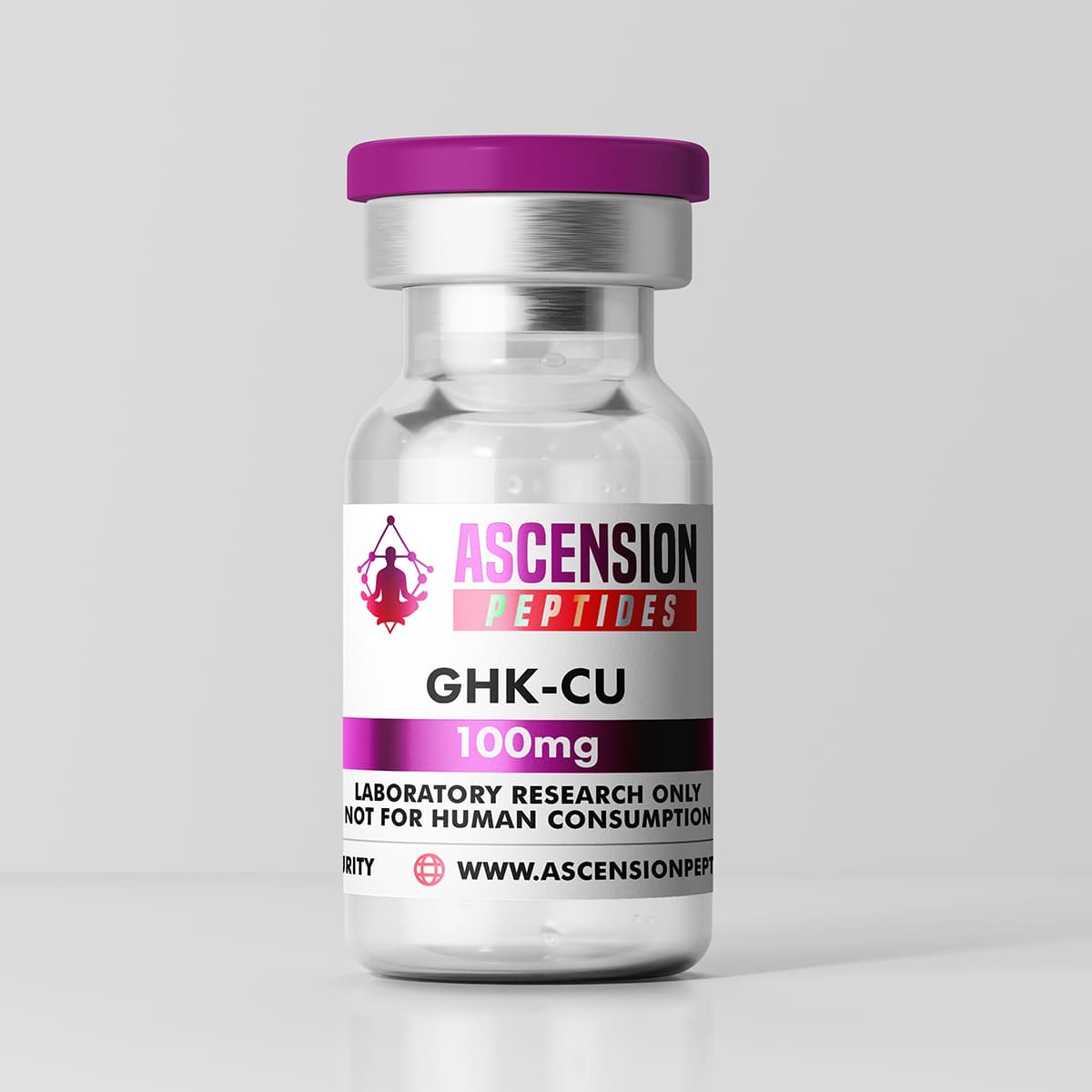
Of everything covered below, GHK-Cu has the most follicle-level evidence behind it — Ascension's 100mg vial is the lab-grade version, distinct from the cosmetic serums.
Do Peptides Actually Work for Hair Growth?
Yes, with the strongest evidence for GHK-Cu and a growing research base for thymosin beta-4, GH secretagogues, and cosmetic biomimetic peptides.
The clearest clinical-level comparison comes from GHK-Cu. A 2023 comparative study reported that topical GHK-Cu initiated follicle growth at day 6 versus day 9 for 5% minoxidil, and produced comparable increases in hair density over a 12-week window. Earlier research going back to 2007 had already documented GHK-Cu's effect on follicle size and anagen-phase extension, which are the two mechanisms that matter most for converting miniaturized follicles back into productive ones.
Beyond GHK-Cu, thymosin beta-4 (the molecule behind TB-500) has been shown to activate hair follicle stem cells and accelerate follicle morphogenesis in animal studies. CJC-1295 + Ipamorelin raises IGF-1, which extends the anagen growth phase. BPC-157 supports scalp angiogenesis and blood flow. PTD-DBM activates the Wnt/β-catenin pathway, a core regulator of hair follicle cycling.
Peptides are not a cure for androgenetic alopecia on their own. They work best as part of a multi-mechanism stack alongside minoxidil, finasteride (or natural DHT modulators), microneedling, and nutritional optimization (ferritin, vitamin D, protein). Used alone, effects are real but modest. Used in a stack, they add meaningful acceleration to an established hair-loss protocol.
The 7 Best Peptides for Hair Growth: Quick Comparison
How Peptides Stimulate Hair Growth
Hair follicles cycle through anagen (active growth, 2 to 7 years), catagen (transition, 2 to 3 weeks), and telogen (resting and shedding, 2 to 3 months). Hair loss is usually one of three things: premature exit from anagen, follicle miniaturization (follicles getting smaller and producing thinner hair), or follicle dormancy (follicles staying in telogen instead of re-entering anagen).
Peptides can hit any of these failure points, depending on which peptide you are using:
- Anagen extension: GHK-Cu and CJC-1295 / Ipamorelin both lengthen the anagen phase, which means hairs stay in active growth longer before shedding
- Follicle enlargement: GHK-Cu directly reverses follicle miniaturization, the core mechanism of pattern hair loss
- Stem cell activation: Thymosin beta-4 activates dormant follicle stem cells, pulling inactive follicles back into the growth cycle
- Angiogenesis: BPC-157 and GHK-Cu both upregulate VEGF, which improves blood supply to follicles. Poor scalp circulation is a common limiting factor in pattern hair loss
- Inflammation reduction: KPV and GHK-Cu both reduce scalp inflammation, which is a frequently overlooked driver of accelerated hair loss
- DHT modulation (cosmetic peptides): Biotinoyl Tripeptide-1 (Procapil) and Acetyl Tetrapeptide-3 (Capixyl) interfere with DHT signaling at the follicle level, similar in direction to finasteride but much weaker
- Wnt/β-catenin activation: PTD-DBM promotes follicle cycling via the Wnt pathway, which is one of the most important regulators of follicle development
#1: GHK-Cu, The Strongest Hair Growth Peptide
GHK-Cu (glycyl-L-histidyl-L-lysine copper, also called copper tripeptide-1) is the most evidence-backed peptide for hair growth. It is the active molecule in most "copper peptide" hair serums and has the deepest research base of any compound on this page.
How GHK-Cu Works for Hair
- Follicle enlargement: GHK-Cu directly enlarges miniaturized follicles, reversing the primary mechanism of pattern hair loss
- Anagen phase extension: Keeps follicles in the growth phase longer before shedding
- Stem cell activation: Promotes dermal papilla cell proliferation, the cells that regulate follicle cycling
- VEGF-mediated angiogenesis: Improves scalp blood supply
- Anti-inflammatory: Reduces scalp inflammation that accelerates loss
- Collagen and matrix support: Strengthens the connective tissue framework that supports hair follicles
Clinical Evidence
A 2023 comparative study reported GHK-Cu initiated follicle growth at day 6 versus day 9 for 5% minoxidil, with comparable density improvements at 12 weeks. Earlier research (2007 onward) documented follicle enlargement and anagen-phase extension in both animal and human studies. A 2010 genomic analysis found GHK-Cu modulates approximately 4,048 human genes, including follicle-stem-cell pathways, DNA repair genes, and hair-cycle regulators.
Practical Protocol
GHK-Cu Topical Protocol
- Concentration: 0.5% to 1% serum
- Application: Daily on dry scalp, focus on thinning areas
- With microneedling: Apply immediately after weekly 0.5 mm to 1.0 mm scalp microneedling
- Combine with minoxidil: Apply 4 hours apart (GHK-Cu AM, minoxidil PM)
- Timeline: Visible reduction in shedding at 4 to 8 weeks, new growth at 12 to 16 weeks
GHK-Cu Subcutaneous Protocol
- Dose: 1 to 3 mg subcutaneously, 2 to 4 times weekly
- Timing: Evening or morning, rotate injection sites
- Cycle: 8 to 12 weeks on, 4 weeks off
- Best paired with: topical GHK-Cu for direct scalp exposure
For the complete GHK-Cu deep dive, see our GHK-Cu copper peptide page.
#2: Thymosin Beta-4 (TB-500), Stem Cell Activation
Thymosin beta-4 is the naturally occurring molecule; TB-500 is its synthetic analog with better stability and half-life. Both activate hair follicle stem cells and promote follicle development, with research going back nearly two decades.
How TB-500 Works for Hair
Thymosin beta-4 binds and sequesters G-actin monomers, which regulates cell migration and morphogenesis. In hair follicle context, it promotes the migration of follicle stem cells from the bulge region into the hair matrix, where they initiate new follicle growth. Animal studies have shown thymosin beta-4 accelerates hair follicle morphogenesis, improves hair quality, and supports wound-induced hair regeneration.
Beyond the stem cell effect, TB-500 supports general tissue repair and angiogenesis, which improves overall scalp health and blood supply to existing follicles.
Clinical Evidence
Human hair trials of thymosin beta-4 are more limited than GHK-Cu, but the mechanism is well-characterized and animal data is strong. Community use in the last 5 years has produced consistent anecdotal reports of reduced shedding and modest regrowth, particularly when paired with microneedling.
Protocol
- Subcutaneous: 2 to 5 mg weekly, divided into 2 doses. Cycle 4 to 8 weeks on, 2 to 4 weeks off
- Topical: Some compounding pharmacies produce TB-500 scalp solutions. Less evidence-based than GHK-Cu for topical use, but low risk
- Best stacked with: GHK-Cu, microneedling
For more, see our TB-500 peptide guide.
#3: CJC-1295 + Ipamorelin, IGF-1 for Follicle Cycling
The growth hormone secretagogue stack works indirectly through IGF-1. Higher IGF-1 levels extend the anagen phase, which keeps more follicles in active growth longer. This is the same mechanism that makes IGF-1 a theoretically useful hair compound in its own right, but CJC-1295 + Ipamorelin are easier to source and safer than direct IGF-1 administration.
How the Stack Works for Hair
CJC-1295 is a GHRH analog that triggers sustained pituitary GH release. Ipamorelin is a selective ghrelin receptor agonist that adds a pulsatile GH release on top. The combined effect produces physiological GH elevation that translates to IGF-1 increase in the liver. IGF-1 receptors are present in hair follicles, and their activation extends anagen.
Who This Is For
Best suited for men and women experiencing age-related hair thinning (rather than acute pattern hair loss). Also useful as a background protocol when the primary goal is broader anti-aging and hair is a secondary target. For isolated hair loss in younger patients, GHK-Cu or TB-500 are more directly targeted.
Protocol
- Dose: CJC-1295 (no DAC) 100 mcg + Ipamorelin 100 mcg, subcutaneously
- Frequency: Daily, before bed (2 to 3 hours after last meal)
- Cycle: 12 weeks on, 4 weeks off
- Expected hair timeline: 12 to 24 weeks for visible density change
For dosing details, see our CJC-1295 dosage guide and the Ipamorelin guide.
#4: BPC-157, Scalp Angiogenesis and Blood Flow
BPC-157 is not a hair-specific peptide, but its angiogenic mechanism makes it a useful adjunct. Poor scalp circulation contributes to follicle miniaturization and slowed cycling. BPC-157 upregulates VEGF and supports new blood vessel formation, which improves the oxygen and nutrient supply to follicles.
Position in a Hair Protocol
BPC-157 is best treated as a supporting peptide rather than a primary hair treatment. It shines when paired with GHK-Cu or the CJC/Ipamorelin stack, particularly in patients where cardiovascular or circulatory factors contribute to hair loss. Animal data shows reliable angiogenesis, while direct human hair trials are limited.
Protocol
- Subcutaneous: 250 to 500 mcg daily or 5 days on / 2 off
- Topical BPC-157 scalp solutions: Emerging, limited evidence
- Cycle: 4 to 8 weeks on, 2 to 4 weeks off
See our BPC-157 page for the full mechanism and dosing walkthrough.
#5: PTD-DBM, The Wnt/β-catenin Activator
PTD-DBM is a newer research peptide that activates the Wnt/β-catenin signaling pathway, one of the most important regulators of hair follicle cycling and development. Wnt signaling is the master switch for anagen initiation, and enhancing it can push dormant follicles back into the growth phase.
Early research, mostly in topical formulations, has shown PTD-DBM promotes follicle regrowth in animal models and reduces miniaturization markers. Human data is limited but growing. Some custom-compounded topical hair serums include PTD-DBM alongside GHK-Cu and other actives.
PTD-DBM is a reasonable option for users already running GHK-Cu and minoxidil who want to add a third mechanism. It is not a first-line standalone treatment because the human evidence is still thinner than GHK-Cu.
#6: Cosmetic Biomimetic Peptides (Procapil, Capixyl, Biotinoyl Tripeptide-1)
These are the peptides you see listed on commercial hair growth serums. They are not research peptides, and they are not injectable. They are topical cosmetic actives with specific trial data supporting their use in hair serums.
Biotinoyl Tripeptide-1 (Procapil)
A biotinylated tripeptide often formulated into "Procapil" (alongside oleanolic acid and apigenin). Works through improved follicle microcirculation and mild DHT modulation. Cosmetic trial data supports improvements in hair density and reduction in shedding over 3 to 6 months of daily use.
Acetyl Tetrapeptide-3 (Capixyl)
Formulated as "Capixyl" with red clover extract. Targets 5-alpha-reductase enzyme activity (similar direction as finasteride, much weaker) and promotes extracellular matrix synthesis in the follicle. Clinical trials in hair serums have shown density improvements.
Myristoyl Pentapeptide-17 and Oligopeptide-2
Myristoyl Pentapeptide-17 targets keratin production in hair fiber. Oligopeptide-2 supports follicle cell signaling. Both appear in "growth factor" serums and work-supplements but with thinner individual trial data.
Where These Shine
Cosmetic peptide serums are the low-risk, non-invasive entry point for anyone who does not want injections, prescriptions, or pharmaceutical-strength interventions. They work best for early-stage thinning, as part of a broader routine (with minoxidil, gentle shampoo, and nutritional optimization). For established androgenetic alopecia, they are supporting actors at best.
#7: KPV, Anti-Inflammatory Support
KPV is a tripeptide fragment of alpha-melanocyte-stimulating hormone (α-MSH) with strong anti-inflammatory effects. Scalp inflammation contributes to accelerated hair loss in many patients, particularly those with scalp psoriasis, dandruff (seborrheic dermatitis), or chronically inflamed scalps from harsh products or sun damage.
KPV topical protocols reduce scalp inflammation and can improve hair quality when inflammation was a contributing factor. It is not a direct hair-growth driver, but clearing out inflammation often reveals hair growth that was being suppressed by the inflammation itself.
Typical use: topical 0.1% to 0.5% KPV scalp serum daily, or subcutaneous 250 to 500 mcg for systemic anti-inflammatory effect.
Topical vs Injectable Peptides for Hair Growth
The two routes serve different mechanisms.
The honest take: the strongest hair-peptide protocols combine both. Daily topical GHK-Cu directly on the scalp plus nightly subcutaneous CJC-1295 + Ipamorelin covers direct follicle stimulation and systemic IGF-1 elevation simultaneously. Adding weekly microneedling enhances topical absorption dramatically.
Peptides vs Minoxidil vs Finasteride
Peptides are best combined with, not substituted for, conventional treatments. The mechanisms overlap only partially, so a protocol that includes minoxidil (vascular) plus finasteride or a cosmetic DHT modulator plus GHK-Cu plus microneedling gives you four distinct attack angles on hair loss. Compare that to running a single agent, and the regrowth trajectory is meaningfully different.
Hair Growth Timeline: What to Expect Week by Week
Weeks 1 to 4 (Initiation)
- Starting dose or daily topical application established
- Initial shed possible (normal, follicles exit telogen before entering new anagen)
- Scalp may feel slightly more oily or itchy as circulation improves
- No visible change yet
Weeks 4 to 12 (Reduction in Shedding)
- Daily shed count drops noticeably by week 6 to 8
- Pillow and shower drain have less hair
- Fine vellus hairs start appearing at the hairline and crown (peach fuzz)
- Scalp feels thicker or denser to the touch
Weeks 12 to 24 (Visible Regrowth)
- New terminal hairs emerge in thinning areas
- Photos at week 16 vs week 0 show visible difference
- Existing hair thickens (individual follicle enlargement effect)
- Hair feels stronger and breaks less
Months 6 to 12 (Peak Density)
- Maximum improvement reached for most users around month 9 to 12
- Continued protocol maintains the gains
- Stopping the protocol will result in gradual reversion over 12 to 24 months
Hair growth is slow by biology. The hair cycle itself takes months, so even with optimal peptide activity, visible change requires patience. Users who quit at week 6 thinking nothing is working are quitting right before the benefits start to appear.
Best Peptide Stacks for Hair Growth
Stack 1: GHK-Cu + Minoxidil + Microneedling (Foundational Topical Stack)
The most evidence-backed combination for early-stage hair loss. GHK-Cu covers follicle enlargement and anagen extension. Minoxidil provides vasodilation and its own anagen extension. Microneedling improves topical absorption and triggers a separate wound-healing signal that activates follicle stem cells.
- GHK-Cu 1% serum, morning application on dry scalp
- 5% minoxidil, evening application (4+ hours after GHK-Cu)
- 0.5 mm to 1.0 mm scalp microneedling, weekly
- Apply GHK-Cu immediately after microneedling for enhanced absorption
Stack 2: CJC-1295/Ipamorelin + GHK-Cu Topical (Systemic + Topical)
For users wanting systemic hormonal support plus direct scalp stimulation. IGF-1 elevation from the GH stack extends anagen throughout the body, while topical GHK-Cu targets the scalp directly.
- CJC-1295 100 mcg + Ipamorelin 100 mcg, subcutaneously before bed, daily
- GHK-Cu 0.5% to 1% serum, daily morning
- Cycle CJC/Ipamorelin 12 weeks on, 4 weeks off
Stack 3: Full-Protocol (Injectable + Topical + Cosmetic)
Most aggressive protocol, best for established androgenetic alopecia with multiple contributing factors.
- GHK-Cu topical + minoxidil + microneedling (as Stack 1)
- CJC-1295 + Ipamorelin subcutaneous (as Stack 2)
- TB-500 2 to 5 mg weekly subcutaneous for stem cell activation
- Optional: finasteride 1 mg daily or natural DHT modulator
- Cosmetic peptide serum (Procapil or Capixyl-based) for maintenance
Side Effects
Hair peptides generally have the cleanest side effect profile of any peptide category. Most issues are scalp-level irritation from topical products, or mild injection-site reactions for subcutaneous peptides.
Who Should Use Peptides for Hair Growth
- Early-stage thinning: Noticeable increased shedding, widening part, or receding hairline. Peptides are most effective before follicles are fully dormant
- Non-responders to minoxidil or finasteride: Users who have not seen adequate response to conventional treatments
- Men with finasteride side effects: Peptides provide alternative DHT-modulation (Capixyl) or DHT-independent mechanisms without the sexual side effect profile of finasteride
- Women with female pattern hair loss: Peptides are a primary option because finasteride is generally not prescribed for women
- Postpartum hair loss: GHK-Cu and scalp microneedling speed recovery
- Telogen effluvium recovery: After stress, illness, or rapid weight loss (including Ozempic hair loss)
- Existing routine users: Adding peptides to an existing minoxidil or finasteride routine can accelerate and maintain results
Where to Buy Peptides for Hair Growth
Three tiers:
- Cosmetic peptide hair serums (Procapil, Capixyl formulations): Available over the counter. Check ingredients for Biotinoyl Tripeptide-1, Acetyl Tetrapeptide-3, Myristoyl Pentapeptide-17.
- Compounded GHK-Cu topical: Available through licensed compounding pharmacies. Typically 0.5% to 1% formulation.
- Injectable peptides: Available as lyophilized vials. Look for ≥98% purity verified by independent HPLC and mass spectrometry, third-party Certificate of Analysis per batch, US-based manufacturing with cold-chain handling, and clear batch numbers.
Avoid any source that cannot provide independent lab verification. For a full vendor vetting walkthrough, see our best legit peptide vendors guide.
Frequently Asked Questions
References
- Pickart, L., & Margolina, A. (2018). Regenerative and Protective Actions of the GHK-Cu Peptide in the Light of the New Gene Data. International Journal of Molecular Sciences, 19(7), 1987.
- Trüeb, R. M. (2018). Dermocosmetic Aspects of Hair and Scalp. Journal of Investigative Dermatology Symposium Proceedings.
- Pyo, H. K., et al. (2007). The effect of tripeptide-copper complex on human hair growth in vitro. Archives of Pharmacal Research, 30(7), 834-839.
- Philp, D., et al. (2004). Thymosin beta 4 promotes hair growth in C57/BL6 mice. FASEB Journal.
- Gao, X., et al. (2015). Thymosin beta-4 induces mouse hair growth. PLOS ONE.
- Weger, N., & Schlake, T. (2005). IGF-I signalling controls the hair growth cycle and the differentiation of hair shafts. Journal of Investigative Dermatology, 125(5), 873-882.
- Lee, B. H., et al. (2020). Inhibitors of Wnt/β-catenin signaling in hair regeneration. Development & Reproduction.
- Seikrit, C., et al. (2019). BPC-157: angiogenic and tissue-regenerative mechanisms. Frontiers in Pharmacology.
- Dhurat, R., et al. (2013). A Randomized Evaluator Blinded Study of Effect of Microneedling in Androgenetic Alopecia. International Journal of Trichology, 5(1), 6-11.
- Pickart, L., et al. (2015). GHK peptide as a natural modulator of multiple cellular pathways in skin regeneration. BioMed Research International.
- Olsen, E. A., et al. (2002). A randomized clinical trial of 5% topical minoxidil versus 2% topical minoxidil and placebo in the treatment of androgenetic alopecia in men. Journal of the American Academy of Dermatology, 47(3), 377-385.
- Mysore, V. (2012). Finasteride and sexual side effects. Indian Dermatology Online Journal, 3(1), 62-65.