🔑 Key Takeaways
- "Alpha peptides" isn't a single compound — it covers structural configurations, specific named molecules, and brand usage
- Key alpha-designated compounds include thymosin alpha-1 (immune modulation), alpha-MSH (melanocortin signaling), and alpha-helical AMPs
- Thymosin alpha-1 has the deepest clinical evidence — approved as Zadaxin in 35+ countries for hepatitis B and C
- Alpha-helical structure is critical for many GH secretagogues and antimicrobial peptides — storage conditions directly affect activity
- When "alpha" appears as a vendor brand name, it has no scientific meaning — evaluate on COA quality, not branding
The phrase "alpha peptides" appears constantly in research forums, vendor catalogs, and scientific literature — yet most people aren't entirely sure what it means. That confusion is understandable, because "alpha" in peptide science doesn't refer to a single compound. It can describe a structural configuration, a specific molecule within a peptide family, or simply a brand name that happens to include the word.
Getting clear on which definition of alpha peptides applies to your research goals is the difference between studying the right compound and ordering the wrong one entirely.
💡 The 3 Core Meanings of "Alpha Peptides"
- Structural alpha peptides: Peptides that adopt an alpha-helix secondary structure — important in drug design and receptor targeting
- Alpha-designated compounds: Specific molecules named with "alpha" to distinguish them within a family (thymosin alpha-1, alpha-MSH)
- Vendor/brand usage: "Alpha" used as a trade name — no inherent scientific meaning
What Does "Alpha" Mean in Peptide Terminology?
In biochemistry, the Greek letter alpha carries specific and distinct meanings depending on context.
Alpha-Helix Secondary Structure
Proteins and peptides fold into three-dimensional shapes. One of the most stable and common is the alpha-helix, a right-handed coiled structure stabilized by hydrogen bonds. First described by Linus Pauling in 1951, it remains one of the most studied structural motifs in biochemistry.
Many peptides deliberately engineered to be alpha-helical show dramatically improved receptor binding, membrane penetration, and biological stability. Disrupting the helix — through improper storage, pH shifts, or temperature extremes — can eliminate activity entirely.
Alpha as a Family Designator
Alpha frequently distinguishes one molecule from close relatives. Thymosin alpha-1 vs. thymosin beta-4 (TB-500) — both thymosin-family peptides with immunological and regenerative properties, but structurally distinct with different research profiles. Alpha-MSH vs. beta-MSH vs. gamma-MSH — each binds different receptor subtypes with different effects.
Thymosin Alpha-1: The Immune Modulator
What It Is
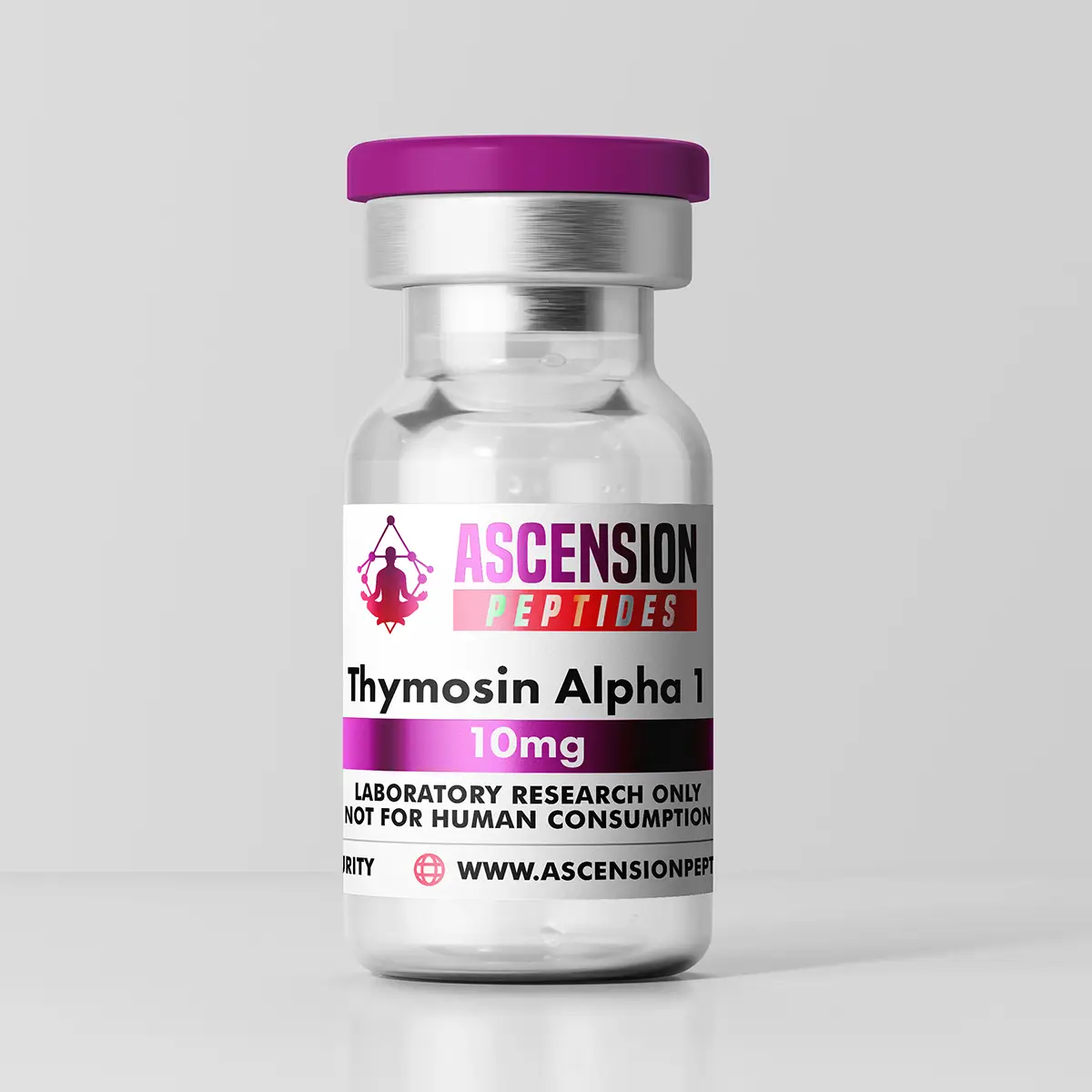
Thymosin alpha-1 is a 28-amino-acid peptide naturally produced by the thymus gland. It's one of the most extensively studied immune-modulating peptides globally, with clinical trial data spanning decades across multiple countries (Romani et al., 2012).
Mechanism
Tα1 primarily acts on Toll-like receptors (TLR-7 and TLR-9) on dendritic cells and T lymphocytes, upregulating interferon production and natural killer cell activity. It acts as an immune calibrator — amplifying a suppressed response while potentially moderating an overactive one.
Clinical Applications
- Chronic hepatitis B and C (approved as Zadaxin in 35+ countries)
- Immune reconstitution during chemotherapy
- Vaccine response adjuvant
- Sepsis immune modulation
Unique Position
Unlike most research peptides, thymosin alpha-1 has a legitimate pharmaceutical history with extensive clinical data. This gives researchers a comparatively robust dataset for protocol design.
Alpha-MSH and Melanocortin Peptides
The POMC-Derived Signaling Molecule
Alpha-melanocyte-stimulating hormone (α-MSH) is an endogenous neuropeptide derived from POMC. It binds primarily to melanocortin receptors 1 and 4 (MC1R and MC4R).
MC1R Pathway: Pigmentation
MC1R activation drives melanin production in skin cells — the mechanism behind tanning research. Synthetic derivatives include afamelanotide (FDA-approved for EPP), Melanotan II, and PT-141.
MC4R Pathway: Metabolism and Sexual Function
MC4R activation produces appetite suppression, energy expenditure increases, and sexual function signaling. PT-141 (Bremelanotide) is the MC4R-preferring analog with FDA approval for HSDD (Kingsberg et al., 2019).
Key Derivatives
Alpha-Helical Antimicrobial Peptides (AMPs)
How They Work
One of the most active areas of alpha peptide research involves antimicrobial peptides that adopt alpha-helical conformations upon contact with bacterial membranes. These represent a potential avenue for addressing antibiotic resistance (Mahlapuu et al., 2016).
Physical Mechanism
Classic examples include magainins, defensins, and cathelicidins like LL-37. Their mechanism doesn't rely on receptor binding — instead, the positively charged alpha-helix disrupts negatively charged bacterial membranes directly, a physical mechanism that bacteria find significantly harder to develop resistance against compared to conventional antibiotics.
Clinical Translation Challenges
The selectivity of AMPs for bacterial versus mammalian membranes is a critical research variable. Some show cytotoxicity against mammalian cells at concentrations close to antimicrobial effective concentrations, limiting therapeutic windows.

Alpha-Helix GH Secretagogues
Structure-Dependent Receptor Engagement
Several growth hormone-releasing peptides depend on alpha-helical structures for receptor engagement. Ipamorelin, CJC-1295, and Sermorelin all engage GHRH receptors through conformations that include helical elements. The stability of that helical region directly influences binding affinity and half-life.
Why Storage Conditions Are Critical
For alpha-helical peptides, storage isn't optional — it's a critical variable. Heat, extreme pH, and freeze-thaw cycling can denature helical conformations, converting an active compound into a disordered chain with minimal receptor affinity. Always store lyophilized at -20°C and reconstitute immediately before use.
Role in Muscle Growth Research
For researchers interested in peptides for muscle growth, alpha-helical GH secretagogues represent one of the most established categories. They work by stimulating natural GH pulsatility rather than introducing exogenous hormone — an important distinction for safety profiles.
Alpha Peptides in the Context of Peptide Therapy
The alpha peptide categories described here fit within the broader peptide therapy landscape. From immune modulation (thymosin alpha-1) to melanocortin signaling (alpha-MSH derivatives) to muscle growth (GH secretagogues), alpha peptides touch multiple therapeutic domains.
Anti-Aging Applications
Several alpha peptide categories have relevance to anti-aging research. Thymosin alpha-1's immune reconstitution effects address immunosenescence. Alpha-helical GH secretagogues support age-related changes in body composition. Alpha-MSH signaling through MC1R enhances DNA repair capacity — relevant to photoaging prevention.
Sourcing Alpha Peptides for Research
Quality Standards
Third-party testing is non-negotiable. A reputable supplier provides:
- Purity ≥98% by HPLC analysis
- Molecular weight confirmation via mass spectrometry
- Absence of endotoxins (LAL test)
- Sterility testing for injectable preparations
Thymosin Alpha-1 Verification
For thymosin alpha-1 specifically, molecular weight verification is critical because the 28-amino-acid sequence must be complete and correctly ordered. Truncated or scrambled sequences show different masses and reduced or absent bioactivity.
Vendor Red Flags
Cannot produce COA upon request. Pricing significantly below market rates. Explicit therapeutic claims on website. Quality alpha peptides require sophisticated synthesis, rigorous QC, and appropriate compliance — all reflected in legitimate pricing.
Safety Profiles by Category
Thymosin Alpha-1
Among the best-tolerated research peptides with decades of clinical data. Adverse effects limited to mild injection site reactions. No significant drug interactions reported.
Alpha-MSH Derivatives
More significant safety considerations. MC4R activation produces nausea (dose-dependent), spontaneous erections, and blood pressure changes. Melanotan II has a narrow therapeutic window. PT-141 has a better-characterized profile as FDA-approved.
GH Secretagogues
Generally favorable safety profiles but carry theoretical considerations for any GH pathway intervention — effects on insulin sensitivity and IGF-1 levels with prolonged use.