

PNC-27 is the most oversold peptide on the market.
If you have found your way here, you have probably read that it kills cancer cells and leaves healthy ones alone. That claim traces back to real laboratory work by real scientists, published in real journals. It is also, as of today, entirely confined to cells in dishes and animals in labs.
This page covers what PNC-27 was designed to do, what has actually been demonstrated, and — just as importantly — what has not. If you or someone close to you is dealing with cancer, read the section titled "What PNC-27 Is Not" before anything else.
🔑 Key Takeaways
- PNC-27 is a designed molecule, not a natural one — two useful pieces of protein stitched together deliberately.
- The mechanism is unusual and worth understanding: it does not switch cells off, it opens holes in them.
- The selectivity claim rests on where HDM-2 sits in cancer cells versus normal cells.
- Every result to date comes from cell culture and lab models. There is no human trial, not even an early-phase one.
- It is not a cancer treatment and must not be used as one. What it is instead is set out below.
What Is PNC-27?
It is two things fused together.
The first is a fragment of p53, the tumour-suppressor protein — specifically residues 12 to 26, the stretch that binds HDM-2. The second is a 17-residue membrane-penetrating leader sequence whose job is to carry the fragment through a cell membrane, which a bare peptide could not do on its own.
Put together, that is a 32-residue chimeric peptide: a targeting head and a delivery tail, designed rather than discovered.
How PNC-27 Is Designed to Work
The mechanism is not the usual one.
Most anticancer agents interfere with a process — dividing, repairing, signalling — and the cell dies over hours or days through apoptosis, the orderly self-destruct programme. PNC-27 is proposed to work differently and much faster.
HDM-2 is normally an intracellular protein that keeps p53 in check. The work behind PNC-27 reports that in cancer cells, HDM-2 is also present in the cell membrane itself, where it is largely absent in normal cells. PNC-27 binds that membrane-bound HDM-2, and the peptide–HDM-2 complex is described as forming pores in the membrane. The cell then loses its contents — necrosis rather than apoptosis.
The selectivity argument follows directly: if the target only sits in the membrane of cancer cells, only those cells get holes. Recent reviews of this work (Pincus and colleagues, Biomedicines, 2024) describe tumour cell necrosis across a range of solid tumour cell types without corresponding effects on normal cells.
What the Evidence Actually Shows
Read this part slowly.
The published record for PNC-27 consists of cell culture experiments and animal tumour models. Within that record the findings are consistent and have been reproduced by the group that developed it over a couple of decades.
What the record does not contain:
- No completed phase I trial — the first-in-human safety step that every cancer drug must pass.
- No published human dosing, and therefore no known safe dose.
- No human pharmacokinetics: nobody has published what happens to it in a human body, how long it lasts, or where it goes.
- No independent replication at scale outside the originating research programme.
- No regulatory approval anywhere in the world.
Cell-culture selectivity is a long way from clinical benefit. The history of oncology is substantially a history of compounds that killed cancer cells beautifully in a dish and did nothing useful, or something harmful, in people.
What PNC-27 Is Not
PNC-27 is not a cancer treatment. It has never been tested in humans. It has no approved use, no established dose, and no safety data in people. It must not be used in place of, or alongside, oncology care without the knowledge of the treating oncology team. If you are considering it because conventional options feel exhausted, speak to your oncologist about clinical trials you may be eligible for — those are supervised, documented, and free to enter.
We are direct about this because the search results for this compound are not. Pages that describe cell-line necrosis and then move straight to a buy button are, in effect, selling hope to people in the worst week of their lives.
The legitimate reasons to read about PNC-27 are to understand an interesting piece of protein engineering, to follow whether it ever reaches a trial, or to evaluate claims you have encountered elsewhere. Those are the reasons this page exists.
Dosage Information People Cite
There is no established dose, and we are not going to invent one.
Figures circulating online are extrapolated from lab concentrations, which do not convert to a human dose in any defensible way. Cell-culture work reports concentrations in a dish; translating that to milligrams in a person requires pharmacokinetic data that does not exist for this compound.
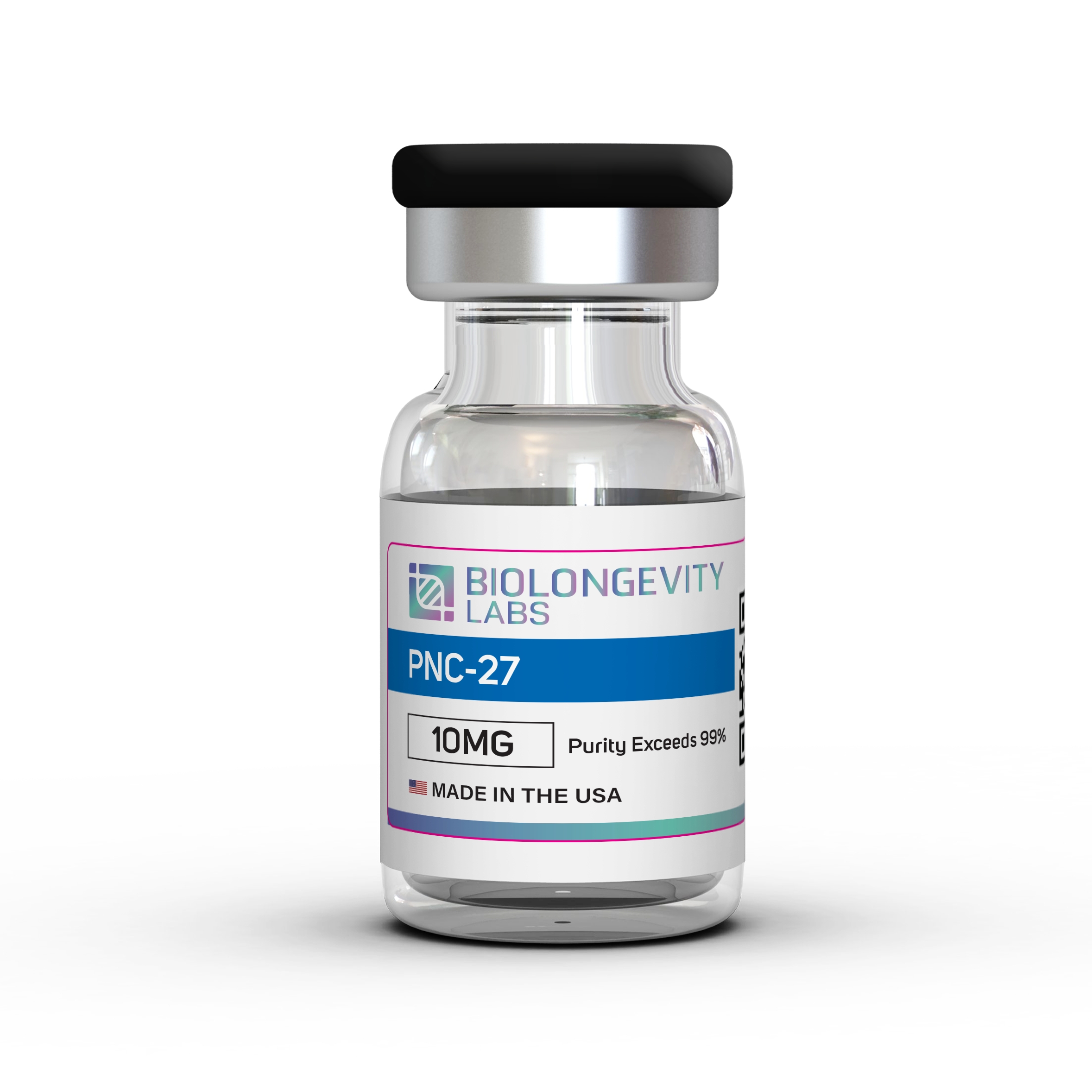
The vials sold are typically 10 mg of lyophilized powder, reconstituted with bacteriostatic water in the same way as any other peptide — our reconstitution guide covers that mechanics. What to do after that is not something the published record answers.
Side Effects and Unknowns

Unknown, and that is the finding.
With no human exposure data, there is no side effect profile to report. Two things are worth reasoning about:
- Necrosis is inflammatory. Unlike apoptosis, which is tidy, necrosis spills cell contents and provokes an inflammatory response. At scale that is a meaningful clinical event, not a side note.
- Selectivity in a dish is not selectivity in a body. A membrane target that is absent from the normal cell lines tested is not necessarily absent from every tissue in a person.
Where PNC-27 Comes From
A small number of suppliers stock it. BioLongevity Labs lists PNC-27 as a 10 mg vial at $279.97, tested by an independent lab against a lot-matched certificate of analysis.
We list that for completeness, not as a recommendation. Nothing on this page should be read as a suggestion to use PNC-27 for cancer or anything else — the evidence does not support that, and the honest position is that it is a laboratory compound with an interesting mechanism and no clinical standing.
Frequently Asked Questions
Medical Disclaimer: This content is for informational purposes only and does not constitute medical advice. Always consult a qualified healthcare provider before starting any new supplement, medication, or treatment. PeptideDeck may earn a commission from affiliate links at no additional cost to you.