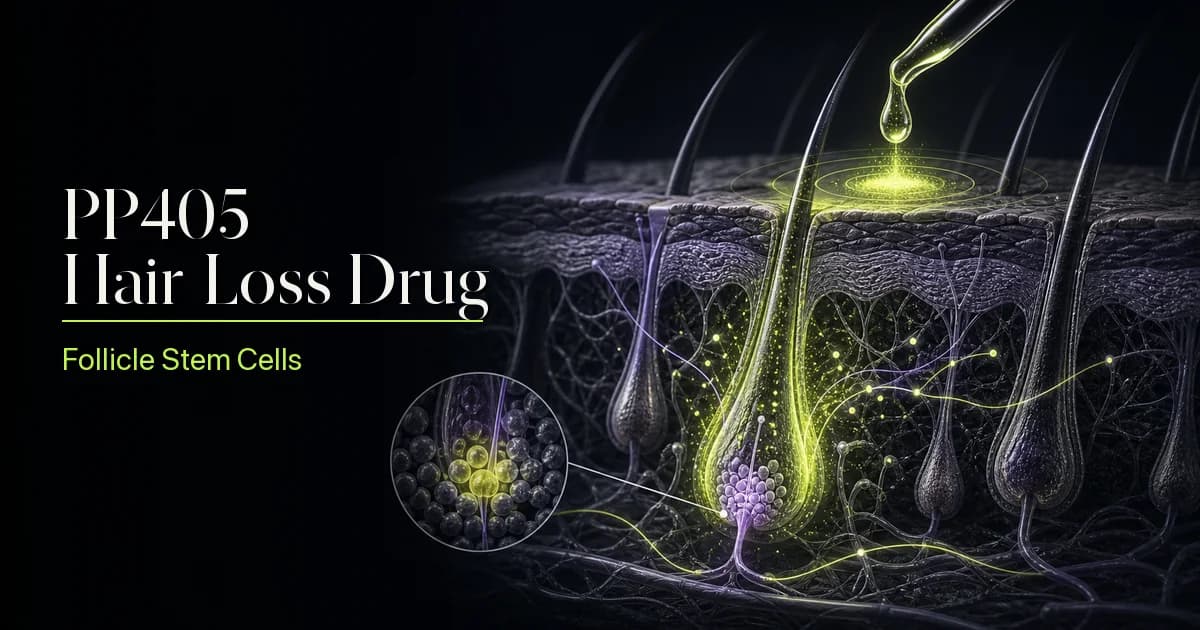
PP405 is an experimental, once-daily topical drug for pattern hair loss that does something neither minoxidil nor finasteride attempts: it reprograms the metabolism inside dormant hair follicle stem cells to wake them back up. Developed by Pelage Pharmaceuticals out of the University of California, Los Angeles (UCLA), the small molecule blocks a mitochondrial transporter to flood follicle stem cells with the chemical signal that normally tells them to start a new growth cycle. In June 2025, Pelage reported the first human efficacy data from a Phase 2a trial, and the company plans to begin pivotal Phase 3 testing in 2026.[1] This guide explains what PP405 is, exactly how it works, what the trial actually showed, how it compares to current treatments, who it might help, and a realistic timeline for if and when you could ever get it.
🔑 Key Takeaways
- PP405 is a topical small molecule that inhibits the mitochondrial pyruvate carrier (MPC), forcing hair follicle stem cells to make more lactate, which is the metabolic switch that activates them.[3][5]
- In a 78-person Phase 2a trial, 31% of treated men with more advanced loss saw a greater than 20% increase in hair density by week 8, versus 0% on placebo, after only 4 weeks of once-daily use.[1][2]
- It is a regenerative approach, not a DHT blocker or a vasodilator, so its mechanism is fundamentally different from finasteride and minoxidil.[7][9]
- No systemic absorption was detected in the blood and there were no systemic adverse events in early trials, which is the headline safety advantage over oral options.[1]
- PP405 is investigational and not FDA approved. The earliest plausible approval is 2027 to 2029, contingent on successful Phase 3 trials starting in 2026.[6][10]
What Is PP405?
PP405 is a clinical-stage, non-invasive topical drug being developed as a first-in-class regenerative treatment for androgenetic alopecia, the medical term for male and female pattern hair loss. It is a small molecule, not a peptide and not a biologic, applied to the scalp as a 0.05% gel once per day.[10] The compound came out of UCLA research and is now owned and being advanced by Pelage Pharmaceuticals, a company founded in 2018 by UCLA scientists Bill Lowry, Heather Christofk, and Michael Jung.[10] The name reflects the company (Pelage is French for an animal's coat of fur) and a nod to the Interstate 405 in Los Angeles.
The reason PP405 has generated so much attention is the angle of attack. Existing pattern-hair-loss drugs either slow the hormone driving the loss or modestly prod existing follicles. PP405 instead targets the energy metabolism of the stem cells that sit at the base of each follicle and decide whether to grow a new hair. The goal is to switch those cells from a dormant, energy-starved state back into an active, hair-producing one.[3][5] If you are new to the broader category, our overview of the best peptides and compounds for hair growth puts PP405 in context alongside the topical and injectable options people use today.
How PP405 Works: The Metabolic Switch
The science behind PP405 traces to a 2017 study published in Nature Cell Biology by Aimee Flores and colleagues at UCLA, titled "Lactate dehydrogenase activity drives hair follicle stem cell activation."[3][4] The researchers made a counterintuitive discovery: hair follicle stem cells (HFSCs) rely heavily on glycolysis and produce far more lactate than the surrounding skin cells, and that lactate production is what flips them into their active, hair-growing phase.[3]
They proved this two ways. First, when they genetically deleted lactate dehydrogenase A (the enzyme LDHA that makes lactate), the stem cells stayed dormant and could not be activated. Second, when they genetically deleted mitochondrial pyruvate carrier 1 (MPC1), the cells were forced to convert more pyruvate into lactate, and hair follicle stem cell activation accelerated, speeding up the hair cycle in mice.[3]
That second finding is the entire premise of PP405. The mitochondrial pyruvate carrier is a transporter that ferries pyruvate into the mitochondria to be burned for energy. If you block that door, pyruvate piles up in the cell and gets shunted into lactate production instead.[3][5] In the foundational research, the team showed that a small-molecule MPC inhibitor called UK5099 could do this pharmacologically and, when applied topically, induce the hair cycle in mice.[5] PP405 is the optimized, drug-like descendant of that proof-of-concept: a topical MPC inhibitor designed to raise lactate inside human follicle stem cells and trigger them to start growing hair again.[10]
The one-sentence mechanism
PP405 blocks the mitochondrial pyruvate carrier, which forces hair follicle stem cells to convert more pyruvate into lactate, and that surge in lactate is the natural signal that wakes dormant follicles and pushes them into a new growth phase.[3][5]
Why This Is Different From Minoxidil and Finasteride
Only two drugs are FDA approved specifically for pattern hair loss, and both have been around for decades. Minoxidil (the active ingredient in Rogaine) is a direct arteriolar vasodilator that opens potassium channels; topical 2% solution was approved in 1988 and 5% in 1991.[8][9] Finasteride (Propecia) is a type II 5-alpha-reductase inhibitor that lowers dihydrotestosterone (DHT), the androgen that miniaturizes susceptible follicles.[7] Androgenetic alopecia itself is driven by a genetic predisposition combined with follicle sensitivity to DHT, which progressively shrinks terminal hairs into wispy vellus hairs.[8]
Neither approved drug regenerates a follicle that has gone dormant. Minoxidil prolongs the growth phase and improves blood supply, and finasteride removes the hormonal driver of miniaturization, but both work best at preserving and thickening what you still have, and both require continuous use because the benefit reverses when you stop.[7][9] PP405 is pursuing a genuinely different goal, reactivating the stem cells themselves, which is why it is described as regenerative rather than maintenance. Notably, in the Phase 2a trial it also produced new hair growth from follicles where no hair was previously present, an outcome the existing drugs are not designed to deliver.[1]
PP405 vs Current Pattern-Hair-Loss Options
For a deeper dive on what the established topical compounds can and cannot do, see our guide to peptides for hair growth and the comparison-style roundup of the best peptides for hair growth in 2026.
What the Phase 2a Trial Actually Showed
Pelage announced topline Phase 2a results on June 17, 2025. The study (registered as NCT06393452) was a randomized, double-masked, vehicle-controlled trial that enrolled 78 men and women with androgenetic alopecia across a range of skin phototypes and hair textures.[1][2] Participants applied PP405 or placebo to the scalp once daily for 4 weeks and were then followed out to 12 weeks.[1]
The trial's primary endpoint was safety, and it met it. PP405 was well tolerated, there was no systemic absorption detectable in the blood, and there were no systemic adverse events.[1] That safety profile is meaningful because it is the cleanest selling point against oral finasteride, whose hormonal mechanism carries the risk of sexual side effects.[7]
On the efficacy side, the headline result was that at week 8, which is 4 weeks after dosing ended, 31% of treated men with a higher degree of hair loss had a greater than 20% increase in hair density, compared to 0% in the placebo group.[1][2] Pelage also reported that PP405 induced new hair growth from follicles that previously had none, the regenerative signal the company was looking for.[1] A company representative framed it this way: the early results "reinforce the potential of our approach to go beyond slowing hair loss and directly drive hair follicle regeneration."[1]
Reading the Numbers Honestly
Phase 2a data is encouraging but early, and it pays to keep three caveats in mind. First, this was a small trial (78 people) over a short window (4 weeks of treatment), so it tells you about a signal and safety, not durable real-world effectiveness. Second, the standout 31% figure applied to a subgroup of men with more advanced loss, not the entire enrolled population. Third, "greater than 20% increase in hair density" is a measurable improvement but is not the same as a full restoration, and density gains in early trials do not always translate into the cosmetic result a person actually wants. None of that is unusual for a Phase 2a readout. It simply means PP405 has cleared an early bar and now has to prove itself in larger, longer Phase 3 trials.[1][6]
What "20% more density" feels like in practice
Hair density is typically measured as hairs per square centimeter. A healthy scalp runs roughly 200 to 300 hairs per square centimeter, and thinning areas can drop well below that. A 20% increase on a thinned patch sitting at, say, 120 hairs per square centimeter would add roughly 24 hairs per square centimeter. That is a noticeable improvement in coverage for many people, but it is incremental, not a reversal back to a full head of hair. Treat the trial number as a directional signal, not a promise.
Estimated PP405 Development and Access Timeline
PP405 is not for sale anywhere as an approved product, and any website claiming to sell "PP405" today is not selling the genuine, patented Pelage compound, whose structure remains undisclosed.[10] Here is a realistic, source-based timeline of where the program stands and what would have to happen for it to reach patients.
The October 2025 Series B of $120 million, led by ARCH Venture Partners and GV (Google Ventures), exists specifically to fund the Phase 3 program.[6] A well-funded Phase 3 starting in 2026 is the prerequisite for any approval, but pivotal trials commonly take two to three years to run and report, and many drugs that look good in Phase 2 fail in Phase 3. The honest planning assumption is: PP405 will not be a treatment you can buy for at least a few years, if it gets approved at all.
Who Might PP405 Help (and Who Should Wait)?
Because PP405 is investigational, no one can use it outside a clinical trial today. But it is reasonable to think about who the eventual candidate profile looks like based on how it was studied and how it works.
- Likely a good fit, eventually: men and women with androgenetic alopecia who still have living but dormant follicles, especially people who want to avoid the hormonal side effects of oral finasteride. The trial enrolled both sexes, which matters because women have far fewer well-tolerated options.[1]
- Possibly less benefit: people with long-standing, "slick bald" scalp where follicles may be scarred or gone entirely. A drug that reactivates stem cells needs viable follicles to work with, and the trial signal was strongest as a density increase rather than total regrowth on bare scalp.[1]
- Should not chase it now: anyone tempted to buy a gray-market "PP405" online. The real compound is not commercially available, its structure is undisclosed, and counterfeit risk is total.[10] If you want to act today, the evidence-backed route is the approved drugs (minoxidil, finasteride) or working with a clinician.[7][9]
If you are weighing what to do in the meantime, our breakdown of peptide shampoos for hair growth and the research summary on GHK-Cu copper peptide for skin and hair cover the topical options people commonly try while drugs like PP405 work their way through trials.
Safety: What We Know and What We Don't
The most reassuring data point so far is the absence of systemic exposure. PP405 was engineered to penetrate the scalp without entering the bloodstream, and in clinical testing no PP405 was detected in the blood, with no systemic adverse events reported.[1][10] A purely local, topical drug with no measurable circulating levels is exactly what you want for a chronic, cosmetic-adjacent indication, and it is the structural reason PP405 could appeal to people who avoid oral finasteride over hormonal concerns.[7]
What we do not yet know is the long-term safety of repeatedly shifting follicle stem cell metabolism toward glycolysis over months and years, or how PP405 performs in much larger and more diverse populations. Those are precisely the questions Phase 3 is designed to answer. Until that data exists, any strong claim about long-term safety is premature. Pattern hair loss is also a lifelong condition, so even if PP405 is approved, the realistic expectation is ongoing use rather than a one-time cure, similar to how the current drugs require continued application to maintain results.[7][9]
Frequently Asked Questions
References
- Pelage Pharmaceuticals. Positive Phase 2a Clinical Trial Results for PP405 in Regenerative Hair Loss Therapy (press release, June 17, 2025).
- ClinicalTrials.gov. Safety, Pharmacokinetics and Efficacy of PP405 in Adults With Androgenetic Alopecia (NCT06393452).
- Flores A, et al. Lactate dehydrogenase activity drives hair follicle stem cell activation. Nature Cell Biology. 2017;19(9):1017-1026. PMC5657543.
- Flores A, et al. Lactate dehydrogenase activity drives hair follicle stem cell activation. PubMed PMID: 28812580.
- UCLA Newsroom. UCLA scientists identify a new way to activate stem cells to make hair grow (2017).
- Pelage Pharmaceuticals. $120 Million Series B Financing to Advance Regenerative Medicine Treatments for Hair Loss (press release, October 15, 2025).
- Gupta AK, et al. Topical Finasteride: A Comprehensive Review of Androgenetic Alopecia Management for Men and Women. PMC10561660.
- Ho CH, et al. Androgenetic Alopecia. StatPearls (NCBI Bookshelf), NBK430924.
- MedlinePlus (U.S. National Library of Medicine). Minoxidil Topical drug information.
- PP405. Wikipedia (developer, formulation, and program background overview).