How Fast Does Mounjaro Work? Week-by-Week Weight Loss Timeline and Plateau Fixes
Published April 16, 2026Updated October 7, 2026
Quick Brief
Week-by-week timeline of what Mounjaro does to your weight from the first injection, when the plateau usually hits, and the dose and habit changes that get it moving again. SURMOUNT data, no hype.
How Fast Does Mounjaro Work? Week-by-Week Weight Loss Timeline and Plateau Fixes
The first week is appetite, not weight. Most people feel Mounjaro before they measure it: food noise drops within days, the scale follows from week 3 or 4, and the plateau that worries everyone usually arrives between months 6 and 9. This page is the week-by-week timeline and what to do when it stalls. For what Mounjaro is, how it is dosed, what it costs and how it compares to Zepbound, start with our main Mounjaro weight loss guide; tirzepatide is also the most prescribed of all weight loss injections in the country.
Last UpdatedMay 5, 2026
22.5%Average body weight loss at 15 mg over 72 weeks (SURMOUNT-1 completers)
20.2%Loss vs 13.7% on Wegovy in head-to-head SURMOUNT-5 (2025)
82%Of patients lose 5%+ of body weight by week 12
24.3 wksMedian time to first plateau in real-world data
Key Takeaways
Mounjaro (tirzepatide) is FDA-approved for type 2 diabetes. Zepbound is the same molecule approved for weight loss. Physicians prescribe Mounjaro off-label when insurance covers diabetes drugs but not anti-obesity drugs.
SURMOUNT-1 showed 15.0%, 19.5%, and 20.9% body weight loss at 5 mg, 10 mg, and 15 mg over 72 weeks. Completers (people who finished the trial) hit 22.5% at the top dose.
Head-to-head SURMOUNT-5 (2025) showed tirzepatide caused 47% more weight loss than the highest dose of Wegovy in non-diabetic adults.
Most people see appetite changes by week 1, first scale movement by week 5, and the steepest weight loss curve between months 4 and 8.
Plateaus are biology, not failure. The median first plateau hits around week 24, often coinciding with the 10 mg or 12.5 mg dose. Strategies below.
Stopping the drug almost always leads to weight regain. SURMOUNT-4 confirmed continued treatment is needed to maintain loss.
This page covers what to realistically expect: trial-by-trial weight loss numbers, a week-by-week timeline, a dose escalation tracker, plateau strategies that actually work, and how Mounjaro stacks up against Ozempic and Wegovy in 2026.
How Much Weight Do You Lose on Mounjaro?
It depends on which trial you're looking at.
There are two complete sets of trial data for tirzepatide. SURPASS studied diabetes patients (where weight loss was a secondary outcome). SURMOUNT studied obese non-diabetic adults specifically for weight loss. The SURMOUNT numbers are dramatically higher because the trials were longer, the population was selected for weight loss, and lifestyle counseling was built in.
SURMOUNT Trials (Weight Loss Population, Same Molecule as Zepbound)
Trial
Population
Dose
Avg Weight Loss
% Hitting 20%+ Loss
Duration
SURMOUNT-1
Obese adults, no T2D
5 mg
-15.0%
30.0%
72 weeks
SURMOUNT-1
Obese adults, no T2D
10 mg
-19.5%
50.1%
72 weeks
SURMOUNT-1
Obese adults, no T2D
15 mg
-20.9%
56.7%
72 weeks
SURMOUNT-2
Obese adults with T2D
10 mg
-13.4%
~32%
72 weeks
SURMOUNT-2
Obese adults with T2D
15 mg
-15.7%
~41%
72 weeks
SURMOUNT-3
After 12-week intensive lifestyle
Max tolerated
-26.6% total
~87%
84 weeks total
SURMOUNT-4
Withdrawal after 36 weeks
Continued vs placebo
+5.5% if stopped, -5.5% if continued
n/a
88 weeks
SURMOUNT-5
Tirzepatide vs Wegovy 2.4 mg
10-15 mg
-20.2% vs -13.7%
~52% vs ~28%
72 weeks
SURMOUNT-1
Population
Obese adults, no T2D
Dose
5 mg
Avg Weight Loss
-15.0%
% Hitting 20%+ Loss
30.0%
Duration
72 weeks
SURMOUNT-1
Population
Obese adults, no T2D
Dose
10 mg
Avg Weight Loss
-19.5%
% Hitting 20%+ Loss
50.1%
Duration
72 weeks
SURMOUNT-1
Population
Obese adults, no T2D
Dose
15 mg
Avg Weight Loss
-20.9%
% Hitting 20%+ Loss
56.7%
Duration
72 weeks
SURMOUNT-2
Population
Obese adults with T2D
Dose
10 mg
Avg Weight Loss
-13.4%
% Hitting 20%+ Loss
~32%
Duration
72 weeks
SURMOUNT-2
Population
Obese adults with T2D
Dose
15 mg
Avg Weight Loss
-15.7%
% Hitting 20%+ Loss
~41%
Duration
72 weeks
SURMOUNT-3
Population
After 12-week intensive lifestyle
Dose
Max tolerated
Avg Weight Loss
-26.6% total
% Hitting 20%+ Loss
~87%
Duration
84 weeks total
SURMOUNT-4
Population
Withdrawal after 36 weeks
Dose
Continued vs placebo
Avg Weight Loss
+5.5% if stopped, -5.5% if continued
% Hitting 20%+ Loss
n/a
Duration
88 weeks
SURMOUNT-5
Population
Tirzepatide vs Wegovy 2.4 mg
Dose
10-15 mg
Avg Weight Loss
-20.2% vs -13.7%
% Hitting 20%+ Loss
~52% vs ~28%
Duration
72 weeks
SURMOUNT-3 is the trial most people miss. Participants did 12 weeks of intensive diet and exercise first, lost about 7%, then started tirzepatide. The total loss after 84 weeks averaged 26.6% of starting weight. That's the closest data we have to a best-case scenario, and it shows lifestyle plus drug beats either alone.
SURPASS Trials (Diabetes Population, Same Molecule as Mounjaro)
Trial
Dose
Weight Loss
Duration
Comparator
SURPASS-1
15 mg
-9.5 kg (21 lbs)
40 weeks
Placebo
SURPASS-2
15 mg
-11.2 kg (25 lbs)
40 weeks
Semaglutide 1 mg: -5.7 kg
SURPASS-3
15 mg
-11.7 kg (26 lbs)
52 weeks
Insulin degludec: +2.3 kg
SURPASS-4
15 mg
-11.7 kg (26 lbs)
52 weeks
Insulin glargine: +1.9 kg
SURPASS-1
Dose
15 mg
Weight Loss
-9.5 kg (21 lbs)
Duration
40 weeks
Comparator
Placebo
SURPASS-2
Dose
15 mg
Weight Loss
-11.2 kg (25 lbs)
Duration
40 weeks
Comparator
Semaglutide 1 mg: -5.7 kg
SURPASS-3
Dose
15 mg
Weight Loss
-11.7 kg (26 lbs)
Duration
52 weeks
Comparator
Insulin degludec: +2.3 kg
SURPASS-4
Dose
15 mg
Weight Loss
-11.7 kg (26 lbs)
Duration
52 weeks
Comparator
Insulin glargine: +1.9 kg
If you're using Mounjaro for weight loss without diabetes, the SURMOUNT data is the closer comparator. Diabetic patients consistently lose 5-7 percentage points less than non-diabetic patients on the same dose, likely due to insulin and metabolic differences.
Mounjaro Weight Loss Week-by-Week Timeline
Don't expect results at week one.
This timeline assumes standard 4-week titration. Individual response varies, but the curve is consistent across SURMOUNT-1 and real-world data from 2024-2026.
Week
Dose
Cumulative Avg Loss (% of starting weight)
What's Happening
Week 1
2.5 mg
0-1%
Appetite blunting starts within 24-48 hours. Mild nausea common.
Real momentum. 8-12 lbs lost for a 200 lb starting weight.
Week 12
Dose
7.5 mg
Cumulative Avg Loss (% of starting weight)
6-9%
What's Happening
82% of users have lost 5%+ by now. Clothes fitting differently.
Week 16
Dose
10 mg
Cumulative Avg Loss (% of starting weight)
9-12%
What's Happening
Steepest part of the curve. People around you start noticing.
Week 24
Dose
10-12.5 mg
Cumulative Avg Loss (% of starting weight)
12-15%
What's Happening
Median first plateau hits here for many patients.
Week 36
Dose
12.5-15 mg
Cumulative Avg Loss (% of starting weight)
15-18%
What's Happening
Body composition changes obvious. BP, A1C, lipids improving.
Week 48
Dose
15 mg
Cumulative Avg Loss (% of starting weight)
17-20%
What's Happening
Approaching the SURMOUNT-1 average for top dose.
Week 60
Dose
15 mg
Cumulative Avg Loss (% of starting weight)
19-22%
What's Happening
Curve flattens. Loss continues but slower.
Week 72
Dose
15 mg
Cumulative Avg Loss (% of starting weight)
20-23%
What's Happening
Trial endpoint. Average completer hits 22.5%.
The fastest weight loss happens between weeks 8 and 36. After that, the curve flattens because your body has fewer pounds to give up easily, and metabolic adaptation kicks in.
Mounjaro Dose Escalation Tracker
Standard titration protocol from Eli Lilly. Print this or screenshot it for your phone.
Phase
Weeks
Dose
Goal
Hold Longer If
Starter
1-4
2.5 mg/week
Adaptation, not weight loss
GI side effects severe; extend to 8 weeks
Step 1
5-8
5 mg/week
First real weight loss phase
Strong nausea or vomiting; hold 4 more weeks
Step 2
9-12
7.5 mg/week
Optional intermediate step
Many physicians skip this and go straight to 10 mg
Step 3
13-16
10 mg/week
Common maintenance dose
Hitting weekly loss goals; no need to escalate further
Step 4
17-20
12.5 mg/week
Optional intermediate step
10 mg working well; stay there
Step 5
21+
15 mg/week
Maximum dose
Side effects outweigh additional 1-2% loss
Starter
Weeks
1-4
Dose
2.5 mg/week
Goal
Adaptation, not weight loss
Hold Longer If
GI side effects severe; extend to 8 weeks
Step 1
Weeks
5-8
Dose
5 mg/week
Goal
First real weight loss phase
Hold Longer If
Strong nausea or vomiting; hold 4 more weeks
Step 2
Weeks
9-12
Dose
7.5 mg/week
Goal
Optional intermediate step
Hold Longer If
Many physicians skip this and go straight to 10 mg
Step 3
Weeks
13-16
Dose
10 mg/week
Goal
Common maintenance dose
Hold Longer If
Hitting weekly loss goals; no need to escalate further
Step 4
Weeks
17-20
Dose
12.5 mg/week
Goal
Optional intermediate step
Hold Longer If
10 mg working well; stay there
Step 5
Weeks
21+
Dose
15 mg/week
Goal
Maximum dose
Hold Longer If
Side effects outweigh additional 1-2% loss
Don't auto-escalate to 15 mg.
The difference between 10 mg and 15 mg in SURMOUNT-1 was 1.4 percentage points (19.5% vs 20.9%). The difference between 5 mg and 10 mg was 4.5 points. Diminishing returns hit hard after 10 mg. Many people get excellent results at 10 mg or 12.5 mg with milder side effects. The "right" dose is the lowest one that's still producing weight loss.
Real-World Mounjaro Data: 2026 Update
Trial numbers are the ceiling. Real-world numbers are what most patients actually see.
Three large cohort analyses published in 2025-2026 looked at insurance claims data for tirzepatide users:
Cleveland Clinic / Truveta cohort (2025): 18,386 tirzepatide users in real-world primary care. Average weight loss at 12 months was 13.4% of starting weight (vs the 19-20% trial average). Adherence at 12 months was 56%, well below trial adherence of 80%+.
JAMA Internal Medicine cohort (2025): Patients on tirzepatide for one year averaged 15.3% loss when adherent (took at least 80% of prescribed doses). Non-adherent patients averaged only 5.6%.
Komodo Health 2026 analysis: Median time to discontinuation was 8.5 months. The biggest reasons people stopped were cost (38%), side effects (27%), and "felt I didn't need it anymore" (19%). The third reason almost always preceded weight regain.
The takeaway: trial results assume you take the drug consistently for 72 weeks at a therapeutic dose with lifestyle support. Real-world results land 4-7 percentage points lower because real patients miss doses, struggle with cost, and stop early. If you can match trial adherence, you can match trial results.
The dual GLP-1/GIP mechanism is the difference. GLP-1 alone suppresses appetite and slows gastric emptying. GIP adds direct fat tissue metabolism, better insulin sensitivity, and appears to buffer nausea. That second receptor is why tirzepatide produces ~47% more weight loss than semaglutide at top doses.
The median time to first plateau in real-world data is 24.3 weeks. It usually hits while you're at 7.5-12.5 mg, after the steepest weight loss phase. Your metabolism downregulates. Your body's hunger signals adapt. Scale stalls for 2-4 weeks at a stretch.
What works (in order of impact):
Recheck protein intake. Aim for 1.2-1.6 g per kg of body weight daily. Most plateau patients are eating 50-70 g protein, which accelerates muscle loss and slows metabolism. Bumping to 100-130 g often restarts loss within 2-3 weeks.
Add resistance training 3x/week. Muscle is metabolically active tissue. Losing it during a plateau makes future plateaus worse. Progressive overload, even with bodyweight, preserves and rebuilds muscle.
Audit calories honestly. Mounjaro suppresses appetite hard at first. Six months in, appetite often partially returns. Many plateau cases are eating 200-400 more daily calories than they realize. Track for 2 weeks.
Increase the dose, but only one step. If you're at 7.5 mg and plateaued for 4+ weeks, moving to 10 mg often restarts loss. Don't jump two steps.
Sleep audit. Less than 6.5 hours per night raises ghrelin (hunger) and lowers leptin (satiety) regardless of medication. This is one of the most underestimated factors.
Diet break, not a cheat day. A planned 1-2 week maintenance phase at your current weight (eating to maintain, not lose) lets metabolic adaptation reset. Then return to a deficit.
When to be patient instead of escalating.
If you've lost 15%+ already and hit a plateau, your body is approaching its new setpoint. Pushing harder rarely produces clean weight loss; it usually produces fatigue, hair shedding, and muscle loss. Spending 8-12 weeks at maintenance to consolidate the loss is often smarter than chasing another 5%.
Mounjaro Off-Label vs Zepbound vs Compounded Tirzepatide
Same molecule, three access paths.
Zepbound is the tirzepatide brand approved for weight loss. Insurance covers it for BMI 30+ or BMI 27+ with a comorbidity (sleep apnea, hypertension, dyslipidemia, T2D).
Mounjaro is the diabetes brand. Physicians can prescribe it off-label for weight loss. Insurance coverage is much better with a T2D diagnosis but rarely covered for off-label weight loss.
Compounded tirzepatide is the same molecule made by 503A and 503B compounding pharmacies. Cost runs $150-$400/month. The FDA shortage list determined whether compounding was permitted; tirzepatide came off the shortage list in late 2024, which restricted but did not eliminate access.
The molecule is identical across all three. Your physician can determine which route fits your insurance and clinical situation.
Mounjaro has measurably lower nausea and vomiting than Ozempic and Wegovy. The GIP component appears to buffer GI effects. If Ozempic was hard on your stomach, Mounjaro is usually easier.
What Happens When You Stop Mounjaro
The weight comes back for most people.
SURMOUNT-4 ran the cleanest test of this. Patients lost weight on tirzepatide for 36 weeks, then half were switched to placebo. The placebo group regained 14 percentage points over the next 52 weeks. The continued-treatment group lost an additional 5.5%. That's a 19.5 percentage point swing based purely on whether the medication continued.
This is why the field now treats obesity as a chronic condition. Mounjaro works while you take it. When you stop, the appetite signaling and metabolic effects reverse. Some people maintain through ironclad diet and exercise habits. Most don't, which mirrors what happens after intensive diet and bariatric surgery without ongoing support.
If cost or side effects force discontinuation, slow the taper, ramp up resistance training, and prioritize protein. Holding 50-70% of your loss is realistic with effort. Holding 100% without medication is rare.
Frequently Asked Questions
How much weight can you lose on Mounjaro?
In SURMOUNT-1, average weight loss at 72 weeks was 15.0% at 5 mg, 19.5% at 10 mg, and 20.9% at 15 mg. Trial completers averaged 22.5% at the top dose. SURMOUNT-3 (lifestyle plus drug) hit 26.6%. Real-world adherence drops these numbers 4-7 points. For a 230 lb starting weight, expect 30-50 lbs over 72 weeks at therapeutic doses.
How fast do you lose weight on Mounjaro?
Appetite changes within 1-2 weeks. First scale movement by week 4 (2-3% loss). Real momentum at week 8 on the 5 mg dose (4-6%). 82% of users have lost 5%+ by week 12. Steepest weight loss curve runs from week 8 through week 36. After that, the curve flattens.
Why has my Mounjaro weight loss plateaued?
Plateaus are biology, not failure. The median first plateau hits at 24.3 weeks in real-world data. Causes are metabolic adaptation, returning appetite, and inadequate protein. Strategies that work: bump protein to 1.2-1.6 g/kg, add resistance training 3x/week, audit actual calorie intake (most plateau patients underestimate by 200-400 daily), step up one dose level, and fix sleep. Don't chase a plateau by under-eating.
Is Mounjaro better than Ozempic for weight loss?
Yes, by a clear margin. SURPASS-2 (head-to-head, T2D population) showed Mounjaro 15 mg produced 11.2 kg loss vs 5.7 kg for Ozempic 1 mg. SURMOUNT-5 (head-to-head, weight loss population) showed tirzepatide produced 20.2% loss vs 13.7% for Wegovy 2.4 mg. The dual GLP-1/GIP mechanism outperforms GLP-1 alone in every direct comparison.
Do you regain weight after stopping Mounjaro?
Most people do. SURMOUNT-4 showed a 14 percentage point regain over 52 weeks after stopping, while patients who continued lost an additional 5.5%. The appetite suppression and metabolic effects reverse when the drug clears. Sustained lifestyle changes can preserve part of the loss but rarely all of it.
What is the best Mounjaro dose for weight loss?
10 mg is the sweet spot for most patients. SURMOUNT-1 showed 19.5% loss at 10 mg and 20.9% at 15 mg, only a 1.4 point difference, while side effects scaled significantly higher at 15 mg. Many people get excellent results at 10 mg or 12.5 mg with milder GI symptoms. Don't auto-escalate to 15 mg.
Can I get Mounjaro for weight loss without diabetes?
Mounjaro is approved for type 2 diabetes only. Without a T2D diagnosis, the FDA-approved option for weight loss is Zepbound (same molecule). Some physicians prescribe Mounjaro off-label for weight loss, but insurance rarely covers off-label use. Compounded tirzepatide remains an alternative cash-pay route at $150-$400/month.
How much weight do you lose in the first month on Mounjaro?
Most people lose 2-5 lbs in the first month on the 2.5 mg starter dose. The starter dose is for adaptation, not weight loss, so don't be discouraged by slow numbers early. Real momentum starts at week 5 when the dose moves to 5 mg.
Medical Disclaimer: This article is for informational purposes only and does not constitute medical advice. Mounjaro (tirzepatide) is a prescription medication FDA-approved for type 2 diabetes. Off-label use for weight loss should be supervised by a licensed healthcare provider. Trial data referenced here is from peer-reviewed publications including SURMOUNT-1 through 5 and SURPASS-1 through 4. Individual results vary based on dose, adherence, lifestyle factors, and baseline metabolism.
Recommended Supplier
In StockShips from USA
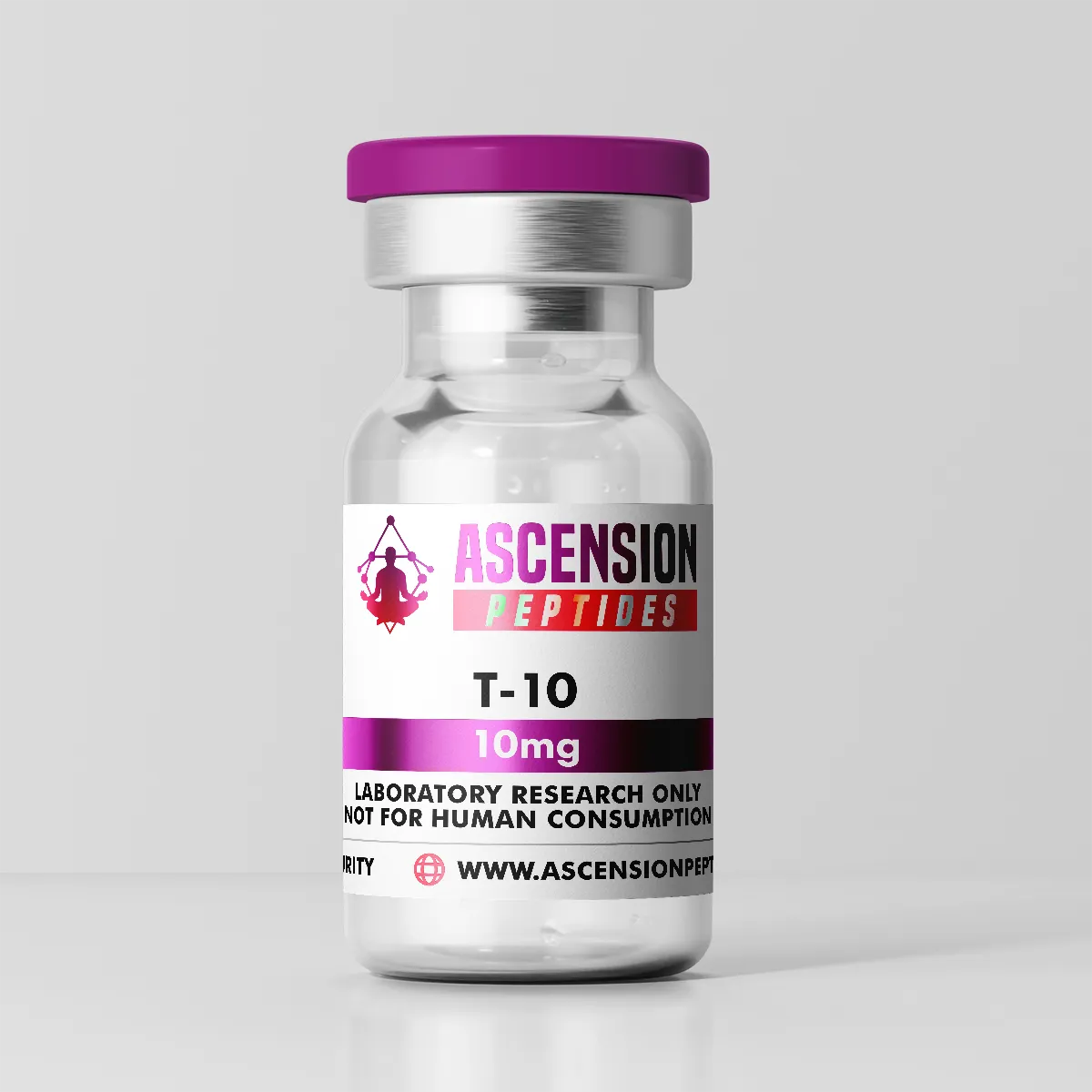
T-10
T-10 from Ascension Peptides, third-party tested and shipped from the US. Use code PEPTIDEDECK for 50% off.