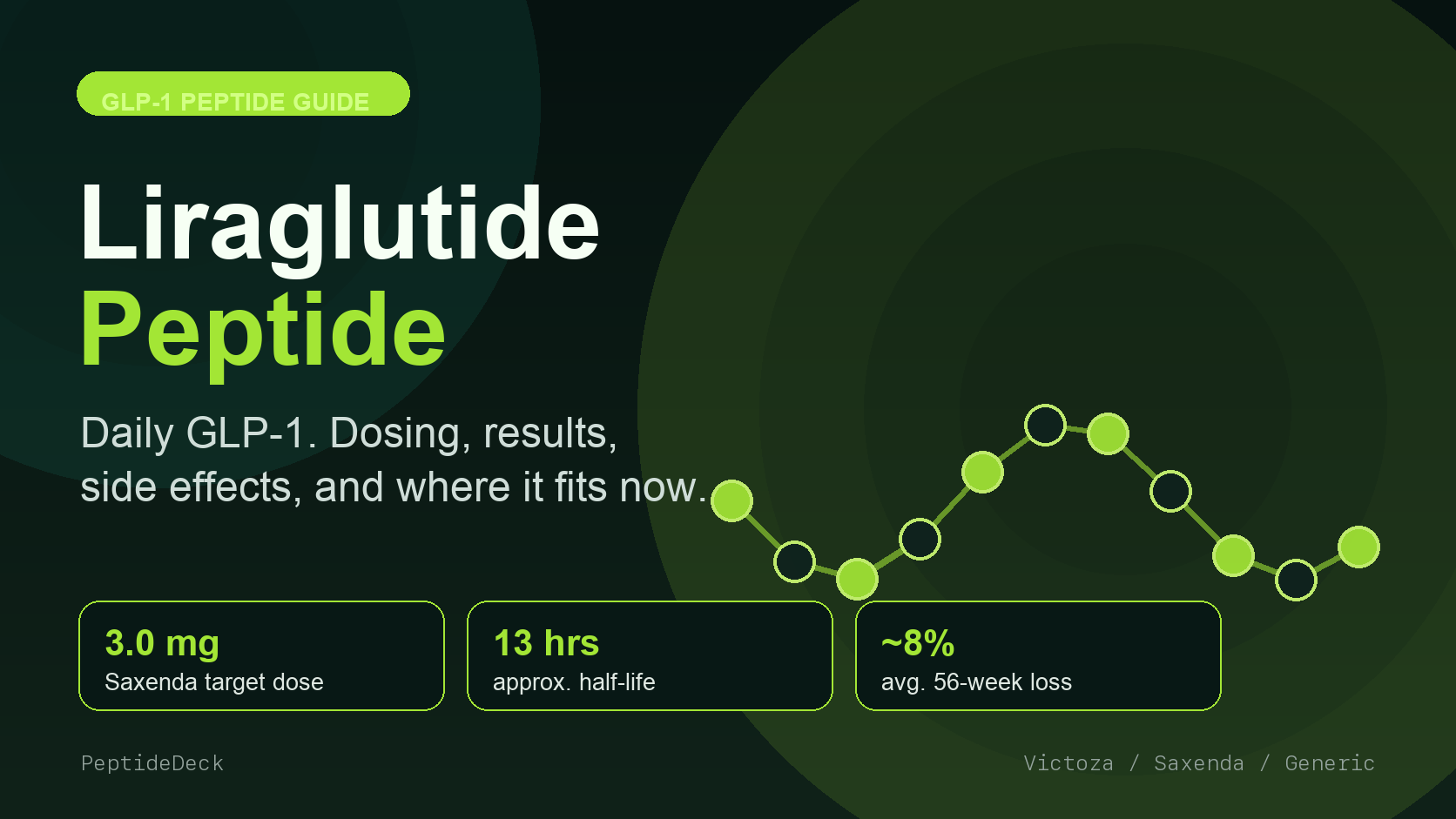
Liraglutide peptide is the original daily GLP-1.
It used to be the standard for GLP-1 weight loss and diabetes care. It no longer sits at the top of the class, but liraglutide still matters when daily dosing, pediatric use, insurance step therapy, generic access, or a shorter half-life changes the decision.
🔑 Key Takeaways
- Liraglutide is a once-daily GLP-1 receptor agonist sold as Victoza (type 2 diabetes) and Saxenda (chronic weight management), both from Novo Nordisk
- FDA approved in 2010 as Victoza and 2014 as Saxenda. It was the first GLP-1 approved in the US for weight loss
- Average weight loss of roughly 8% at 56 weeks in the SCALE trial, significantly less than semaglutide (15%) or tirzepatide (20%)
- Dose titrates from 0.6 mg daily up to 3.0 mg for weight loss or 1.8 mg for diabetes, one subcutaneous injection per day
- Approved for adolescents 12 and older with obesity (Saxenda) or type 2 diabetes in children 10 and older (Victoza, since 2019)
- Do not use if you have a personal or family history of medullary thyroid carcinoma, MEN2, pancreatitis, or are pregnant
- First generic liraglutide launched December 2024, bringing cash prices as low as ~$250/month
- When semaglutide or tirzepatide are available, liraglutide is rarely the first choice. It still fits specific scenarios: step-therapy insurance, short half-life preference, adolescent use, and lower-cost entry after generic launch
This page is the practical 2026 reference for liraglutide peptide: what it is, how it works, how it is dosed, side effects, contraindications, drug interactions, who it is right for, what it costs, and how it compares to every newer GLP-1 on the market.
Liraglutide Peptide at a Glance
The first question is practical.
If your goal is maximum weight loss, newer weekly GLP-1 drugs usually win. If your goal is a shorter-acting GLP-1 with long clinical history, daily dosing, adolescent labeling, or generic access, liraglutide still has a place. For a broader ranking, see our peptides for weight loss guide.
What Is Liraglutide?
A daily GLP-1 agonist with two indications.
Liraglutide is a once-daily glucagon-like peptide-1 (GLP-1) receptor agonist developed by Novo Nordisk. It is a synthetic analog of human GLP-1 with a fatty acid side chain that binds albumin in the bloodstream. That binding extends its half-life from the 1.5 to 2 minutes of endogenous GLP-1 out to about 13 hours, which is why it can be dosed once daily rather than continuously.
Liraglutide Brand Names and Indications
- Victoza (liraglutide 1.2 or 1.8 mg): Type 2 diabetes in adults and children age 10+
- Saxenda (liraglutide 3.0 mg): Chronic weight management in adults with BMI 30+ or 27+ with comorbidity, and adolescents 12+ with obesity
- Generic liraglutide: Launched in the US December 2024 (first generic by Hikma Pharmaceuticals)
Liraglutide has the original code name NN2211 (Novo Nordisk, 2001-2004 development period). It was approved in the EU in 2009 and the US in 2010. Saxenda followed on December 23, 2014. Pediatric diabetes approval came June 17, 2019, making it the first non-insulin diabetes drug for children approved since metformin in 2000.
What Liraglutide Is Used For
Two on-label uses, several practical ones.
- Type 2 diabetes (Victoza): Improves blood glucose control in adults and children 10+. Reduces the risk of major cardiovascular events (cardiovascular death, heart attack, stroke) in patients with established cardiovascular disease, per the LEADER trial. The ADA considers GLP-1 agonists first-line pharmacologic therapy in T2D, particularly for patients with CV disease or obesity.
- Chronic weight management (Saxenda): Approved for adults with BMI 30+ or 27+ with at least one weight-related condition (type 2 diabetes, hypertension, dyslipidemia). Also approved for adolescents 12+ with BMI in the 95th percentile or higher.
- Pediatric T2D: Victoza is approved in children 10+ with type 2 diabetes who are inadequately controlled on metformin with or without insulin.
- Pediatric obesity: Saxenda is approved in adolescents 12+ with obesity. A September 2024 study showed liraglutide reduced BMI by 7.4% in children ages 6 to 12 over 56 weeks, but use below the labeled Saxenda adolescent age range remains a clinician-level decision.
How Liraglutide Works
Same GLP-1 mechanism as the entire class, with a shorter half-life.
Liraglutide is a GLP-1 receptor agonist. GLP-1 is a gut hormone naturally released in response to food intake. When liraglutide activates the GLP-1 receptor at sustained therapeutic levels, four things happen:
- Insulin secretion: Pancreatic beta cells release more insulin, but only when blood glucose is elevated. This glucose-dependent mechanism is why hypoglycemia risk is low when liraglutide is used alone.
- Glucagon suppression: Alpha cells reduce glucagon release, preventing the liver from over-producing glucose after meals.
- Gastric emptying: Food moves through the stomach more slowly, prolonging satiety and reducing post-meal glucose spikes.
- Appetite regulation: GLP-1 receptors in the hypothalamus reduce hunger signaling. Most people describe appetite reduction and decreased food preoccupation within the first weeks.
Compared with newer GLP-1s like semaglutide (weekly) and tirzepatide (weekly, dual GLP-1/GIP), liraglutide produces less weight loss and requires daily dosing. It does not hit the GIP receptor, which is a key difference from tirzepatide.
Liraglutide Dosage and How to Use It
Daily subcutaneous injection, titrated slowly.
Saxenda (weight management) titration
Saxenda Dose Schedule
- Week 1: 0.6 mg once daily
- Week 2: 1.2 mg once daily
- Week 3: 1.8 mg once daily
- Week 4: 2.4 mg once daily
- Week 5 and after: 3.0 mg once daily (target maintenance dose)
Slower titration (holding a dose an extra week or two) is acceptable when GI side effects are strong. There is no requirement to move up every 7 days.
Victoza (type 2 diabetes) titration
- Week 1: 0.6 mg once daily (priming dose, not expected to improve glucose control)
- Week 2: 1.2 mg once daily
- If needed: Increase to 1.8 mg once daily
Administration
- Subcutaneous injection in the abdomen, front of thigh, or back of upper arm. Rotate injection sites.
- Can be taken any time of day, with or without food.
- Pre-filled multi-dose pen. Attach a new needle for each injection and dispose of it in a sharps container.
- Do not inject intravenously or intramuscularly.
Missed dose
- If you miss a dose and more than 12 hours remain before the next scheduled dose, take it as soon as you remember.
- If less than 12 hours remain, skip the missed dose and resume the regular schedule.
- If you miss doses for 3 or more days, contact your prescriber. You may need to restart titration from a lower dose.
Storage
- Unopened pens: Refrigerate at 2 to 8°C (36 to 46°F). Do not freeze.
- After first use: Store at room temperature (up to 30°C / 86°F) or refrigerated. Use within 30 days.
- Do not store with the needle attached. Protect from light and heat.
Liraglutide Side Effects
Mostly gastrointestinal, mostly temporary.
Serious Side Effects (Rare but Real)
- Pancreatitis: Severe, persistent abdominal pain radiating to the back. Stop the drug and seek medical attention.
- Gallbladder disease: Rapid weight loss increases gallstone risk across the class.
- Thyroid C-cell tumors: An early safety signal led to a boxed warning (thyroid tumor rate in trials was 1.3 per 1000 participant-years vs 1.0 in controls; clinical relevance in humans unknown).
- Kidney injury: Severe vomiting and dehydration can precipitate acute kidney injury.
- Angioedema and hypersensitivity: Any swelling of the face, lips, or tongue requires immediate discontinuation.
- Suicidal ideation: In January 2026 the FDA requested removal of the suicidal ideation warning from the GLP-1 RA class label after reviewing the post-marketing data. The risk is now considered no greater than placebo.
Who Should Not Use Liraglutide
Do NOT Use Liraglutide If You Have:
- Personal or family history of medullary thyroid carcinoma (MTC) or Multiple Endocrine Neoplasia type 2 (MEN2)
- History of pancreatitis
- Severe gastroparesis or other significant GI motility disorder
- Gallbladder disease (relative contraindication, requires monitoring)
- Severe kidney or liver disease
- Pregnancy, active breastfeeding, or plans to conceive in the next 2 months
- Severe hypersensitivity to liraglutide or any component of the formulation
- Known or suspected diabetic ketoacidosis (liraglutide is not a substitute for insulin in DKA)
Liraglutide Drug Interactions
Few, but some are important.
- Insulin and sulfonylureas: Hypoglycemia risk rises substantially. Physician usually reduces insulin or sulfonylurea doses when starting liraglutide.
- Oral medications in general: Liraglutide slows gastric emptying, which can delay or reduce absorption of any oral drug taken near the injection window. Oral contraceptives, levothyroxine, and some antibiotics can be affected.
- Oral contraceptives: Reduced absorption can lower contraceptive effectiveness. Use backup contraception, especially during the first 4 weeks of each dose level.
- Warfarin: Monitor INR more frequently during the first 3 months, as weight loss and diet changes can shift anticoagulation.
- Alcohol: No direct drug interaction, but most patients tolerate alcohol noticeably less well on liraglutide.
Pregnancy, Breastfeeding, and Pediatric Use
- Pregnancy: Contraindicated. Discontinue at least 2 months before attempting to conceive. Liraglutide takes approximately 5 weeks to fully clear the body.
- Breastfeeding: Not recommended. Limited safety data in breast milk.
- Pediatric (Victoza): Approved for children 10+ with type 2 diabetes since June 2019. Dose escalation is the same as adults.
- Pediatric (Saxenda): Approved for adolescents 12+ with obesity. Target maintenance dose is 3.0 mg daily. Children may tolerate titration more slowly.
Liraglutide Cost and Insurance
2024 generic changed the picture.
Prior authorization is typical for Saxenda. Most commercial plans require documented BMI, a weight-related condition, and prior lifestyle intervention before approving. See the GLP-1 without insurance page for broader payment options.
Liraglutide vs Semaglutide vs Tirzepatide
Newer GLP-1s are stronger.
Liraglutide produces less weight loss than semaglutide or tirzepatide, requires a daily injection instead of weekly, and offers similar cardiovascular benefit only in T2D with established CVD (LEADER trial). In head-to-head comparisons, every newer GLP-1 outperforms it on weight loss.
When Liraglutide Still Makes Sense in 2026
Specific scenarios, not general preference.
- Insurance step therapy: Many plans require a failed trial of liraglutide before approving semaglutide or tirzepatide.
- Adolescent use: Saxenda is approved from age 12 with the longest pediatric safety track record. Wegovy is also approved from 12 but with a shorter real-world history in pediatrics.
- Short half-life preference: In patients anticipating surgery or pregnancy planning in a few months, liraglutide's 13-hour half-life clears faster than semaglutide's 7-day half-life.
- Generic availability: After the December 2024 Hikma generic launch, cash price fell meaningfully below Saxenda brand. For patients paying out of pocket who want a proven GLP-1, generic liraglutide is now a realistic budget option.
- Patients who failed weekly GLP-1s for tolerance: Daily dosing spreads the GI burden more evenly than a weekly peak.
For the broader landscape of what has replaced it, see our peptides for weight loss overview, our what is GLP-1 explainer, and the retatrutide dosing schedule for a newer multi-receptor comparison point.
Is Liraglutide Really a Peptide?
Yes. That detail matters.
Liraglutide is a modified peptide because it is built from an amino-acid chain designed to mimic human GLP-1. Natural GLP-1 disappears quickly after it is released from the gut. Liraglutide changes that by adding a fatty-acid side chain that helps the molecule bind albumin in the bloodstream. That albumin binding is the reason the signal lasts long enough for once-daily dosing.
This is why people search both liraglutide peptide and liraglutide. The first phrase is usually asking what kind of molecule it is. The second is usually asking what the medication does. The answer overlaps: liraglutide is a GLP-1 receptor agonist peptide used as a prescription injection under the Victoza and Saxenda brands, with generic versions now available for the diabetes indication.
Plain-English version
Liraglutide takes the body's short-lived GLP-1 signal and makes it last through the day. That daily GLP-1 signal is what reduces appetite, slows stomach emptying, and improves glucose control.
The peptide structure also explains why liraglutide is injected. Standard peptide molecules are broken down in the digestive tract before they can work reliably as swallowed tablets. Oral semaglutide exists because it uses a separate absorption strategy, but liraglutide is used as a subcutaneous injection pen.
What Liraglutide Feels Like by Week
The first signal is appetite.
Most people do not feel a dramatic body-composition change in week one. The first noticeable shift is usually meal size. Food may sit longer. Snacks may become less automatic. Large meals can become uncomfortable sooner than expected, especially after the dose moves from 0.6 mg to 1.2 mg or 1.8 mg.
This is where expectations matter. Liraglutide can work, but it usually does not create the same scale of weight loss as newer weekly agents. In STEP 8, semaglutide 2.4 mg produced 15.8% average weight loss at 68 weeks, while liraglutide 3.0 mg produced 6.4%. That gap is the reason liraglutide is now more of a specific-fit medication than a default first choice for adults seeking the strongest result.
Liraglutide Pens vs Peptide Vials
This is a common confusion.
Most real-world liraglutide use happens through prefilled pens, not mixed vials. Victoza, Saxenda, and generic liraglutide injection are supplied as 6 mg/mL solutions in pens. The patient selects a dose on the pen and injects under the skin. There is no reconstitution math in normal prescription use.
That makes liraglutide different from many peptides discussed on PeptideDeck, where readers often need to calculate bacteriostatic water volume, vial concentration, and U-100 syringe units. With liraglutide pens, the dose selection is built into the device. The practical errors are different: forgetting daily dosing, leaving the pen too long after first use, using the same injection site repeatedly, or trying to combine it with another GLP-1.
If you came here expecting vial math, liraglutide is probably not the same category as the peptide you had in mind. The safer comparison is between prescription GLP-1 options: liraglutide, semaglutide, tirzepatide, and newer pipeline agents.
Who Is a Poor Fit for Liraglutide?
Some readers should look elsewhere.
Liraglutide is least attractive when the main goal is maximum adult weight loss and a newer weekly medication is accessible. Daily injections are a real adherence burden. The weight-loss ceiling is lower. The side-effect profile still overlaps heavily with the rest of the GLP-1 class, so the older drug is not automatically easier.
- Someone who wants the strongest weight-loss data: Semaglutide and tirzepatide usually outperform liraglutide in adult obesity trials.
- Someone who forgets daily medication: A daily injection only works when the routine is realistic.
- Someone with severe GI motility problems: Liraglutide slows gastric emptying, which can worsen symptoms in vulnerable patients.
- Someone already using another GLP-1: Combining overlapping GLP-1 drugs is usually the wrong direction unless a qualified clinician is supervising a transition.
- Someone paying full brand cash price: Saxenda brand pricing can make little sense when stronger weekly options or generic access routes are available.
The better fit is narrower: a patient whose plan covers Saxenda but blocks Wegovy or Zepbound, an adolescent where labeling matters, a person who wants a shorter-acting GLP-1, or someone with type 2 diabetes where Victoza/generic liraglutide and cardiovascular outcome history are relevant.
Frequently Asked Questions
References
- Drugs.com. Liraglutide uses, dosage, side effects, and warnings.
- Saxenda. Official dosing schedule for liraglutide 3 mg.
- Victoza. Official indication and safety information.
- Pi-Sunyer X, et al. A randomized, controlled trial of 3.0 mg of liraglutide in weight management. N Engl J Med. 2015.
- Marso SP, et al. Liraglutide and cardiovascular outcomes in type 2 diabetes. N Engl J Med. 2016.
- Rubino DM, et al. Semaglutide vs liraglutide in adults with overweight or obesity. JAMA. 2022.
- Hikma. FDA approval and US launch of generic Victoza/liraglutide injection.
The information in this article is for educational purposes only and does not constitute medical advice. Always consult a healthcare professional before starting any new supplement or compound. Results vary by individual.