Melanotan 1 vs Melanotan 2: Full Comparison Guide for 2026
Melanotan 1 and Melanotan 2 are both synthetic analogues of alpha-melanocyte stimulating hormone (alpha-MSH) — but they are different compounds with different receptor selectivities, different side effect profiles, and different regulatory statuses. In 2026, one has FDA approval for a specific medical condition; the other remains a research chemical with a reputation shaped largely by community use. If you are researching either compound, understanding these differences is essential before buying.
This guide provides a complete comparison of Melanotan 1 vs Melanotan 2 across mechanism, tanning effects, side effects, legal status, and who each compound is suited for.
Background: What Is Alpha-MSH and Why Does It Matter?
Alpha-MSH is a peptide hormone produced in the pituitary gland that binds to melanocortin receptors throughout the body. Different melanocortin receptors (MC1R through MC5R) mediate different effects:
- MC1R: Pigmentation (skin darkening) — expressed in melanocytes
- MC3R and MC4R: Energy balance, sexual function, appetite regulation — expressed in brain
- MC5R: Exocrine gland function
Both Melanotan peptides are designed to mimic and amplify alpha-MSH activity, but their selectivity for different receptor subtypes is what distinguishes them.
Melanotan 1 (Afamelanotide): The Clinically Approved Version
Melanotan 1, now known by its INN as afamelanotide, is a linear analogue of alpha-MSH with high selectivity for the MC1R receptor — the receptor specifically responsible for skin pigmentation. By selectively targeting MC1R, it produces robust melanin synthesis (skin darkening) with minimal activity at MC3R and MC4R receptors in the brain.
This selectivity is precisely what allowed afamelanotide to navigate the FDA approval process. It received FDA approval in 2019 under the brand name Scenesse (as a subcutaneous implant) for preventing phototoxicity in adults with erythropoietic protoporphyria (EPP) — a rare genetic condition that causes extreme skin pain upon sun exposure.
Key Characteristics of Melanotan 1 (Afamelanotide):
- MC1R selective — primarily a pigmentation compound
- FDA-approved as Scenesse implant (16 mg slow-release implant, inserted under skin every 60 days)
- Strong, reliable skin darkening without UV exposure required
- Minimal to no sexual arousal effects (due to low MC4R activity)
- Minimal appetite suppression
- No significant nausea compared to Melanotan 2
- Better side effect profile overall for pure tanning purposes
Melanotan 2: The More Potent, More Complex Version
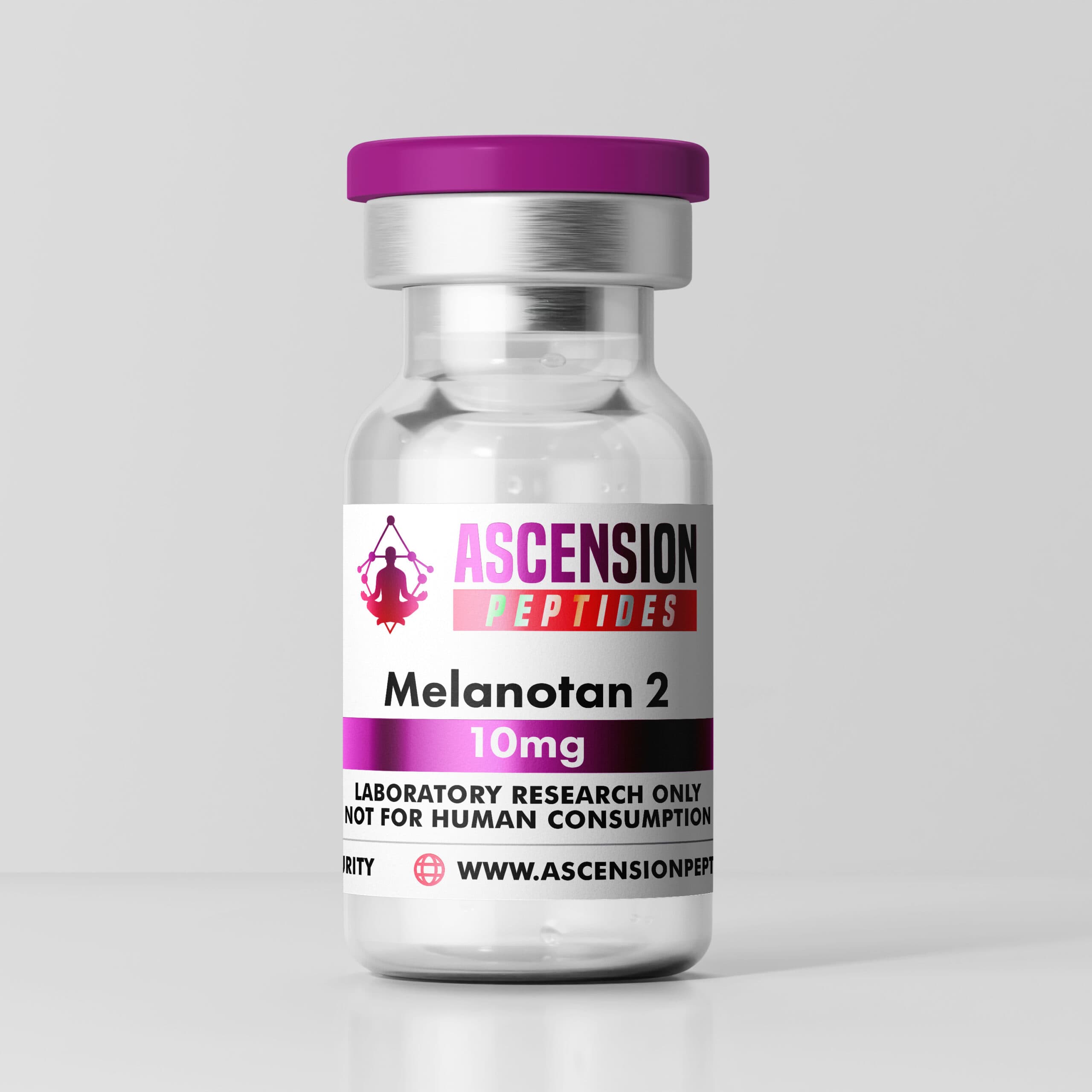
Melanotan 2 is a cyclic analogue of alpha-MSH that is significantly less receptor-selective than Melanotan 1. It binds to MC1R (pigmentation), MC3R, MC4R (sexual function, appetite, energy), and MC5R. This broad activity profile creates a more potent tanning effect alongside a range of additional — and sometimes unwanted — physiological effects.
Melanotan 2 was never submitted for FDA approval as a drug. It remains a research chemical in the US and most other jurisdictions.
Key Characteristics of Melanotan 2:
- Non-selective — activates multiple melanocortin receptors
- Powerful tanning effect — often produces noticeable pigmentation within 2–4 weeks
- Sexual arousal and spontaneous erections are common side effects (MC4R activity in hypothalamus)
- Appetite suppression — can be significant at higher doses
- Nausea — particularly in early use and at higher doses; largely a MC4R-mediated side effect
- Facial flushing, yawning (early dosing side effects)
- Melanocytic nevi (moles) can darken or new moles may appear — a safety concern requiring monitoring
- NOT FDA-approved for any indication
Melanotan 1 vs Melanotan 2: Side-by-Side Comparison

- Tanning Potency: MT-2 slightly faster initial tan; MT-1 more reliable and consistent
- Receptor Selectivity: MT-1 (MC1R selective) vs MT-2 (MC1R, MC3R, MC4R, MC5R)
- Sexual Side Effects: MT-1 (none/minimal) vs MT-2 (significant — spontaneous arousal common)
- Nausea: MT-1 (rare) vs MT-2 (common, especially early use)
- Appetite Suppression: MT-1 (minimal) vs MT-2 (significant at higher doses)
- Mole Development Risk: Both can darken moles; MT-2 may have higher risk due to broader receptor activation
- FDA Status: MT-1 (approved as Scenesse for EPP) vs MT-2 (not approved, research chemical)
- Administration: MT-1 (implant in clinical use; research injection) vs MT-2 (subcutaneous injection)
- Cost: MT-1 typically more expensive as research chemical; Scenesse is prescription only
Dosing Protocols
Melanotan 1 (Research Injectable Form):
- Reconstitute with bacteriostatic water (standard 2 mL for a 10 mg vial)
- Starting dose: 100-200 mcg subcutaneous daily or every other day
- Loading phase: Daily injections for 2-4 weeks to establish baseline tan
- Maintenance: 2-3x per week once desired pigmentation achieved
- UV exposure during loading phase accelerates results but is not required
Melanotan 2:
- Reconstitute with bacteriostatic water (standard 1-2 mL for a 10 mg vial)
- Starting dose: 50-100 mcg to assess sensitivity (nausea risk is real at higher starting doses)
- Loading phase: Increase to 100-250 mcg daily or every other day over 2-4 weeks
- Maintenance: 100-200 mcg 2-3x per week once tan established
- Evening dosing reduces nausea impact for many users
- Antihistamine (benadryl) taken 30 min before injection can significantly reduce nausea and flushing
Safety Considerations: The Mole Question
Both Melanotan peptides stimulate melanocytes — the cells that produce melanin. This raises a legitimate concern about melanocytic nevi (moles):
- Existing moles can darken during use
- New moles may appear with prolonged use (case reports)
- No controlled human studies have definitively established a melanoma risk, but the theoretical concern exists
- Dermatological monitoring (annual mole mapping) is strongly recommended for anyone using either compound
- Any changing mole during use warrants immediate dermatologist evaluation
- Individuals with existing dysplastic nevi, a family history of melanoma, or significant UV damage should exercise extra caution
Regulatory Status in 2026
Afamelanotide (Melanotan 1) is FDA-approved for EPP as a prescription implant. As a research injectable, it exists in the same research chemical gray zone as other peptides in the US.
Melanotan 2 is not approved anywhere as a pharmaceutical. It is a research chemical in the US. It is banned in Australia and New Zealand. Some European countries have moved against vendors selling it as a supplement.
Both are WADA-prohibited in competitive sports.
Related comparison: PT-141 vs Melanotan 2.
Frequently Asked Questions
This content is for informational and educational purposes only. Peptides discussed on this page are research compounds not approved by the FDA for human use. Always consult a licensed medical professional before using any peptide or supplement.