Erythropoietin grows red blood cells and also protects tissue. In 2008 a scientist found you could separate those two functions. The tissue-protection side became ARA-290.
🔑 Key Takeaways
- ARA-290 (also called cibinetide) is an 11-amino-acid peptide derived from the helix B surface of erythropoietin (EPO). The sequence is pGlu-Glu-Gln-Leu-Glu-Arg-Ala-Leu-Asn-Ser-Ser
- Developed by Dr. Michael Brines and Araim Pharmaceuticals specifically to retain EPO's tissue-protective effects while eliminating the red-blood-cell-stimulating effect that makes EPO risky
- Works through the innate repair receptor (IRR), a heteromer of the classical EPO receptor and the common beta receptor, which is only expressed on tissue under stress or injury
- Primary research focus is neuropathy, particularly diabetic peripheral neuropathy and sarcoidosis-associated small fiber neuropathy. Both have shown meaningful clinical improvement in published trials
- Secondary applications include anti-inflammatory effects, macrophage reprogramming, beta cell protection in diabetes, and emerging neuropsychiatric research
- Typical subcutaneous dose is 2 to 8 mg daily in published trials. Community protocols run 4 to 8 mg daily in 14 to 28 day cycles with 2 to 4 week breaks between cycles
- Side effects are unusually mild. Unlike EPO, ARA-290 does not raise hematocrit, does not cause thrombotic events, and has a clean safety profile across published trials
- Not FDA approved. Sold as a lab-use compound. Clinical development has progressed through several Phase 2 trials but has not reached Phase 3 approval for any indication as of 2026
This page is the full reference on ARA-290 peptide: chemistry, the discovery story that separated tissue protection from erythropoiesis, mechanism through the innate repair receptor, every documented clinical benefit, dosing protocols, side effects, contraindications, stacking, and what the current research status looks like.
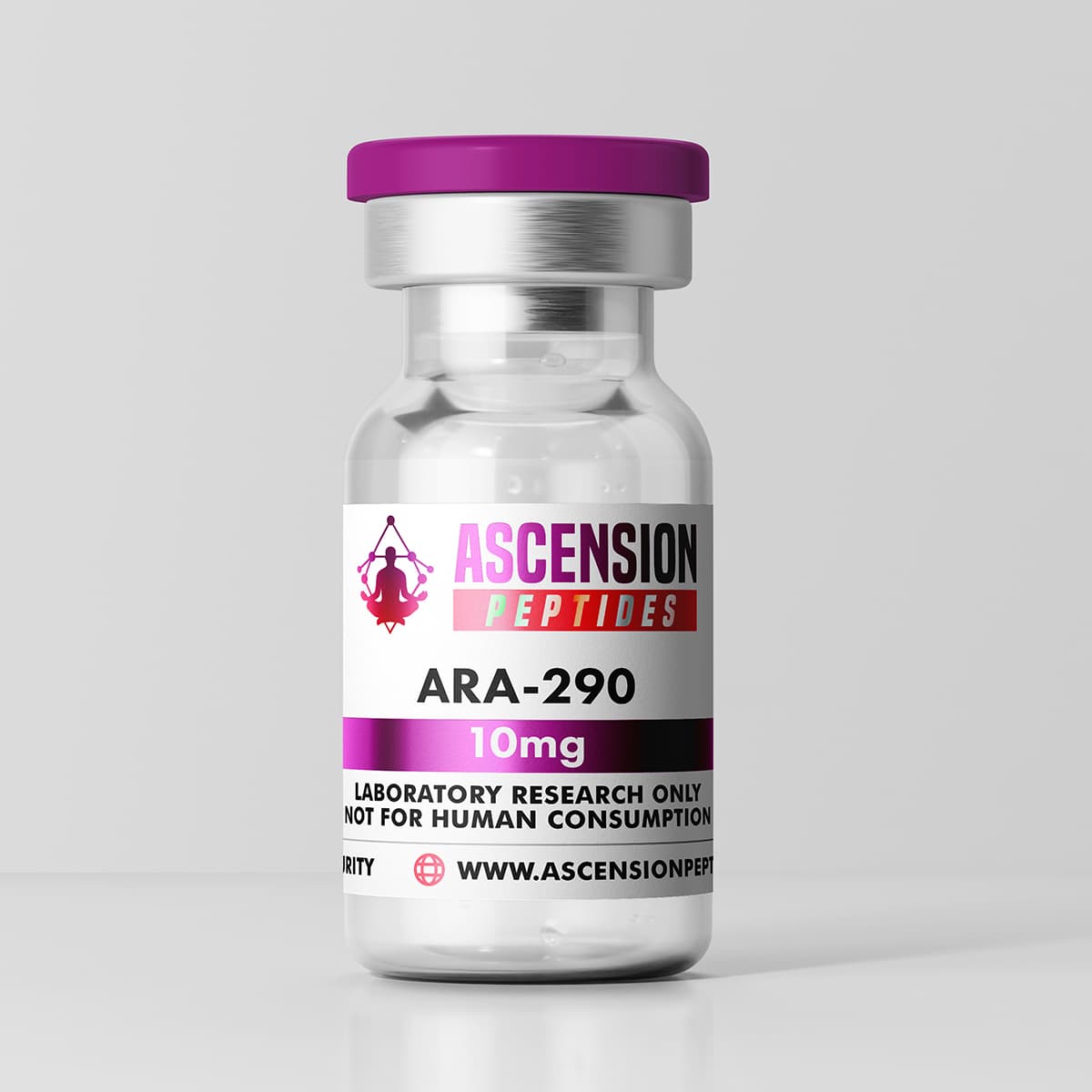
ARA-290 is stocked as a lyophilised research peptide — Ascension's 10mg vial is third-party tested and ships domestically.
What Is ARA-290?
An 11-amino-acid peptide that captures half of erythropoietin's biology.
ARA-290 is a synthetic peptide with the sequence pGlu-Glu-Gln-Leu-Glu-Arg-Ala-Leu-Asn-Ser-Ser. It was designed to mimic a specific structural region of erythropoietin (EPO) called the helix B surface. The developmental code name is ARA-290 (from Araim Pharmaceuticals) and the official pharmacological name is cibinetide.
ARA-290 at a Glance
- Pharmacological name: Cibinetide
- Developmental name: ARA-290
- Alternative name: Pyroglutamate helix B surface peptide (pHBSP)
- Sequence: pGlu-Glu-Gln-Leu-Glu-Arg-Ala-Leu-Asn-Ser-Ser (11 amino acids)
- Chemical formula: C51H84N16O21
- Molar mass: 1,257.3 g/mol
- Derived from: Erythropoietin (EPO) helix B surface region
- Developer: Dr. Michael Brines, Araim Pharmaceuticals
- Research status: Multiple Phase 2 trials completed, no FDA approval
The conceptual breakthrough behind ARA-290 came from Dr. Brines's recognition that EPO is a dual-function hormone. It stimulates red blood cell production (erythropoiesis) and it protects tissue from injury (through a separate innate repair pathway). Clinically, using EPO to leverage its tissue-protective effects was limited by the red-blood-cell stimulation, which raises hematocrit, increases thrombosis risk, and can produce cardiovascular complications. ARA-290 was engineered to activate only the tissue-protection pathway and leave erythropoiesis alone.
How ARA-290 Works
The mechanism is the innate repair receptor (IRR).
Classical EPO binds to the EPO receptor on red blood cell precursors, which is a homodimer of two EPO receptor subunits. This drives erythropoiesis.
ARA-290 does something different. It binds specifically to the innate repair receptor, which is a heteromeric complex of the classical EPO receptor and the common beta receptor (βcR, also called CD131). This IRR complex is only expressed on tissue that is injured, stressed, or inflamed. Tissue that is healthy does not express the IRR, so ARA-290 has nothing to bind to in uninjured tissue.
The consequences of IRR activation are:
- Anti-inflammatory signaling: Reduces pro-inflammatory cytokines (TNF-alpha, IL-6, IL-1β) at the site of tissue injury. Does not create systemic immunosuppression
- Cell survival pathways: Activates anti-apoptotic (anti-cell-death) signaling (PI3K/Akt, MAPK pathways) in stressed tissue
- Nerve regeneration: Supports axonal repair and remyelination in peripheral nerve injury, particularly small fiber nerves
- Macrophage reprogramming: Shifts macrophage populations from pro-inflammatory M1 phenotype toward pro-repair M2 phenotype, which accelerates tissue healing
- Angiogenesis support: Modest stimulation of new blood vessel formation at injury sites
- No erythropoiesis: Because ARA-290 does not bind the classical EPO homodimer, hematocrit does not rise
This last point is what separates ARA-290 from EPO clinically. Hematocrit elevation is the main safety concern with EPO, responsible for most of its thrombotic and cardiovascular risks. ARA-290 bypasses this entirely by targeting only the repair-specific receptor complex.
ARA-290 Benefits
Five clinical and investigational categories with published evidence.
Diabetic peripheral neuropathy
The most studied indication. Phase 2 trials have shown ARA-290 produces clinically meaningful improvements in neuropathic pain scores, peripheral sensation thresholds, and quality of life in patients with diabetic peripheral neuropathy. Dosing in these trials was typically 4 mg subcutaneously daily over 28 days. The improvement was not just symptom suppression; small fiber density measured through skin biopsy showed partial regeneration in some patients, consistent with the axonal repair mechanism.
Sarcoidosis-associated small fiber neuropathy
Sarcoidosis frequently produces small fiber neuropathy that is poorly managed by conventional analgesics. Brines and colleagues have published Phase 2 results showing ARA-290 reduces neuropathic symptoms and improves autonomic function in sarcoidosis patients. This is a niche but clinically underserved population, and ARA-290 has been one of the more promising emerging options.
Anti-inflammatory and autoimmune applications
The macrophage reprogramming mechanism has implications beyond neuropathy. ARA-290 has been investigated in models of rheumatoid arthritis, inflammatory bowel disease, and other chronic inflammatory conditions. Clinical trials in autoimmune indications are earlier-stage than the neuropathy work, but the mechanism and early data suggest potential.
Metabolic benefits and beta cell protection
Pancreatic beta cells (which produce insulin) express the IRR when stressed by glucotoxicity or inflammation. ARA-290 has been shown in animal models to protect beta cells in type 1 diabetes models and reduce insulin requirements in some type 1 diabetic patients in small trials. This is an early application but mechanistically consistent.
Neuropsychiatric and antidepressant potential
Emerging research has explored ARA-290 in treatment-resistant depression. The rationale combines IRR activation in brain tissue with ARA-290's clean safety profile relative to EPO. Trials in depression have been smaller and earlier-stage than the neuropathy work, and the investigational pathway was paused for some indications during Araim's development prioritization.
ARA-290 Dosage
Subcutaneous injection, cycled, dose by body weight or flat mg.
Standard ARA-290 Protocol
- Typical dose: 4 to 8 mg subcutaneously daily
- Starting dose: 2 to 4 mg daily for the first 3 to 5 days
- Working dose: 4 mg daily is the most-used community dose; 8 mg for heavy neuropathic pain
- Timing: Morning injection, subcutaneous into abdomen, thigh, or upper arm. Rotate sites.
- Cycle length: 14 to 28 days
- Break: 2 to 4 weeks between cycles
- Frequency: No more than 4 cycles per year in typical use
Published Phase 2 trials have generally used 4 mg daily over 28 days as the standard research dose. Community protocols frequently land at the same dose and duration, sometimes extending to 8 mg for cases of severe neuropathic pain.
Reconstitution
ARA-290 is sold as a lyophilized powder in vials typically of 16 mg or 32 mg. A 16 mg vial reconstituted with 2 mL bacteriostatic water gives 8 mg/mL. A 4 mg dose is 50 units on a standard U-100 insulin syringe. Use our reconstitution calculator for other vial sizes.
Storage
- Lyophilized vial: Refrigerate at 2 to 8°C for long-term storage, or store at room temperature for shorter periods
- Reconstituted: Refrigerate. Use within 4 to 6 weeks
- Protect from light. Do not freeze. Do not use if cloudy or discolored
ARA-290 Side Effects
Unusually clean safety profile.
Across multiple Phase 2 trials, ARA-290 has been described by investigators as well tolerated with no dose-limiting toxicities. This is in sharp contrast to EPO, where hematocrit elevation and thrombotic risk are the dominant concerns.
No serious adverse events specifically attributable to ARA-290 have been reported in published clinical trials. Long-term safety of repeated annual use in humans is not well characterized.
Who Should Not Use ARA-290
Do NOT Use ARA-290 If You:
- Have active cancer, particularly hematologic malignancies or tumors known to overexpress the common beta receptor (precautionary, not a documented risk)
- Are pregnant or actively breastfeeding, no safety data
- Are under 18, no pediatric safety data
- Have known hypersensitivity to ARA-290 or any component of the formulation
- Are on erythropoiesis-stimulating agents like EPO or darbepoetin, without physician coordination
- Have an active uncontrolled thrombotic disorder (even though ARA-290 does not raise hematocrit, physician supervision is prudent)
ARA-290 vs Other Neuroprotective and Regenerative Peptides
ARA-290's distinguishing feature is the innate repair receptor mechanism, which is selectively expressed on injured tissue. This produces an unusually clean safety profile because healthy tissue is unaffected. For peripheral neuropathy specifically, it has more direct human clinical trial data than most peptides in the space.
ARA-290 Stacks
- ARA-290 + BPC-157: The repair-focused stack. ARA-290 for nerve and IRR-mediated repair, BPC-157 for soft tissue and gut healing. Used in post-injury recovery protocols.
- ARA-290 + TB-500: Adds systemic cell migration and recovery to the IRR-mediated protection. Combined recovery stack.
- ARA-290 + SS-31: Mitochondrial and nerve protection combined, particularly relevant in diabetic neuropathy contexts where both mitochondrial dysfunction and nerve damage are at play.
- ARA-290 + alpha-lipoic acid (600 to 1,200 mg daily) and acetyl-L-carnitine (2 to 3 g daily): Non-peptide neuropathy support stack commonly layered with ARA-290 cycles.
Avoid stacking ARA-290 with erythropoiesis-stimulating agents without physician supervision. Even though ARA-290 itself does not raise hematocrit, the combination introduces variables that are not well studied.
Research Status in 2026
ARA-290 has progressed further through formal clinical development than most peptides in the research space. Multiple Phase 2 trials have been completed in diabetic peripheral neuropathy and sarcoidosis-associated neuropathy, with generally positive efficacy and clean safety signals.
What has held up further progression is primarily commercial and regulatory. The peptide patent landscape, the relatively small patient population for niche neuropathy indications, and the Phase 3 trial cost have all contributed to Araim Pharmaceuticals' pacing. Modified longer-duration ARA-290 analogs are reportedly in development. For 2026, the situation is: meaningful Phase 2 data exists, no FDA approval yet, community use continues with the Phase 2 dosing as the template.
Where to Buy ARA-290
Quality matters more than price.
- ≥98% purity verified by independent HPLC and mass spectrometry
- Third-party Certificate of Analysis per batch
- Lyophilized vials of 16 mg or 32 mg, properly sealed
- US-based manufacturing with cold-chain handling
- Clear batch numbers and lot documentation
Avoid any source selling loose powder or lacking independent lab verification. For a broader vendor vetting guide, see our best legit peptide vendors breakdown.